A chemical feed system that drifts 5 percent off its target dose is not a calibration footnote — it is the difference between a compliant water supply and a Safe Drinking Water Act violation. Municipal water utilities depend on precisely maintained chemical feed systems to deliver chlorine disinfection, coagulant dosing, pH correction, and fluoride addition at the exact rates their treatment process requires. An underdosed chlorine pump allows pathogens into the distribution network. An overdosed coagulant pump wastes chemical, creates excessive sludge, and can push settled solids into filtered water. The EPA's SDWA treatment technique requirements specify that dosing pump calibration deviations greater than 3 percent from setpoint constitute a reportable violation — making accurate, documented maintenance a direct regulatory obligation for every water utility. Yet across small-to-medium water systems, chemical feed maintenance is still managed on paper logs that go missing before the next sanitary survey. OxMaint's Preventive Maintenance module automates chemical feed pump calibration schedules, stores dosing records against each asset, and generates SDWA audit-ready compliance exports in minutes. Book a demo to see water utility PM workflows in OxMaint.
Checklist · Water Utilities · Chemical Feed Systems · SDWA Compliance
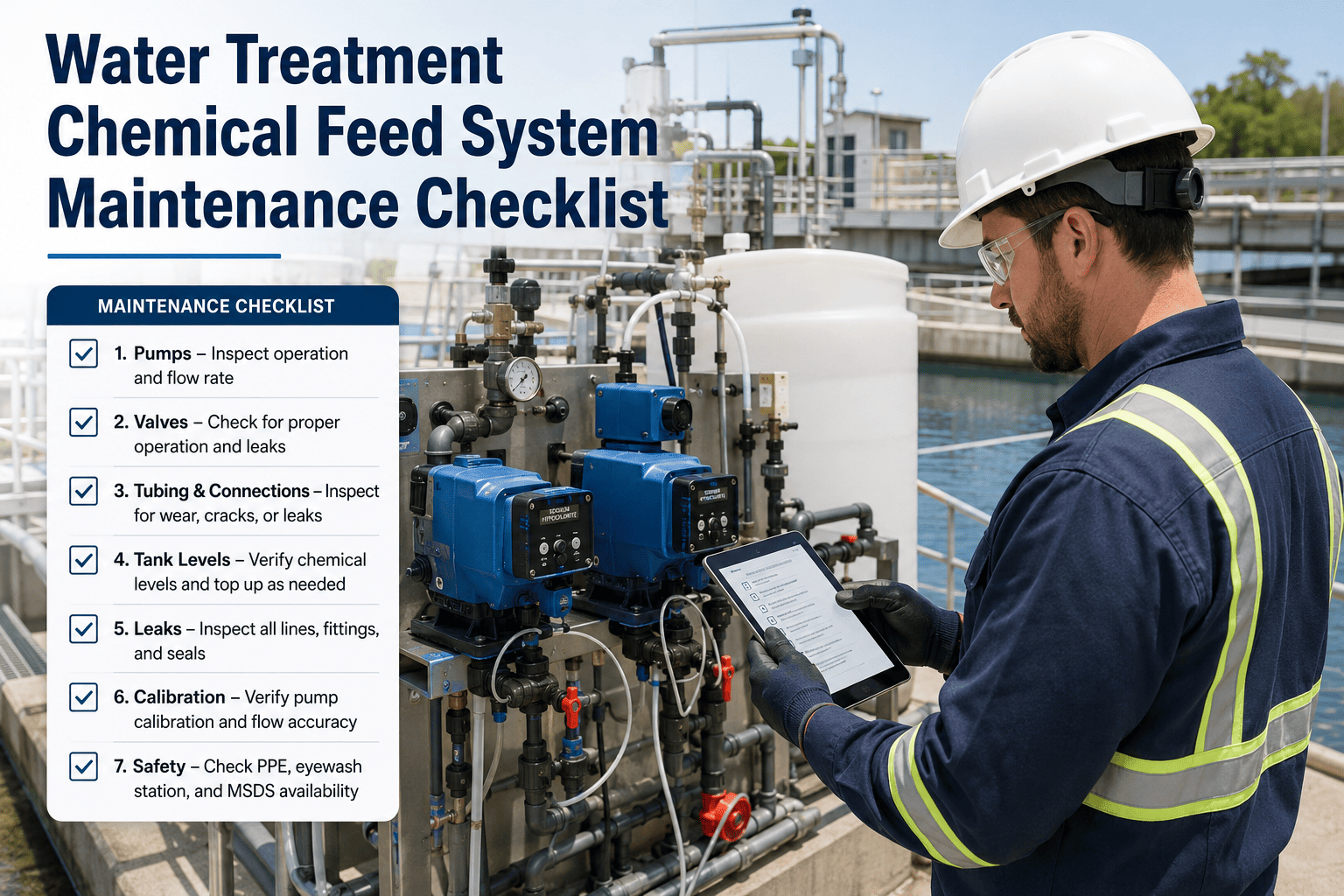
Water Treatment Chemical Feed System Maintenance Checklist
Diaphragm pump calibration, check valve inspection, chemical storage integrity, injection point verification, and SDWA-compliant dosing records — the complete preventive maintenance framework for chlorination, coagulation, pH correction, and fluoridation feed systems.
3%
Max dosing deviation before SDWA treatment technique violation is triggered — most paper-tracked systems exceed this routinely
Quarterly
Minimum calibration frequency for all chemical metering pumps — more frequent for chlorination and fluoride systems
30 Days
Minimum chemical storage reserve recommended for sodium hypochlorite and other primary disinfectants
5 Systems
Typical chemical feed trains in a municipal WTP: chlorination, coagulation, pH adjustment, fluoridation, and corrosion inhibitor
Chemical Feed System Flow — What Gets Maintained at Each Stage
A complete chemical feed system runs from storage tank through to the injection point. Maintenance failure at any node in this chain produces incorrect dosing — even if the pump itself is working perfectly.
01
Chemical Storage Tank
Level, integrity, secondary containment, concentration verification
02
Suction Piping and Foot Valve
Air entrainment, foot valve seating, suction head, anti-siphon valve
03
Metering Pump
Diaphragm, check valves, stroke calibration, output verification
04
Discharge Piping and Back-pressure Valve
Back-pressure setting, pulsation dampener, discharge pressure confirmation
05
Injection Point
Injection quill condition, mixing verification, residual confirmation downstream
The Five Chemical Feed Trains — Maintenance Priorities by System
Chlorination
Sodium Hypochlorite (NaOCl) or Chlorine Gas
Primary disinfection barrier — failure to maintain target CT value is a Surface Water Treatment Rule violation
Calibration: Weekly verification + quarterly formal calibration
Degradation risk: NaOCl loses potency 0.5–1% per day at temperatures above 25°C — concentration must be verified before feed rate adjustment
Coagulation
Aluminum Sulfate (Alum) or Ferric Chloride
Removes suspended solids and organics before filtration — underdosing causes turbidity exceedances, overdosing clogs filters
Calibration: Monthly jar test dose verification + quarterly pump calibration
Seasonal risk: Raw water turbidity and temperature changes require dose adjustment — fixed feed rates miss seasonal demand shifts
pH Correction
Caustic Soda (NaOH), Lime, or Sulfuric Acid
Controls pH for optimal disinfection efficacy (NaOCl is most effective at pH 7.2–7.6) and corrosion control
Calibration: Quarterly pump calibration; pH analyser calibration every 2 weeks
Safety risk: Caustic and acid systems require secondary containment integrity check at every inspection — spill response plan current
Fluoridation
Hydrofluorosilicic Acid (H2SiF6) or Sodium Fluoride
Public health mandate — fluoride target 0.7 mg/L; overdosing above 4.0 mg/L MCL is an immediate reporting obligation
Calibration: Daily output check + monthly calibration cylinder verification
Critical risk: Fluoride MCL exceedance requires immediate public notification — redundant feed control and analyser required
Corrosion Inhibitor
Orthophosphate or Blended Phosphate
Lead and copper rule compliance — phosphate film on distribution pipe walls requires consistent, uninterrupted dosing
Calibration: Quarterly pump calibration; orthophosphate residual verified in distribution monthly
Compliance risk: Gaps in corrosion inhibitor dosing can mobilise lead at household fixtures — documented continuity of dosing is required
OxMaint auto-schedules calibration, inspection, and dosage verification tasks across all five chemical feed trains — sending mobile alerts to operators, capturing calibration cylinder readings digitally, and building a timestamped dosing record that satisfies SDWA sanitary survey requirements.
Metering Pump Calibration
Chemical Metering Pump Calibration and Inspection Checklist
Metering pump calibration is not a once-a-year event — it is a recurring verification that the pump's actual output matches the target dose rate under current operating conditions. Discharge pressure, diaphragm wear, check valve condition, and chemical viscosity all affect actual pump output independently of the stroke and speed settings. The only reliable calibration method is a direct volumetric output measurement using a calibration cylinder — timed over a defined number of strokes, compared against the calculated target volume. SDWA treatment technique requirements and state primacy agency rules typically require this documented verification at least quarterly, and more frequently for fluoride systems.
Metering Pump Calibration Checklist
Quarterly Minimum — SDWA Compliance Required
Pre-calibration conditions confirmed — pump running at normal operating pressure and temperature before calibration is started; system in automatic flow-paced or manual mode consistent with normal operation; calibration cylinder filled with the same chemical solution currently in the storage tank; solution concentration recorded (critical for NaOCl where degradation affects effective dose)
Record: Pre-cal conditions, NaOCl concentration if applicable · Role: Water Treatment Operator
Volumetric output measured with calibration cylinder — pump switched to draw from calibration cylinder; exactly 100 strokes counted (or timed run of defined duration per plant procedure); volume drawn recorded in mL or fl oz; target volume calculated from stroke setting and pump manufacturer's output curve; acceptable deviation: within 3% of target; deviation exceeding 3% requires stroke adjustment and immediate re-test
Record: Strokes counted, volume drawn, target volume, deviation percentage · Role: Water Treatment Operator
Diaphragm and check valve inspection completed — pump head removed (for scheduled quarterly maintenance); diaphragm inspected for cracks, deformation, or chemical attack; ball check valves inspected for wear, corrosion, or debris preventing seating; O-rings and wetted seals inspected and replaced per annual maintenance schedule or if visual degradation is observed; all wetted parts confirmed chemically compatible with current chemical
Record: Diaphragm and check valve condition on maintenance form · Role: Maintenance Technician
Suction and discharge line inspection completed — suction tubing or piping followed from storage tank to pump head; any micro-crack, kink, or whitening on PTFE or PVC tubing flagged for replacement; foot valve (if installed) lifted and confirmed seating correctly; back-pressure valve setting confirmed against design specification; pulsation dampener pre-charge pressure checked with gauge
Record: Suction/discharge line condition, BPV setting, pulsation dampener pressure · Role: Water Treatment Operator
Anti-siphon valve function verified — anti-siphon valve tested by stopping pump and confirming no continued flow into injection point (gravity siphon would overdose chemical without pump running); critical for NaOCl systems where off-gassing can cause siphon breaks and loss of prime; valve replacement required if siphon flow is detected during test
Record: Anti-siphon test result (pass/fail) · Role: Water Treatment Operator
Calibration record completed and signed in OxMaint — as-found output, as-left output, stroke adjustment made (if any), diaphragm/CV condition, and operator name recorded on digital calibration form; form timestamped and linked to pump asset record; OxMaint auto-schedules next calibration based on pump type and chemical system criticality tier
Record: Signed calibration form in OxMaint asset record · Role: Water Treatment Operator
Chemical Storage and Handling
Chemical Storage Tank and Secondary Containment Inspection Checklist
Chemical storage failures — tank leaks, secondary containment breaches, incompatible material contact, and degraded chemical used at incorrect concentration — are a disproportionate source of SDWA compliance events at small and medium water systems. Sodium hypochlorite degrades from trade strength (12.5%) to as low as 8–10% within weeks in warm storage conditions, meaning a pump calibrated at 12.5% concentration may actually be delivering 20 percent less effective chlorine than the treatment plan assumes. Storage tank inspection must include chemical concentration verification, not just tank level and physical condition.
Storage Tank Inspection Checklist
Monthly Minimum — All Chemical Feed Systems
Chemical inventory level recorded and compared to consumption target — tank level gauge reading or float indicator recorded; actual consumption since last inspection calculated and compared to expected consumption at current dose rate and flow; consumption significantly exceeding expected indicates a leak or metering overshoot; significantly below expected indicates pump failure or underdosing
Record: Tank level, consumption vs expected on monthly PM form · Role: Water Treatment Operator
NaOCl concentration verified before adjustment — for sodium hypochlorite systems: chemical concentration tested using DPD kit, chlorine analyser, or iodometric titration; if concentration has degraded more than 10% from purchase specification, feed rate recalculated and pump adjusted before next calibration record is filed; delivery date and concentration tested recorded; never use estimated delivery concentration without verification
Record: Measured NaOCl concentration, test method, and date · Role: Water Treatment Operator
Tank physical condition inspected — tank exterior inspected for cracking, discolouration, UV degradation, and deformation; fittings, valve connections, and level gauge ports inspected for leaks and corrosion; for translucent HDPE NaOCl tanks: excessive yellowing or browning indicates chemical degradation products building up — tank should be emptied, cleaned, and chemically rinsed before refilling
Record: Tank condition notes and any deficiency photos uploaded to OxMaint · Role: Water Treatment Operator
Secondary containment integrity confirmed — bund or containment sump inspected for chemical accumulation, structural cracks, drain valve position (normally closed), and coating integrity; containment capacity confirmed adequate for 110% of largest tank volume or volume of all tanks in the bund, whichever is greater; any breach or chemical accumulation in containment requires immediate maintenance before next delivery
Record: Secondary containment inspection sign-off · Role: Water Treatment Operator
Injection Point and Residual Verification
Injection Point and Downstream Residual Verification Checklist
The injection point is where the chemical feed system meets the water it is treating — and it is the first place where a maintenance failure becomes a water quality problem. A blocked injection quill reduces effective dosing even when the pump is calibrated correctly. A poorly located chlorine injection point — too close to ammonia injection for chloramination — produces incorrect disinfectant chemistry. Downstream residual measurement at defined sampling points closes the loop between feed rate and treatment outcome, confirming that the chemical is mixing correctly and achieving its target concentration in the treated water.
Injection Point Inspection Checklist
Weekly and Post-Maintenance
Injection quill visual inspection — quill tip inspected for scaling, crystallisation, or blockage; for NaOCl quills: calcium carbonate and salt deposits build up where chlorine contacts process water; quill removed and cleaned with dilute acid solution if flow restriction is detected; quill material confirmed compatible with chemical (PVDF or Hastelloy for hypochlorite, CPVC for alum, stainless for caustic)
Record: Quill condition, cleaning performed if applicable · Role: Water Treatment Operator
Downstream residual measured and recorded — chlorine residual measured at the first defined sampling point downstream of the injection point using calibrated DPD colorimetric test or online analyser; result compared to target CT concentration for current flow conditions; residual below target requires immediate pump output check and SCADA alarm verification; residual significantly above target indicates pump overshoot or flow reduction
Record: Downstream residual reading, target value, instrument used · Role: Water Treatment Operator
Flow-pacing signal verification — for flow-paced chemical feed systems: SCADA flow meter output to pump controller verified as correct; pump output confirmed tracking flow changes (step flow up, confirm pump output increases proportionally; step flow down, confirm reduction); any lag greater than 60 seconds between flow change and pump response investigated for signal delay or controller fault
Record: Flow-pacing response confirmation · Role: Water Treatment Operator / SCADA Technician
Impact of Digital PM on Chemical Feed Compliance — OxMaint Results
94%
Reduction in missed calibration events across a 12-system municipal water utility after OxMaint PM scheduling replaced paper tickler files
Before: 23 missed quarterly calibrations per year. After: 1.4 average missed per year — caught by OxMaint overdue alert before the next sanitary survey window.
Zero
SDWA treatment technique violations in 18 months post-implementation vs 3 in prior 18-month period
6 min
Average time to produce a complete chemical feed maintenance record package for a state sanitary survey
31%
Reduction in NaOCl chemical spend from accurate concentration tracking and dose adjustment
100%
Of calibration records with operator name, time, and as-found/as-left data — no unsigned or incomplete forms
Chemical Feed Maintenance Schedule — Frequency Summary
| Task |
System |
Frequency |
Regulatory Basis |
Failure Consequence |
OxMaint PM Type |
| Chlorine residual verification |
Chlorination |
Daily |
SDWA / SWTR |
CT violation, public health risk |
Daily recurring WO with residual entry field |
| Fluoride output check |
Fluoridation |
Daily |
SDWA MCL (4.0 mg/L) |
Immediate public notification required |
Daily PM with upper limit alert |
| NaOCl concentration test |
Chlorination |
Each delivery / monthly |
SDWA treatment technique |
Underdosing at calibrated pump setting |
Triggered WO on delivery + monthly PM |
| Pump output calibration (cylinder) |
All chemical trains |
Quarterly |
SDWA / State primacy |
3%+ deviation = reportable treatment technique violation |
Quarterly PM with as-found/as-left fields |
| Diaphragm and check valve overhaul |
All metering pumps |
Annual |
Manufacturer / industry standard |
Pump failure, dosing loss, potential flooding |
Annual PM WO with parts consumption record |
| Secondary containment inspection |
All chemical storage |
Monthly |
OSHA / EPA SPCC |
Chemical spill, environmental violation |
Monthly PM with photo upload |
| Injection quill inspection and cleaning |
All injection systems |
Monthly |
Plant operations standard |
Partial blockage causing underdosing despite correct pump output |
Monthly PM with quill condition record |
Expert Insight
SM
Suresh Menon
Water Treatment Plant Superintendent · 22 years · Class 4 Water Treatment Operator Certification · AWWA Member · NIT Calicut, Civil Engineering
The two biggest chemical feed problems I see at mid-size utilities are both invisible until the sanitary survey arrives: calibrations done on time but documented only in a binder nobody can find, and NaOCl concentration drift that operators compensate for by eye rather than by measurement. You can have the most reliable metering pump on the market delivering exactly what you set — but if the chemical concentration in the tank dropped 20% since last delivery, you are underdosing by 20% regardless. A digital PM system like OxMaint forces operators to record concentration at every delivery and flags it when calibration is overdue — so the paper trail actually exists when the state inspector walks in.
Frequently Asked Questions
How often must chemical metering pumps be calibrated under SDWA requirements?
The EPA Safe Drinking Water Act and state primacy agency rules generally require quarterly calibration documentation for chemical feed pumps, with more frequent verification for fluoride systems (often monthly or weekly). A deviation exceeding 3% from the target dosage setpoint constitutes a treatment technique violation in many state programs.
OxMaint auto-schedules calibration events and logs as-found and as-left results with timestamps for every pump in your system.
Why does sodium hypochlorite concentration matter for pump calibration?
A pump calibrated at 12.5% NaOCl trade strength may actually be delivering only 10% concentration if the chemical has degraded in storage — meaning 20% less effective chlorine than assumed. Heat, UV exposure, and age all accelerate degradation. Always verify concentration with a test kit before adjusting feed rate after each delivery, and document both the measured concentration and the feed rate adjustment in your maintenance records.
See how OxMaint tracks NaOCl concentration logs in a demo.
What maintenance records do state sanitary surveys require for chemical feed systems?
State sanitary surveys typically require: pump calibration records showing as-found and as-left output with operator name and date; chemical delivery logs with concentration verification; downstream residual monitoring logs; and corrective action documentation for any exceedance events. Records must cover the full period since the prior survey — typically 3–5 years. OxMaint generates this complete audit trail automatically as the byproduct of the digital PM workflow.
What causes a diaphragm metering pump to lose calibration between scheduled checks?
Diaphragm fatigue, check valve wear that allows backflow, changes in discharge pressure, and air entrainment in suction tubing are the primary causes of between-calibration drift. For NaOCl systems, off-gassing in the pump head is a specific issue that causes vapor lock and intermittent output loss. Weekly visual checks of suction tubing for gas pockets, combined with quarterly formal calibration, catch most drift before it reaches the 3% violation threshold.
Explore OxMaint's chemical feed PM templates.
OXMAINT PREVENTIVE MAINTENANCE · WATER UTILITIES
Every Calibration. Every Residual. Every Delivery Log. SDWA Audit-Ready.
OxMaint automates your complete chemical feed PM programme — scheduled calibration reminders, mobile operator forms with as-found/as-left fields, NaOCl concentration tracking, injection point inspection records, and instant export of your complete maintenance history for state sanitary surveys.