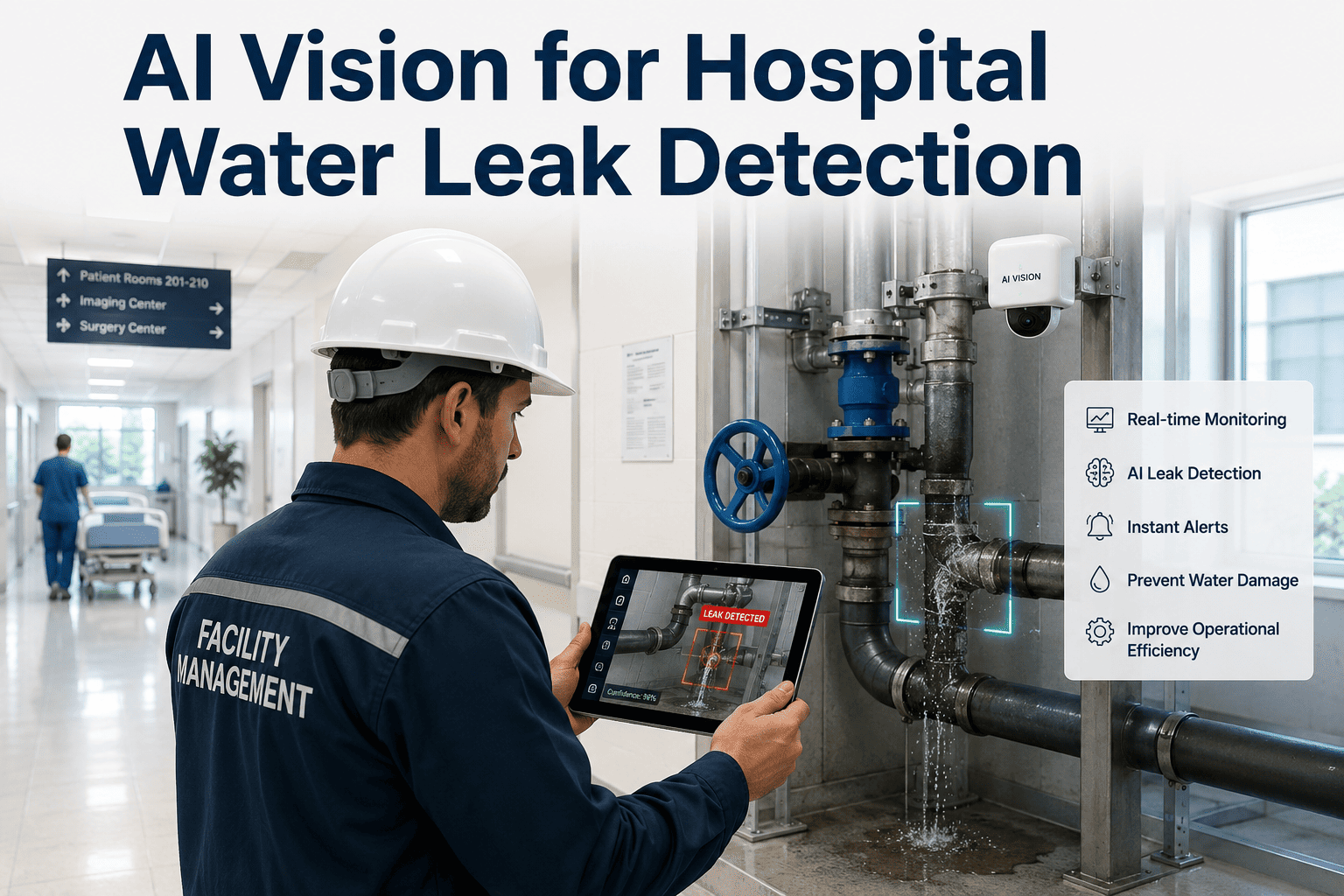
Water damage is among the top causes of commercial property loss — and in hospitals, the stakes go far beyond repair costs. A leak in an operating room ceiling, a sterile compounding pharmacy, or a NICU can render a clinical space unusable for days, contaminate critical surfaces, and trigger infection control investigations that shut down patient care entirely. Most hospital leaks are not sudden pipe bursts — they are slow seeps, ceiling bleeds, and plant room drips that go unnoticed for hours or days because no one is watching. OxMaint's AI Vision Camera watches continuously, detects visible moisture accumulation and active leak signatures in real time, and automatically generates a photo-evidenced work order the moment a threat is identified — before a single drop reaches a patient room floor. Every second of delay in human response to a water leak can mean thousands of dollars in additional damage. OxMaint closes that gap entirely.
AI Vision · Hospital Facility Management · Leak Detection
AI That Sees Hospital Leaks Before Your Maintenance Team Does
Facilities lose trillions of gallons annually to undetected leaks. In hospitals, the cost is not just water — it is clinical space, patient safety, and accreditation. OxMaint AI Vision detects visible moisture events and triggers work orders with photo evidence in real time.
$1M+
water damage avoided at a single hospital using AI detection
24/7
continuous visual monitoring — no shift change, no blind spot
Minutes
from first visible moisture to auto-generated work order
0
manual inspections required to trigger leak detection alerts
Where Leaks Happen
High-Risk Hospital Leak Zones That Require Continuous Visual Monitoring
01
Plant Rooms and Mechanical Spaces
Pipe joints, valve packing, and heat exchangers in mechanical rooms are the most common source of hospital water events — and the least-visited spaces on daily rounds.
Risk: undetected for days — extensive structural and equipment damage
02
Ceiling Voids and Interstitial Spaces
Roof drainage failures, condensate overflows, and chilled water pipe condensation collect invisibly above ceiling tiles — appearing only as stains once significant saturation occurs.
Risk: infection control concern, ceiling collapse, hidden mold development
03
Sterile and Clinical Areas
Even a minor drip from above a sterile processing area, compounding pharmacy, or operating room requires immediate shutdown, terminal clean, and investigation before patient use resumes.
Risk: full room shutdown, patient safety event, regulatory reporting
04
Rooftop Plant and Cooling Towers
Rooftop units, condensate pans, and cooling tower sumps overflow seasonally. Without visual monitoring, pan overflows drain through the building envelope into occupied floors below.
Risk: multi-floor water ingress, HVAC contamination, Legionella concern
How It Works
OxMaint AI Vision — From Pixel to Work Order
▶
Camera Monitors Continuously
OxMaint AI Vision cameras watch assigned zones 24/7 — plant rooms, ceiling areas, floor drains, and pipe runs — with no human intervention required.
→
▶
AI Detects Moisture Signature
The AI model identifies visible moisture, pooling water, dripping pipes, or surface wet patterns — distinguishing real leak events from condensation or cleaning activity.
→
▶
Photo Evidence Captured
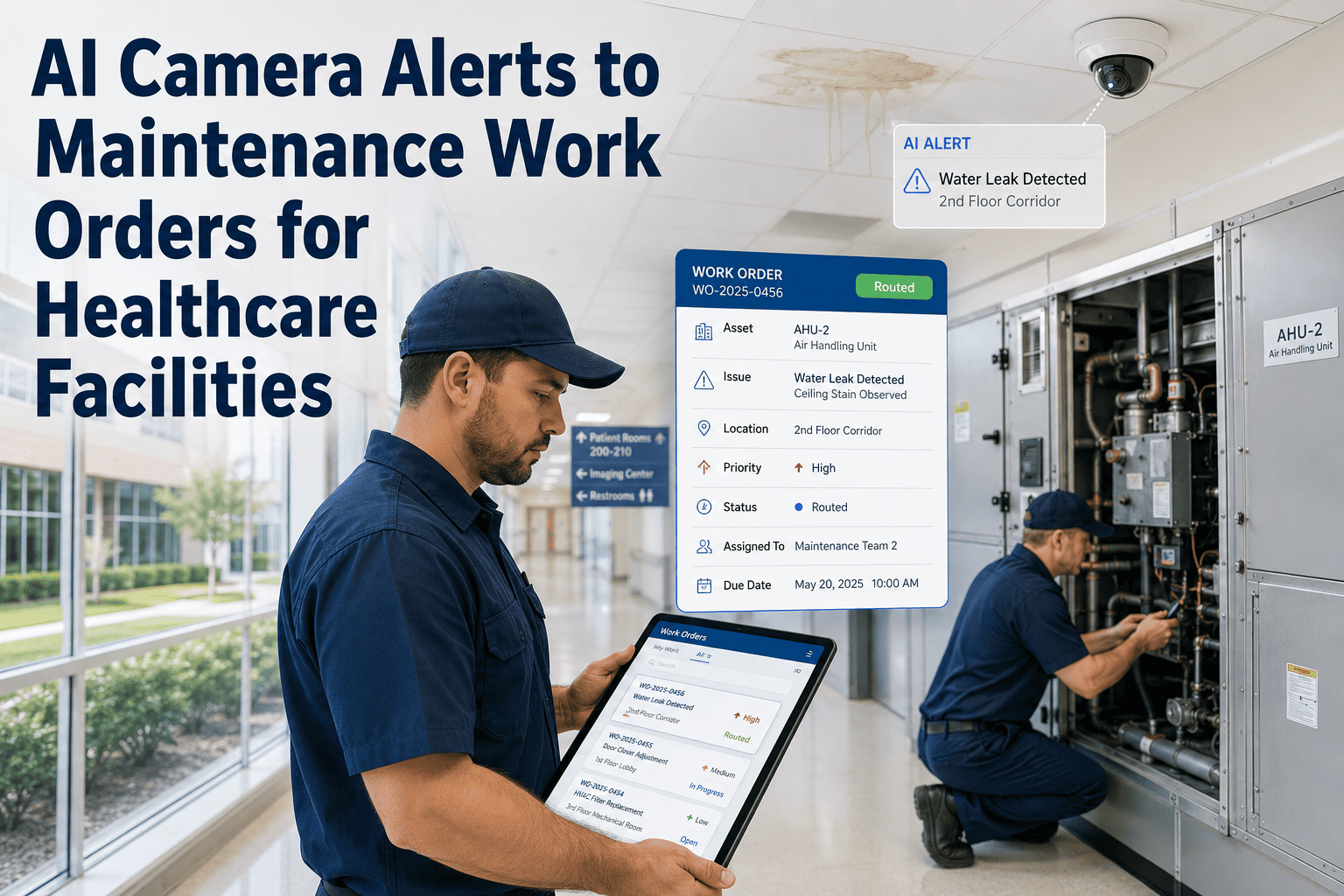
The triggering frame is captured with timestamp, camera ID, and location tag — creating an auditable photo record of the event at the moment of detection.
→
▶
Work Order Auto-Generated
OxMaint creates a priority-coded work order with the photo attached, assigned to the appropriate technician, with supervisor notification sent immediately.
Response Time Impact
How Detection Speed Determines the Cost of a Hospital Leak Event
| Time to Detection |
Typical Damage Scope |
Estimated Remediation Cost |
Clinical Impact |
| Under 15 minutes (AI Vision) |
Surface moisture, isolated puddle |
$200–$800 cleanup |
None — area remains operational |
| 2–4 hours (manual round) |
Ceiling tile saturation, subfloor wet |
$5,000–$25,000 |
Area out-of-service 12–24 hours |
| 12–24 hours (stain observed) |
Structural materials affected, mold risk begins |
$40,000–$120,000 |
Multi-day closure, infection review |
| 48+ hours (undetected) |
Mold, structural damage, equipment loss |
$150,000–$1,000,000+ |
Full area shutdown, regulatory event |
Every Minute Between a Leak and Detection Has a Dollar Value
OxMaint AI Vision cameras compress that window from hours to minutes — automatically generating work orders with photo evidence before a drop reaches a patient room. See the detection live.
Expert Review
What Hospital Facility Managers Say About AI Leak Detection
"We had a rooftop condensate pan overflow that drained into the corridor above an operating suite. By the time the morning crew found it, we had 6 ceiling tiles and a 3-day room shutdown. With continuous camera monitoring, that event gets caught in the first 20 minutes."
Director of Facilities, 300-bed Surgical Hospital
12 years hospital facility operations
"Infection control and facility management don't naturally communicate quickly. An AI camera that auto-creates a work order and notifies both teams simultaneously is the response time improvement that no amount of protocol training achieves."
VP of Operations, Regional Healthcare System
CMMS and safety technology implementation lead
FAQs
Common Questions About AI Vision for Hospital Water Leak Detection
How does OxMaint AI Vision distinguish a real leak from condensation, cleaning, or spilled water?
OxMaint AI Vision is trained on facility-specific visual patterns — including typical condensation zones, cleaning schedules, and surface types in each monitored area. The model flags events based on moisture signature characteristics, growth rate, and location context — significantly reducing false positives compared to simple moisture sensors. Alerts are validated by the AI model before generating a work order.
Try OxMaint free and configure your first camera zone today.
Does OxMaint AI Vision require dedicated camera hardware or does it work with existing facility cameras?
OxMaint AI Vision can integrate with many existing IP camera systems already deployed in mechanical rooms, plant areas, and corridors. For areas without existing coverage, OxMaint-compatible cameras can be added rapidly. The AI model runs in the cloud — no on-site server or edge computing hardware is required.
Book a demo to review compatibility with your current camera infrastructure.
Can the AI Vision system support insurance claims or regulatory investigations with photo evidence?
Every OxMaint AI Vision detection event generates a timestamped, location-tagged photo record that is stored in the CMMS work order history. These records are exportable and serve as documented evidence of detection time, initial response, and remediation actions — supporting property insurance claims, OSHA documentation, and Joint Commission Environment of Care reviews. The photo evidence trail is permanent and searchable by date, location, or asset.
Stop Discovering Hospital Leaks After the Damage Is Done
OxMaint AI Vision gives your facility team continuous, intelligent leak surveillance — with automatic work order generation, photo evidence, and supervisor notification. No new inspection rounds. No shift-change blindspot. Just instant detection.




.jpg)