Hospital plant rooms — the boiler room, chiller plant, electrical switchrooms, medical gas manifold spaces — are among the most hazardous areas in any healthcare facility, and among the least watched. People come and go through them all day: in-house techs, contractors, vendors, often alone, often for two minutes, often without the hard hat, eye protection or hearing protection the space requires. A supervisor can't be at every door, and a monthly spot-check sees almost none of it. AI vision changes that equation — a camera that already watches the room can check PPE on everyone who enters, every time. This article covers how it works, what it watches for, and how to use it responsibly. OXMAINT AI — the AI-powered maintenance management software — turns a flagged PPE gap into a logged event and corrective action.
Healthcare · AI Vision · PPE Compliance · Hospital Plant Rooms · 2026
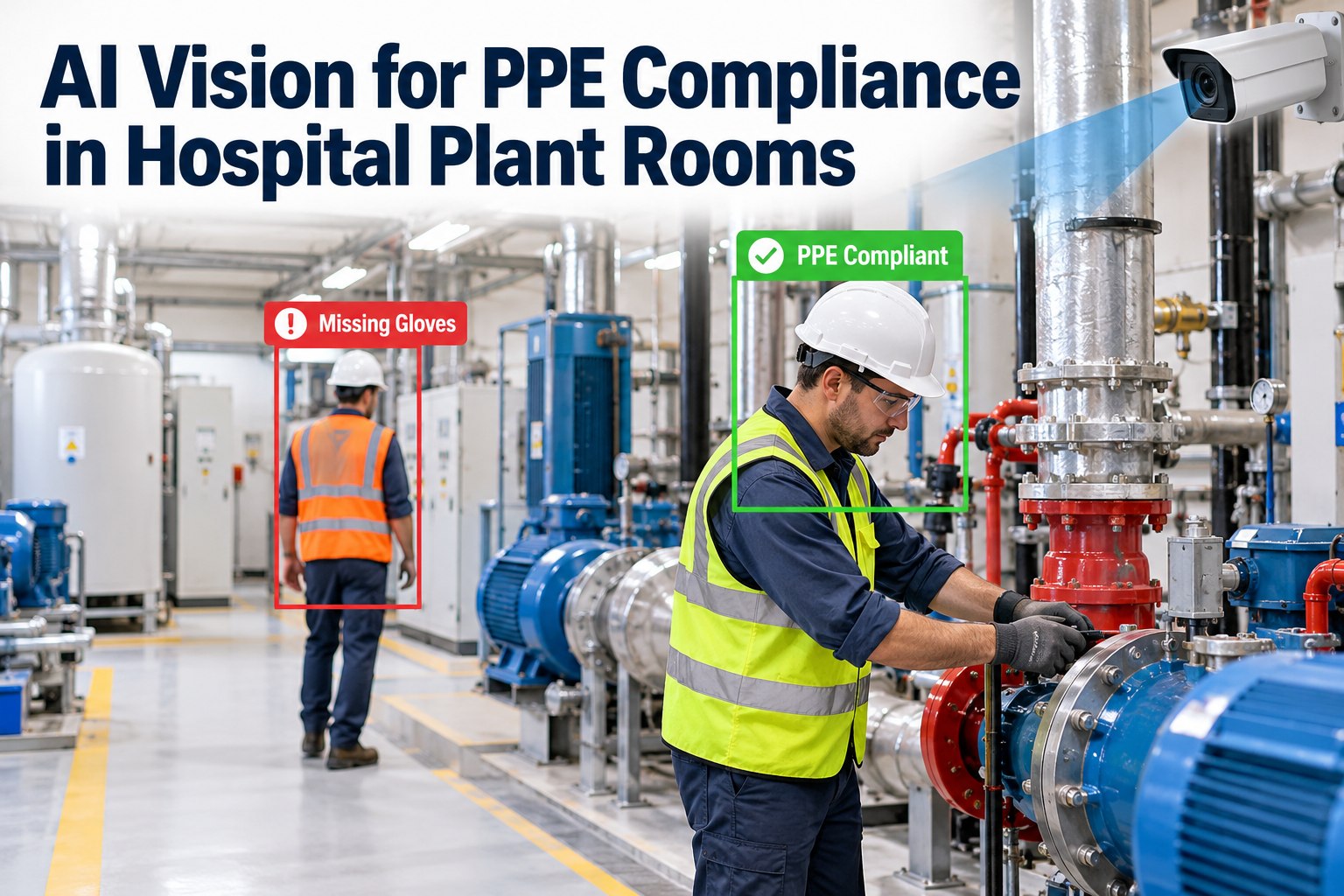
AI Vision for PPE Compliance in Hospital Plant Rooms
A camera that already watches the plant room can check that everyone who enters is wearing the PPE the space demands — every person, every time, not just when a supervisor happens to look. The OXMAINT AI maintenance management software turns a flagged gap into a record and a corrective action.
Detect
Alert
Record
Correct
Every entry
PPE checked on everyone who walks in, not a monthly sample
Unsupervised
covers the spaces where people work alone, without a watcher
Logged
each gap captured as an event with a time and a location
Acted on
a flagged gap becomes a corrective action, not just a clip
Why Plant-Room PPE Compliance Slips
PPE rules in plant rooms aren't ignored out of carelessness so much as out of the gap between the rule and anyone watching it. These are the reasons compliance quietly erodes where the hazards are highest; book a demo to see PPE monitoring in OXMAINT AI.
Nobody's watching
Plant rooms rarely have a supervisor present — most entries happen with no one there to notice a missing hard hat.
"Just a minute" entries
A quick check of a gauge feels too brief to gear up for — and the quick entries are exactly the ones that skip PPE.
Spot-checks miss most
A monthly walk-through samples a sliver of all entries — the vast majority happen unobserved and unrecorded.
Contractors & vendors
Outside workers may not know the room's specific PPE rules, and there's often no one to brief or check them.
How AI Vision PPE Detection Works
AI vision doesn't replace the camera already in the plant room — it adds a layer of understanding to what that camera sees. The flow is a short, repeating loop; start free and see the loop running in OXMAINT AI.
1
Watch the entry and work area
A camera covers the plant-room door or work zone — often one that's already installed — giving the vision model a live view of who enters and what they're wearing.
2
Check for required PPE
The model identifies whether the person is wearing the gear the space requires — hard hat, eye and hearing protection, gloves, hi-vis — against the rule set for that room.
3
Flag a gap in real time
When required PPE is missing, the system raises an alert — a prompt at the door, a notice to the safety lead — so the gap can be closed before the work, not reviewed after an incident.
4
Record it and act
The event is logged with time and location, and becomes a corrective action — a reminder, a toolbox talk, a vendor follow-up — so a pattern gets addressed instead of repeating unseen.
What It Watches For
A hospital plant room has its own PPE profile, set by the hazards in the space. AI vision checks for the gear each room's rules require; book a demo to set room-specific PPE rules in OXMAINT AI.
Head protection
Hard hats where overhead hazards, pipework or moving plant are present.
Eye protection
Safety glasses around pressurised systems, chemicals and rotating equipment.
Hearing protection
Ear defenders in high-noise spaces — chiller plant, pump and generator rooms.
Hand protection
Gloves suited to the task — thermal near hot surfaces, insulated near electrical.
High-visibility wear
Hi-vis where vehicles, moving plant or low light make a worker hard to see.
Protective footwear
Safety boots across plant spaces with heavy equipment and trip or crush risks.
Safety, not surveillance. AI vision for PPE works best when it's about conditions, not individuals — flagging that required gear is missing so a hazard gets closed, not building profiles of people. Use it with clear signage, consultation with staff and their representatives, access controls on the footage, and alignment with your privacy obligations and local law. The system flags a gap; a person decides what to do about it.
A Clip of a Near-Miss Is Evidence. A Flag Before the Work Is Prevention.
Reviewing camera footage after an incident tells you what went wrong; catching a missing hard hat at the door stops it. The OXMAINT AI maintenance management software turns the flag into an event and a corrective action, so PPE gaps are closed and the pattern behind them gets addressed.
From Flag to Fixed: The Maintenance Workflow
A PPE flag is only worth something if it leads somewhere. Tied into the maintenance system, each one drives action and builds a record; start free and route PPE events through OXMAINT AI.
AI vision monitoring
PPE checked on plant-room cameras against each room's rule set, continuously and on every entry.
Real-time alerts
A missing-PPE flag reaches the door or the safety lead at once, so the gap closes before the work starts.
Logged events
Each gap recorded with time, location and context, so there's a complete picture instead of a sampled one.
Corrective actions
A flag becomes a task — a reminder, a toolbox talk, a vendor follow-up — tracked to closure like any work order.
Compliance trends
Gaps trended by room, shift and team, so the recurring hot spots and weak points stand out for action.
Audit-ready record
A documented safety trail of gaps and the actions taken, ready for safety audits and incident reviews.
“
Our plant rooms were a blind spot — we had a PPE policy and no real way to know if anyone followed it once the door shut. Adding vision checks on the entry cameras gave us honest numbers for the first time, and they weren't pretty. But within a couple of months the flags fell away, because people knew the gap would be caught and followed up. The win wasn't catching people — it was that the quick in-and-out entries, the ones that used to skip the hard hat, stopped skipping it.
Safety & Facilities Manager · Hospital Estates Team
Frequently Asked Questions
How does AI vision detect PPE compliance?
A vision model watches a plant-room camera feed and identifies whether people entering are wearing the PPE the space requires — hard hat, eye and hearing protection, gloves, hi-vis — against that room's rule set. When required gear is missing, it raises a flag that becomes an alert and a logged event.
Start free to see it work.
Does it need new cameras?
Often not — AI vision usually adds a layer of understanding to cameras that already cover plant-room doors and work zones. The value is in interpreting what the camera sees, so an existing feed with a clear view of the entry is frequently enough to start checking PPE on everyone who comes through.
Is PPE monitoring by camera a privacy concern?
It can be, which is why it should be run as a safety tool, not surveillance — focused on whether required PPE is present rather than on tracking individuals, with clear signage, consultation with staff and their representatives, controlled access to footage, and alignment with your privacy obligations and local law. The system flags a condition; people decide the response.
Book a demo to discuss responsible setup.
Which PPE matters most in hospital plant rooms?
It depends on the space: head, eye and hearing protection and safety footwear across most plant rooms, gloves matched to thermal or electrical work, and hi-vis where moving plant or low light are a factor. Each room's rule set should reflect its actual hazards — a chiller plant, a boiler room and a switchroom don't all require the same gear.
How does this connect to maintenance management?
A PPE flag becomes an event in the maintenance system, which turns it into a corrective action tracked to closure, trends the gaps by room and team to show where to focus, and keeps an audit-ready record of what happened and what was done — so vision monitoring drives real action and documentation, not just a wall of camera clips.
Check the PPE on Everyone — in the Rooms No One Is Watching.
Close the plant-room blind spot with the OXMAINT AI maintenance management software and AI vision — PPE checked on every entry, real-time alerts, logged events, corrective actions tracked to closure, and an audit-ready safety record. Run responsibly as safety, not surveillance — and stop hoping the quick entries geared up.


.jpg)

