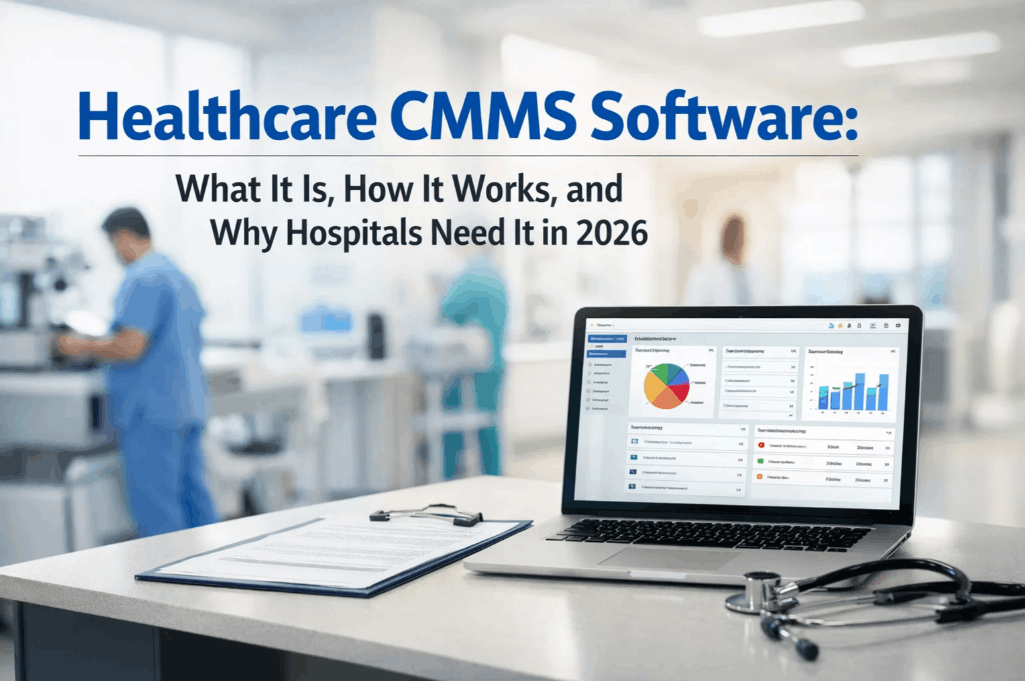
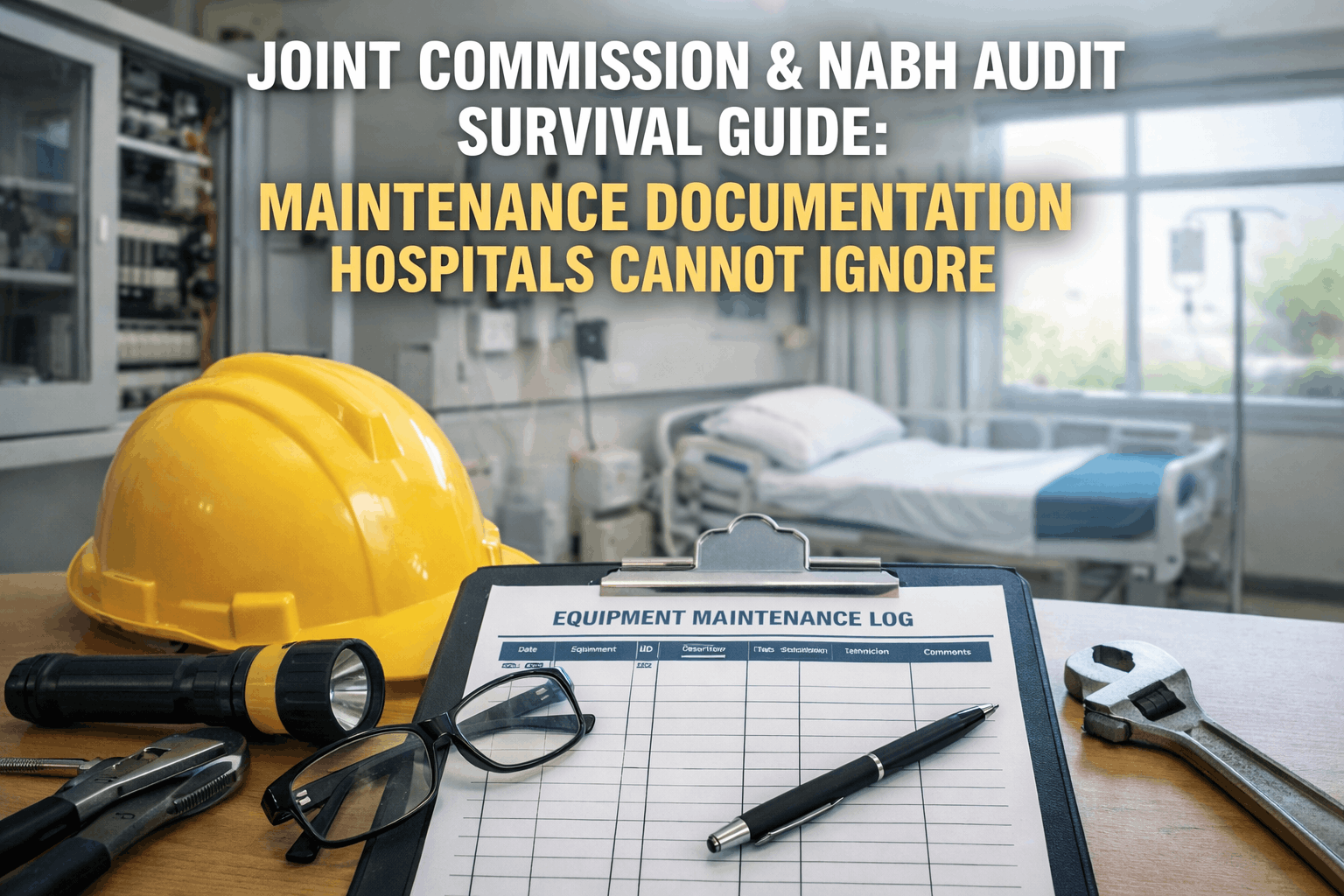
Hospitals and medical facilities run under some of the most demanding regulatory frameworks in any industry — Joint Commission surveys, NABH accreditation cycles, CMS Conditions of Participation, and a growing stack of region-specific audit requirements. When documentation is incomplete, PM records have gaps, or asset histories are scattered across spreadsheets, the exposure is not just operational — it is financial and reputational. Healthcare compliance software changes the equation by centralising every maintenance record, inspection log, and regulatory task into a single audit-ready platform. If your facility is still pulling records manually before every survey, start a free trial for 30 days and see what always-current compliance looks like in practice, or book a demo with our healthcare operations team.
72%
Of Joint Commission citations relate to incomplete maintenance documentation
$1.9M
Average cost of a CMS regulatory penalty following a failed hospital audit
4.8x
Emergency repairs cost more than planned, scheduled maintenance events
60%
Reduction in pre-audit prep time for facilities using digital compliance platforms
What Is Healthcare Compliance Software?
Healthcare compliance software is a purpose-built digital platform that automates the documentation, scheduling, tracking, and reporting of all regulatory and maintenance obligations across hospital facilities and medical campuses. Unlike generic work order tools or spreadsheet-based tracking, it is architected around the compliance frameworks that govern healthcare operations — Joint Commission Environment of Care standards, NABH infrastructure requirements, CMS life safety codes, and OSHA facility obligations. The platform maintains a continuous, always-current audit trail for every asset, every inspection, and every corrective action — so when a surveyor walks in, the records are already complete. If your current process involves manual compilation in the days before a survey, start a free trial to see what automated compliance readiness looks like, or book a demo and we will map it to your regulatory obligations.
Core Components of a Healthcare Compliance Software Platform
Audit-Ready Documentation Engine
Every maintenance event, inspection, corrective action, and equipment test generates structured digital records with technician identity, timestamp, digital signature, and completion evidence — always retrievable in seconds
Regulatory Task Scheduling
PM schedules, inspection cycles, and compliance tasks are tied directly to asset records and regulatory frameworks — with automated reminders and escalation before deadlines are missed
Asset Lifecycle and Condition Tracking
Each regulated asset carries a full service history, condition score, and remaining useful life estimate — giving facilities directors the data to justify CapEx decisions and demonstrate proactive stewardship during audits
Compliance Dashboard and Reporting
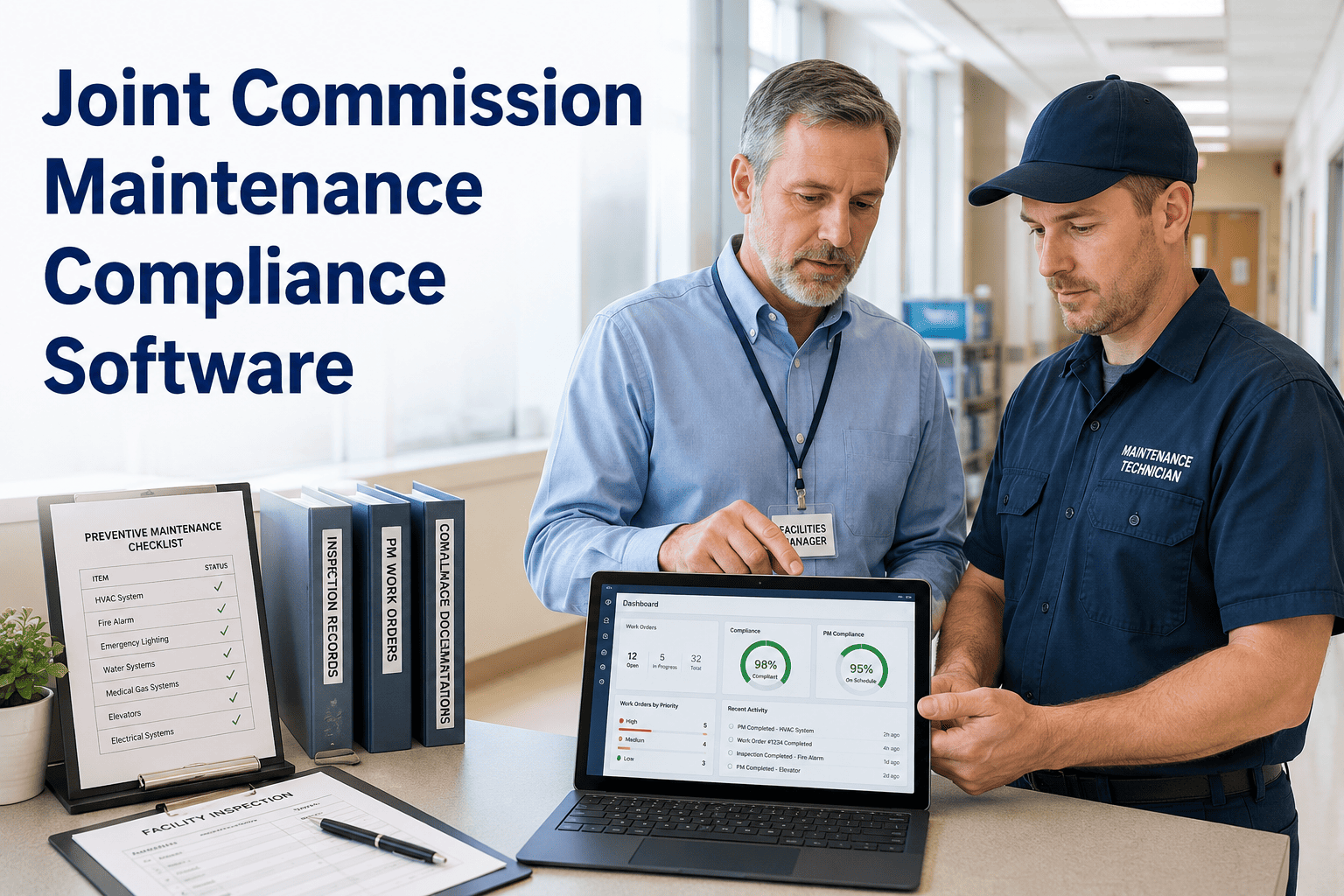
Real-time visibility into PM completion rates, overdue tasks, open corrective actions, and audit readiness scores — across a single site or an entire multi-hospital portfolio — with exportable reports formatted for surveyor review
Key Compliance Frameworks Healthcare Software Must Cover
Hospitals do not operate under a single regulatory body. A 300-bed acute care facility in the United States is simultaneously accountable to the Joint Commission, CMS, OSHA, The Joint Commission's Life Safety chapter, and state health department requirements. A multi-site health system adds portfolio-level reporting obligations on top. Compliance software that only addresses one framework creates gaps that expose the facility in every other. Every framework below must be traceable through a unified platform — if you want to see how that works in practice, start a free trial or book a demo with our team today.
USA
Joint Commission — Environment of Care
EC.02.05 and EC.02.06 standards require documented PM completion for all life-safety, utility, and medical equipment assets. Incomplete records are among the top three findings in every TJC survey cycle.
USA / Global
CMS Conditions of Participation
CMS §482.41 Physical Environment standards mandate facility maintenance programs with documented evidence. Non-compliance triggers corrective action plans and, in repeat cases, payment suspension affecting millions in annual revenue.
India / Global
NABH Infrastructure and Safety Standards
NABH accreditation requires hospitals to maintain equipment inventories, scheduled maintenance records, and safety inspection logs across all departments — with evidence available on demand during assessment visits.
UK
NHS HTM Standards and CQC Registration
NHS Health Technical Memoranda set mandatory maintenance standards for medical gas systems, HVAC, electrical infrastructure, and fire safety. CQC registration requires demonstrable compliance evidence across all asset categories.
USA / Global
OSHA 29 CFR 1910 — Facility Safety
OSHA standards covering electrical safety, hazardous energy lockout/tagout, and facility hazard controls require documented procedures and training records that must be produced on request during any inspection.
Global
ISO 55001 — Asset Management Systems
ISO 55001 certification demonstrates systematic asset lifecycle management with documented maintenance plans, condition monitoring, and performance reporting — increasingly required by healthcare groups operating across multiple jurisdictions.
UAE
DHA / HAAD Healthcare Facility Regulations
Dubai Health Authority and HAAD regulations require maintenance records, equipment calibration logs, and facility safety documentation as part of licensing and renewal — with digital submission increasingly mandated under Vision 2030 smart facility initiatives.
Australia
Australia
NSQHS Standards — Clinical Governance
National Safety and Quality Health Service Standards require documented maintenance programs for all clinical and support equipment, with evidence of compliance available at assessment. High labor costs make digital automation particularly high-ROI in the Australian context.
Why Manual Compliance Tracking Is a Liability in 2026
Spreadsheets and paper logs were not built for the regulatory density hospitals now operate under. The cost of getting it wrong — in citations, corrective action plans, payment impacts, and reputational damage — has made manual compliance tracking an institutional risk, not just an operational inefficiency.
Audit Exposure
PM Record Gaps Trigger Immediate TJC Findings
Joint Commission surveyors request PM completion records for regulated assets on the first day of a survey. A single missing record for a fire suppression system or medical gas component can trigger a Requirements for Improvement that triggers a follow-up visit 60 days later.
Pre-Survey Scramble
Manual Compilation Takes Weeks Before Every Survey
Facilities teams spending 2 to 4 weeks before each Joint Commission or CMS survey manually compiling maintenance records from multiple systems, paper files, and technician notes are carrying a structural cost that compounds across every survey cycle.
Missed Deadlines
No Automated Reminders Means Overdue Tasks Slip
Calendar-based manual tracking fails when staff change, PM cycles extend across fiscal years, or asset additions are not captured in the master schedule. Overdue PM tasks discovered during a survey become immediate compliance findings with mandatory correction timelines.
Siloed Records
Multi-Site Systems Have No Unified Compliance View
Health systems managing 5 or more facilities have no standardised view of PM compliance rates, overdue tasks, or corrective action status across the network. Every site operates in its own system, making portfolio-level compliance reporting impossible without manual aggregation.
How Oxmaint Delivers Always-Ready Hospital Compliance
Oxmaint is built for operational complexity at scale — not adapted from a generic work order system. The platform layers regulatory scheduling, condition-based maintenance, automated documentation, and portfolio reporting into a single compliance infrastructure. Ready to see it mapped to your facility's audit obligations — start a free trial for 30 days at no cost, or book a demo with the healthcare operations team.
Feature 01 — Asset Registry
Full Asset Hierarchy With Compliance Tagging
Every regulated asset — from ATS panels to autoclave units — is registered in a structured hierarchy: Portfolio, Property, System, Asset, Component. Each carries its regulatory category, compliance schedule, and full service history in a single retrievable record.
Feature 02 — PM Scheduling
Regulatory PM Schedules Tied to Asset Records
Preventive maintenance tasks are scheduled based on regulatory requirements — not generic calendar intervals. When an asset's compliance schedule changes based on usage cycles or condition data, the PM schedule updates automatically without manual intervention.
Feature 03 — Digital Inspections
GMP-Compliant Inspection Forms With Digital Signatures
Technicians complete structured inspection checklists on mobile — with photo capture, pass/fail criteria, and mandatory fields that cannot be bypassed. Digital signatures and timestamps are embedded in every record at the point of completion, not added afterward.
Feature 04 — Audit Trail
Every Action Captured — Survey-Ready in Seconds
Every work order completion, inspection, corrective action, and parts replacement is logged with full traceability — who, what, when, and the outcome. Surveyors can be handed a complete asset compliance report in the time it takes to run a filter.
Feature 05 — Automated Alerts
Compliance Deadline Reminders Before Tasks Go Overdue
Automated reminders escalate through the chain — technician, supervisor, facilities director — before any compliance task reaches its deadline. Overdue task tracking gives leadership real-time visibility into compliance exposure without waiting for a survey to surface it.
Feature 06 — CapEx Forecasting
5 to 10 Year Capital Planning From Live Asset Data
Asset condition scores and service history feed into rolling multi-year CapEx replacement forecasts — giving CFOs and directors data-backed timelines for equipment budgeting instead of vendor guidelines or age-based assumptions. Regulators and investors get the same visibility.
Feature 07 — Portfolio Reporting
Multi-Site Compliance Dashboard for Health Systems
Health systems across 3 to 30 or more facilities get a unified compliance dashboard — PM completion rates, overdue tasks, corrective action status, and audit readiness scores by site. Portfolio leadership gets the view they need without manual aggregation from site teams.
Feature 08 — MRO and Parts
Integrated Spare Parts Inventory Closes the Compliance Loop
Parts used in compliance-critical maintenance events are logged against the work order and asset record automatically. Inventory management ensures the components needed for scheduled PM tasks are available before the task is due — not sourced as an emergency after a failure.
Manual Tracking vs. Digital Compliance Platform: The Real Difference
The gap between a manual compliance process and a purpose-built digital platform is not just efficiency — it is risk. Every survey cycle run on spreadsheets and paper logs is a cycle where the outcome depends on whether every record happens to be in the right place at the right time.
See Oxmaint's Healthcare Compliance Platform in Action
Hospitals and health systems using Oxmaint eliminate pre-survey scrambles, maintain always-current audit trails, and give portfolio leadership real-time visibility into compliance status across every facility — without a dedicated IT project or a 6-month implementation. Operational in weeks, not quarters.
Compliance ROI: What Digital Audit Tracking Delivers
The return on healthcare compliance software is not theoretical — it is measurable across avoided citations, staff time recovered, and penalty costs that never materialise. Healthcare facilities that move from manual to digital compliance management report consistent, quantifiable improvements within the first 12 months of deployment.
60%
Reduction in pre-audit preparation time
Records are always complete — no manual compilation sprint before each survey cycle
$420K
Average annual savings from avoided penalties and reactive repairs
Combined impact of avoided citations, emergency repair cost reduction, and extended asset life
34%
Fewer unplanned equipment failures within 12 months
Condition-based PM scheduling closes the gap between calendar intervals and actual asset needs
3.2x
Average ROI on digital compliance platform investment
Measured across penalty avoidance, staff time, and CapEx extension within 24 months
Frequently Asked Questions
What does healthcare compliance software actually do that a CMMS does not?
A standard CMMS manages work orders and maintenance scheduling — but it is not built around regulatory compliance frameworks. Healthcare compliance software integrates PM scheduling with the specific documentation requirements of Joint Commission, NABH, CMS, and regional regulators. It generates audit-ready records at the point of task completion — with digital signatures, timestamps, and structured evidence that a surveyor can access in minutes. It also tracks corrective action plans, flags overdue compliance tasks before they become findings, and produces portfolio-level compliance dashboards that a standard CMMS cannot. Oxmaint combines both — full CMMS functionality built within a compliance-first architecture — so hospitals do not need separate platforms for operations and audit management.
How does Oxmaint support Joint Commission audit preparation specifically?
Joint Commission Environment of Care and Life Safety surveys require documented evidence of PM completion for every regulated asset in the facility. Oxmaint maintains that evidence automatically — every work order completion captures the technician, timestamp, inspection result, and digital signature without any manual entry after the fact. When a surveyor requests PM records for a medical gas system or fire suppression asset, the facilities team can produce a complete, structured service history in under two minutes. The platform also flags overdue PM tasks in real time — so compliance gaps are identified and closed internally, not discovered during the survey. Facilities using Oxmaint report a 60 percent reduction in pre-survey preparation time and significantly fewer Environment of Care findings per survey cycle.
Can Oxmaint support compliance tracking across a multi-hospital health system?
Yes — Oxmaint is built specifically for multi-site portfolios. Health systems managing 3 to 30 or more facilities get a single portfolio-level compliance dashboard showing PM completion rates, overdue tasks, corrective action status, and audit readiness scores by site. Each facility operates within its own asset hierarchy — Portfolio, Property, System, Asset, Component — so site-level detail is preserved while portfolio leadership gets the cross-site view they need. Regional directors can identify which facilities have compliance exposure before a survey, not after. For health systems currently aggregating compliance data manually from site-level spreadsheets, this alone recovers significant staff time and eliminates the reporting lag that creates blind spots in portfolio oversight.
How long does it take to deploy Oxmaint in a hospital environment?
Oxmaint is operational in weeks, not months. There is no heavy implementation project, no specialist consultant dependency, and no requirement for a dedicated IT resource to stand the platform up. Asset data is imported from existing inventories, PM schedules are configured to match current regulatory obligations, and technicians are trained on the mobile app within days. For most mid-size hospitals, the platform is live and tracking compliance tasks within two to three weeks of kickoff. Facilities with complex multi-site portfolios typically reach full operational deployment within 30 to 45 days. The free 30-day trial gives facilities teams the ability to run the platform against real asset data before any commercial commitment —
start a free trial or
book a demo to walk through the deployment process with our team.
Built for Hospital Compliance — Not Adapted From a Generic CMMS
Oxmaint gives hospital facility and operations teams always-current audit documentation, automated regulatory PM scheduling, real-time compliance dashboards, and rolling CapEx forecasts — all in one platform. No heavy implementation. No specialist consultants. Survey-ready from week one.
Joint Commission audit-ready documentation
NABH and CMS compliance tracking
GMP-compliant digital inspections
Real-time overdue task alerts
Multi-site portfolio compliance dashboard
5 to 10 year CapEx forecasting
.jpg)


.png)