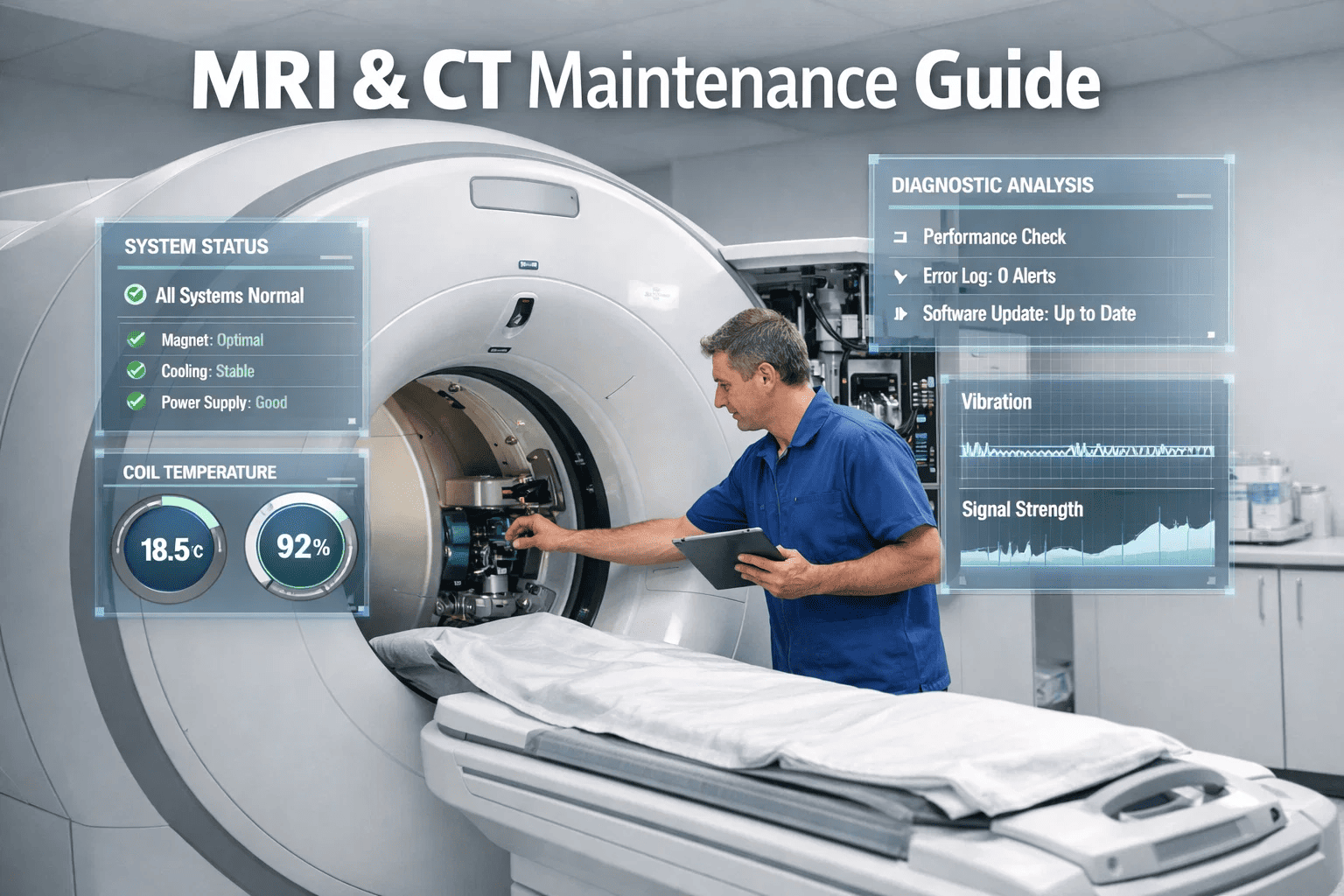
An MRI scanner goes offline at 7 AM on a Monday. By noon, twelve patients have been rescheduled, four referring physicians are on hold, and your biomedical team is chasing a parts lead time of three to five business days. That single unplanned failure just cost your imaging center between $10,000 and $15,000 in lost daily revenue — and if it stretches to a full week, you are looking at a $50,000 to $75,000 hole before emergency service fees are counted. The harder reality: nearly 70% of imaging equipment failures produce detectable warning signals — vibration anomalies, thermal drift, helium pressure trends, and tube heat unit patterns — weeks before the failure event itself. The equipment was telling you. Nobody was listening. That is the gap Oxmaint closes. Start a free trial and connect your imaging fleet to a maintenance platform built around preventing failures, not reacting to them. Or book a demo to see how radiology departments track scanner health in real time.
Why MRI and CT Maintenance Is Unlike Any Other Medical Equipment
A hospital bed fails and a patient is moved. An infusion pump fails and a nurse switches units. An MRI scanner fails and your radiology department stops — completely. MRI and CT systems are the highest-revenue, highest-complexity, highest-consequence assets in any hospital or imaging center. A single MRI unit costs $1M to $3M. A CT scanner runs $600K to $2.5M. Full-service maintenance contracts on either modality can exceed $100,000 annually. Studies show that 37% of a hospital's total revenue is derived from imaging services — meaning a multi-day scanner outage directly threatens a disproportionate share of institutional income. The maintenance model these assets demand is not a quarterly PM visit and a signed checklist. It is continuous condition monitoring, predictive failure detection, and structured work order execution with full audit documentation. Start a free trial and bring that level of rigor to your imaging fleet without adding headcount.
MRI SYSTEMS
The 5 Failure Modes That Shut Down MRI Operations
Helium Level Depletion
Superconducting magnets require liquid helium at near absolute zero. When helium drops below 55%, boil-off accelerates. An unmanaged quench costs $30,000–$80,000 in helium refill, emergency service, and downtime. Daily monitoring prevents this entirely.
Risk: Magnet quench, full system loss
Cryocooler / Cold Head Failure
Cryocoolers maintain helium recirculation. Motor wear and compressor degradation generate detectable vibration signatures 3–6 weeks before failure. Undetected, a cold head failure leads to magnet warmup and weeks of downtime.
Detection window: 3–6 weeks with vibration monitoring
Gradient Coil Overheating
Gradient coils generate intense heat during scanning cycles. Cooling circuit degradation shows as progressive thermal drift over 4–8 weeks. Without trending, the first indication is a thermal shutdown mid-scan with a patient in the bore.
Detection window: 4–8 weeks with thermal monitoring
RF Coil Degradation
Radiofrequency coils show SNR (signal-to-noise ratio) decline before complete failure. Image quality artifacts appear gradually — a problem clinical staff often adapt to rather than flag as a maintenance issue, masking the real asset condition.
Impacts diagnostic accuracy before visible failure
Magnetic Field Homogeneity Drift
Magnetic field uniformity degrades with mechanical stress, vibration, and environmental changes. Quarterly shimming and field mapping detect drift before it affects image quality at clinical protocols.
Manageable with scheduled field mapping
CT SCANNERS
The 5 Failure Modes That Shut Down CT Operations
X-Ray Tube Failure
CT tubes are the single largest unplanned maintenance cost in CT operations. Tube replacement runs $60,000–$150,000. Heat unit accumulation logs and filament performance trends predict end-of-life 3–8 weeks in advance — enough time to schedule a planned swap.
Largest single repair cost in CT operations
Detector Calibration Drift
Ring artifacts, banding, and non-uniformity in CT images indicate detector drift. These symptoms appear gradually — teams adapt to slight image degradation without recognizing the underlying calibration failure that will eventually stop scanning entirely.
Degrades diagnostic accuracy silently
Gantry Bearing Wear
CT gantry assemblies complete thousands of rotations daily. Bearing wear produces characteristic vibration frequency shifts detectable 2–5 weeks before mechanical failure. A collapsed bearing stops the gantry mid-rotation — a full system-down event.
Detection window: 2–5 weeks with vibration analysis
Cooling System Overload
CT tubes generate extreme heat. Clogged filters, failed fans, and degraded coolant performance allow thermal accumulation that triggers automatic shutdown or, worse, uncontrolled tube damage. Weekly airflow checks and temperature trending prevent this.
Can cause permanent tube damage if undetected
Software and Firmware Instability
Outdated firmware and skipped software updates can corrupt image reconstruction algorithms, crash console workstations, or produce scan data that fails to archive. Structured update scheduling and version control prevent these avoidable digital failures.
Manageable with structured update scheduling
CONTINUOUS MONITORING FRAMEWORK
What Must Be Tracked Daily, Weekly, Monthly, and Quarterly
Reactive maintenance teams track one thing: whether the scanner is on or off. Preventive teams track schedules. Predictive teams track trends. The difference in outcomes is dramatic — AI-monitored imaging fleets reduce unplanned service events by more than 60% versus calendar-based PM programs. The monitoring framework below maps every critical parameter to the interval that generates actionable intelligence before failure, not after it. Book a demo to see how Oxmaint automates this entire monitoring framework for your imaging fleet.
Daily
Helium level reading and trend check
Cryocooler operating pressure
CT air calibration scan
CT number accuracy (water phantom)
Tube warm-up protocol execution
Error log review before first patient
Image quality visual QC check
Console and workstation status
Weekly
CT tube heat unit log review
Cooling airflow and filter check
SNR measurement on RF coils
Gantry vibration level check
Table travel and laser alignment
MRI bore temperature log
Noise level vs. baseline comparison
Safety system functional check
Monthly
CTDI dose measurement with phantom
MTF spatial resolution test
Slice thickness verification
Tube current output linearity
MRI gradient performance check
Cryocooler compressor service hrs
Preventive lubrication schedule
Firmware version audit
Quarterly
Magnetic field homogeneity mapping
Full gantry bearing vibration analysis
Detector channel integrity test
Tube life projection vs. OEM curve
Full compliance documentation review
CapEx forecast update for tube/coil
Multi-system performance comparison
Accreditation record package audit
Radiology departments operating on reactive maintenance lose an average of $180,000 per year to preventable downtime. A single CT tube failure that could have been predicted costs the same as a full year of predictive monitoring software for an entire imaging fleet.
Helium Monitoring: The MRI Maintenance Priority Nobody Automates
Liquid helium keeps superconducting MRI magnets operational. It is also the single highest-consequence monitoring gap in imaging center maintenance programs. Most facilities rely on manual weekly readings — a process that is both inconsistent and too infrequent to catch accelerating boil-off. The standard guidance is clear: begin planning a refill when helium reads in the 60s and have one firmly scheduled before levels reach the mid-50s. Below that threshold, boil-off rate increases non-linearly. An unmanaged quench — the rapid, uncontrolled venting of helium as the magnet warms — causes $30,000 to $80,000 in direct costs and days to weeks of downtime. Oxmaint connects helium level sensors to automated alerts and scheduled refill workflows, so your team gets a notification at 65% with a work order already drafted — not a crisis call at 40%. Start a free trial and set up helium monitoring alerts for your MRI fleet in under 30 minutes.
MRI Helium Level — Action Thresholds
80–100%
Optimal
Continue routine monitoring. Log weekly.
60–79%
Plan Refill
Schedule helium refill. Confirm supplier lead time. Increase monitoring frequency to daily.
40–59%
Urgent Action
Refill must be confirmed and imminent. Boil-off rate increasing. Alert biomedical engineering leadership.
Below 40%
Critical
Emergency protocol. Quench risk elevated. Emergency service vendor on standby. Clinical leadership notified.
$30K–$80K
Cost of unmanaged magnet quench
2–6 wks
Typical downtime after unplanned quench
$0
Cost of a planned, scheduled refill
Oxmaint Automates This
Set threshold alerts at 65%, 55%, and 45%. Automated work orders draft the refill task, attach supplier contacts, and notify the biomedical team — before the reading hits the danger zone.
CT Tube Life Tracking: Turning $150,000 Surprises into Planned Events
CT x-ray tube replacement is the largest single unplanned cost in CT operations — routinely running $60,000 to $150,000 per event when emergency parts sourcing and labor are included. Every CT tube has a measurable end-of-life trajectory. Heat unit accumulation, filament performance curves, and output linearity trends all tell the same story weeks before the tube fails. The difference between a planned tube swap during a scheduled maintenance window and an emergency replacement after mid-scan failure is exactly 4.8x in cost — and several days of downtime your patients cannot afford. Oxmaint tracks tube heat unit logs, generates end-of-life projections against OEM lifetime curves, and creates advance CapEx forecasting entries so your finance team knows the replacement is coming six months before it happens. Book a demo to see how tube life tracking integrates with preventive maintenance scheduling in Oxmaint.
Reactive Tube Management
Tube fails mid-scan, patient in bore
Emergency parts sourcing: 2–5 day lead
Weekend/overtime labor at premium rates
Replacement cost: $120K–$150K emergency
3–7 days of patient cancellations
Finance team blindsided — no CapEx budget
Staff morale impact, patient complaints
Referring physician trust damaged
Total Impact: $200K–$350K
Planned Tube Replacement (Oxmaint)
Heat unit alert at 80% projected life
Parts ordered 6 weeks in advance — list price
Swap scheduled during low-volume slot
Replacement cost: $60K–$80K planned
Zero patient cancellations
CapEx forecast updated 6 months prior
Zero staff disruption
Referral relationships maintained
Total Impact: $60K–$80K
HOW OXMAINT SOLVES IT
Oxmaint for Imaging Centers: Every Feature That Prevents Scanner Downtime
Oxmaint was built for asset-intensive operations where equipment failure has direct patient and revenue consequences. For radiology and imaging center teams, that means a platform that connects sensor data to maintenance workflows, tracks every asset from scanner to compressor to coil, and generates the compliance documentation your accreditation bodies require — without a complex implementation project. Reach out and start a free trial with your real equipment inventory today.
IoT Sensor Integration
Connect helium pressure sensors, vibration monitors, and thermal probes directly to Oxmaint. Real-time data feeds trigger automated alerts and work orders without requiring manual readings.
Tube Life Tracking
Track CT tube heat unit accumulation against OEM lifetime curves. Automatic alerts at configurable thresholds — 70%, 80%, 90% — give your team weeks of lead time to plan replacements.
Audit-Ready Documentation
Every maintenance action timestamped, signed, and stored. ACR, Joint Commission, and state radiation control documentation generated automatically — not assembled the week before an audit.
Preventive Maintenance Scheduling
Daily, weekly, monthly, and quarterly tasks auto-scheduled to each asset. Mobile checklists sent to technicians. Completion tracked, missed tasks escalated — no relying on memory or paper logs.
Predictive Failure Alerts
Vibration, thermal, and operational trend analysis flags anomalies 2–8 weeks before failure. Risk-scored alerts prioritize your team's attention — highest consequence assets get first response.
CapEx Forecasting
5–10 year rolling CapEx forecasts built from asset condition data. Tube replacement, cold head service, and coil upgrades appear in your capital plan long before they become emergency budget requests.
Multi-Site Fleet Management
Manage MRI, CT, and all imaging equipment across multiple facilities in one platform. Portfolio-level uptime dashboards show which site, which system, and which asset needs attention — right now.
Mobile-First Technician Tools
Biomedical engineers and service technicians complete inspections, log findings, and close work orders from mobile devices at the equipment — not a desktop terminal in a back office.
400%+
18-month ROI on imaging fleet PdM
$189K+
Value of a single prevented failure event
3–5 yrs
Asset life extension with PdM programs
23%
Radiology delays caused by equipment issues
No Credit Card Required · Deploy in Days, Not Months
Your MRI and CT Scanners Are Sending Warning Signals Right Now
Oxmaint connects your imaging equipment's sensor data to automated maintenance workflows — turning helium level trends, tube heat unit logs, and vibration signatures into planned repairs before they become $150,000 emergencies. Start free and validate with your own equipment data before committing to anything.
Compliance and Accreditation: The Documentation Problem Nobody Plans For
ACR accreditation, Joint Commission surveys, and state radiation control inspections all require documented evidence of structured maintenance programs. Not just that maintenance happened — that it happened on schedule, was performed by qualified personnel, and produced recorded results with timestamps and signatures. Paper-based tracking systems consistently fail this standard. A multi-modality imaging center generates hundreds of individual test records per year per scanner. Manually compiling that documentation during the week before an accreditation visit is a multi-day scramble that diverts your entire biomedical team from actual maintenance work. Oxmaint automatically timestamps every action, stores test results and images against the work order record, and generates compliance summary reports in the format accreditation bodies expect — making your facility permanently audit-ready, not seasonally prepared. Start a free trial and see compliance documentation build automatically from day one, or book a demo for a walkthrough of Oxmaint's radiology compliance module.
ACR
ACR Accreditation
American College of Radiology requires documented QC programs for MRI, CT, mammography, and nuclear medicine. Oxmaint generates the equipment performance records and physicist review logs ACR surveyors require.
TJC
Joint Commission
TJC Environment of Care standards require documented maintenance programs with evidence of completion. Digital work orders with technician signatures satisfy this requirement without paper filing systems.
FDA / State
Radiation Control
State radiation control programs conduct annual or biennial CT and fluoroscopy inspections. Oxmaint's dose measurement logs, calibration records, and corrective action trails satisfy inspector requirements on demand.
OSHA
Safety Compliance
MRI safety incidents — quench events, RF exposure, and ferromagnetic object accidents — require documented safety system checks. Oxmaint logs every safety system functional test with timestamp and technician record.
Frequently Asked Questions
How often should MRI helium levels be checked and what triggers an emergency refill?
Helium levels should be checked and logged at minimum once per day for active MRI systems. The refill planning threshold is when levels enter the 60s percentage — at that point you should be confirming supplier availability and lead time. A refill should be firmly scheduled before levels reach the mid-50s, as boil-off rate accelerates non-linearly below that point. Oxmaint automates this by connecting to helium level sensors and triggering a work order and alert at your configurable threshold — typically 65% — with follow-up escalations at 55% and 45%. A managed, planned refill costs a fraction of the $30,000 to $80,000 impact of an unmanaged magnet quench. Start a free trial and set up automated helium monitoring for your MRI fleet today.
What are the early warning signs of CT tube failure that maintenance teams can monitor?
CT tube degradation produces several measurable leading indicators before failure. Heat unit accumulation against the OEM lifetime curve is the primary metric — most tubes fail within a predictable range of accumulated heat units, so tracking this gives 3–8 weeks of advance warning. Filament performance trends show increasing inconsistency as the tube ages. Output linearity tests — checking CT number and noise performance across mA settings — flag deteriorating tube output before visible image quality changes. Arc events logged in the error system increase in frequency as tubes approach end of life. Oxmaint tracks all of these parameters, plots them against expected curves, and generates a projected failure date that feeds directly into your CapEx plan and maintenance scheduling calendar.
How does Oxmaint handle compliance documentation for ACR and Joint Commission audits?
Oxmaint automatically creates a permanent, timestamped record for every maintenance action completed in the system. Work orders capture who performed the task, when it was done, what results were recorded, and any digital signatures required. This creates an always-current compliance trail rather than a document scramble before audit season. For ACR accreditation, Oxmaint generates equipment performance logs and QC records in the formats ACR surveyors review. For Joint Commission Environment of Care surveys, the platform provides maintenance completion evidence with full technician records. State radiation control inspections are supported by dose measurement logs, calibration records, and corrective action documentation — all retrievable in seconds rather than hours of paper file searching. Book a demo to see a live walkthrough of compliance reporting for an imaging center environment.
What is the realistic cost of MRI or CT downtime and how is ROI calculated for predictive maintenance?
Industry data consistently puts imaging downtime cost at $10,000 to $15,800 per day for a single MRI or CT system — factoring in lost procedure revenue, staff wages during idle time, and emergency service premiums. A medium-sized hospital can lose nearly $300,000 annually from imaging system outages. Emergency repairs carry a 4.8x cost premium over the same service performed on a planned schedule, making the math straightforward: a single prevented CT tube failure event saves $80,000 to $120,000 versus the emergency alternative. Predictive maintenance infrastructure for a single imaging system typically costs $15,000 to $20,000 per year. The value of one prevented failure event alone — conservatively estimated at $189,000 for 24 hours of lost uptime plus emergency service — generates full program ROI. Healthcare facilities deploying AI predictive maintenance on multi-system imaging fleets report average 18-month ROI exceeding 400%, driven by avoided downtime, repair cost reduction, and extended CapEx cycles.