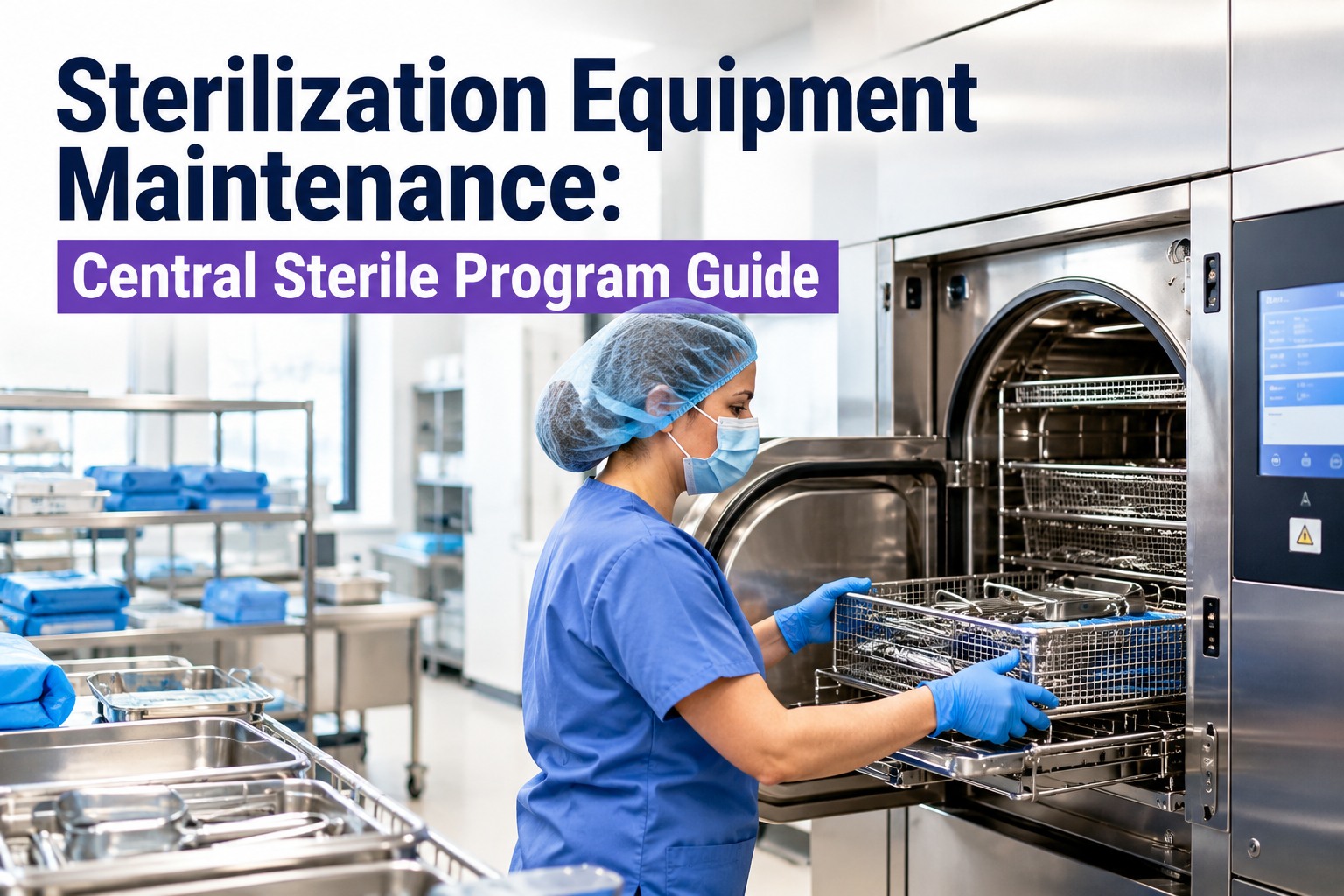
When a sterilizer goes down mid-shift, the problem is never just the sterilizer. A positive biological indicator quarantines every load processed since the last negative result, a cracked door gasket pulls a prevacuum unit out of the rotation your OR schedule depends on, and a missing calibration certificate turns a routine Joint Commission visit into a finding. For the central sterile department, the sterilizer fleet is the one asset class where a maintenance gap and a patient-safety event are the same gap. A reliable sterilization equipment maintenance program closes that gap by making preventive maintenance, calibration, validation, and record-keeping a single scheduled workflow rather than five disconnected binders. This guide lays out how to build that program for a central sterile or sterile processing department, and how OxMaint's AI-powered CMMS runs it end to end.
Missed air-removal tests, a gasket overdue for replacement, a calibration certificate no one can find — in sterile processing, every one of those is a patient-safety exposure, not a maintenance backlog. Build a program where preventive maintenance, calibration, validation, and compliance records run as one scheduled workflow.
Start with the fleet, not the sterilizer
A central sterile program rarely runs one sterilizer technology. Each modality has its own cycle parameters, its own critical components, and its own validation requirements, so the program has to recognise them as distinct asset classes from the first day of the register.
Steam sterilizers
EtO sterilizers
H₂O₂ plasma units
Five pillars of a reliable program
A mature sterilization maintenance program stands on five pillars. Treat any one as optional and the whole program carries risk — a perfect PM calendar means little if the calibration behind the readings has lapsed, and flawless validation is undermined by records no one can produce at audit.
Asset register and criticality
Every chamber, generator, vacuum pump, and water system entered with model, install date, OEM service terms, and a criticality rank so the busiest prevacuum unit is never the one with the thinnest maintenance history.
Tiered preventive maintenance
Daily, weekly, monthly, and annual tasks assigned per asset and per modality, so air-removal testing, descaling, and OEM service each land on the right cadence rather than being remembered at random.
Calibration and validation
NIST-traceable sensor calibration and full cycle validation tracked with certificates attached to the asset, because a reading you cannot trust is worse than no reading at all.
Monitoring to corrective action
A single path from a failed Bowie-Dick, a positive biological indicator, or a cycle abort to an immediate work order, load quarantine, and documented return-to-service.
Compliance records
Installation qualification, air-removal logs, BI results, PM history, and cycle printouts held in one place and retained for the required period, ready to produce in minutes rather than days.
Ownership and governance
Named responsibility for each pillar, a review cadence for overdue work, and a clear escalation line when a sterilizer has to leave the rotation — the glue that keeps the other five standing.
The tiered PM calendar
This is the operating heart of the program: the recurring tasks that keep every sterilizer inside its validated envelope. Build it once per asset in a short planning session with the OxMaint team and the calendar generates the work automatically from then on.
| Cadence | Core steam / prevacuum tasks | Added for EtO and H₂O₂ |
|---|---|---|
| Daily | Bowie-Dick air-removal test on prevacuum units, biological indicator run, cycle printout review, door gasket and chamber inspection, water supply verification | Electrode visual check on H₂O₂ units; exposure and ventilation verification on EtO |
| Weekly | Door gasket seal and torque test, drain strainer cleaning, steam trap functional check, safety valve manual lift test, alarm functional test | Cassette and cartridge inventory review; canister integrity check on EtO |
| Monthly | Chamber descaling, thermometric mapping, vacuum pump oil check, air detector check per AAMI ST79, locking mechanism lubrication, records completeness audit | Plasma generator test and humidity sensor calibration on H₂O₂ units |
| Annual | OEM preventive service, door gasket replacement, NIST-traceable thermocouple calibration, pressure vessel inspection, full cycle validation with mapping, safety interlock testing | Electrode replacement on H₂O₂; ventilation and exhaust performance test on EtO |
Calibration and validation that hold up
Preventive maintenance keeps a sterilizer running; calibration and validation prove it is still doing what it claims. In central sterile these are not interchangeable, and a defensible program keeps both on a documented schedule.
Sensor calibration
Temperature sensors, pressure gauges, and timers verified against NIST-traceable standards on a fixed cadence, with the certificate stored against the asset so the chain of traceability is never broken.
Thermocouple verification
Chamber temperature confirmed at multiple locations, with annual NIST-traceable calibration, so a mapping study rests on instruments you can trust.
Cycle validation
Full validation with a mapping study at least annually and after any major service, relocation, or change that could move the sterilizer outside its qualified envelope.
Biological confirmation
Weekly biological indicators on every unit and an indicator in every implant load, with the implant load quarantined until a negative result is confirmed.
From a failed indicator to a closed work order
The moment a monitoring result fails is the moment the program proves its worth. A positive BI, a failed Bowie-Dick, or a cycle abort has to move through the same disciplined path every time — no judgement calls under pressure, no loads released on hope.
Detect
A failed air-removal test, positive biological indicator, cycle abort, or out-of-range printout is flagged the moment it happens.
Quarantine
Every load back to the last negative result is held, and the sterilizer is pulled from the rotation before the next cycle starts.
Work order
A critical work order is raised with the asset history, recent PM, and calibration record attached for whoever responds.
Return to service
Root cause documented, corrective action verified, and a negative indicator confirmed before the unit rejoins the schedule.
The records that stand behind every tray
When a surveyor or a recall asks what happened to a given load, the answer lives in the records. A program that generates them as a by-product of the work — rather than as a separate chore — is the one that passes inspection without a scramble.
Qualification records
Installation and performance qualification for each sterilizer, kept for the life of the asset.
Daily air-removal logs
Bowie-Dick and air-detector results captured each day on prevacuum units.
Biological indicator results
Weekly BI logs plus every implant-load result, with quarantine and release documented.
PM and calibration history
Preventive maintenance per OEM specification and calibration certificates attached to each asset.
Cycle logs
Temperature and pressure records for every cycle, retained for the required period.
Load recall procedure
A tested recall path so any load can be traced and pulled when a result turns.
The standards the program answers to
A central sterile maintenance program does not sit in isolation. These are the authorities a sterile processing department is measured against, and each one maps directly to a pillar above.
The governing document for steam sterilization in healthcare — PM, validation, air-removal, and load release.
Requires a documented equipment maintenance program; sterilizers rank as high-priority devices.
Device reprocessing and the validation recordkeeping that intersects with sterilizer performance.
The ethylene oxide standard covering exposure limits, monitoring, and maintenance access.
How OxMaint runs the whole program
The five pillars become one system when a CMMS carries them. OxMaint turns the sterilization maintenance program from binders and spreadsheets into a workflow that schedules itself, reacts in minutes, and produces its own evidence.
PM that schedules itself
Daily, weekly, monthly, and annual tasks generate automatically for every sterilizer and modality, so nothing depends on a technician remembering the cadence.
Failed indicators raise work orders
A positive BI, failed Bowie-Dick, or cycle abort triggers a critical work order within minutes, with the asset history already attached.
Calibration tracking
NIST-traceable certificates, OEM service reports, and repair records live on the asset, so the next audit finds a complete chain rather than a gap.
Audit-ready reporting
Pull a readiness report across the whole fleet in seconds, with PM, calibration, and indicator history in one view for the surveyor.
Spare parts on hand
Gaskets, electrodes, and filters reorder on a minimum threshold, so an annual gasket replacement is never held up waiting on a part.
One asset history
Every PM, calibration, failure, and repair on one timeline per sterilizer, turning scattered records into a maintenance history you can act on.
Build a program your next audit passes
Put every sterilizer, every PM, every calibration certificate, and every indicator result on one workflow — and give your central sterile team one place to run it all.
Frequently asked questions
What does AAMI ST79 require for sterilizer maintenance?
AAMI ST79 is the governing document for steam sterilization in healthcare. It covers preventive maintenance, cycle validation, air-removal testing, biological indicator use, and load release, and it anchors most of the PM calendar a central sterile program should follow.
How often should biological indicators be run?
At minimum, weekly on every sterilizer, plus an indicator in every implant load. The implant load stays quarantined until a negative result is confirmed, and any positive result pulls the unit from service for investigation.
What happens when a sterilizer fails a Bowie-Dick or returns a positive BI?
The unit comes out of the rotation, every load back to the last negative result is quarantined, and a corrective work order is raised. The sterilizer returns to service only after root cause is documented and a negative indicator confirms the fix. You can see this loop configured in a quick OxMaint demo.
Which records should a central sterile department keep?
Installation and performance qualification, daily air-removal logs, weekly BI results, PM and calibration history, and temperature and pressure cycle logs retained for the required period — plus a tested load recall procedure.
Can one program cover steam, EtO, and hydrogen peroxide sterilizers?
Yes. Each modality is treated as its own asset class with its own cycle parameters, critical components, and tasks, while sharing the same calendar, calibration, monitoring, and record-keeping structure so the program stays consistent across the fleet.




.png)
.jpg)