.png)
In 2026, hospitals that still manage medical equipment maintenance on spreadsheets, paper logs, or disconnected work order systems are operating with a blind spot that directly costs lives and millions in avoidable downtime. Healthcare CMMS software — Computerized Maintenance Management Systems built specifically for clinical environments — is no longer a luxury for large health systems. It is the operational baseline for any facility serious about equipment uptime, regulatory compliance, and patient safety. Facilities that have deployed modern CMMS platforms report up to 35% fewer equipment-related incidents and a 28% drop in unplanned downtime within the first year. The gap between managed and unmanaged healthcare facilities is widening fast. Start a free trial for 30 days and book a demo to see where Oxmaint fits your hospital's operational reality.
Healthcare CMMS Software for Hospitals
The complete operational guide for hospital administrators, biomedical engineers, and facility managers deploying CMMS in clinical environments — with real implementation steps, compliance frameworks, and ROI benchmarks.
See How Oxmaint Powers Hospital Facility Operations
From biomedical equipment tracking to multi-ward work order management — Oxmaint is built for the compliance, complexity, and uptime demands of modern healthcare facilities in the USA, UK, Australia, UAE and beyond.
What Is Healthcare CMMS Software?
Healthcare CMMS software is a purpose-built maintenance management platform that enables hospitals and healthcare facilities to plan, schedule, track, and document all maintenance activity across medical equipment, building systems, and physical infrastructure — from a single digital interface.
Unlike generic CMMS tools designed for manufacturing or commercial real estate, healthcare-specific CMMS platforms are built around the compliance, audit, and patient-safety requirements that govern clinical environments. They connect biomedical engineering teams, facilities management departments, and clinical leadership under one operational system — eliminating the siloed, paper-based processes that create regulatory risk and equipment downtime. When you are ready to move beyond disconnected systems, start a free trial for 30 days and book a demo to walk through how Oxmaint handles your specific environment.
- Medical imaging equipment (MRI, CT, X-ray)
- Life-support and ventilation systems
- HVAC and clean room environments
- Sterilisation and surgical equipment
- Electrical and generator systems
- Patient lift and mobility equipment
- Building safety and fire systems
- Infusion pumps and diagnostic devices
8 Core Features Every Hospital CMMS Must Have
Not all CMMS platforms are built for the demands of clinical environments. These are the non-negotiable capabilities your healthcare facility management system must deliver.
A complete digital record for every asset — serial numbers, manufacturer service specs, warranty status, condition scores, and full maintenance history. No equipment should exist outside the registry.
Schedule maintenance by calendar interval, runtime hours, usage cycles, or manufacturer recommendation. PM triggers fire automatically — no manual tracking, no missed service windows on life-critical equipment.
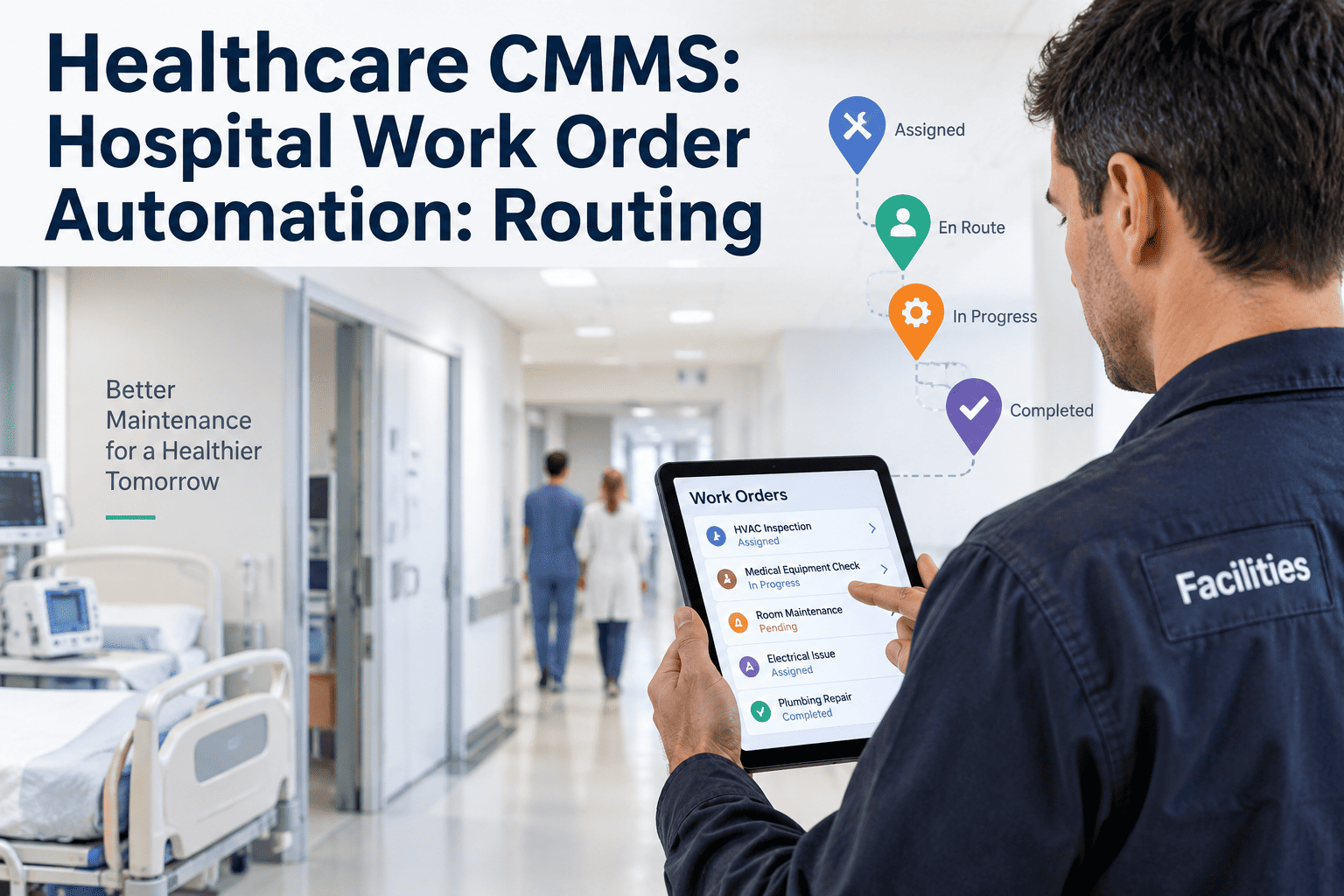
Create, assign, track, and close work orders from any device. Full technician history, parts used, labor time, and resolution notes captured on every job — building an institutional knowledge base with each completed task.
Every inspection, service event, and equipment sign-off is timestamped with digital signatures. JCI, NHS, OSHA, TGA, and HAAD inspectors get complete records instantly — no scrambling for paper files before audit day.
Connect IoT sensors across critical systems — refrigeration, HVAC, medical gas, and power infrastructure. Anomalies trigger automatic alerts and work orders before equipment failure impacts patient care.
Rolling 5–10 year capital expenditure models built from real asset condition data — not guesswork. Present board-level replacement plans with confidence. Eliminate budget surprises from aging equipment failure.
Hospital groups, NHS trusts, and multi-facility health systems manage all sites under one platform. Compare equipment health, maintenance compliance rates, and spend across every property in the portfolio.
Biomedical engineers and facility technicians receive, update, and close work orders from their phone — no paperwork, no radio-back to admin, no delays. Real-time job status visible to supervisors at all times.
Why Hospital Maintenance Fails Without CMMS
These are the operational realities facing hospitals that manage maintenance without a dedicated CMMS — and the compounding cost of doing nothing.
A single MRI machine breakdown can delay 30–40 patient appointments per day and generate $40,000–$80,000 in lost revenue per incident. Hospitals without PM scheduling average 2.3x more unplanned failures than CMMS-managed facilities.
JCI, CQC, OSHA, and TGA accreditation bodies require complete maintenance records for all life-safety and patient-contact equipment. Paper-based facilities report 62% higher rates of documentation findings during inspections — a direct accreditation risk.
Emergency repair contracts, rush-order spare parts, and overtime labor for reactive breakdowns cost 4.8x more than the same work performed on a planned schedule. Across a mid-size hospital, this adds up to $200,000–$400,000 in avoidable annual spend.
When biomedical, facilities, and IT teams maintain separate asset registers, no one has a complete picture of equipment age, condition, or upcoming capital obligations. Critical replacement decisions get made on intuition — and the wrong assets get funded while higher-risk items age past safe useful life.
How Oxmaint Solves Healthcare Facility Management
Oxmaint is designed for the operational complexity of healthcare — multi-site portfolios, compliance-driven environments, and the zero-tolerance for downtime that clinical settings demand.
Every medical device, building system, and piece of equipment enters Oxmaint's asset hierarchy: Portfolio — Property — System — Asset — Component. Each record holds manufacturer specs, condition scores, service history, and replacement timelines. Nothing operates outside visibility.
Tie PM schedules directly to asset records. Oxmaint triggers work orders by calendar, runtime, cycles, or IoT sensor data — whichever comes first. Technicians receive mobile alerts. Supervisors see completion rates in real time. Missed PMs become a thing of the past.
Requests from any ward, floor, or department route to the right technician instantly. Full job history, parts consumed, and resolution time are captured automatically — building an institutional knowledge base and eliminating the verbal-handoff gaps that cause repeat failures.
Every inspection and service event is timestamped with digital signatures. Pull complete equipment histories for JCI, CQC, OSHA, or TGA audits in minutes — not days of manual document retrieval. GMP-compliant records are always current and always accessible.
Oxmaint's rolling 5–10 year CapEx models draw from real asset condition data — not depreciation schedules or best guesses. Present board and ownership groups with investor-grade replacement plans backed by condition scores, failure frequency, and lifecycle benchmarks.
Whether you manage one hospital or a national health system, Oxmaint's portfolio dashboard gives leadership visibility across all sites in one interface. Compare maintenance compliance, asset health, and spend performance across every facility simultaneously. Ready to see it live? Start a free trial for 30 days and book a demo with our healthcare operations team.
How to Implement CMMS in a Hospital: Step-by-Step
A structured implementation roadmap reduces risk, accelerates time-to-value, and prevents the configuration errors that cause most CMMS deployments to underperform.
Map all maintenance stakeholders — biomedical engineering, facilities, IT, and clinical leadership. Define the asset scope, compliance requirements (JCI, NHS, OSHA), and priority equipment categories. Agree on KPIs: PM compliance rate, mean time to repair, and work order closure rate.
Import existing asset records — from spreadsheets, legacy CMMS exports, or paper registers — into Oxmaint's asset hierarchy. Assign condition scores to high-priority equipment. Build the asset tree from portfolio level down to component. Oxmaint's import tools handle bulk data with no heavy IT lift.
Build preventive maintenance schedules for each asset category — using manufacturer service intervals as baseline, then layering in regulatory requirements (e.g., HTM 08-01 for electrical, NHS guidance for medical devices). Oxmaint's PM templates accelerate configuration for common healthcare equipment types.
Mobile app training for technicians takes less than 2 hours with Oxmaint's guided onboarding. Supervisor and management training covers dashboard reporting, work order oversight, and compliance documentation. Most Oxmaint healthcare customers reach full operational use within 30 days of go-live — no heavy consulting fees, no 6-month deployment timelines.
Hospital Maintenance: Without CMMS vs With Oxmaint
The operational gap between unmanaged and CMMS-managed hospital facilities is measurable across every key dimension. Here is what the data shows.
| Operational Dimension | Without CMMS | With Oxmaint CMMS |
|---|---|---|
| Equipment Failure Rate | 2.3x industry average — reactive response only | 35% fewer incidents — PM-driven prevention |
| Maintenance Cost | 4.8x cost premium on emergency repairs | Planned maintenance at standard rate — consistent budgeting |
| Audit Preparation | Days of manual document retrieval — high gap risk | Complete digital records pulled in minutes — always ready |
| Work Order Visibility | Radio calls, whiteboards, paper logs — zero real-time data | Live dashboard — every job status visible instantly |
| CapEx Planning | Guesswork and depreciation schedules — budget surprises | Condition-based 5–10 year forecast — investor-grade models |
| Multi-Site Oversight | Separate systems per site — no portfolio view | Unified dashboard across all facilities — one truth |
| Technician Productivity | 30–40% time lost to admin and chasing information | Mobile-first workflow — more wrench time, less paperwork |
| Regulatory Compliance Rate | 62% report documentation findings at inspection | 72% reduction in compliance risk with digital audit trails |
The Business Case for Healthcare CMMS in 2026
Numbers that hold up in board presentations, budget reviews, and procurement conversations — drawn from real healthcare facility data.
CMMS-managed hospitals achieve measurably better equipment uptime within 12 months of deployment — directly protecting patient throughput and revenue.
Combining reduced emergency repair spend, lower food-service and supply waste, fewer compliance penalties, and improved technician utilisation across the full facility.
Most mid-size hospital CMMS implementations reach full return on investment within 12–18 months — faster in high-labor-cost markets like Australia and the UAE.
When technician notes, root cause data, and parts history are captured in CMMS, repeat failures on the same equipment drop significantly — breaking the reactive cycle permanently.
These are not theoretical numbers — they represent what happens when hospital maintenance shifts from reactive to planned, from paper to digital, and from siloed to portfolio-wide. If you want to build a business case for your board, start a free trial for 30 days and book a demo — our team will model the ROI against your facility's current data.
Healthcare CMMS: Frequently Asked Questions
Direct answers to the questions hospital administrators, biomedical engineers, and facility directors ask most before selecting a CMMS platform.
How does healthcare CMMS software differ from a generic CMMS?
Generic CMMS platforms are designed for manufacturing or commercial real estate — their compliance frameworks, asset hierarchies, and reporting structures reflect those environments. Healthcare CMMS software is built around the specific requirements of clinical settings: JCI and NHS accreditation documentation, medical device regulatory compliance (FDA, TGA, MDR), life-safety equipment prioritisation, biomedical engineering workflows, and the patient safety implications of equipment downtime. Oxmaint's healthcare module includes GMP-compliant inspection records, digital signature capture for regulatory events, and IoT integration pathways for medical-grade monitoring equipment — capabilities that generic CMMS tools do not deliver without expensive customisation.
How long does a hospital CMMS implementation typically take?
Traditional enterprise CMMS implementations in hospital settings have historically taken 6–18 months and required dedicated IT project teams and external consultants. Oxmaint is designed to deliver meaningful operational value within 30 days. The structured 8-week implementation roadmap — covering asset data migration, PM schedule configuration, and team onboarding — is managed through Oxmaint's guided setup tools with minimal IT dependency. Large hospital groups managing multiple sites may extend this timeline for phased site rollouts, but single-facility deployments consistently reach full operational use within the first month. There are no heavy implementation fees or long onboarding contracts that lock your facility in before you have seen value.
Which compliance frameworks does Oxmaint support for healthcare facilities?
Oxmaint's audit documentation and digital inspection modules are designed to support the major regulatory frameworks governing healthcare facility management across target markets. In the USA: OSHA, Joint Commission (JCI), and NFPA life-safety requirements. In the UK: CQC standards, NHS Estates technical memoranda (HTM series), and Building Safety Act obligations. In Australia: ACHS accreditation, TGA medical device requirements, and state-based work health and safety legislation. In the UAE: HAAD and DHA compliance requirements under Vision 2030 smart health initiatives. In Germany: DIN standards and MPBetreibV (Medical Devices Operator Ordinance). Timestamped digital records with digital signatures satisfy the documentation requirements across all these frameworks — meaning inspection readiness is a continuous state, not a pre-audit scramble.
Can Oxmaint integrate with our existing hospital systems and IoT infrastructure?
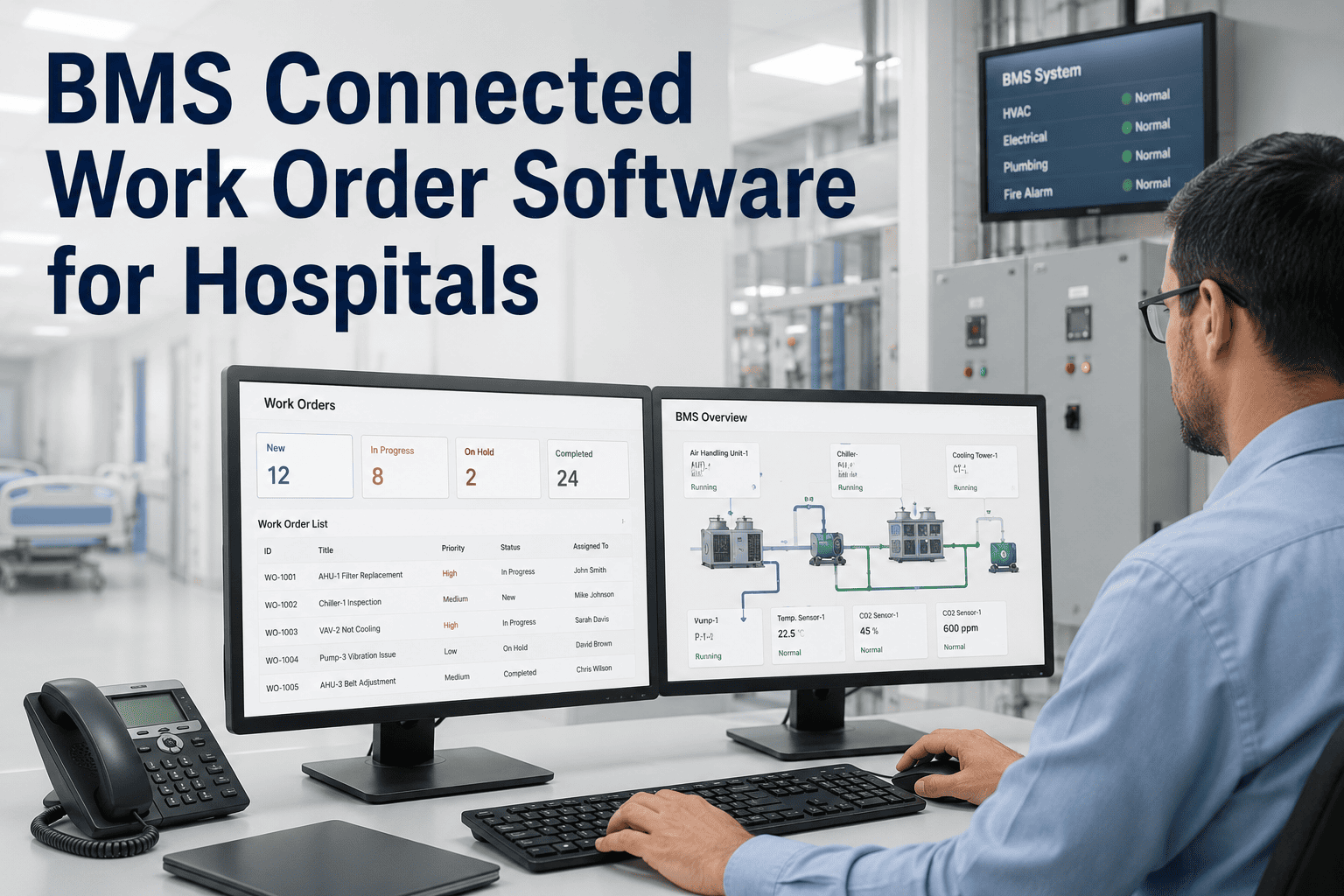
Oxmaint integrates with IoT sensors, SCADA systems, and building management systems (BMS) to pull real-time equipment data directly into the maintenance management layer. Temperature sensors on pharmaceutical refrigerators, vibration monitors on HVAC units, and runtime counters on generators all feed into Oxmaint's asset condition scoring and PM trigger logic — automatically generating work orders when thresholds are breached. For EHR and hospital information system (HIS) integration, Oxmaint supports API-based data exchange to enable coordinated asset and patient-care system workflows. The platform is mobile-first and cloud-hosted, meaning deployment does not require on-premise server infrastructure and scales without additional IT investment as your facility or portfolio grows.
Give Your Hospital the Operational Infrastructure It Deserves
Oxmaint is the CMMS platform built for healthcare facilities that need more than a work order tool — they need a complete asset management, compliance documentation, and CapEx planning system that works on day one and scales across their entire portfolio.
No heavy implementation fees. No 6-month onboarding. Full operational value within 30 days. Join hundreds of facility managers who have moved from reactive firefighting to proactive, data-driven operations.

.jpg)
.jpg)
