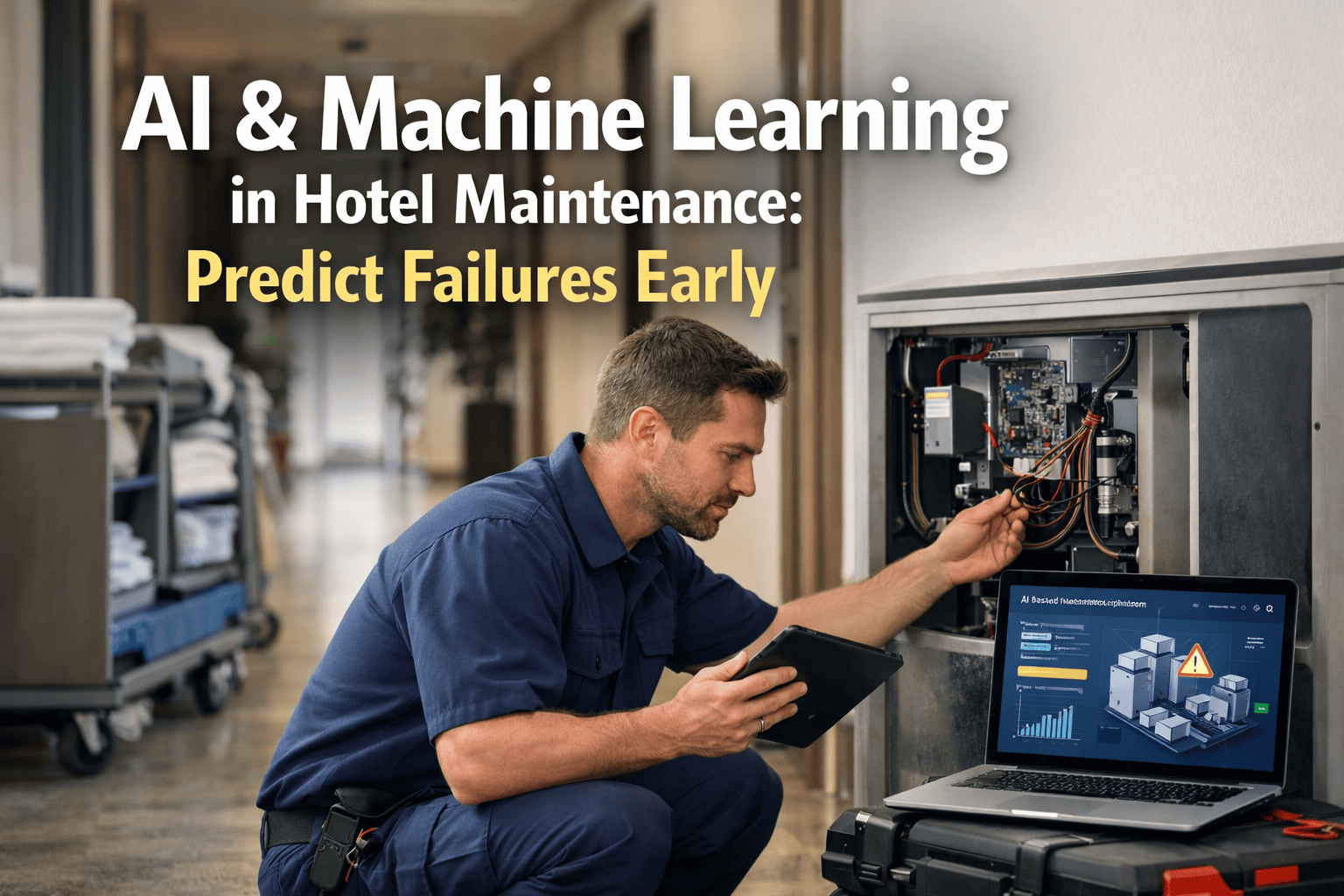
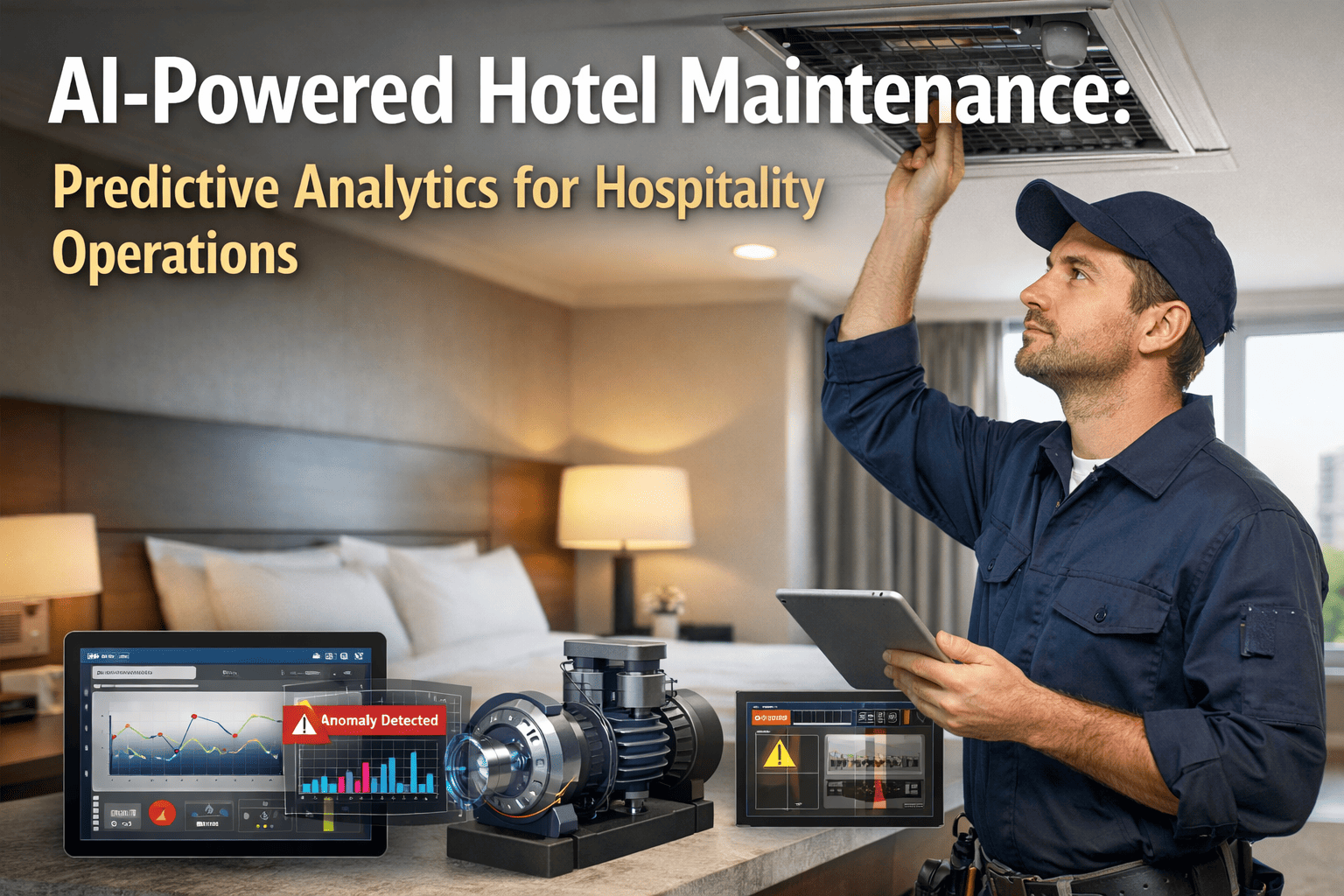
AI Powered Predictive Maintenance For Hotel Assets
By Jonathan Reed on February 5, 2026
At 2:14 AM on a Saturday in July, the primary chiller at a 340-room waterfront resort began showing subtle signs that no human could detect: compressor current draw had increased 3.2% over 11 days, condenser approach temperature had drifted 1.8°F above baseline, and vibration frequency on the bearing housing shifted from 42Hz to 47Hz. On a traditional maintenance schedule, the quarterly inspection wasn't due for six weeks. By then, the bearing would have failed catastrophically—knocking out cooling for 340 rooms during peak season, triggering $87,000 in emergency repairs, guest relocations, and lost revenue. Instead, the AI-powered predictive maintenance system flagged the anomaly pattern at day 7, auto-generated a priority work order with the specific diagnosis ("compressor bearing degradation—Stage 2 of 4"), and the $3,200 bearing replacement was completed Tuesday morning during low occupancy. Zero guest impact. Zero emergency premium. Hotels without predictive AI spend an average of $127,000 annually on preventable emergency repairs—72% of which AI systems can identify and prevent weeks before failure occurs.
The Predictive Maintenance Advantage for Hotels
How AI transforms reactive repairs into intelligent failure prevention
72%
Unplanned downtime reduction
AI catches failures weeks early
38%
Maintenance cost reduction
Scheduled vs emergency repairs
45%
Equipment lifecycle extension
Optimal maintenance timing
2-4 wk
Advance failure warning
Before any guest impact
$127K average annual emergency repair cost per hotel property—72% preventable with AI predictive maintenance
How AI Predictive Maintenance Works in Hotels
Traditional preventive maintenance follows fixed schedules—inspect the chiller every 90 days regardless of condition. AI-powered predictive maintenance continuously analyzes real-time equipment data to detect degradation patterns invisible to human observation, generating maintenance actions based on actual condition rather than calendar dates. Hotels that implement AI-driven maintenance platforms shift from "fix it when it breaks" to "fix it before anyone notices." Book a free consultation to see how AI transforms your maintenance operations.
AI Predictive Maintenance Intelligence Pipeline
From raw sensor data to automated maintenance action in real time
Data Collection
IoT Sensor Network
Vibration, temp, current, pressure
Processing
Edge Analytics
Real-time data filtering
AI Analysis
Pattern Detection
ML anomaly recognition
Prediction
Failure Forecasting
Time-to-failure estimate
Action
Auto Work Order
Scheduled repair before failure
High-Value AI Predictive Targets in Hotels
Equipment Categories with Highest Predictive ROI
Prioritized by failure cost, guest impact, and AI detection accuracy
HVAC Systems
Chillers, boilers, AHUs, RTUs
VibrationCurrentTemperaturePressure
Elevators
Motors, drives, door operators
VibrationDoor CycleMotor Load
Kitchen Equipment
Refrigeration, ovens, dishwashers
TemperatureEnergyCycle Time
Emergency Power
Generators, UPS, ATS systems
Fuel QualityBatteryLoad
Water Systems
Pumps, heaters, treatment
FlowPressureChemistry
Laundry Systems
Washers, dryers, ironers
VibrationBearingBelt Wear
AI Detection Methods & Sensor Requirements
Predictive Analytics Techniques for Hotel Equipment
1
Vibration Analysis
Bearing degradation detection
Motor imbalance identification
Pump cavitation prediction
Fan belt wear forecasting
2
Electrical Signature
Compressor current trending
Motor winding degradation
Power factor anomalies
Harmonic distortion patterns
3
Thermal Analysis
Heat exchanger fouling
Refrigerant charge drift
Insulation breakdown
Electrical connection hot spots
4
Acoustic Analysis
Leak detection in piping
Valve malfunction identification
Steam trap failure
Refrigerant leak location
5
Performance Trending
Efficiency degradation curves
Cycle time drift analysis
Energy consumption anomalies
Output capacity decline
6
Fluid Analysis
Oil contamination monitoring
Coolant chemistry trending
Water treatment effectiveness
Fuel quality degradation
AI Risk Scoring & Maintenance Priority
AI-Generated Asset Health Classification
Machine learning assigns real-time risk scores to every monitored asset
Critical Risk (Score 80-100)
Failure Imminent — Immediate Action Required
Compressor bearing Stage 3-4Auto-WO: Emergency
Motor winding insulation breakdownAuto-WO: Critical
Refrigerant charge below thresholdAuto-WO: Urgent
Generator fuel contaminationAuto-WO: Critical
AI Action: Auto-generates emergency work order, dispatches nearest qualified tech, notifies management, orders parts, blocks affected rooms if guest-impacting
Elevated Risk (Score 50-79)
Degradation Detected — Schedule Within 1-2 Weeks
Vibration trending above baselineAuto-WO: High
Current draw +5% above normalAuto-WO: Medium
Heat exchanger approach temp driftAuto-WO: Medium
Pump efficiency declining 8%+Auto-WO: Medium
AI Action: Generates scheduled work order, recommends optimal service window based on occupancy, pre-orders likely parts, assigns to appropriately skilled technician
AI Action: Increases monitoring frequency, adds to next scheduled PM for investigation, flags for technician awareness, tracks progression rate
From Data to Action: AI Predictive Workflow
How AI Converts Equipment Signals Into Maintenance Intelligence
Sensor Data
24/7 equipment monitoring
AI Engine
Pattern recognition
Risk Score
Failure probability
Auto Work Order
Diagnosis + parts + tech
Zero Downtime
Repaired before failure
-72%
Unplanned equipment downtime
+3.4
Guest satisfaction score increase
$312K
Avg annual savings (300-room property)
Expert Analysis: AI Maintenance Trends in Hospitality
"The hotels that dominate guest satisfaction in 2026 won't be the ones with the fanciest lobbies—they'll be the ones where nothing ever breaks. AI predictive maintenance is the invisible infrastructure behind that experience. When your chiller gets serviced two weeks before it would have failed, your guest in Room 412 never knows how close they came to an 82°F room. That's the magic: the best maintenance is the kind nobody ever notices because failures simply stop happening."
Digital Twin Adoption
Virtual replicas of hotel mechanical systems enable AI to simulate failure scenarios, test maintenance strategies, and predict cascade failures across interconnected building systems before they occur in reality.
Edge Computing Speed
On-property AI processors now analyze sensor data in milliseconds—enabling real-time automated responses like compressor shutdowns before catastrophic failure, without relying on cloud connectivity or internet latency.
Cross-Portfolio Learning
AI models trained on equipment data from thousands of hotels recognize failure patterns faster than single-property systems—a chiller pattern seen at Property A triggers preventive action at Properties B through Z automatically.
90-Day AI Predictive Maintenance Implementation
Deploying AI predictive maintenance doesn't require ripping out existing systems—it layers intelligence on top of current equipment through wireless sensors and cloud analytics. Most hotels achieve measurable results within 90 days using a phased approach. Start your free trial and our implementation team guides you through each phase.
Proven AI Deployment Timeline for Hotels
Days 1-30
Foundation & Sensor Deployment
Identify top-10 critical assets
Install wireless IoT sensors
Connect to AI analytics platform
Establish equipment baselines
Train engineering on dashboards
Days 31-60
AI Learning & Integration
AI models learn normal patterns
Configure alert thresholds
Integrate with CMMS work orders
Expand to 30+ monitored assets
Validate first predictions
Days 61-90
Optimization & Scale
Full property sensor coverage
Automated work order generation
Build predictive dashboards
Measure ROI vs baseline
Roll out to portfolio properties
Transform Your Hotel From Reactive to Predictive
Join forward-thinking hotel properties using OXmaint's AI-powered predictive maintenance to eliminate guest-impacting failures, reduce maintenance costs by 38%, and extend equipment lifecycles by 45%.
What equipment should hotels monitor with AI predictive maintenance first?
Start with the top-10 assets where failure causes the highest guest impact and cost: central HVAC chillers and boilers (failure affects entire property), elevators (guest experience and ADA compliance), emergency generators (life safety), kitchen walk-in refrigeration (food safety and spoilage cost), fire pumps (life safety compliance), domestic hot water systems (guest complaints), pool equipment (amenity closure), laundry tunnel washers (operational disruption), cooling towers (Legionella risk), and building automation controllers (system-wide impact). These assets typically account for 80% of emergency repair costs. Wireless sensors install on each unit in minutes with no wiring required. Schedule a consultation to identify your property's highest-ROI predictive targets.
How accurate is AI at predicting hotel equipment failures?
Modern AI predictive maintenance systems achieve 85-92% accuracy for detecting developing equipment failures 2-4 weeks before they occur. Accuracy improves over time as the AI model learns each specific asset's normal operating patterns—by month 3, most systems exceed 90% true-positive rates for critical failure modes like bearing degradation, refrigerant leaks, and motor winding breakdown. False-positive rates are typically under 8%, meaning the vast majority of AI-generated alerts represent genuine developing issues. The systems are most accurate for rotating equipment (compressors, pumps, motors) where vibration and electrical signature analysis provide clear degradation signals.
What does AI predictive maintenance cost for a hotel?
A comprehensive AI predictive maintenance deployment for a 250-room hotel typically costs $25,000-$50,000 in the first year including wireless sensors ($75-$250 per asset), gateway infrastructure ($2,000-$5,000), AI analytics platform subscription ($500-$1,500/month), and implementation support. Annual recurring costs are $15,000-$25,000 for platform and sensor maintenance. Against average annual savings of $200,000-$350,000 through prevented emergency repairs, extended equipment life, energy optimization, and guest satisfaction improvement, the typical ROI is 400-700% with payback in 3-6 months. Start a free trial to begin monitoring your critical assets immediately.
Can AI predictive maintenance work with existing hotel equipment?
Yes—AI predictive maintenance layers on top of existing equipment regardless of age, brand, or type. Wireless sensors attach externally to compressors, motors, pumps, and piping without any modification to the equipment itself. Installation takes 10-30 minutes per asset with adhesive mounting—no wiring, no downtime, no equipment modification required. The AI platform connects to existing BMS/BAS systems via standard protocols to incorporate operational data alongside sensor readings. Even equipment from the 1990s can be monitored effectively because the AI analyzes physical parameters (vibration, temperature, electrical signatures) that all mechanical equipment produces regardless of vintage or manufacturer.
How does AI predictive maintenance differ from regular preventive maintenance?
Preventive maintenance follows fixed calendar schedules—inspect the chiller every 90 days whether it needs it or not. This results in two problems: unnecessary maintenance on healthy equipment (wasting labor and parts) and missed failures between scheduled inspections. AI predictive maintenance continuously monitors actual equipment condition and triggers maintenance only when degradation is detected—meaning healthy equipment runs undisturbed while developing problems are caught weeks before failure regardless of calendar schedules. The result: 38% lower maintenance costs (eliminating unnecessary PM tasks), 72% fewer unplanned failures (catching issues between scheduled inspections), and 45% longer equipment lifecycles (optimal maintenance timing instead of over-servicing or under-servicing).
Stop Waiting for Equipment to Fail—Start Predicting
See how OXmaint's AI-powered platform detects equipment degradation weeks before failure, auto-generates work orders with specific diagnoses, and delivers measurable ROI within 90 days.