.png)
Guestroom HVAC compliance and indoor air quality is the operational obligation that touches every room release decision, every guest check-in, and every energy consumption profile in hospitality-driven operations — and in 2026, it is enforced with a precision that manual paper log audits could never achieve. Refrigerant consumption data uploads to environmental compliance dashboards, EPA Section 608 violations for improper venting are automatically flagged, and properties accumulating delayed filter change citations watch their TripAdvisor and guest satisfaction scores deteriorate to critical thresholds faster than at any point in the program's history. A single EPA Clean Air Act violation for improper refrigerant management carries a civil penalty of up to $55,808 per offense per day. A pattern of deferred maintenance that elevates your Legionella risk or mold spore count above acceptable thresholds triggers targeted corporate investigations that can pull key inventory from operation for weeks. The operational challenge is that HVAC compliance is not just an engineering responsibility — it is a guest safety and financial function. Chillers operated without regard to strict preventive schedules will generate massive capital replacements regardless of ownership intent. Real-time HVAC compliance monitoring in OxMaint closes this gap by surfacing each asset's current runtime availability, flagging developing mechanical drift before a compressor fails, and integrating PM data directly into dispatch decisions so no assignment is missed on a unit that is legally required to be inspected.
Hotel HVAC Maintenance Log Template: The Complete EPA Compliance & Asset Strategy Guide
Download the professional engineering metrics framework designed for resort Operations Managers and Chief Engineers. Track filter changes, coil cleanings, refrigerant levels, and motor amp draws with real-time operational visibility.
The Core HVAC Rules: Every Limit Operations Managers Must Know
HVAC maintenance regulations for commercial properties operate as a set of simultaneous constraints — not a single checklist. An engineering team must satisfy all applicable limits at the same time, and violating any one of them while complying with the others still exposes the property to liability. The most common compliance gap is not ignorance of the quarterly filter change — most technicians know that rule. The gap is in the overlapping constraints: properties that reach the 5-year chiller overhaul window while still missing weekly cooling tower chemical logs, dispatchers who assign a route that requires a technician to exceed their available shift hours, and carriers who miss the 30-day refrigerant leak rate check because they track cumulative runtime imprecisely.
Bridging the Gap Between Engineering Execution and Energy Yield
In complex resort environments, HVAC systems account for up to 60% of the entire property's energy consumption. When engineering departments operate in silos, managing their workflows via fragmented spreadsheets or manual whiteboards, Operations Managers only discover maintenance inefficiencies when they manifest as massive utility bill spikes, elevated CapEx replacement requests, or lost room nights. Establishing a standardized, digital HVAC logging system bridges this gap. By measuring and reporting on critical velocity and compliance metrics, management can identify failing compressors, optimize cooling staging, and justify CapEx funding with empirical data rather than anecdotal complaints.
Integrating these metrics into a comprehensive inspection report amplifies this visibility, tying maintenance performance directly to asset lifecycles. When a Chief Engineer can instantly prove to ownership that a specific PTAC unit is drawing 40% more amps than its baseline, securing funding for a replacement becomes a data-driven formality.
CMMS Mandate: How Digital Logging Changes Enforcement
The shift to digital CMMS platforms transformed HVAC enforcement from a paper audit exercise into a near-real-time data system. Where paper log violations required a skilled inspector to detect discrepancies between log entries, chemical receipts, and work orders, digital data is machine-readable — every motor amp draw, every filter swap, every refrigerant addition is timestamped and uploaded automatically. Properties that maintained marginal compliance under paper logs are now accumulating citations for violations that would previously have gone undetected. OxMaint's integrated compliance monitoring reads the same data stream that corporate auditors access — surfacing violations in the hotel's own system before they reach a QA inspection report.
HVAC Violation Prevention: How to Stop Failures Before They Happen
HVAC failure prevention is fundamentally a dispatch planning problem, not a technician behavior problem. The failures that generate the most guest impact — catastrophic chiller shutdowns and widespread room AC failures — are almost always predictable from the dispatch assignment itself. A dispatcher who assigns a critical cooling tower cleaning to a technician who lacks the proper chemical safety certification has created the conditions for a violation before the work begins. Real-time CMMS monitoring converts this from a reactive violation discovery into a proactive dispatch gate: the system shows exactly which PMs are legally required, and flags any assignment that would require the asset to exceed its maximum operational threshold.
The Financial Mathematics of Deferred HVAC Maintenance
When a property delays preventive maintenance on its cooling infrastructure, the financial damage is not immediately obvious in the CapEx budget; it bleeds out slowly through the monthly utility bill. To understand this, Operations Managers must look at the thermodynamics of heat transfer. A commercial HVAC condenser coil relies on unrestricted airflow to reject heat drawn from the guestrooms. When this coil becomes coated with just 0.042 inches of dirt, dust, and environmental grime, the unit's heat transfer efficiency drops by 21%. To compensate for this thermal resistance, the compressor must run longer cycles, consume more amperage, and operate at higher head pressures to achieve the thermostat's setpoint.
In a 400-key property operating primarily on PTAC (Packaged Terminal Air Conditioner) units, this subtle efficiency drop scales into a massive financial liability. If each PTAC draws an average of 1,200 watts and runs for an estimated 10 hours a day during the cooling season, a 21% efficiency penalty translates directly to a 21% increase in kilowatt-hour (kWh) consumption. At a blended commercial rate of $0.14 per kWh, that single microscopic layer of grime across 400 units will generate an additional $12,700 in pure energy waste over a 90-day summer season. A robust digital KPI dashboard tracks this energy drift, alerting engineering directors to schedule chemical coil cleanings precisely when the energy penalty begins to exceed the labor cost of the maintenance.
Indoor Air Quality (IAQ): The Silent Killer of Guest Satisfaction
Post-2020, guest awareness of Indoor Air Quality (IAQ) has fundamentally shifted. A guestroom is no longer judged solely on the firmness of the mattress or the speed of the Wi-Fi; it is judged heavily on the olfactory experience and the ambient humidity upon entering. Musty odors, stagnant air, and excessive humidity are universally cited in 1-star TripAdvisor reviews. These symptoms are almost entirely the result of deferred HVAC maintenance—specifically, clogged condensate drain pans, fouled evaporator coils, and saturated primary filters.
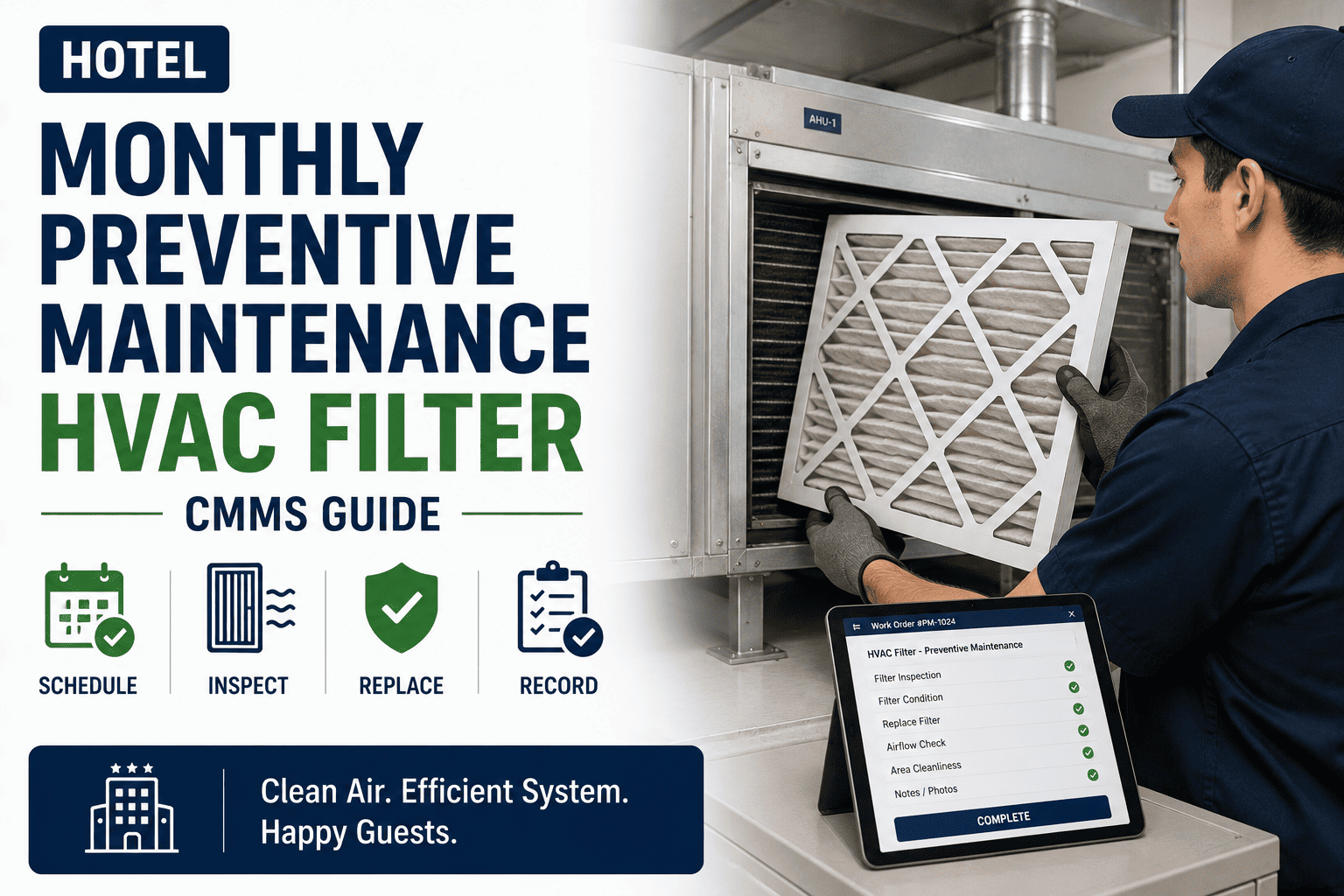
When a PTAC filter becomes saturated, airflow across the evaporator coil drops. This causes the coil temperature to plummet below the dew point, resulting in excessive condensation. If the drain pan is partially clogged with biological growth (slime), this condensation pools, creating the perfect breeding ground for mold spores and odor-causing bacteria. Every time the fan cycles on, these spores are blasted directly into the guestroom. Relying on paper logs makes it impossible to guarantee that every single room's filter and pan are treated on a strict 30-day cycle. A digital CMMS forces accountability, requiring technicians to physically scan a QR code on the unit and upload a photo of the clean drain pan before the PM can be closed. This guarantees that your property's IAQ remains a competitive advantage rather than a reputational hazard.
When you run a 600-key resort in Texas, HVAC is your entire guest experience. Moving from paper binders to OxMaint's digital HVAC logging completely eliminated our deferred maintenance backlog. We cut our guest room AC complaints by 75% in the first summer, and our EPA logs are flawless and audit-ready at all times.
Frequently Asked Questions
Skipping this cycle restricts airflow, increases energy consumption by up to 15%, and drastically shortens compressor life.
Failure to log this data digitally exposes the property to massive daily fines and potential facility shutdowns.
This predictive approach allows you to replace a $200 motor during normal hours rather than paying emergency overtime rates.
Forcing a mandatory photo upload in the CMMS ensures the coil is actually chemically cleaned, guaranteeing heat transfer efficiency.
The system allows bulk-uploading of your asset list via CSV, mapping your existing routines to QR codes in minutes.
If a critical life-safety or EPA check is missed, the system ensures management knows immediately.
It proves you are actively maintaining fresh air intake dampers and filtering particulates to protect guest and staff health.
This allows Operations Managers to test the mobile app with their engineering team completely risk-free.