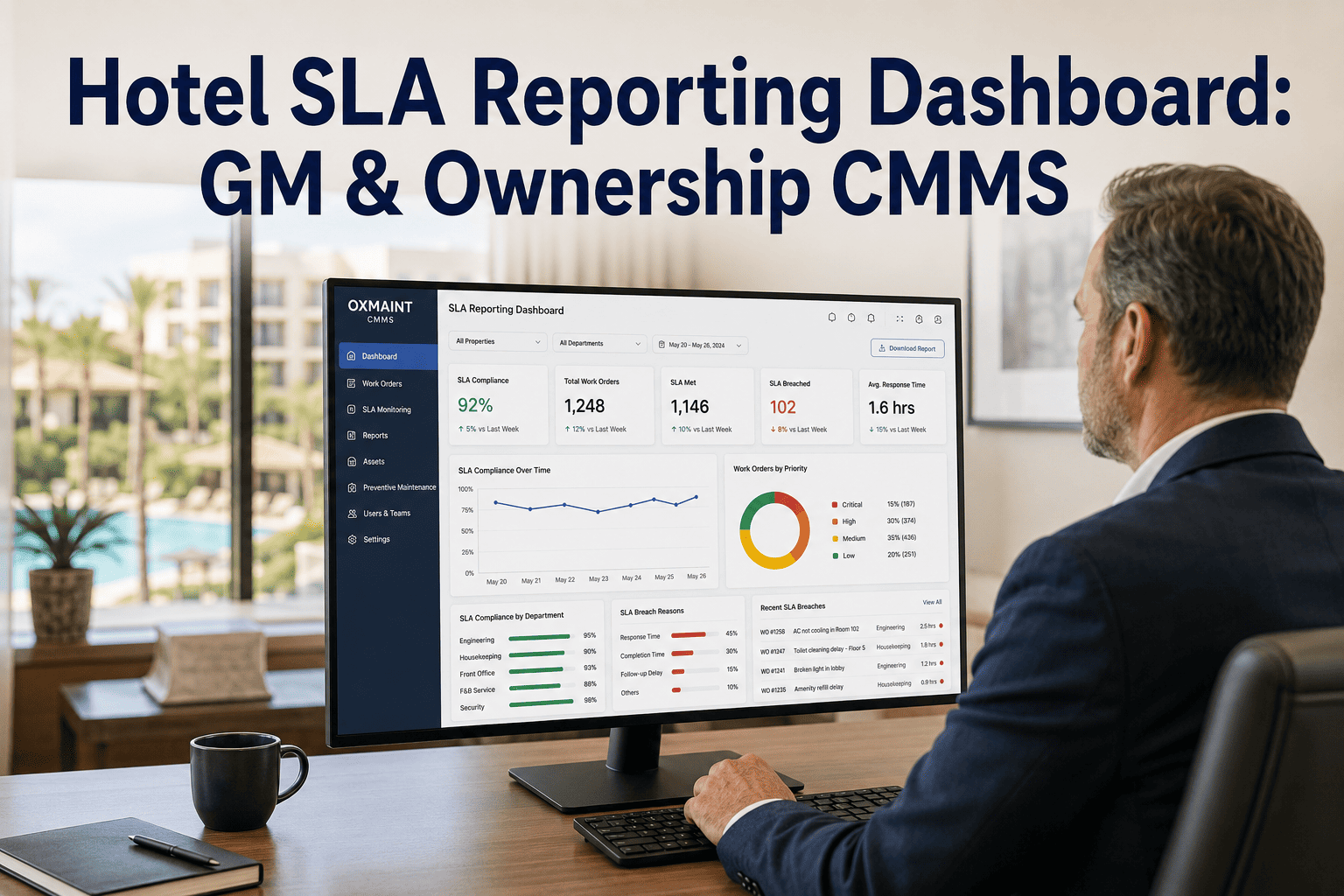
Guestroom physical compliance is the operational obligation that touches every room release decision, every guest check-in, and every preventative window in hospitality-driven operations — and in 2026, it is enforced with a precision that manual paper log audits could never achieve. Room check uploads to the hotel property management system (PMS) within 24 hours of every guest check-out ensure out-of-service alerts are automatically flagged, and properties accumulating delayed maintenance citations watch their TripAdvisor and guest satisfaction scores deteriorate to critical thresholds faster than at any point in the program's history. A single ADA violation or unresolved safety hazard in a guestroom carries a civil penalty of up to $75,000 per offense. A pattern of room release delays that elevates your guest out-of-service room rate above the 5% threshold triggers targeted corporate investigations that can pull key inventory from operation for weeks. The operational challenge is that room maintenance is not just a technician responsibility — it is a front desk coordination function. Rooms assigned without regard to outstanding corrective work orders will generate guest complaints regardless of housekeeping intent. Real-time room status monitoring in OxMaint closes this gap by surfacing each room's current maintenance availability, flagging developing mechanical drift before it occurs, and integrating engineering logs directly into PMS room release decisions so no assignment is made against a room that cannot legally or comfortably support a guest. By coupling live tracking with a structured maintenance schedule, properties stop reacting to breakdowns and start preventing them. Book a demo to align your engineering scorecards with operational realities.
Hotel Maintenance KPI Dashboard Template: Streamline Engineering Scorecards for General Managers
Download the professional engineering metrics framework designed for resort General Managers and Finance Directors. Track MTTR, PM compliance, work order backlogs, and RevPAR leakage with real-time operational visibility.
Bridging the Gap Between Engineering Execution and Financial Yield
In complex resort environments, engineering departments often operate in silos, managing their workflows via fragmented spreadsheets or manual whiteboards. This lack of transparency means General Managers and Finance Directors only discover maintenance inefficiencies when they manifest as negative online reviews, elevated CapEx replacement requests, or lost room nights. Establishing a standardized KPI dashboard bridges this gap. By measuring and reporting on critical velocity and compliance metrics, management can identify labor bottlenecks, optimize inventory staging, and justify staffing levels with empirical data rather than anecdotal complaints.
Integrating these velocity metrics into a dynamic asset register amplifies this visibility, tying maintenance performance directly to asset lifecycles. When a Chief Engineer can instantly prove to ownership that a specific chiller unit accounts for 30% of the entire department's repair hours, securing CapEx funding for a replacement becomes a data-driven formality rather than an uphill battle.
The Anatomy of a High-Yield Hotel Engineering Scorecard
Static spreadsheets provide a historical snapshot of engineering costs, but they fail to measure the *velocity* and *quality* of the work being performed. When a sudden influx of guest requests overwhelms a skeletal maintenance crew, a static budget doesn't reveal the soaring MTTR or the plummeting PM compliance rate. A digital KPI dashboard acts as a real-time operational pulse monitor. It translates raw work order data into actionable intelligence, enabling General Managers to preemptively address resource constraints before they impact guest satisfaction scores or violate brand standards. Leveraging an automated work order ticketing system feeds pure, timestamped data directly into this dashboard without administrative friction.
The 4 Core Maintenance KPIs Every GM Must Track
Effective facilities management requires focusing on metrics that drive operational outcomes. While hundreds of data points can be tracked, these four core KPIs provide a comprehensive view of an engineering department's efficiency, effectiveness, and impact on property revenue. Monitoring these indicators ensures that maintenance is acting as a value protector rather than a cost center. Without these baselines, properties bleed RevPAR silently through deferred compliance and escalating emergency repair rates.
Deep Dive: The Financial Cost of Ignored KPIs in Hospitality
When a hotel operates without a rigorous KPI framework, the financial leakages are immediate but often invisible on a standard P&L statement until the end of the fiscal year. Consider a 300-key property operating at 75% occupancy with an Average Daily Rate (ADR) of $180. If an inefficient maintenance process allows the Out-of-Service (OOS) rate to creep from a healthy 1.5% up to 4.5% due to delayed plumbing and HVAC repairs, the property is essentially removing 9 saleable rooms from its inventory every single night.
Over a 365-day operational year, that 3% increase in OOS inventory translates to 3,285 lost room nights. At the $180 ADR, the property hemorrhages $591,300 in unrecoverable top-line revenue. This calculation doesn't even account for the secondary damage: the cost of guest compensation (comped meals, discounted rates) for rooms that were sold but suffered mid-stay failures because the PM Compliance rate dropped below 60%. A digital CMMS dashboard acts as an early warning radar for these exact scenarios, flagging the rising MTTR and dropping PM completion rates weeks before they permanently impact RevPAR.
A Chief Engineer's Playbook: Deploying a Digital KPI Dashboard in 30 Days
Transitioning our engineering team to OxMaint's digital KPI dashboard revolutionized our morning stand-ups. We finally have real-time visibility into our MTTR and PM compliance, allowing us to accurately stage inventory and reduce our out-of-service rooms by 40% during peak season.
Frequently Asked Questions
Live tracking allows management to identify and fix dispatch bottlenecks before they affect the guest experience.
A backlog shorter than 1 week indicates overstaffing, while anything over 4 weeks signals a need for contract support.
Preventing these massive failures keeps room blocks available for sale, protecting the property's revenue generating potential.
This ensures front desk agents are immediately notified when a room is cleared by engineering and ready for check-in.
Tracking this rate helps justify CapEx spending to replace aging assets that repeatedly take rooms offline.
This frictionless process ensures high adoption rates and generates highly accurate velocity data for management dashboards.
This provides verifiable, timestamped proof-of-work that helps properties achieve high scores during QA inspections.
This allows General Managers to evaluate the dashboard's impact on their engineering operations risk-free.