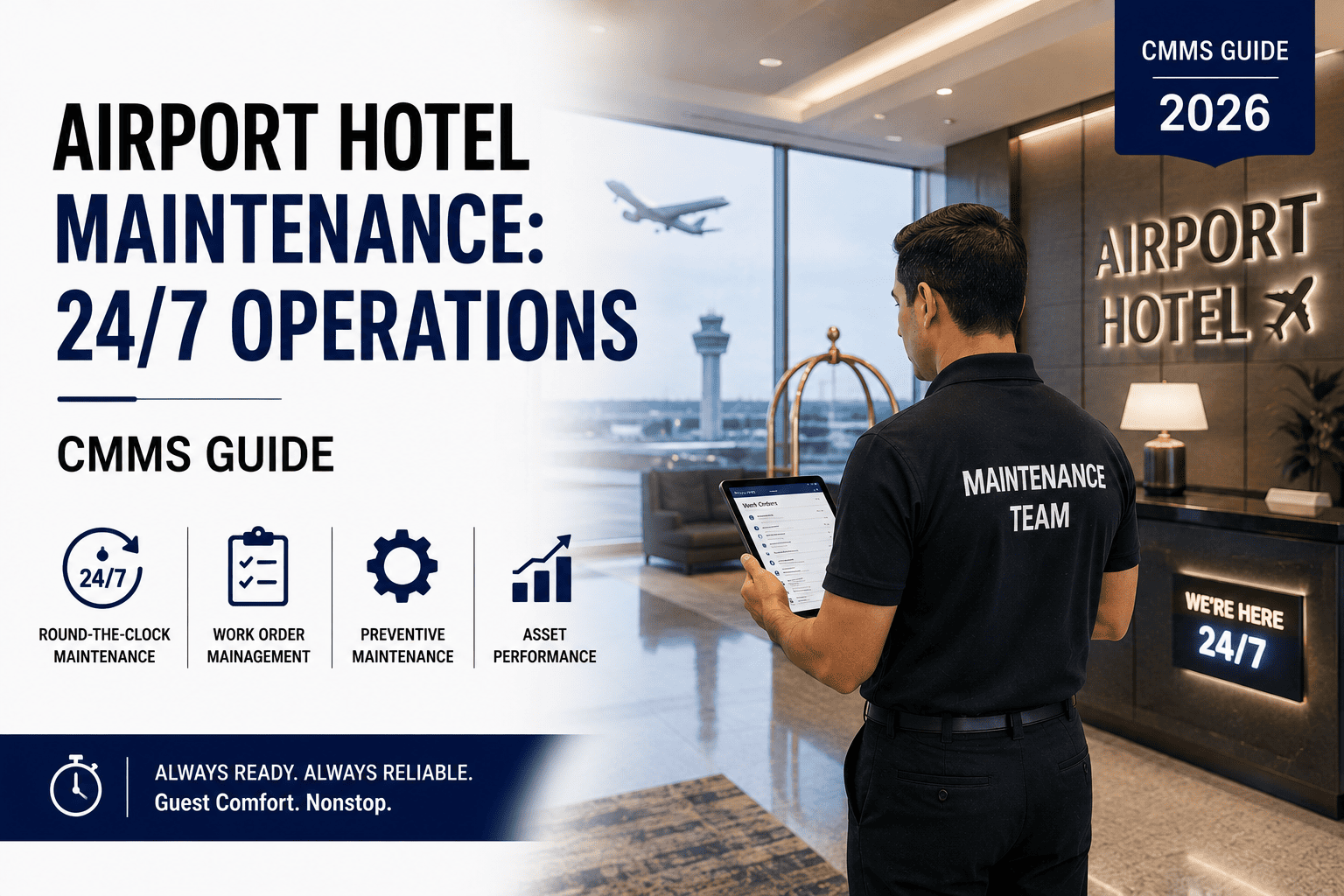
Airport hotel maintenance demands a fundamentally different approach from a standard property: because these hotels run 24/7 with continuous occupancy and a high turnover rate, every HVAC unit, elevator, and guest-room asset sees significantly more wear per week than a typical hotel sees in a month. A purpose-built CMMS for airport hotel operations is no longer optional in 2026 — it is the only way to intensify preventive maintenance cadence, manage high-use assets, and coordinate work around the clock without disturbing sleeping guests. This guide walks through the operational intensity of airport hotels and shows how OxMaint's AI-powered EAM platform converts that complexity into measurable uptime, cost savings, and guest satisfaction. You can explore the platform yourself when you Start Free Trial or keep reading for the full framework.
Can your maintenance team keep pace with a property that never sleeps?
Airport hotels face continuous 24/7 occupancy and some of the highest turnover rates in hospitality. Without a CMMS built for that intensity, reactive repairs spiral, guest complaints rise, and asset lifespans collapse. OxMaint changes the math.
Why 24/7 Operations CMMS Is Essential for Airport Hotels
A 250-key airport hotel with 80% occupancy and a 1.4-night average stay turns over roughly 140 rooms every single day — double the churn of a downtown business hotel.
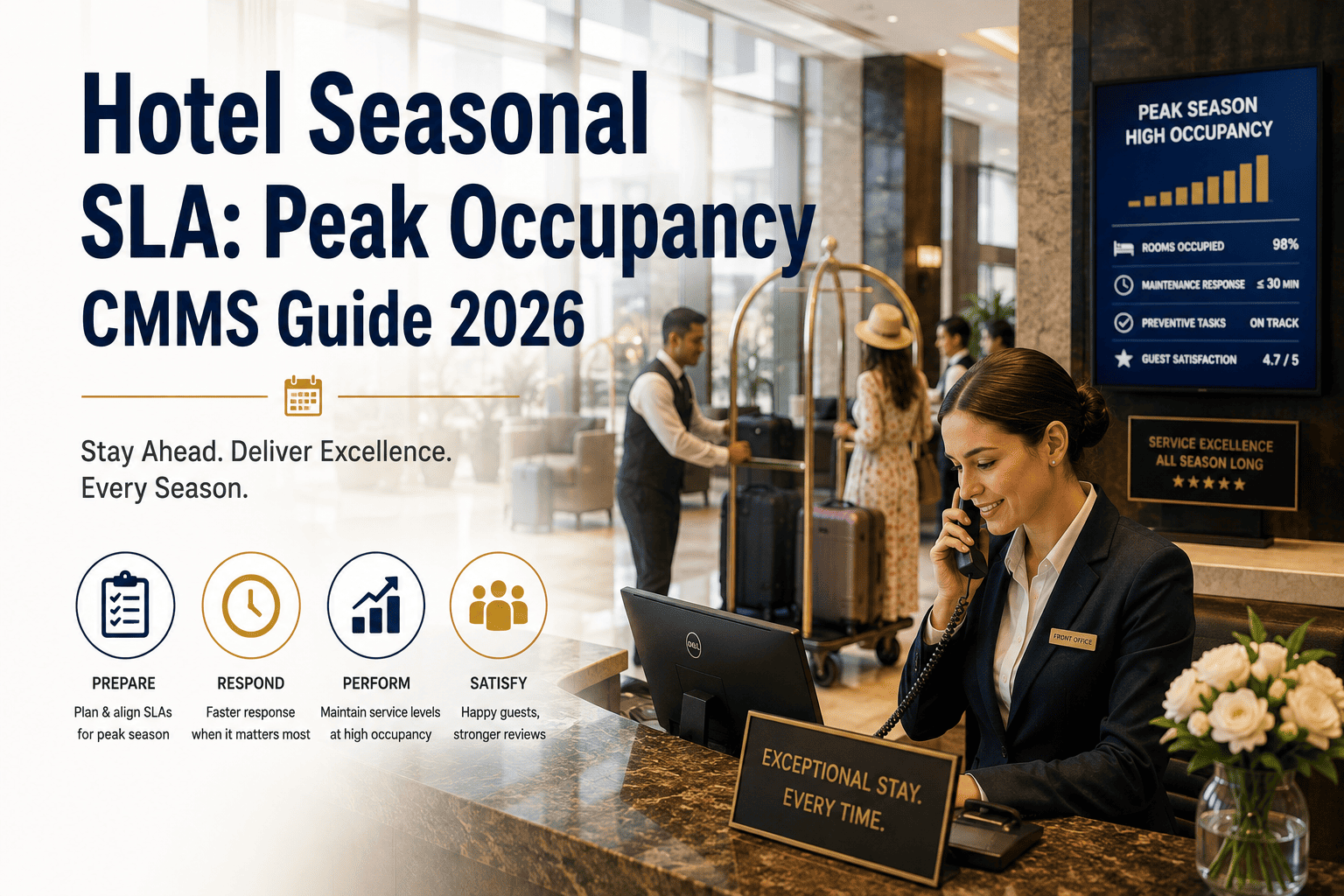
The core problem is not a lack of effort — it is a lack of scheduling intelligence. When a maintenance team relies on spreadsheets or a legacy work-order system, they cannot dynamically prioritize tasks around live check-in data, flight delays, or noise-restricted hours. A continuous occupancy hotel CMMS solves this by syncing preventive maintenance (PM) triggers with real-time front-desk status, ensuring technicians enter rooms only when they are vacant and completing work before the next guest arrives. OxMaint's AI-powered scheduling engine does this automatically, cutting idle time and eliminating the "fire-drill" culture that burns out airport maintenance teams.
How to Manage High-Use Assets in a High Turnover Rate Hotel
An airport hotel's PTAC units, ice machines, and elevators accumulate run-hours 2.5–3.5x faster than comparable assets in a leisure property — your PM cadence must reflect that reality.
Asset Audit & Criticality Tagging
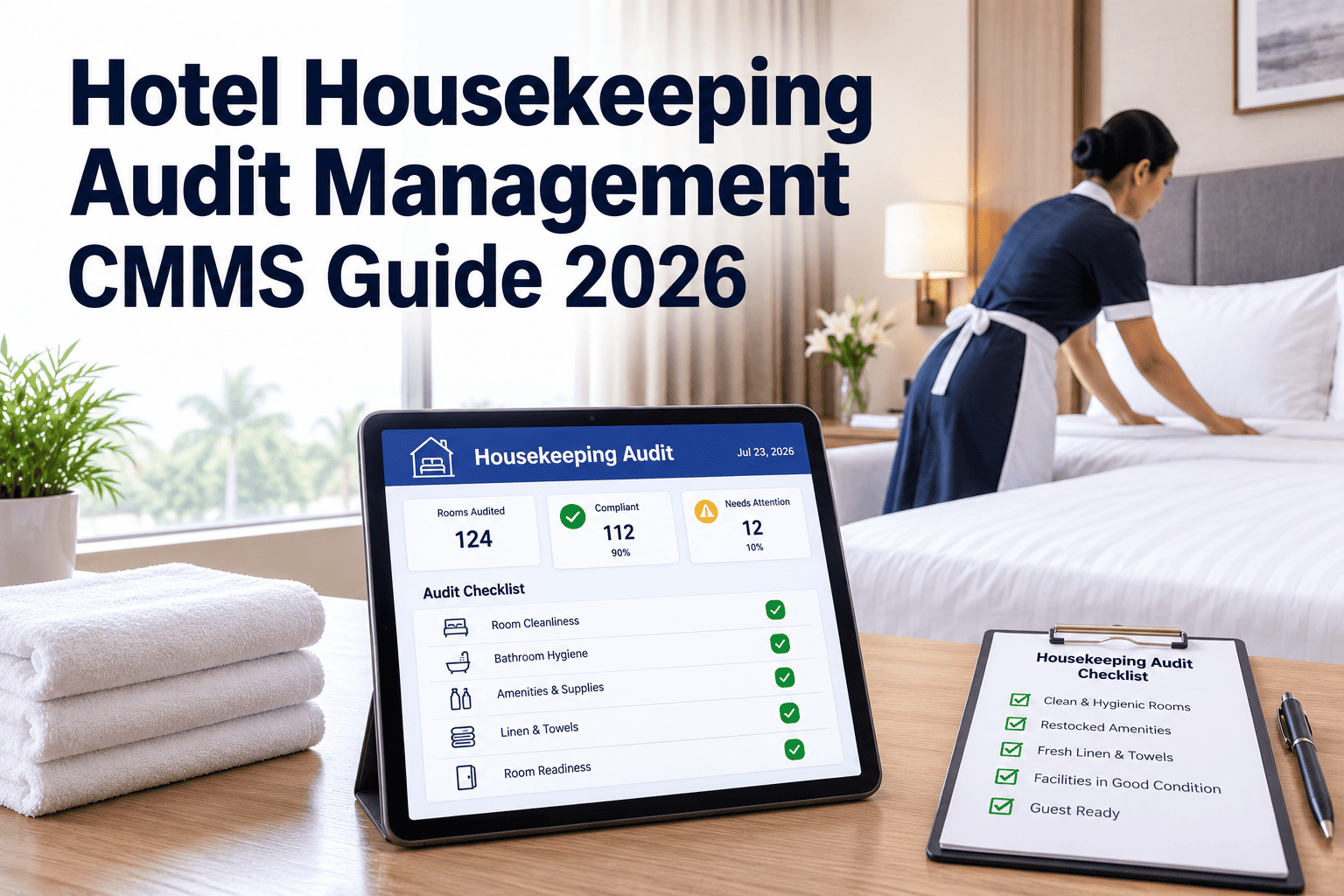
Barcode or QR-tag every asset above 1 HP. Assign a criticality score (A/B/C) based on guest impact and redundancy. OxMaint's mobile app lets technicians scan and tag 200+ assets in a single shift, importing them directly into your EAM hierarchy.
Intensified PM Schedule Setup
Compress standard OEM intervals by 40% for Class-A assets. A quarterly filter change becomes monthly; a semi-annual belt inspection becomes quarterly. OxMaint auto-generates the work orders and assigns them based on technician availability and room vacancy.
Predictive Maintenance Layer
Install IoT vibration and temperature sensors on rooftop RTUs and laundry equipment. OxMaint's AI analyzes the data stream, predicts bearing failures 7–14 days out, and converts the alert into a scheduled work order — not an emergency call.
Continuous Optimization & KPI Tracking
Review MTBF, MTTR, and PM compliance rates weekly. OxMaint's analytics dashboard flags drift — if elevator downtime rises above 0.5% of available hours, the system recommends an unscheduled inspection before a guest gets trapped.
Silent Service: Scheduling Maintenance Around Continuous Occupancy
Airport guests sleep at odd hours. A compressor swap at 2 PM can be as disruptive as one at 2 AM — which is why your CMMS must filter work orders by noise level and proximity to occupied rooms.
Without a CMMS
- Technicians knock on occupied doors for routine filter changes.
- Loud repairs scheduled during afternoon nap windows for red-eye passengers.
- No visibility into which rooms are vacant — work orders guessed at.
- Guest noise complaints average 12–18 per month at a 250-key property.
With OxMaint CMMS
- Work orders auto-gated by live PMS integration — only vacant rooms queued.
- Loud tasks (compressors, drill work) auto-blocked 10 PM – 9 AM local time.
- Technicians see a real-time vacant-room map on their mobile device.
- Noise complaints drop 70–85% within the first 90 days of deployment.
The ROI of an Airport Hotel Maintenance CMMS
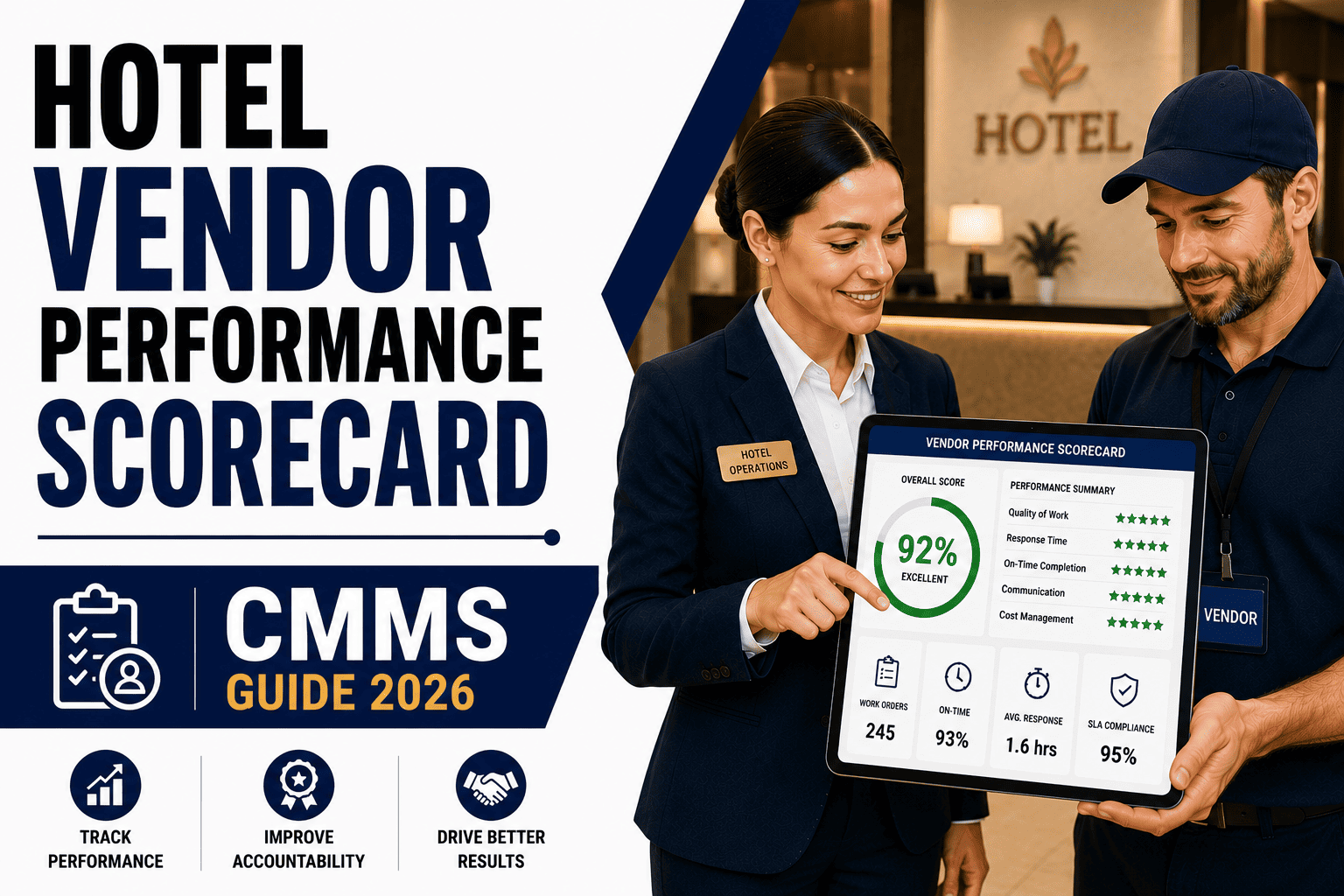
A 250-key airport hotel spending $185K annually on maintenance labor and parts typically recovers the full cost of an OxMaint subscription within the first 11 weeks of deployment.
Cutting emergency call-outs by 60% through predictive PM saves roughly 960 technician hours per year.
Intensified PM extends RTU and elevator life by 3–5 years, deferring $180K+ in capex replacement costs.
A 70% drop in maintenance-related complaints preserves online review scores and protects corporate rate contracts.
| Metric | Spreadsheet / Reactive | OxMaint CMMS (Month 6) | Improvement |
|---|---|---|---|
| PM Compliance Rate | 52% | 94% | +42 pts |
| Mean Time to Repair (MTTR) | 18.2 hrs | 4.5 hrs | -75% |
| Unplanned Downtime (assets) | 11.3% | 3.1% | -73% |
| Maintenance-Related Complaints | 15 / month | 4 / month | -73% |
| Spare Parts Inventory Carry | $34K | $19K | -44% |
See OxMaint on your assets — book a 30-minute demo
Walk through a live airport hotel maintenance scenario: from guest-noise-gated work orders to AI-driven failure predictions. See exactly how your team cuts reactive repairs by 60% in the first quarter.
How OxMaint Solves Airport Hotel Maintenance Challenges
OxMaint was built for assets that never stop running. Four capabilities map directly to the operational intensity of a 24/7 airport property:
PMS-Integrated Work Order Scheduling
OxMaint integrates with major hotel PMS platforms to sync room status in real time. Work orders for PM tasks are only released to the mobile queue when a room is marked "vacant/inspected," eliminating guest-facing disruptions entirely.
AI-Powered Predictive Maintenance
Machine-learning models analyze vibration, temperature, and current-draw data from your rooftop units and elevators, predicting failures 7–14 days before they occur and auto-creating priority work orders for the engineering team.
Spare-Parts Inventory Auto-Replenishment
When a technician closes a work order and logs parts consumed, OxMaint decrements inventory and triggers a reorder at your defined min-stock threshold — no manual stock counts, no overnight parts shortage that delays a repair.
Audit-Ready Compliance & Analytics
Every work order, inspection, and parts transaction is timestamped and geo-tagged. Generate ISO 55000-aligned reports, fire-safety inspection logs, and health-department documentation in one click — no more scrambling before a brand audit.
A 250-Key Airport Hotel: From Reactive Chaos to Predictive Control
The Baseline
A 250-key property near a major international hub operated on paper logs and a shared Google Sheet. The 6-person maintenance team handled 310 work orders per month — 68% of them reactive. Elevator downtime averaged 14 hours per month, and the hotel carried $34K in spare parts "just in case." Guest review scores had slipped from 4.4 to 4.1 over 18 months, and the GM was under pressure from the brand.
After 6 Months on OxMaint
The team deployed OxMaint, QR-tagged 380 assets, and set up noise-gated PM schedules synced to the PMS. By month 6, reactive work orders dropped to 22% of total volume, MTTR fell from 18 hours to 4.5, and the parts inventory was trimmed to $19K with zero stockouts. The property's review score recovered to 4.4, and the avoided capex from extended asset life was projected at $92K over three years.
"We stopped fighting fires and started preventing them. OxMaint gave us the scheduling intelligence to maintain a 24/7 property without ever knocking on a guest's door at the wrong time."
Airport Hotel Maintenance CMMS: Top Questions
What makes airport hotel maintenance different from a regular hotel?
Airport hotels operate with continuous 24/7 occupancy and a high turnover rate — often 1.4-night average stays versus 3+ nights at leisure properties. Assets accumulate run-hours 2.5–3.5x faster, guests sleep at irregular hours due to red-eye flights, and there is no "quiet season" to catch up on deferred maintenance. This intensity requires a CMMS with real-time room-status integration, noise-gated scheduling, and a compressed preventive maintenance cadence that a standard hotel PMS or spreadsheet simply cannot handle.
How does a CMMS handle maintenance during continuous hotel occupancy?
A continuous occupancy hotel CMMS like OxMaint integrates directly with the property management system to pull live room status. Work orders for preventive maintenance are only released to the technician's mobile queue when a room is marked vacant and inspected. Loud tasks — compressor swaps, drilling, generator tests — are automatically blocked during noise-restricted hours. This ensures maintenance happens without disturbing guests, eliminating the primary source of complaints at airport properties. You can see this in action when you Book a Demo.
How long does it take to implement a CMMS in an airport hotel?
A typical 200–300 key airport hotel can go live on OxMaint in 4–6 weeks. Weeks 1–2 cover asset tagging and hierarchy import; weeks 3–4 set up PM schedules, spare-parts min/max levels, and PMS integration; weeks 5–6 train the team and run a parallel period. Because OxMaint is cloud-based and mobile-first, there is no on-premise server installation, and technicians can start scanning QR codes and closing work orders on day one of go-live.
What is the typical ROI and payback period for an airport hotel CMMS?
Most airport hotels recover the full annual subscription cost of OxMaint within 8–12 weeks of deployment. The savings come from three sources: a 60% reduction in reactive labor (typically $40K–$55K/year for a 250-key property), deferred capex from extended asset life ($30K–$45K/year), and preserved revenue from fewer guest complaints and higher review scores. A detailed savings breakdown is available when you Start Free Trial and run the ROI calculator with your own numbers.
Can OxMaint integrate with our existing hotel PMS and accounting software?
Yes. OxMaint offers native integrations with major hotel PMS platforms including Opera, Mews, Cloudbeds, and RoomMaster, as well as accounting systems like Sage Intacct and QuickBooks. The PMS integration enables real-time room-status gating for work orders, while the accounting sync ensures parts purchases and labor costs flow directly into the right GL codes — no manual double-entry. API access is available for properties with custom or legacy systems.
Stop reacting. Start predicting. Transform your airport hotel maintenance today.
Join the airport properties using OxMaint to cut unplanned downtime by 50%, eliminate paper work orders, and deliver a silent-service guest experience — 24 hours a day, 7 days a week.
Free 14-day trial · No credit card