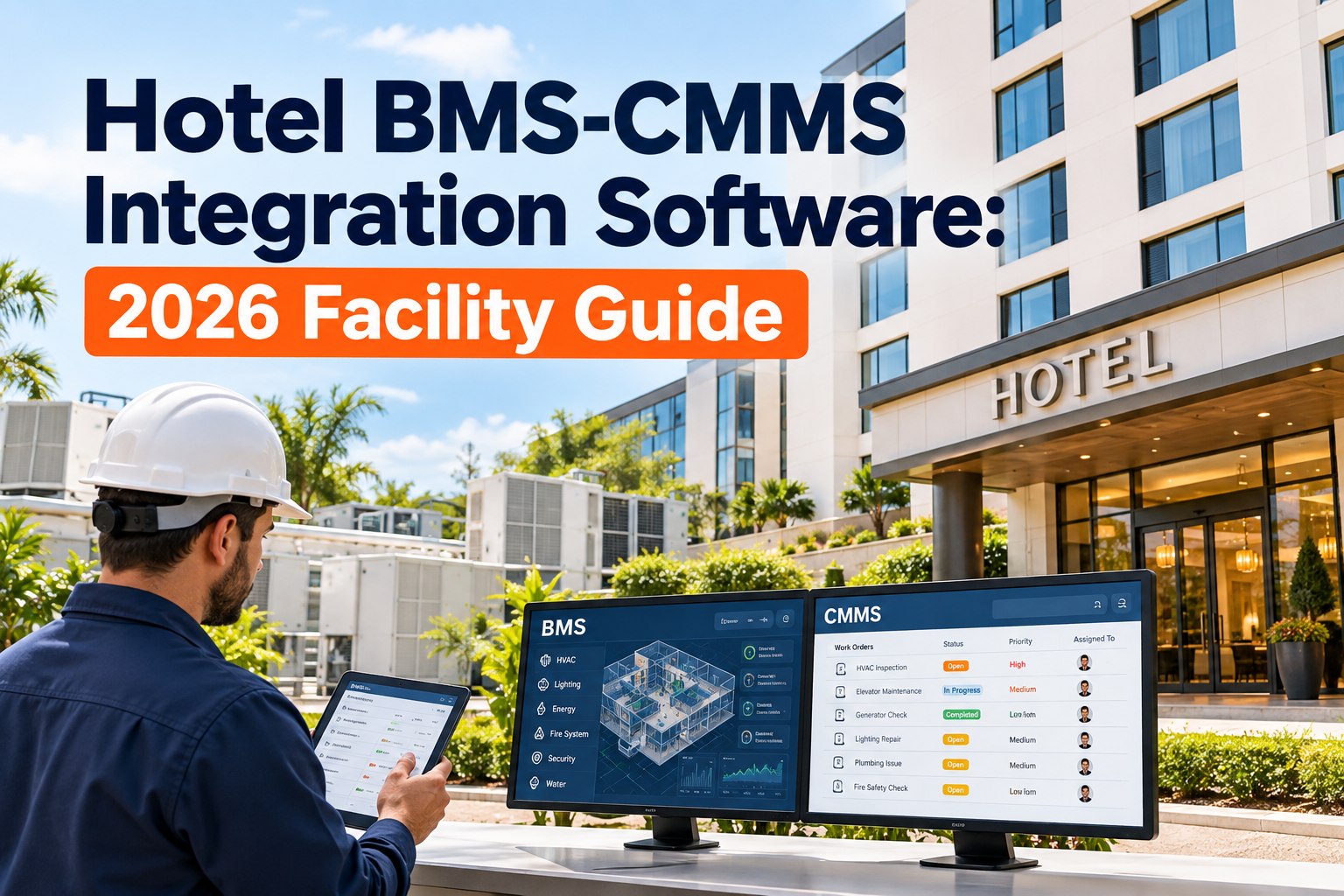
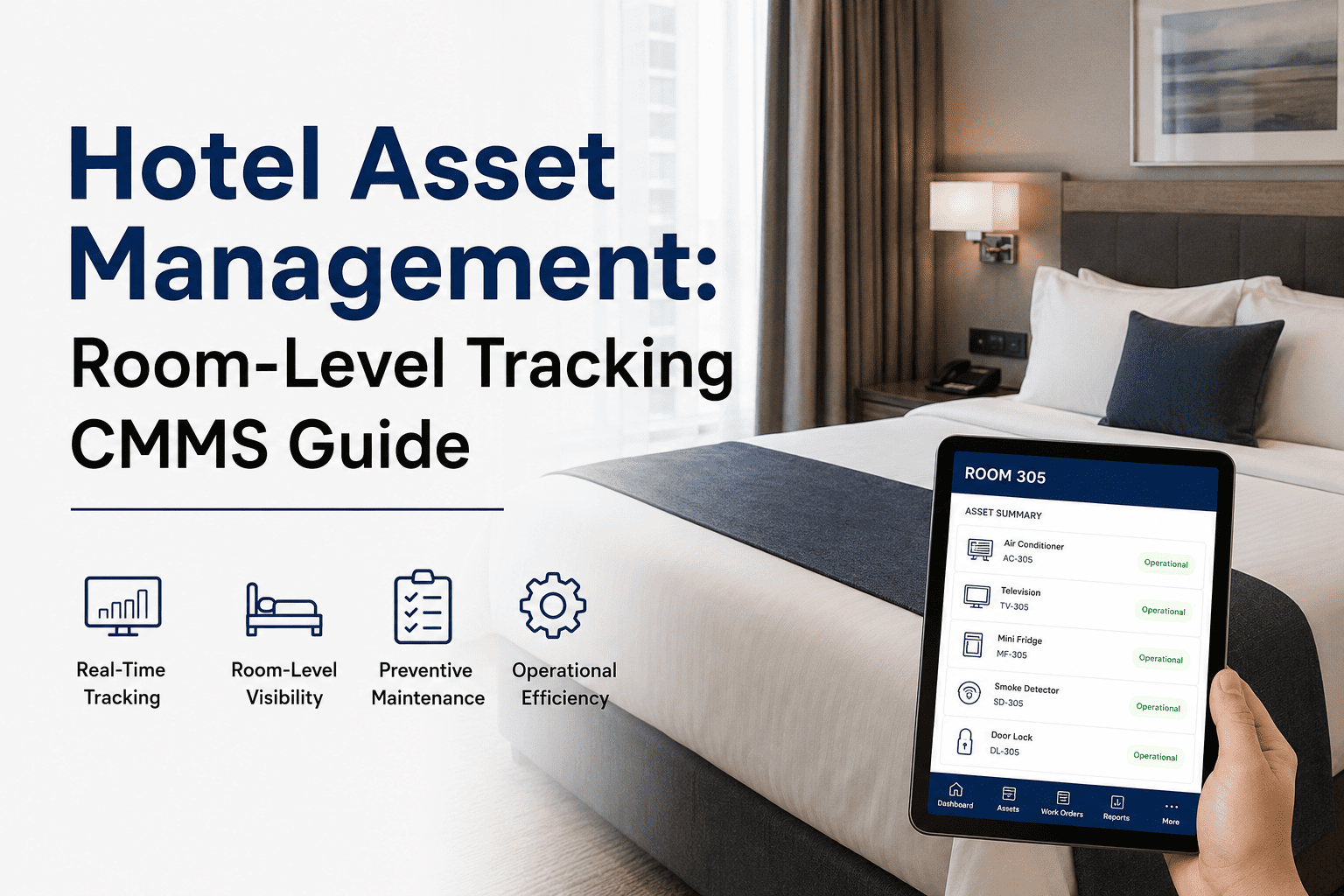
A general manager at a 340-room resort received a question from her ownership group that she could not answer: "What was your HVAC maintenance spend per room last year?" She had the invoices somewhere. She had the work orders in a binder. She had the vendor receipts in a folder. But pulling a single, verified number with asset attribution, labor breakdown, and month-by-month trend — that took three days and still produced a number nobody fully trusted. A CMMS would have answered that question in thirty seconds. For hospitality operations, a CMMS is not a cost — it is the operational infrastructure that makes every other management decision more accurate, faster, and defensible. Sign up free on OxMaint or book a demo to see the full hospitality CMMS platform in action.
Hospitality CMMS Guide
CMMS for Hospitality: Asset Tracking, Maintenance, and Operations
The complete platform guide for hotel engineering teams, facility managers, and hospitality operators
Asset Tracking
Work Orders
PM Scheduling
Compliance
Analytics
97%
PM completion rate with CMMS vs. 41% on paper
6.2x
ROI in year one for hospitality CMMS deployments
68%
Fewer repeat maintenance incidents in year one
12 min
To generate a full compliance report vs. 3 days manually
What This Guide Covers
01What CMMS Does for Hotels
02Asset Tracking Deep Dive
03Work Order Management
04Preventive Maintenance
05Operational Visibility
06Choosing the Right CMMS
Chapter 01
What a CMMS Actually Does for Hotel Operations
A CMMS — Computerized Maintenance Management System — is the operational platform that connects every maintenance task, every asset, every technician, and every compliance record in one searchable, reportable system. For hotels, it replaces the fragmented combination of paper logs, spreadsheets, email chains, and verbal handovers that most engineering teams currently use to manage a property worth tens of millions of dollars.
From Fragmented to Connected: What CMMS Replaces
Every tool on the left still exists at most hotels — all of them are replaced by one platform
Current State — Most Hotels
With CMMS — One Platform
Digital work orders with full asset history and photo documentation
Automated PM schedules with 97% tracked completion rate
Mobile dispatch with skill-based routing and SLA timers
Vendor portal with shared asset history and digital service records
Compliance report export in 12 minutes — brand audit ready always
Replace five disconnected tools with one hospitality CMMS
OxMaint consolidates paper logs, PM calendars, radio dispatch, vendor emails, and compliance binders into one digital platform — live in 30 days, no disruption to active operations.
Sign up free and start your first digital shift today.
Chapter 02
Asset Tracking: Every Asset, Every Location, Every History
Asset tracking is the operational foundation of hospitality CMMS. Without knowing what assets you have, where they are, what condition they are in, and what has been done to them, every other maintenance decision is made with incomplete information. A CMMS asset register is the difference between "I think we have four chillers" and "I know we have four chillers, here is their service history, their PM schedules, their warranty status, and their repair cost trend over the last three years." Sign up to start building your hotel asset register in OxMaint today.
Hotel Asset Tracking: What the CMMS Captures Per Asset
From first registration through the full service life — every data point that drives better maintenance decisions
Asset Identity
Name, category, location, make, model, serial number, install date, QR/barcode tag, warranty expiry
Operational Context
Criticality level, PM schedule link, service vendor, replacement cost, linked room or zone, documentation files
Service History
Every completed work order, parts replaced, technician notes, before/after photos, inspection records
Analytics Layer
Failure frequency, repair cost trend, health score, MTBF, failure probability curve, capital replacement forecast
Asset Register Coverage — Full-Service Hotel
180–420
HVAC Units
FCUs, PTACs, AHUs, chillers, cooling towers, RTUs
60–140
Plumbing Assets
Water heaters, pumps, backflow preventers, pool equipment
40–90
Life Safety
Generators, UPS, fire panels, elevators, suppression systems
80–200
Kitchen and Laundry
Commercial ranges, walk-in refrigeration, washers, dryers
Chapter 03
Work Order Management: From Complaint to Completion in One System
Work order management is where a CMMS delivers its most immediate operational value. Every maintenance request — guest complaint, PM trigger, safety inspection, or engineering observation — travels through the same digital lifecycle: created, classified, assigned, executed, and closed with a timestamped, photo-documented record. The result is accountability that paper dispatch and radio calls can never produce. Book a demo to see OxMaint's work order lifecycle configured for your property.
Work Order Sources and Routing — Hotel CMMS
Every maintenance request enters one queue — regardless of source department
Unified Work Order Queue
Critical — HVAC Room 814 (SLA: 15 min)
High — Walk-in cooler temp alert
Standard — PM filter replacement Floor 9
Routine — Common area fixture repair
Skill-Based Assignment
Tech A — HVAC Certified
Room 814 HVAC
Tech B — Refrigeration
Walk-in Cooler
Tech C — General
PM Filters + Fixture
Every maintenance request tracked from first report to verified completion
OxMaint's work order system captures every request in a unified digital queue, routes it by skill level and urgency, and closes it with photo documentation — creating the accountability trail that radio calls and paper logs never could.
Book a demo to see the routing configuration for your property type.
Chapter 04
Preventive Maintenance: From 41% Completion to 97%
The difference between 41% and 97% PM completion is not effort — it is system. Paper-based PM programs fail because they rely on human memory, manual scheduling, and informal accountability. Digital PM programs succeed because every task is automatically assigned, tracked, escalated if overdue, and closed with a verification record. The 56-point gap between those two completion rates is precisely where hotel equipment failures are born.
PM Program Comparison: Paper vs. Digital CMMS
Across six dimensions that determine whether your PM program actually prevents failures
Task Creation
Manual calendar entry — missed during busy periods
Auto-generated from schedule — never missed regardless of occupancy
Assignment
Verbal — whoever is available, regardless of skill
Digital routing by skill level, shift, and current workload
Overdue Handling
Nobody knows — task silently disappears
Auto-escalation to chief engineer with age-of-deferral visible
Completion Proof
Paper checkmark — no verification, no photo
Digital sign-off with timestamp and mandatory photo documentation
Compliance Record
Binder entry — gaps, illegible, lost at audit time
Searchable digital archive — exported in 12 minutes for any auditor
Chapter 05
Operational Visibility: Reporting That Drives Decisions
Operational visibility is the strategic layer that separates a CMMS from a digital work order tool. When every maintenance action is captured digitally, the accumulated data becomes the evidence base for every capital decision, budget request, staffing argument, and brand compliance conversation. Sign up free to access OxMaint's full analytics and reporting dashboard from your first week of operation.
Four Reporting Views — What Each One Tells You
Each view answers questions that paper-based operations can never answer
Live Operations Dashboard
Answers: Where is every open task right now, which are approaching SLA breach, and which technician has capacity?
Open work orders by priority
SLA compliance rate
Technician utilization
Asset Health Summary
Answers: Which assets have the highest failure frequency, what is the repair cost trend per asset, and which need capital replacement planning?
Repair cost per asset
Failure frequency
Health score trend
PM Completion Report
Answers: What percentage of scheduled PM tasks were completed on time, which categories are falling short, and what is the trend over the last quarter?
PM rate by category
Overdue task age
Quarter-over-quarter trend
Compliance Export Report
Answers: What maintenance was performed on each asset, in what period, by which technician — with timestamps, photos, and test records for brand auditors and insurance carriers?
Complete audit trail
Safety device records
Export in 12 minutes
Chapter 06
Choosing the Right CMMS: Ten Questions to Ask Before You Commit
Not all CMMS platforms are built for hospitality operations. A system designed for manufacturing or facility management will require years of customization to handle the multi-department, 24/7, guest-facing complexity of hotel maintenance. The ten questions below surface the critical differences between a generic work order tool and a hospitality-ready CMMS. Book a demo to see how OxMaint answers every question below.
CMMS Evaluation Checklist for Hospitality Operations
Ask these questions of every platform before making a selection decision
Q1
Is the mobile interface designed for field technicians — not office staff using a phone?
Technicians who find the interface cumbersome will revert to paper within two weeks. Mobile-first means offline capable, one-tap work order creation, photo attachment from the job site, and QR code scan for asset lookup.
Q2
Can all hotel departments — front desk, housekeeping, engineering, F&B — submit requests in one system?
A CMMS that serves only engineering still requires the phone calls, radio relays, and email chains between departments that create duplicate dispatch and missed handovers.
Q3
Does the platform include pre-built hospitality PM templates for HVAC, life safety, boilers, and pool systems?
Building PM schedules from scratch for 400+ assets takes months. Hospitality-specific templates should be usable on day one, with customization available for property-specific configurations.
Q4
Does it generate compliance reports in the format that brand auditors, insurance carriers, and regulators require?
A CMMS that stores data but cannot format it for external review fails at the exact moment compliance documentation is most needed — during an audit or after an incident.
Q5
Does the system support a vendor portal so external contractors receive work orders, access asset history, and submit service records digitally?
External vendors are responsible for 40-60% of hotel maintenance work. A CMMS that cannot include them in the accountability chain leaves the majority of maintenance activity undocumented.
Q6
Does the platform scale to multi-property portfolios with portfolio-level dashboards and property-level autonomy?
Properties grow into portfolios. A CMMS that requires separate deployments per property with no shared data structure will create a fragmentation problem that costs more to resolve than starting with a scalable platform.
Q7
How long is the implementation timeline, and does the vendor provide hospitality-specific onboarding support?
A hospitality CMMS should be operationally live within 30-45 days for a full-service hotel. Any platform requiring longer than 90 days before first digital work orders are running is not built for hospitality pace.
Q8
Does the pricing model include unlimited users, or does per-seat pricing make full team adoption cost-prohibitive?
Per-user pricing that limits deployment to engineering staff defeats the cross-department visibility that produces the highest operational value. Full adoption requires all departments to access the system without billing surprises.
OxMaint answers yes to every question above
Mobile-first, multi-department, hospitality PM templates, compliance export, vendor portal, multi-property support, 30-day go-live, and transparent pricing — purpose-built for hospitality operations teams.
Sign up free and see every capability in a live environment today.
Frequently Asked Questions
How long does CMMS implementation take for a hotel?
Most full-service hotels are running live digital work orders within 14 days and fully operational within 30-45 days using OxMaint's hospitality onboarding process. The key phases are asset inventory registration (3-5 days via mobile bulk entry or spreadsheet import), PM template configuration using hospitality-specific presets (2-3 days), and technician mobile training (2-4 hours per person). The speed advantage of hospitality-focused platforms versus generic CMMS is significant — generic platforms often require 6-12 months of customization before go-live, while a hospitality-ready system uses preconfigured templates and workflows that match the operational reality of hotel engineering from day one.
What is the ROI of CMMS for a hotel — and how quickly does it appear?
CMMS ROI for hotel operations typically reaches 6x in the first year across five benefit streams: emergency repair reduction (55% fewer emergency events at 2.4x standard labor rate), technician productivity gain (40% of admin time recaptured per shift), asset lifespan extension (30-year vs. 15-year HVAC lifespan), guest satisfaction protection (fewer maintenance-related complaints and room blocks), and compliance cost reduction (audit prep from 3 days to 15 minutes). For a 280-room full-service hotel, conservative estimates across all five streams produce approximately $140,000 in annual value against a platform cost of approximately $7,800 per year. The fastest-appearing returns — emergency repair reduction and technician productivity — are visible within 30-60 days of deployment.
Can a CMMS help with brand standard compliance and audits?
Yes — this is one of the highest-value use cases for hospitality CMMS deployment. Brand standard audits for major hotel flags require documented PM records for HVAC, life safety, pool systems, and kitchen equipment covering the prior 12-24 months. OxMaint captures every task completion with technician attribution, timestamp, photo documentation, and notes — automatically building the audit trail that properties previously had to assemble manually over several days. When an auditor requests records, the compliance export is produced in 12 minutes. Properties using OxMaint report going from multi-day audit preparation scrambles to same-day report generation, with significant improvement in audit scores on the first cycle after deployment.
Does a small hotel with limited staff need a CMMS?
Hotels with as few as one to two engineering staff and 80 rooms produce measurable CMMS ROI within 12 months. The threshold is not team size — it is asset value and compliance exposure. Any property with a chiller, boiler, elevator, or pool system has HVAC asset replacement value above $200,000 and compliance requirements that paper cannot satisfy consistently. For small properties, the most compelling ROI drivers are compliance documentation (a single brand audit citation can cost more than a year of subscription fees) and the elimination of institutional knowledge risk — when the sole engineer leaves or gets sick, a CMMS preserves every asset history, PM schedule, and vendor contact in a system that the next person can access immediately.
Start Today — No Credit Card Required
Your hotel has hundreds of assets, thousands of maintenance tasks, and one chance to manage them right
OxMaint gives hospitality teams asset tracking, work order management, PM automation, compliance documentation, and analytics in one mobile-first platform — going live in 30 days without disrupting active operations. From 80-room limited service to 1,200-room resort, start free and see your first digital maintenance report within 48 hours.