By 2030, the average hotel will run its entire maintenance operation with fewer engineers, fewer breakdowns, and lower costs than it does today — not because staffing got cut, but because AI, digital twins, and autonomous facility management will handle the detection, scheduling, and dispatch work that currently consumes 60% of an engineering team's day. The hotels investing in smart building infrastructure now are building a compounding advantage that will be very difficult to close in 2028. Book a demo to see how OxMaint is building toward this future today.
The Future of Hotel Maintenance: AI, Smart Buildings, Digital Twins and Autonomous Facility Management by 2030
Five forces will reshape hotel maintenance from a reactive cost centre into a predictive advantage. This guide maps the timeline, the technology, and OxMaint's position on each.
Five technology forces reshaping hotel maintenance by 2030. What each looks like in practice. Where hotels should invest first. How OxMaint's roadmap aligns. Regional compliance implications. Implementation priorities for 2026.
Five Forces Reshaping Hotel Maintenance by 2030
AI detects equipment degradation 4–8 weeks before guest impact — work orders generated autonomously, technicians arrive with diagnosis already done.
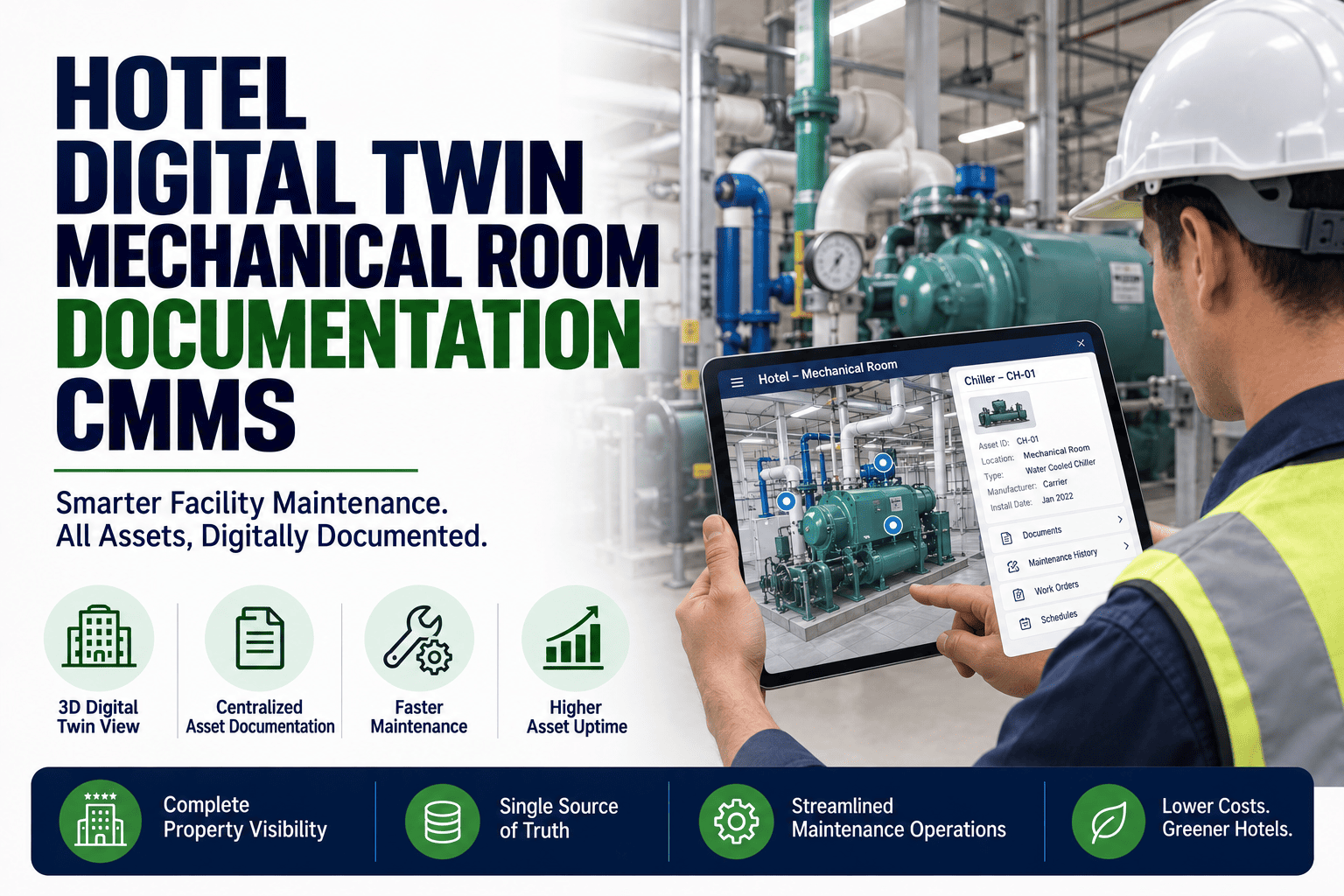
A virtual replica of the hotel's physical systems — updated in real time from sensor feeds — lets teams simulate interventions and model failure scenarios without touching the physical asset.
By 2028, the system detects the fault, raises the work order, schedules the intervention, and orders the part — with a human approving at key decision points, not driving every step.
Dense IoT sensor networks — occupancy, temperature, energy, vibration, water flow — feed a continuous real-time asset health picture that replaces scheduled inspections for most routine checks.
By 2030, sustainability performance directly affects hotel valuation and classification. Maintenance teams will own carbon accounting, embodied carbon in parts decisions, and energy optimisation as a core KPI.
The Hotels Building This Capability in 2026 Will Be Impossible to Catch in 2029
Every month of structured data in OxMaint makes the AI more accurate and the savings larger. Starting now compounds over time.
Technology Readiness: What's Available Now vs. What's Coming
| Technology | Availability | OxMaint Status | Expected ROI Window |
|---|---|---|---|
| AI failure prediction | Available Now | Live — all properties | 6–12 months |
| Autonomous work order dispatch | Available Now | Live — all properties | Immediate |
| IoT sensor integration and BMS API | Available Now | Live — all properties | 4–8 weeks |
| ESG and carbon reporting | Available Now | Live — all properties | First billing cycle |
| Digital twin data pipeline | 2026–2027 | In development | 12–24 months post-launch |
| Autonomous parts ordering | 2027 | Roadmap — Phase 3 | 18–30 months post-launch |
| Contractor autonomous briefing and access | 2028 | Roadmap — Phase 4 | 24–36 months post-launch |
| Self-managing building systems | 2029–2030 | Research phase | Depends on deployment |
What Smart Building Infrastructure Looks Like in 2030
Every HVAC unit, elevator, and pump logs its own health data directly to the maintenance platform — no manual reading required for routine status checks.
Building systems optimise their own set-points based on occupancy, weather, and energy prices — maintenance records updated automatically as parameters drift from design spec.
AI predicts which parts will be needed 30–60 days ahead — triggering purchase orders automatically so critical spares are on-site before the work order is raised.
Technicians wearing AR glasses see asset schematics, fault history, and repair guidance overlaid on physical equipment — eliminating documentation lookup and reducing repair time.
Every maintenance decision scored by carbon impact in real time — engineering teams optimise for cost and carbon simultaneously without separate reporting tools.
Maintenance data linked directly to guest satisfaction scores — AI identifies which asset failures correlate with negative reviews and prioritises PM investment accordingly.
OxMaint Is Building This Future — and You Can Start Capturing Value Today
The AI, IoT, and autonomous work order features in OxMaint now are the foundation every 2028 capability builds on. Start accumulating data and experience today.
Regional Compliance — How Regulations Are Evolving to 2030
| Region | Current Frameworks | 2026–2030 Direction | OxMaint Readiness |
|---|---|---|---|
| USA / Canada | NFPA 101, OSHA, ADA, ENERGY STAR, local benchmarking laws | NYC LL97 carbon penalties expanding to more cities. SEC climate disclosure rules requiring building-level emissions data. ENERGY STAR tightening hotel benchmarks annually. | Carbon tracking, ESG export, and ENERGY STAR-aligned reporting live now. Compliance record automation ready for expanding city-level benchmarking requirements. |
| UK | Fire Safety Order, L8 Legionella, HHSRS, SECR, F-Gas, TM44 | SECR carbon reporting thresholds lowering to capture more hotel operators. EPC minimum ratings rising. F-Gas phase-down accelerating refrigerant management requirements. | SECR-compatible carbon reporting, F-Gas refrigerant log per asset, and EPC evidence documentation all live. System ready for tightening threshold requirements. |
| Australia | NCC, AS 1851, WHS Act, NABERS, NGER | NABERS mandatory disclosure expanding to more hotel categories. Safeguard Mechanism reforms tightening emissions baselines. State-level building efficiency standards rising. | NABERS-aligned energy data export, NGER reporting, and Safeguard Mechanism baseline tracking available. Ready for mandatory disclosure expansion. |
| Germany / EU | GEG, EU EED, EPBD recast, BetrSichV, VDI 6022, EU Taxonomy | EPBD recast requiring Nearly Zero-Energy Buildings by 2030 for all commercial properties. EU Taxonomy green building criteria expanding. CSRD sustainability reporting mandatory from 2025–2026. | EU EED audit data, EPBD energy performance documentation, and CSRD-compatible sustainability reporting in OxMaint energy module now. |
| Saudi Arabia / UAE | Civil Defence, Estidama Pearl, Dubai Green Building, Vision 2030 | Saudi Vision 2030 and UAE Net Zero 2050 driving mandatory green building certification for hotel classifications. Tourism Authority sustainability ratings gaining weighting in hotel licensing. | Estidama Pearl and Dubai Green Building documentation, Vision 2030 KPI tracking, and Tourism Authority audit evidence all available in OxMaint now. |
Where to Start: 2026 Investment Priorities for Hotel Maintenance Leaders
Every AI and digital twin capability that matters in 2028 requires 2–3 years of clean maintenance data. Hotels starting their CMMS journey in 2026 build an advantage that cannot be shortcut.
Chillers, cooling towers, elevators, and electrical systems are highest-consequence assets. AI monitoring on these categories alone typically delivers the full ROI case within 12 months.
Properties without dense IoT coverage should plan a phased sensor retrofit — starting with highest-energy and highest-complaint asset classes, expanding annually based on ROI evidence.
Properties running structured CMMS for 2+ years will be ready to activate autonomy features as they release. Start building clean SOPs and supplier integrations now.
Results: What Early Adopters Are Already Capturing
Frequently Asked Questions
Start Building Your 2030 Maintenance Advantage in 2026
OxMaint's AI, IoT integration, and autonomous work orders deploy in 3 weeks on any hotel property — with the data foundation every future capability builds on.