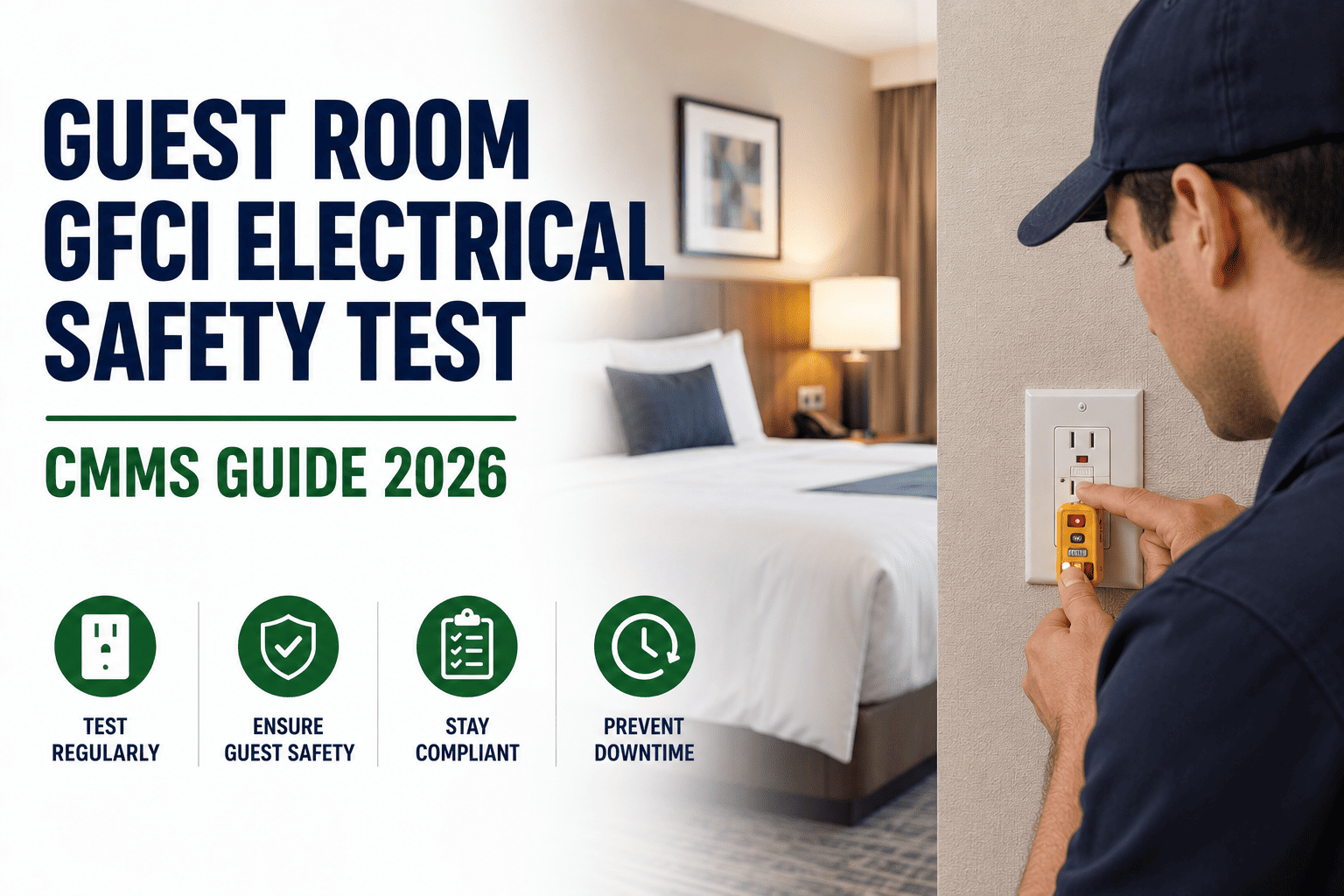
Guest room GFCI outlets are life-safety devices that protect guests from electrocution in wet zones like bathrooms, kitchens, and pool-access corridors — yet NEC 2023 Article 210.8(C) and NFPA 70 require periodic verification that most hotels quietly skip until an inspector or incident forces the question. For a 250-room property, that means over 500 protected receptacles that must be TEST/RESET checked, polarity-verified, and documented on a defensible audit trail. The 2026 standard is a CMMS-driven electrical safety program that turns a scattered clipboard task into a scheduled, photo-logged, work-order-tracked compliance loop. You can Start Free Trial to stand that program up before your next AHJ visit.
When was the last GFCI in Room 412 actually tested — and can you prove it?
NEC 2023 requires guest room GFCI devices to be functionally tested on a documented schedule. A single failed or miswired outlet in a bathroom is a recordable life-safety deficiency. This guide maps the full CMMS-driven inspection program — cadence, test points, polarity checks, and the audit trail that satisfies AHJ and brand-standard reviews across hundreds of rooms.
The NEC and NFPA testing requirements hotels overlook
NEC 2023 Article 210.8(C) mandates GFCI protection for receptacles in guest bathroom, kitchenette, laundry, and outdoor balcony locations — and NFPA 70B classifies GFCI devices as equipment requiring documented maintenance verification, not just installation.
All 125V, 15A and 20A receptacles in guest bathroom, kitchen, laundry, and wet-bar zones must be GFCI-protected. Rooftop and pool-deck adjacent rooms fall under 210.8(A) outdoor provisions.
GFCI devices are listed under periodic maintenance verification. The facility must retain a test record identifying device location, test date, tester, result, and corrective action if any.
Major brand standards align around quarterly GFCI functional tests in guest rooms and monthly tests in common-area wet zones — both tracked in the property CMMS with photo evidence.
An untested GFCI that fails to trip during a fault is statistically invisible — it still passes current — until a guest contacts an energized appliance casing in a wet bathroom. The device protects life only when its internal trip solenoid is verified operational.
Guest room GFCI inspection checklist — every test point
Each guest room wet-zone receptacle requires a four-point verification: physical TEST button, automatic RESET, polarity, and voltage presence — logged against room number and outlet ID in the CMMS mobile app.
Press the TEST button. The device must trip within 1 second, cutting power to the receptacle face and downstream load. A device that does not trip is a failed life-safety unit requiring immediate replacement and room lockout until repaired.
After tripping, press RESET. Power must restore cleanly with no flicker, hum, or warm faceplate. A RESET that will not latch indicates a worn solenoid or miswired line-load configuration — both trigger a corrective work order.
Insert a 3-LED polarity tester. Hot, neutral, and ground must all read correct. Reversed hot-neutral or open ground are common in renovated rooms where circuits were extended — and both defeat GFCI protection logic in certain fault paths.
Measure line voltage at the receptacle: 114–126V is the acceptable band. Low voltage suggests an overloaded shared circuit or loose neutral upstream — conditions that accelerate GFCI solenoid wear and shorten device life by 30–40%.
The quarterly GFCI inspection cycle in a CMMS
A 250-room property running a disciplined CMMS cycle completes full GFCI verification every 90 days, rotating room blocks so no receptacle goes more than 13 weeks between tests.
Technicians test roughly 130 GFCI receptacles across 65 rooms. CMMS auto-assigns work orders by floor; each test logged with pass/fail, photo, and tester ID. Failed units generate same-day swap work orders.
Next 65 rooms enter the cycle. Common-area wet zones (pool restrooms, spa, lobby restrooms) run on a monthly sub-cycle and are folded into each block's work order batch for efficiency.
Third rotation covers remaining rooms plus suites with kitchenettes, where two GFCI zones (bathroom + kitchen) require separate log entries. Polarity anomalies trended across the block.
Final rooms tested; CMMS reconciliation report flags any device past its 90-day window. Open corrective orders escalate to Director of Engineering. Audit packet auto-generated for AHJ and brand review.
What a single failed GFCI actually costs a property
A worked example: a 250-room select-service property with approximately 500 GFCI-protected receptacles across guest bathrooms, kitchenettes, and pool-access corridors.
| Scenario | Annual Cost | Exposure | CMMS Impact |
|---|---|---|---|
| Manual clipboard testing, no digital trail | $3,000 labor | High — no defensible audit record | None — paper logs lost or incomplete |
| Ad-hoc testing during turnover only | $1,200 labor | Critical — gaps exceed 90-day NEC window | None — no scheduling or escalation |
| CMMS-scheduled quarterly cycle | $3,600 labor + tooling | Low — full photo-logged audit trail | Auto-scheduled, trended, audit-ready |
| CMMS + predictive replacement at 7 years | $4,200 lifecycle | Minimal — failures caught pre-service | Failure trend → proactive replacement |
Schedule your property's GFCI compliance cycle before the next audit
Deploy a CMMS-driven electrical safety program across every guest room in under 48 hours — with auto-generated work orders, photo evidence, and AHJ-ready audit packets.
The audit trail that satisfies AHJ and brand reviewers
A defensible GFCI program requires six documentation elements per tested device — all captured automatically in the CMMS mobile app and exportable as a date-stamped audit packet.
Each GFCI receptacle tagged with room number, zone (bath, kitchen, outdoor), circuit ID, and install date. QR code label on each device face links the technician's mobile scan directly to its full test history and warranty status.
Pass/fail for TEST, RESET, polarity, and voltage — each logged with precise date-time to the minute. CMMS enforces all four fields before the work order can be closed, preventing incomplete inspections from silently passing through.
Every test record carries the logged-in technician's name, credentials, and digital signature. For multi-tech properties, this enables performance trending and identifies training gaps in polarity diagnosis or device replacement technique.
Failed devices auto-generate a priority-1 swap work order with the room placed on maintenance hold. The corrective record links back to the originating test, creating an unbroken chain from discovery to resolution to re-test verification.
CMMS requires a photo of the tester plugged into the receptacle showing the LED pattern, plus a photo of the device face with QR visible. Photos are geotagged and time-stamped, defeating after-the-fact paperwork fabrication.
Devices approaching the 7–10 year service-life band are flagged for proactive replacement before failure. Trending identifies circuits with recurring low-voltage or polarity anomalies, pointing to upstream panel or neutral issues.
Common questions about GFCI testing and CMMS compliance
NEC and NFPA 70B do not specify an exact interval, but brand standards and insurance carriers converge on quarterly functional testing for guest room GFCI devices and monthly testing for common-area wet zones. The CMMS enforces this cadence automatically, auto-generating work orders 90 days after the last verified test so no receptacle exceeds the compliance window.
The TEST button verifies the internal trip solenoid mechanically breaks the circuit — confirming the life-safety function. Polarity testing uses a 3-LED plug-in tester to verify hot, neutral, and ground are correctly wired. A GFCI can pass the TEST button but still have reversed polarity or an open ground, both of which create shock hazards in certain fault conditions. The CMMS requires both tests to be logged before the work order closes.
Yes. The CMMS compiles every GFCI test record — device ID, location, result, photo, technician, and timestamp — into a date-stamped, exportable audit packet filtered by date range, floor, or zone. You can generate the packet on demand during an inspection, or schedule it to auto-send to your Director of Engineering and corporate compliance team. To see the audit export in action, Start Free Trial and run a sample property.
The CMMS immediately generates a priority-1 corrective work order for device replacement, places the room on maintenance hold so it is not assigned to a guest, and notifies the Director of Engineering. The failed device is replaced, the new device is tested and logged in the same work order, and the originating failed-test record is linked to the corrective action — creating a defensible chain showing the property responded same-day.
A 250-room property can be fully onboarded — device inventory imported, QR labels printed and applied, floor-based work-order templates configured, and technicians trained on the mobile app — in under 48 hours. The first full quarterly inspection cycle typically completes within two weeks. To map your property's deployment timeline, Book a Demo with our implementation team.
Turn guest room electrical safety into your most defensible audit
Join the properties using CMMS-driven GFCI inspection to eliminate life-safety gaps, pass AHJ reviews on the first pass, and protect every guest in every wet zone — every quarter.
Free 14-day trial · No credit card