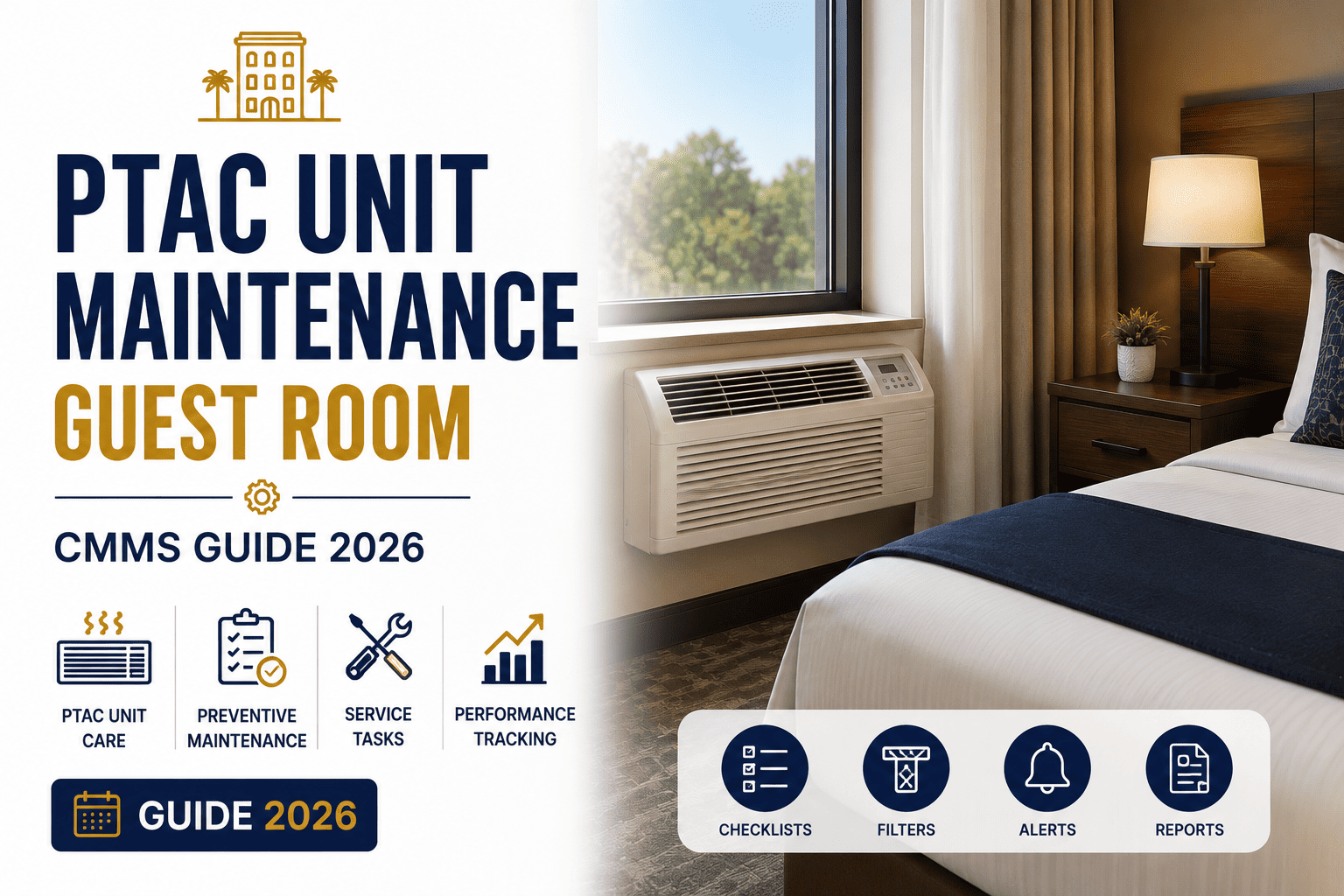
PTAC units sit under the window in nearly every limited-service hotel room, and they handle more heating, cooling, and dehumidification duty than any other asset on the property. Yet roughly 60% of in-room comfort complaints trace back to a PTAC that has not been properly serviced in the last 90 days — usually a clogged coil, a saturated filter, or a dry drain pan letting condensation pool under the sleeve. A CMMS-built PTAC program changes that math: room-by-room PM schedules, photo-logged coil cleanings, refrigerant top-up logs, and warranty-ready service histories all live in one place. This 2026 guide walks through the exact maintenance intervals, inspection tasks, and CMMS workflows that keep PTACs quiet, efficient, and complaint-free. Start Free Trial to operationalize the schedule before peak cooling season.
How many of your 200 guest rooms have a PTAC that will fail before the next cooling season?
Most limited-service hotels lose $18–$42 per room, per month, to PTAC inefficiency — dirty coils, missed filter swaps, and unlogged refrigerant loss. A CMMS-driven room-by-room PTAC program cuts in-room comfort complaints by up to 70% and extends unit life by 3–5 years.
A single dirty PTAC coil can cost $9 per room, per month
When a PTAC coil fouls by even 0.5 mm of biological growth, compressor amperage climbs 12–18% and heat-transfer efficiency drops by roughly 25%. Across a 120-room property running PTACs 14 hours a day, that translates to $1,080–$1,620 in wasted energy monthly — before you count the guest complaints, refund credits, and overtime service calls.
The 2026 PTAC maintenance timeline, mapped to the guest cycle
PTAC maintenance is not seasonal — it is interval-based and tied to occupancy. The timeline below assumes a 70% average occupancy; high-occupancy properties should compress every interval by 30%. Each task is a CMMS work-order template triggered automatically by room number, not by memory.
Filter inspection & swap
Pull the return-air filter, vacuum the grille, and replace the filter if light transmission is below 60%. Log the room number, filter lot, and technician initials in the CMMS. Miss this and static pressure rises 20–30%.
Coil cleaning & drain pan service
Brush the evaporator coil, apply no-rinse coil cleaner, flush the drain pan with biocide tablets, and verify the condensate line is clear. Photo-log the before/after in the CMMS work order to protect warranty claims.
Refrigerant charge & performance check
Measure suction and discharge pressures against the manufacturer chart, verify superheat within 8–12°F of spec, and top up R-410A or R-32 if needed. Record the charge weight, ambient temp, and delta-T across the coil in the CMMS asset record.
Full teardown, sleeve cleaning & controls audit
Pull the chassis from the wall sleeve, clean the condenser coil in place, inspect the fan motor bearings, test the reverse-cycle valve, and recalibrate the thermostat against a reference probe. This is the single task that most directly extends PTAC life beyond year 7.
The 12-point PTAC inspection every housekeeping turnover should flag
Housekeeping is your first sensor network. Train room attendants to run this 12-point visual check on every turnover and auto-route any flagged item to a CMMS work order tied to the room number. Properties using this workflow catch 80% of PTAC issues before the next guest checks in.
Airflow & Filter
- Filter visibly clean and seated
- Airflow strong at supply grille
- No whistling or rattling noise
Moisture & Drain
- No water under unit or on sill
- No musty or moldy odor
- Drain pan dry to touch
Cooling & Heating
- Cooling reaches setpoint within 20 min
- Heating mode engages cleanly
- Thermostat display responsive
Cabinet & Controls
- Front cover snaps flush
- No damage to grille or sleeve
- Power cord intact, not pinched
PTAC maintenance intervals, tasks, and failure signals at a glance
Use this table as the master reference when building CMMS work-order templates. Each row maps a maintenance interval to the specific task, the component touched, the typical time investment, and the failure signal that tells you the interval has already lapsed too long.
| Interval | Task | Component | Time / Room | Failure Signal if Missed |
|---|---|---|---|---|
| 30 days | Filter inspect & swap | Return-air filter | 4 min | Weak airflow, guest calls room "stuffy" |
| 90 days | Coil clean & drain flush | Evaporator coil, drain pan | 18 min | Water on floor, musty odor, icing |
| 180 days | Refrigerant & superheat check | Compressor, charge | 25 min | Cannot reach setpoint, high amperage |
| 365 days | Full teardown & controls audit | Chassis, sleeve, controls | 55 min | Frequent breakdowns, warranty dispute |
| Turnover | 12-point visual check | Full unit (surface) | 2 min | Guest complaint at check-in |
A 140-room hotel saves $34,000 a year with a CMMS PTAC program
Consider a 140-room limited-service property in the Southeast running PTACs an average of 14 hours per day. Before implementing a CMMS-driven schedule, the property averaged 11 PTAC-related guest complaints per month, replaced 9 compressors per year, and spent $4,200 on emergency HVAC callouts. After deploying room-by-room PM work orders in the CMMS, the property cut complaints to 3 per month, reduced compressor replacements to 3 per year, and slashed emergency callouts by 68%.
Net annual savings: $22,440 — a payback period of under 3 months on CMMS subscription cost, before factoring in improved guest satisfaction scores and reduced refund credits.
Numbered steps: building a PTAC PM program in the CMMS
Most PTAC programs fail not because technicians lack skill, but because the schedule lives in a spreadsheet someone forgot to update. These four steps turn the schedule into a self-executing system inside the CMMS.
Create a PTAC asset record for every room
Tag each unit with room number, brand, model, serial, install date, refrigerant type, and warranty end. The CMMS uses this record to trigger every downstream work order and to track lifecycle cost per room.
Build PM templates for each interval
Create reusable work-order templates for the 30-, 90-, 180-, and 365-day tasks. Each template carries the checklist, estimated time, required parts, and photo-upload fields so technicians never start from a blank screen.
Trigger work orders by room and occupancy
Link the PM schedule to the property management system or a fixed rotation so work orders auto-generate per room, not per season. High-occupancy rooms get serviced first; vacant rooms get serviced during turnover windows.
Close the loop with photo logs and analytics
Require before/after photos on every coil cleaning and a delta-T reading on every refrigerant check. The CMMS dashboard then flags rooms trending toward failure — rising amperage, repeated filter clogs, or recurring drain backups — before the guest ever notices.
Turn PTAC maintenance from a fire drill into a scheduled system
Deploy room-by-room PTAC work orders, photo-logged coil cleans, and refrigerant tracking in one platform — before peak cooling season exposes the gaps.
PTAC maintenance & CMMS: the questions hotel engineers ask most
How often should PTAC filters be replaced in a hotel guest room?
Filters should be inspected every 30 days and replaced when light transmission drops below 60%, typically every 60–90 days depending on occupancy and outdoor air quality. High-occupancy properties or those in humid, pollen-heavy climates should lean toward the 30-day replacement interval. The CMMS logs each swap by room number so no filter is missed for more than a cycle. Start Free Trial to automate the rotation.
What is the best coil cleaning interval for PTAC units?
Evaporator coils should be brushed and treated with no-rinse cleaner every 90 days, with a full condenser coil cleaning during the annual teardown. Skipping the 90-day clean allows biological growth to insulate the coil, cutting heat-transfer efficiency by up to 25% and raising compressor amperage 12–18%. Photo-log every cleaning in the CMMS to protect warranty claims and prove compliance during brand audits.
How does a CMMS handle refrigerant tracking for PTACs?
The CMMS stores each unit's refrigerant type, charge weight, and last service reading in the asset record. Every 180-day refrigerant check logs suction pressure, discharge pressure, superheat, and any top-up weight — creating an EPA-compliant trail and flagging units that lose charge repeatedly, which signals a leak before the guest reports poor cooling.
Can housekeeping staff use the CMMS for PTAC turnover checks?
Yes. Housekeeping runs a simplified 12-point visual checklist on every turnover — airflow, moisture, odor, noise, thermostat response. Any flagged item auto-generates a maintenance work order tied to the room number, so 80% of PTAC issues are caught before the next guest checks in. Book a Demo to see the housekeeping workflow live.
What is the typical payback period for a CMMS PTAC program?
Most limited-service hotels recover the CMMS subscription cost within 2–3 months. A 140-room property typically saves $15,000–$25,000 annually through reduced energy waste, fewer compressor replacements, and slashed emergency callout fees. The payback accelerates during peak cooling and heating seasons when PTACs run longest and unscheduled failures hit hardest.
Stop replacing PTAC compressors you could have saved
Deploy a room-by-room PTAC maintenance program in the CMMS and cut comfort complaints by up to 70% before the next peak season.
Free 14-day trial · No credit card