At 2:14 AM during a severe thunderstorm, a 310-room full-service hotel lost utility power. The automatic transfer switch — which should have transferred the load to the emergency generator within 10 seconds — failed to operate. The generator started but never received the transfer signal. For 73 minutes: corridor emergency lighting failed on floors 3 through 8, all electronic door locks defaulted to secure position trapping guests who had exited their rooms, two elevators stopped between floors with guests inside, and the fire alarm annunciator panel went dark. The ATS had not been exercised in 19 months. Its failure cost $180,000 in liability settlements and triggered a full electrical system audit. The root cause was not a mechanical failure. It was a maintenance program that did not exist. Sign up for Oxmaint and load your complete emergency power PM program into a CMMS that confirms every monthly test is run, every fluid is checked, and every compliance record is current — before the next storm.
Hotel Backup Power & Generator Maintenance: Ensuring 24/7 Guest Safety
A complete technical guide for hotel engineering teams — covering diesel generator PM, automatic transfer switch testing, UPS maintenance, emergency lighting compliance, and NFPA 110 documentation protocols that protect guests and keep properties legally compliant during every power failure event.
Why Hotel Generators Fail: The Five Root Causes
Hotel generators are not passive assets. A diesel generator sitting in standby at 72°F, fully fueled, connected to a working ATS, and tested last month is a reliable piece of life-safety infrastructure. The same generator — sitting in standby for 19 months without a test, with a battery charger that failed six months ago and a fuel tank that has not been treated with biocide since commissioning — is a liability waiting to become a crisis. The difference between these two generators is entirely the presence or absence of a documented PM program. Oxmaint manages every scheduled generator task — assigned by interval, escalated if overdue, and documented for NFPA 110 compliance automatically.
The five root causes below account for more than 90% of documented hotel generator "fail to start" and "fail to transfer" events. None of them requires expensive diagnostic equipment to detect. All of them are caught by a technician performing the weekly and monthly checks in this article.
The most common single cause of hotel generator "fail to start" events. A start battery that has not been float-charged loses 1–2% capacity per day. A charger that has been in FAULT mode for 90 days produces a battery with 70–80% of rated cranking amps — enough to spin the starter, not enough to fire the engine under cold load. Battery charger status must be verified weekly.
The failure mode that produced the $180,000 liability event described above. ATS contacts that are never exercised develop resistive oxidation on the contact faces that prevents reliable engagement under load. An ATS that transfers in a lab test but fails under actual building load has a contact resistance issue detectable only by a loaded transfer test — not a visual inspection.
Hotel generators routinely run at 8–20% of rated capacity during monthly tests because the building's emergency load — corridor lighting, fire alarm, minimal HVAC — is a fraction of the generator's nameplate. Running at below 30% rated load causes unburned fuel to accumulate in the exhaust, rings, and injectors. Wet stack accumulation reduces compression, fouls injectors, and eventually limits maximum output — appearing as a gradual power reduction before a full failure.
Diesel stored in a generator tank for more than 6 months without biocide treatment begins to support microbial growth — bacteria and algae colonies that form a sludge at the tank bottom. A fuel sample drawn from a hotel generator tank at 14 months of standing fuel routinely shows microbial colonies visible to the naked eye. This sludge clogs the primary and secondary fuel filters within minutes of a loaded run — producing an engine shutdown during an actual outage event.
A generator starting in cold weather with a failed block heater requires 3–5 additional seconds to reach operating temperature and speed — potentially exceeding the NFPA 110 10-second startup window. A generator with degraded coolant freeze protection can crack its engine block during an extended cold standby period. Coolant condition testing (freeze point, pH, and inhibitor concentration) is rarely performed at hotel properties and has a high finding rate when tested for the first time.
NFPA 110: What Hotel Engineering Teams Are Required to Document
NFPA 110 (Standard for Emergency and Standby Power Systems) is the governing federal standard for hotel emergency generators. It is enforced by the Authority Having Jurisdiction — your local fire marshal, building department, or state electrical inspector — who may request your EPSS maintenance records at any life-safety inspection, Certificate of Occupancy inspection, or following any guest safety incident involving a power failure event. Properties that cannot produce maintenance records are considered non-compliant from the earliest missing record forward.
Level 1 systems (life-safety loads) must be tested monthly under load for a minimum of 30 minutes. The generator must reach 90% of rated voltage and frequency within 10 seconds of the utility power interruption signal.
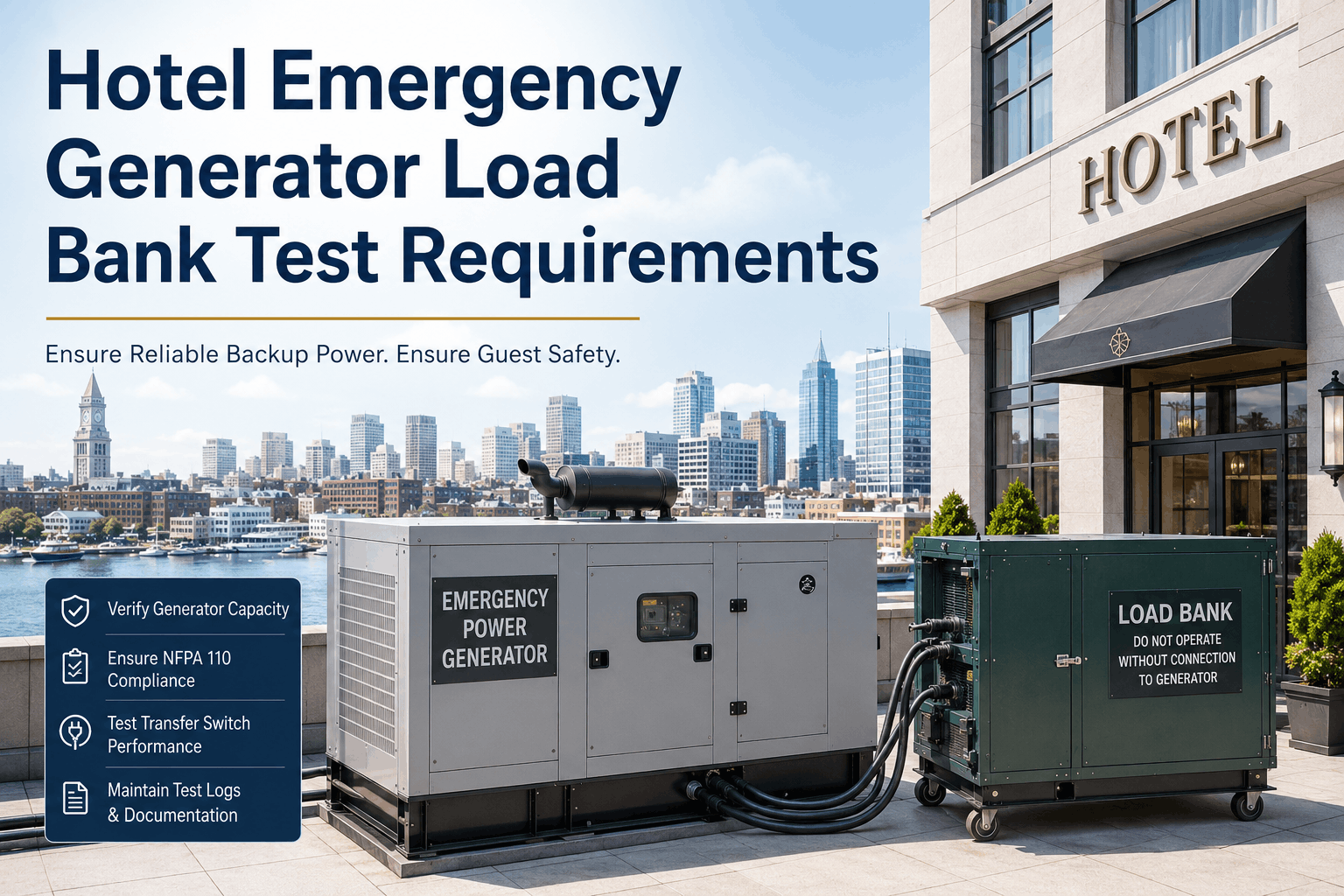
An annual test at 100% of nameplate kW for a minimum of 2 continuous hours is required. A portable load bank must be used when the building's emergency load cannot reach 100% rated capacity on its own.
All maintenance records must be kept for the service life of the equipment and produced on demand for the AHJ. Records must include every test result, every repair, every parts replacement, and the identity of the person performing each task.
Emergency lighting and exit signs require monthly 30-second tests and annual 90-minute full-discharge tests. All results must be recorded by unit location. Failed units must be replaced before the next inspection.
The most practical solution for NFPA 110 compliance is a CMMS that generates the compliant record automatically from a mobile task completion. Oxmaint generates a complete NFPA 110 maintenance record — including start time, load percentage, ATS transfer result, operator name, and timestamp — from the mobile form the technician completes during the monthly test. The record is stored against the generator asset and exportable as a formatted compliance report in under five minutes at any time.
PM Schedule by Interval: Weekly, Monthly, and Annual
Hotel generator PM programs fail not because the tasks are complex but because no one owns the interval. Monthly run tests slip to every 6 weeks, then to quarterly, then to "we'll get to it." The tasks below are organized by interval, with time requirements that make scheduling realistic. Book a demo to see how Oxmaint auto-assigns each interval to the right shift without any manual scheduling required.
ATS, UPS, and Emergency Lighting: The Three Systems Hotels Forget
Hotel engineering teams that maintain their generators conscientiously often neglect the three downstream systems that determine whether the generator's power actually reaches the guest: the automatic transfer switch, the UPS systems protecting reservation and fire alarm infrastructure, and the individual emergency lighting units on every floor. All three have failure modes that produce guest safety events despite a perfectly functioning generator.
The Automatic Transfer Switch: The Most Overlooked Life-Safety Device in the Hotel
The automatic transfer switch is the device that connects the generator's output to the building's emergency loads. It is also the device most commonly omitted from hotel PM programs because it is neither the generator nor the building electrical system — it falls in the gap between engineering and the electrical contractor. An ATS that has not been exercised in more than 12 months has a documented higher failure rate than one exercised monthly, because contact oxidation and solenoid spring fatigue develop under static conditions that do not appear during a generator run test that never completes a transfer cycle. Every monthly generator test must include a full ATS transfer and retransfer cycle — not just a generator start and run. Book a demo to see how Oxmaint tracks ATS exercise separately from generator run test compliance.
UPS Systems: The 10-Second Bridge the Generator Depends On
A diesel generator takes 8–10 seconds to reach stable output voltage and frequency after the ATS receives the transfer signal. During those 8–10 seconds, the entire building's emergency load is powered by UPS batteries — the uninterruptible power supplies protecting the fire alarm panel, the hotel's PMS servers, the front desk systems, and the emergency lighting systems. A UPS whose batteries have not been capacity-tested in 3+ years may drop voltage within 4–5 seconds of utility loss, causing a fire alarm panel reset or an emergency lighting failure during the exact gap the generator is bridging. UPS battery replacement at the manufacturer's specified interval (typically 3–5 years for VRLA batteries) is not optional in a life-safety application. Track UPS battery installation dates and replacement alerts in Oxmaint free.
Emergency lighting units — the individual battery-backup fixtures mounted in hotel corridors, stairwells, and exit pathways — are tested under NFPA 101, not NFPA 110. They require monthly 30-second function tests and annual 90-minute full-discharge tests by unit location. Most hotel properties have 80–200 individual emergency lighting units, and the annual full-discharge test is the only way to identify which units have batteries that will fail before 90 minutes — the minimum duration required by life-safety code. A unit that passes a 30-second monthly test may fail at 12 minutes on a 90-minute annual test. Units that fail the annual test must be replaced before the next AHJ inspection.
How Oxmaint Manages Your Hotel Emergency Power Program
The engineering challenge with hotel emergency power maintenance is not the technical complexity of the tasks — it is the coordination of four different maintenance domains (generator, ATS, UPS, emergency lighting) across weekly, monthly, semi-annual, and annual intervals, with documentation requirements that must be production-ready for an AHJ inspector who may arrive with no advance notice. Oxmaint solves this coordination problem by treating every emergency power component as a named asset with its own PM schedule, its own compliance documentation, and its own escalation chain for overdue tasks.
Each emergency power component is a named asset in Oxmaint with its own PM schedule, service history, battery replacement tracking, and compliance documentation. When an AHJ inspector requests the last three years of EPSS maintenance records, the chief engineer generates a complete, formatted NFPA 110 compliance report from the generator asset record in under five minutes — not from a binder of handwritten test logs that may be incomplete. Set up your emergency power asset records free today.
Oxmaint assigns the monthly generator run test to the engineering lead on the first Monday of each month. The mobile task form captures start time in seconds, load percentage, ATS transfer time, room temperature, and operator name — creating a complete NFPA 110 monthly test record without manual log entry. If the test is not completed by the 7th of the month, an escalation goes to the chief engineer. No test is missed because no one remembered it was due. See the monthly test workflow in a live demo.
The annual load bank test requires a certified technician and a portable load bank — both of which must be scheduled weeks in advance. Oxmaint generates the annual test scheduling alert at 60 days and 30 days before the due date, sent to both the chief engineer and the service contractor. The contractor's written test report is stored as an attachment in the generator asset record. Properties that miss the annual load bank test due date are technically NFPA 110 non-compliant from that date forward. Configure annual test scheduling alerts free.
Weekly fuel level entries in Oxmaint create a consumption trend visible to the chief engineer — showing average standby consumption rate, any anomalous decline (indicating a slow leak or day tank pump failure), and advance warning when the tank approaches the 75% minimum standby threshold. Battery installation dates generate replacement alerts at 30 months and replacement work orders at 36 months — proactive replacement rather than emergency replacement after a "fail to start" event at 2 AM during a hotel full of guests. See fuel trending and battery threshold management in a 30-minute live demo.
Our generator was on a maintenance contract for 14 years. What we didn't know was that the monthly tests were being run at 8% load — not the 30% minimum. When we finally did an annual load bank test after loading Oxmaint, the generator failed at 65% load in under 40 minutes from wet stack accumulation. We replaced the turbocharger, injectors, and exhaust components at $28,000. Before Oxmaint, we had no record of load percentages on any of the monthly tests. The contractor's paperwork just said "tested — passed" for 14 years.