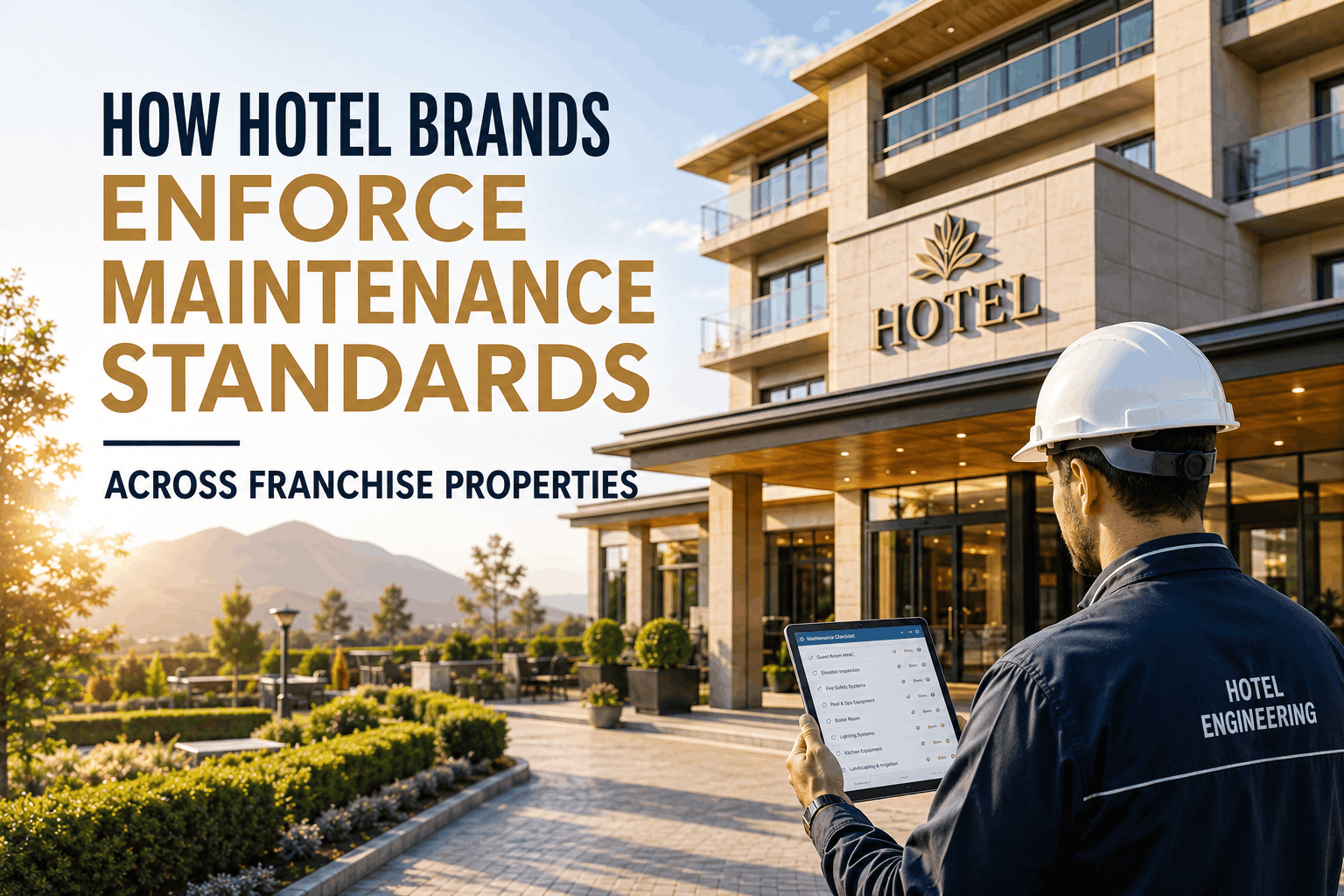
How Hotel Brands Enforce Maintenance Standards Across Franchise Properties
By Alex Jordan on May 27, 2026
Hotel franchise agreements contain explicit maintenance standards that franchisees must maintain across every physical asset — from HVAC room temperature accuracy to paint color consistency to carpet fiber quality. Failure to maintain these standards triggers Property Improvement Plans (PIPs), franchise fee penalties, and in severe cases, flag removal and loss of brand protection. Yet 68% of franchise hotels report they lack systematic documentation of brand standard compliance, making them vulnerable to audit findings even when properties are actually well-maintained. The problem isn't maintenance execution — it's documentation. An inspector arrives unannounced, finds a perfectly functional HVAC system, but maintenance records showing quarterly service are scattered across three different documents. The absence of consolidated, timestamped compliance documentation creates an audit failure even though the property is physically maintained. This guide covers how multi-property operators and franchisees can build brand standard compliance programs that meet Marriott, Hilton, Hyatt, IHG, and other major brand audit requirements using a unified CMMS, track compliance in real-time, and generate audit-ready documentation automatically when brand assessors arrive.
FRANCHISE COMPLIANCE · GUIDE · 2026
How Hotel Brands Enforce Maintenance Standards Across Franchise Properties
Build brand-standard compliance into every PM task. Automated audit-ready checklists and timestamped evidence keep every franchisee inspection-ready, every time.
The Hidden Cost of Brand Standard Audit Failures — PIPs & Fee Penalties
Hotel brand standards aren't suggestions — they're contractually enforceable requirements. Marriott, Hilton, Hyatt, and IHG all conduct announced and unannounced audits using standardized checklists covering 80–120 specific maintenance, operational, and aesthetic checkpoints. A single scored deficiency contributes to an overall audit score. Audit scores below a specified threshold trigger a Property Improvement Plan (PIP) — a formal remediation requirement with specific repair timelines, cost estimates, and compliance verification. A modest PIP might cost $50,000–$150,000 (paint, carpet, fixture replacement). A major PIP following a low-score audit can exceed $500,000 and require 60–90 day closure or limited operations during repairs. Beyond capital costs, PIPs carry franchise fee penalties (1–3% additional of gross revenue for non-compliance period) and reputational damage that follows the property in reservation systems and investor reporting. Properties that fail brand audits also face investor divestment risk — capital partners require consistent brand compliance for portfolio valuation. The economics are brutal: a property with poor audit documentation might spend $200,000+ on a forced PIP, plus $40,000 in fee penalties, plus face threat of flag removal. A property with strong pre-audit preparation and documentation typically receives a commendation instead — with no remediation costs, no fee penalties, and improved investor confidence. The cost difference between prepared and unprepared franchisees: $200,000–$300,000 per audit cycle, repeating every 24–36 months.
Major Brand Audit Requirements (Enforcement Categories)
Cleanliness & Appearance Standards
Critical Audit Category
Guest rooms: carpet cleanliness, paint touch-up, fixture condition, window clarity. Public areas: lobby cleanliness, common area paint/carpet, outdoor grounds. Auditors inspect 15–25 guest rooms and all public spaces. Photo documentation of each room before and after PM work required for compliance proof.
HVAC & Mechanical Systems
Critical Audit Category
Room temperature accuracy (±2°F requirement in most brands), filter maintenance schedules, condensate drain cleaning, thermostat calibration. Brands measure actual room temps at unannounced audit; documented PM records must prove maintenance schedule was followed.
Safety Systems Compliance
High Audit Category
Fire alarm system inspection certificates, fire suppression system certifications, emergency lighting functionality, AED placement and testing records, emergency egress signage. All documentation must be current (not expired) at time of audit. Missing a single certification = audit deficiency.
Kitchen & Food Service (F&B Properties)
High Audit Category
Walk-in cooler temperature logs, food contact surface sanitization records, HACCP compliance, equipment service records, grease trap maintenance. Audit teams pull 7–14 days of temperature logs randomly; any gap or missing entry = violation. Daily documentation is non-negotiable.
Brand-Specific Enforcement Mechanisms
Unannounced Quality Assurance Audits
Critical Enforcement
Brand QA team arrives with scored checklist, inspects property across all categories, scores deficiencies. Audit score below brand threshold triggers PIP process. Properties with documented PM records receive commendations. Same audit, different outcomes based entirely on documentation posture.
Leading Quality Assurance (LQA) Mystery Guest Programs
Critical Enforcement
Brand inspector books room as regular guest, stays 1–2 nights, scores everything a guest would experience (room cleanliness, AC temperature, shower functionality, TV operation, amenities). Guest-facing defects score highest. Properties can't "prepare" for LQA — it's purely operational cleanliness and equipment reliability.
Property Improvement Plan (PIP) Enforcement
High Enforcement
Brand specifies required repairs, timelines (usually 60–180 days), cost estimates. Franchisee must document all repairs with photos and invoices. Follow-up audit verifies completion. Non-compliance extends PIP period and increases penalties. Documented proactive maintenance reduces PIP frequency by 70–80%.
Non-compliant properties assessed 1–3% additional franchise fee during PIP period. Large portfolios: 1% fee on $10M revenue = $100K annual penalty. Major violations can trigger revenue share adjustments affecting profitability. Financial consequences force remediation regardless of owner preference.
Brand Compliance Architecture — How Major Brands Structure & Audit
Each brand has slightly different audit programs, scoring thresholds, and remediation timelines. What's consistent across all major flags is the structure: detailed audit checklists covering specific equipment and maintenance requirements, scoring systems that produce pass/fail or numeric grades, and remediation processes triggered by audit failures. To maintain franchise compliance, operators need to: (1) understand their specific brand's audit requirements, (2) map brand requirements to specific PM tasks and inspections, (3) execute PM tasks consistently with photo documentation, (4) maintain accessible records that prove compliance at any moment. Below is the brand-specific landscape of audit programs that govern the majority of franchised hotel properties in North America.
Major Hotel Brands: Audit Programs & Compliance Requirements
Summary of audit frequency, deficiency thresholds, and PIP triggers for Marriott, Hilton, Hyatt, IHG, Choice, Wyndham — USA 2026
24–36 mo
Average audit frequency — brands conduct announced + unannounced audits within this window annually or biannually
80–120
Specific maintenance checkpoints audited per property — from HVAC calibration to paint color to fixture functionality
3–5 major
Average deficiency triggers per property — above this number typically requires PIP or remediation plan
$50K–$500K
Average PIP cost range — capital repairs for remediation plus fees and penalties during compliance period
"When Marriott auditors arrived at our property, their first question wasn't 'does your HVAC work' — it was 'show me your documented maintenance records.' We pulled up Oxmaint on a tablet, showed 18 months of timestamped PM completion with photo evidence, and received a commendation. Three months earlier, a competing property with similar equipment got flagged for a PIP because their PM records were scattered."
— General Manager, 200-Room Marriott Property · New Jersey · 2025
Building a Brand-Compliant Maintenance Program — Framework & Execution
The simplest path to brand compliance is embedding brand-specific requirements directly into your preventive maintenance program, then executing PM with photo documentation at every step. This approach shifts brand compliance from "something we prove during audit" to "something our normal operations generate automatically." Every PM task completed becomes documented proof of compliance. Every photo taken becomes audit evidence. When brand auditors arrive, compliance documentation is already complete — there's nothing to scramble to find or recreate. Below is the three-phase framework that successful multi-property operators use to build audit-ready maintenance programs.
Phase 1: Brand Standard Inventory & Mapping
PLANNING
Document all brand audit requirements for your specific property type (luxury vs. select-service vs. limited-service). Create mapping: each brand requirement → corresponding PM task in your system. Assign responsibility (who verifies each requirement?). Establish photo documentation standard (what angle, what evidence). This inventory becomes your compliance audit checklist.
Phase 2: CMMS Configuration & PM Template Loading
EXECUTION
Load Oxmaint with hospitality PM templates for your property type. Customize to include your brand's specific requirements. Pre-configure photo requirements so technicians know what to document. Set frequency schedules based on brand audit cycles. Enable automatic work order generation so PM happens on schedule without manual intervention.
Every PM completion includes timestamped photos, technician sign-off, and notes. Oxmaint stores all evidence in permanent audit trail. Compliance dashboard shows which requirements are current, which are upcoming, which need immediate attention. 30 days before audit, generate comprehensive compliance report showing every brand requirement, evidence date, and verification status. Hand this to auditor as they arrive — demonstrating documented compliance proactively.
Multi-Property Portfolio Compliance Consolidation
PORTFOLIO
For hotel groups operating 5+ properties, Oxmaint's portfolio dashboard shows compliance status across all sites in single view. Identify which properties are audit-ready, which are at risk. Reallocate resources to underperforming properties before audit. Generate portfolio-wide compliance report for brand contact — demonstrates proactive multi-property governance.
Audit Encounter Protocol & Documentation Delivery
AUDIT
When brand auditors arrive, Chief Engineer meets them with printed compliance documentation showing: every audit checkpoint, last verification date, photo evidence of current status, service certificates (fire, elevator, etc.), all current and validated. Auditors verify 3–5 items spot-check; if all match documentation, property passes audit rapidly. Comprehensive documentation shifts presumption to compliance (you're compliant until proven otherwise).
Post-Audit Follow-Up & Continuous Improvement
CONTINUOUS
Even with commendation, audit outcomes reveal areas for improvement. If auditors noted 2–3 items as "marginal," increase PM frequency or verification rigor for those systems before next cycle. Oxmaint tracks audit history — patterns emerge showing which systems need more attention. Proactive adjustment prevents future deficiencies before next audit.
Turn Brand Compliance Into Operational Routine
Brand-specific checklists, automated photo documentation, and audit-ready reporting embedded in your daily PM workflow. No last-minute scrambling. No audit surprises.
What's the difference between a Marriott QA audit and an LQA mystery guest inspection?
QA audit: announced, comprehensive checklist across all departments, focuses on documented compliance. LQA: unannounced, guest experiences the property as a paying guest, focuses on operational quality and guest-facing condition. Both are scored. Documentation helps QA; only actual operational excellence helps LQA.
How often do brands audit hotel properties, and can we prepare for unannounced audits?
Major brands audit every 24–36 months on average. You can prepare for unannounced audits by maintaining continuous brand compliance (not preparation that happens 30 days before). If your PM program runs continuously with documented compliance, the audit simply verifies what's already in place.
What happens if we fail a brand audit and get a Property Improvement Plan?
Brand specifies required repairs, timelines (60–180 days), cost estimates. Hotel must complete repairs and document with photos/invoices. Additional franchise fees (1–3% revenue) apply during compliance period. Follow-up audit verifies completion. Properties with documented PM before failure avoid PIPs entirely.
Can a single major audit failure result in flag removal (loss of brand protection)?
Single failure: typically no. Multiple failures over audit cycles: possible. Repeated non-compliance with PIPs or failure to remediate triggers brand escalation. Hotels with strong documented compliance avoid this scenario entirely — they pass audits consistently.
What ROI should we expect from brand compliance program investment?
Avoided PIP costs ($50K–$500K), avoided franchise fee penalties ($40K–$150K per cycle), reduced emergency repair costs (25–40% decrease), and improved investor confidence. A 50-property portfolio avoiding even one major PIP per year saves $200K+. ROI positive within first audit cycle.