Hotel Bed and Mattress Maintenance Program: Protecting Your Biggest FF&E Investment
By Peter Parker on February 27, 2026
A hotel mattress absorbs up to 1,000+ hours of guest use per year. Yet most properties have no structured system to track wear, schedule rotation, or trigger timely replacement — until a guest complaint lands in a review. Your beds are your single largest per-room FF&E investment. Protecting them is not optional; it is your competitive edge.
$800–$3,000Cost per mattress replacement
2–3 YrsExtra life with proactive care
38%Guests cite bed comfort in reviews
5–7 YrsIndustry-standard replacement cycle
55%Faster deficiency resolution with Oxmaint
Why Mattress Maintenance Fails at Most Hotels
The problem is not awareness — it is execution. Housekeeping teams are stretched thin, maintenance logs are paper-based, and no one owns the replacement schedule until a guest complaint forces the issue. The result: reactive spending that costs 3x more than planned replacement.
01
No Rotation Tracking
Body impressions form in high-occupancy rooms while other mattresses sit underused. Without rotation logs, wear is invisible until it becomes permanent damage that forces early — and unbudgeted — replacement.
02
Reactive Replacement Cycles
Waiting for guest complaints means the damage is already done. Emergency replacements disrupt room availability, inflate procurement costs by 20–35%, and consume maintenance budgets that were never planned for unscheduled spend.
03
Hidden Hygiene Risks
Surface cleaning misses allergens, dust mites, and moisture trapped inside the mattress core. Unseen contamination degrades materials from the inside out and creates measurable health risks — and reputational ones — for every subsequent guest.
04
No Asset Lifecycle Data
Without a digital record per room, you cannot forecast FF&E capex or prove compliance to brand inspectors. Every audit becomes guesswork, and every PIP review surfaces surprise costs that could have been planned and budgeted 18 months in advance.
Mattress Lifecycle: Know Where Every Asset Stands
Every mattress in your property follows a predictable lifecycle. The difference between profitable properties and reactive ones is knowing which stage each asset is in — before it becomes a problem that drives guest satisfaction scores down and emergency spending up.
Yr 0–2
New & Optimal
Monthly inspection only. Confirm protector fit and frame integrity at each turnover.
Yr 2–4
Stable
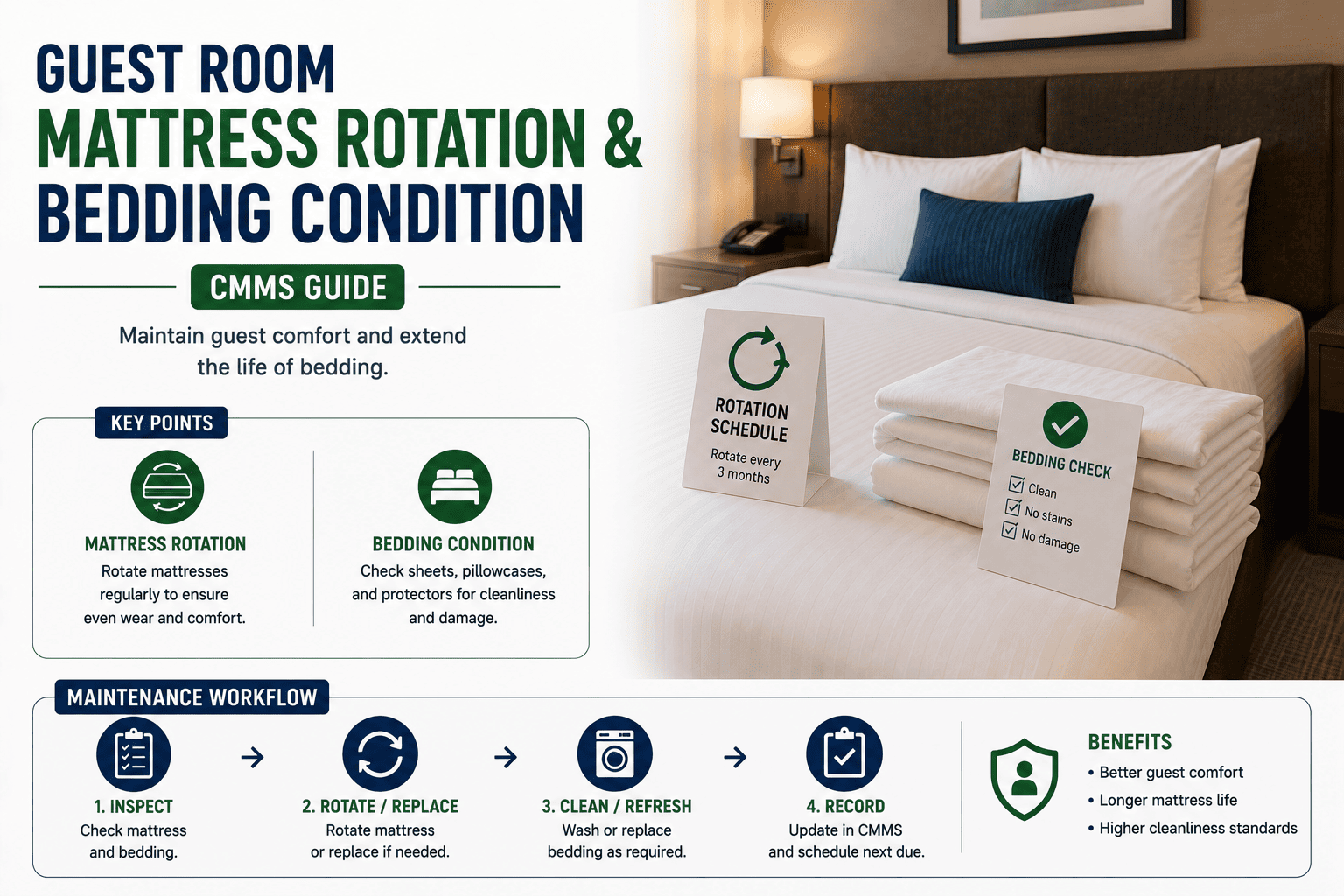
Rotate 180 degrees every 3 months. Begin logging condition scores in asset record.
Yr 4–6
Monitor Closely
Inspect bi-monthly. Log sag, staining, or stitching failures. Flag for replacement window.
Yr 6–8
Replace Window
Budget and schedule replacement. Begin vendor procurement. Prioritize high-occupancy rooms first.
Yr 8+
Critical Risk
Immediate replacement required. Flag in PMS until asset is replaced and re-inspected and signed off.
Mattress Replacement Decision Matrix
Not every aging mattress needs immediate replacement. Use this matrix to prioritize spend across your property's FF&E budget and focus resources on rooms with the highest guest impact before budget constraints force purely reactive decisions.
Condition Signal
Occupancy Impact
Action Required
Timeline
Priority
Visible sagging over 1.5 inches
All room types
Replace immediately, remove from service
24–48 hrs
Critical
Persistent stains or odor after deep clean
All room types
Replace and log as hygiene incident
24–48 hrs
Critical
Exposed springs or broken border rods
All room types
Replace and file safety report
Immediate
Critical
Body impression forming under 1.5 inches
High-occupancy rooms
Rotate and schedule replacement within 90 days
90 days
High
Age 5–7 years with no recent complaints
Standard rooms
Increase inspection frequency to bi-monthly
Next quarter
Medium
Mattress protector worn or missing
Any room
Replace protector and log in room record
Same day
Monitor
Minor seam wear with no structural impact
Low-occupancy rooms
Log and monitor at next monthly inspection
30 days
Monitor
Age under 3 years, passes full inspection
Any room
Continue standard rotation schedule
Ongoing
Pass
Daily and Weekly Bed Inspection Checklist
Housekeeping teams are your first line of defense. Structured daily checks catch issues while they are still inexpensive to address — before a single-night guest complaint turns into a one-star review that costs your property far more than any mattress replacement ever would.
D
Daily Room Turnover Checks
Every Checkout — Housekeeping Team
M
Monthly Deep Inspection and Rotation Checks
Monthly — Maintenance Team with Housekeeping Supervisor
Turn every checklist finding into a tracked work order automatically.Oxmaint connects inspection results to maintenance tasks, asset records, and replacement forecasts in real time — so nothing slips through the cracks between teams.
Beyond routine care, certain checks only make sense once or twice a year — and they are the ones that protect your guests' health, satisfy brand compliance requirements, and give your finance team the accurate capex forecast they need to plan the next fiscal year without surprises.
A
Annual Asset Audit and Hygiene Standards
Annually — Maintenance Manager and General Manager Review
Six Signs a Hotel Mattress Needs Immediate Replacement
Not all mattress issues follow a schedule. Your team needs to recognize the triggers that require same-day action regardless of where the asset sits in its planned lifecycle. These six conditions override all rotation and inspection timetables without exception.
1
Visible Sagging Over 1.5 Inches
A straight edge across the mattress reveals a depression exceeding 1.5 inches. This level of structural failure cannot be recovered through rotation and directly causes back pain complaints that appear in online reviews and influence future booking decisions.
2
Persistent Odor After Deep Cleaning
If a professional steam clean and full air-dry cycle does not eliminate the odor, the source is inside the core — typically microbial growth or fluid saturation that no surface treatment can reach regardless of the chemicals or methods applied.
3
Stains That Cannot Be Fully Removed
Staining that remains visible after approved chemical treatment and extraction is a compliance risk during brand inspections and a hygiene concern that experienced guests and professional inspectors will notice, photograph, and report in reviews.
4
Repeated Guest Comfort Complaints in the Same Room
Two or more comfort-related complaints within a 90-day window tied to the same room number is a statistically significant signal that the mattress has degraded beyond what rotation or cleaning can address and replacement is the only viable corrective action.
5
Exposed Springs or Broken Border Rods
Any structural protrusion that creates a guest safety risk — sharp spring ends, buckled border wire, or collapsed edge support — requires immediate removal from service and replacement with no exceptions and no temporary fixes.
6
Any Confirmed Bed Bug Evidence
Even one confirmed positive finding requires immediate room closure, mattress disposal with tamper-evident bagging, full professional pest treatment, and a minimum 72-hour hold with documented re-inspection before the room returns to sellable inventory.
FF&E Cost Comparison: Reactive vs. Proactive
The math is clear. A 100-room property without a mattress maintenance program does not save money — it defers costs and multiplies them. The comparison below shows what unplanned replacement really costs over a 10-year period compared to a structured program managed through Oxmaint.
No Maintenance Program
Reactive Approach
100-room property over 10 years
Average mattress lifespan5 years
Total replacements over 10 years200 units
Emergency procurement premium+20–35%
Average cost per replacement unit$1,800–$2,400
Guest complaint risk levelHigh
Brand inspection readinessLow
Capex predictabilityNone
Revenue impact from out-of-service roomsHigh
Estimated 10-Year Spend: $360,000 – $600,000
VS
Structured Oxmaint Program
Proactive Approach
100-room property over 10 years
Average mattress lifespan7–8 years
Total replacements over 10 years125–143 units
Planned procurement savings−15–20%
Average cost per replacement unit$1,200–$1,600
Guest complaint risk levelLow
Brand inspection readinessAudit-ready always
Capex predictability12–18 months ahead
Revenue impact from out-of-service roomsMinimal
Estimated 10-Year Spend: $200,000 – $280,000
Room Type Maintenance Priority Framework
Not all rooms carry equal risk. A suite mattress at 30% annual occupancy ages very differently than a standard king in your highest-demand corridor. Use this framework to allocate maintenance resources where the return on investment is highest across your property's room mix.
Room Type
Typical Occupancy
Rotation Schedule
Inspection Frequency
Replacement Target
High-Demand Standard King / Queen
75–90%
Every 6–8 weeks
Bi-monthly
5–6 years
Standard Double / Twin
55–75%
Every 3 months
Monthly
6–7 years
Junior Suite / Upgraded King
40–60%
Every 3–4 months
Monthly
7–8 years
Full Suite / Presidential
20–40%
Every 6 months
Quarterly
8–10 years
ADA / Accessible Rooms
Varies
Every 3 months
Monthly + compliance check
5–7 years
Bed Bug Prevention: A Dedicated Protocol
Bed bugs represent the single highest reputational and legal risk in hotel room maintenance. One confirmed case that reaches a public review platform can suppress booking demand for months. Prevention is not a checkbox — it is a continuous operational discipline that requires specific process ownership and digital documentation at every step.
01
Weekly Seam Inspection at Deep Clean
Train housekeeping to check mattress seams, piping, and tufting at every deep clean cycle. Dark fecal spotting no larger than a pen tip is often the first and only visible indicator before an infestation becomes uncontrollable and operationally devastating.
02
Full Zippered Encasements on All Mattresses
Encasements that cover the entire mattress — not just the top surface — eliminate hiding spots and make inspections dramatically faster. They also protect simultaneously against moisture, allergens, and staining that would otherwise require the same mattress to be replaced earlier than its structural lifespan would necessitate.
03
New Arrival Luggage Handling Protocol
Establish a property-wide policy for luggage placement. Luggage racks positioned away from bed frames and baseboards reduce the primary vector by which bed bugs enter hotel rooms. Bell staff and housekeeping should both be trained on the specific placement guidelines and why they matter operationally.
04
Confirmed Positive Response Workflow
Document the exact response steps: immediate room closure, mattress disposal in sealed tamper-evident bags, professional treatment within 12 hours, a 72-hour minimum inspection hold, and general manager sign-off before the room returns to inventory. Every step must be logged with timestamps and staff identification.
05
Quarterly Pest Control Partnership Review
Conduct a quarterly review with your contracted pest management provider covering detection trends, treatment efficacy, staff training status, and any layout or procurement changes that might affect risk exposure. Document the review findings and action items in your maintenance system.
06
Digital Incident Log with Photo Evidence
Every finding — positive or negative — must be documented in your maintenance system with timestamped photos and staff attribution. This log is your primary legal protection in the event of a guest liability claim and your operational data source for long-term trend analysis and staff training improvements.
How Oxmaint Manages Your FF&E Mattress Program
Checklists do not protect your investment on their own — systems do. Oxmaint connects inspections, work orders, asset records, and replacement forecasts in one platform so your team never guesses what needs attention, and your managers always have the documentation they need for brand inspections, capex planning, and ownership reporting.
01
Asset Registration Per Room
Each mattress is logged as a named digital asset linked to its room number, purchase date, make and model, warranty expiration, and current condition score. No spreadsheets, no paper trails, no history lost when staff turns over.
02
Automated Inspection Scheduling
Daily, monthly, and annual inspection tasks are auto-generated and assigned to the correct team member based on room type and asset age. Reminders go out before tasks are due — not after they are missed.
03
Issue Flagging and Instant Work Orders
When a housekeeper flags a sag, stain, or structural issue, Oxmaint instantly creates a prioritized work order, notifies the maintenance supervisor, and tracks resolution end-to-end with before and after photo evidence attached to the permanent asset record.
04
Replacement Forecasting Dashboard
A real-time dashboard shows every mattress approaching end-of-life organized by room type and priority. Finance teams get a 12–18 month forward view of replacement spend — enabling planned procurement instead of emergency buying at inflated costs.
05
Audit-Ready Documentation
Every inspection, rotation, complaint correlation, and work order resolution is permanently logged with timestamps and staff attribution. Brand inspectors, GMs, and ownership groups get full lifecycle visibility without chasing paper records before every audit.
06
Multi-Property Portfolio Management
For hotel groups and management companies, Oxmaint provides portfolio-level visibility across all properties. Compare FF&E performance by property, flag outliers before they become brand risks, and standardize maintenance SOPs across your entire portfolio from a single management dashboard.
Stop Guessing. Start Tracking.
Oxmaint gives your property a complete FF&E maintenance system — from daily inspection to 10-year replacement forecasting. Join the hotels that have reduced deficiency resolution time by 55% and maintained 100% audit-ready records across every asset category.
Hotel mattress maintenance does not exist in a vacuum. Brand standards, franchise agreements, and general duty-of-care obligations create enforceable requirements that define the minimum acceptable maintenance practice for any professionally operated property.
01
Brand PIP Requirements
Most major hotel brands — including Marriott, Hilton, IHG, Hyatt, and their sub-brands — specify mattress age limits, encasement requirements, and inspection frequency in their Property Improvement Plan standards. Failure to document compliance results in failed brand audits and potential franchise agreement consequences that far outweigh the cost of a structured maintenance program.
02
OSHA and Guest Safety Standards
Exposed springs, broken border rods, or structural failures that cause guest injury create direct OSHA and general negligence liability. Documented maintenance records showing proactive inspection and timely repair are your primary defense in any guest injury claim related to bed equipment — and without them, your insurance exposure is dramatically higher.
03
State Health Code Requirements
Many U.S. states and international jurisdictions require hotel operators to maintain bedding and sleep surfaces to defined hygiene standards. Health department inspections increasingly include mattress condition and documentation checks. Digital maintenance records satisfy these requirements on demand without requiring manual record assembly before every inspection.
04
Manufacturer Warranty Conditions
Commercial hospitality mattress warranties — typically covering 5–10 years — require documented rotation schedules, approved foundation use, and approved cleaning methods as conditions of coverage. Without maintenance logs proving compliance with these conditions, warranty claims are denied regardless of how clear the manufacturing defect may be.
Mattress Maintenance by Hotel Category
Maintenance frequency, product specifications, and replacement timelines differ significantly across hotel segments. Applying a luxury standard to a budget property wastes resources; applying a budget standard to a luxury property destroys the guest experience. Use this reference to calibrate your program correctly for your segment.
Luxury and Upper-Upscale
5-Star / 4-Star
Rotation every 6–8 weeks regardless of occupancy
Bi-monthly full inspection with condition scoring
Professional deep clean every 6 months minimum
Replacement target: 5–7 years with no tolerance for cosmetic defects
Premium encasements replaced every 12 months
Topper replacement on the same cycle as protectors
Upscale and Upper-Midscale
Select-Service Brands
Rotation every 3 months for standard rooms
Monthly inspection with digital condition log
Professional deep clean annually minimum
Replacement target: 6–8 years with brand PIP compliance
Encasements replaced every 12–18 months
Protectors inspected at every monthly check
Midscale and Economy
Budget and Extended Stay
Rotation every 3–4 months minimum
Monthly inspection focused on sag and hygiene triggers
Deep clean annually or after any hygiene incident
Replacement target: 7–10 years based on condition score
Encasements inspected monthly and replaced every 18 months
Emphasis on cost-per-year-of-use tracking to justify replacement
Frequently Asked Questions
QHow often should hotel mattresses be rotated?
Industry best practice is to rotate hotel mattresses every 3 months — four times per year — for standard rooms. High-occupancy rooms running above 75% annual occupancy benefit from rotation every 6–8 weeks. High-demand room types such as standard kings in select-service hotels may justify monthly rotation during peak seasons. Consistent rotation distributes body impression wear evenly across the sleep surface and can extend functional mattress life by 1.5–2 years compared to unrotated assets in the same property.
QWhat is the average replacement cycle for hotel mattresses?
Most branded hotels target a 5–8 year replacement cycle depending on occupancy rates, maintenance quality, and brand flag requirements. Luxury properties with lower occupancy often extend to 7–10 years, while high-occupancy limited-service properties typically refresh at 5–6 years. A proactive maintenance program that includes documented rotation, monthly inspections, and properly maintained protectors extends mattress life by 2–3 years beyond what a reactive-only approach achieves — representing a direct and measurable reduction in FF&E capital expenditure over any 10-year planning horizon.
QHow does Oxmaint help with hotel mattress asset management?
Oxmaint creates a digital asset record for each mattress in your property, capturing purchase date, room assignment, warranty details, rotation history, inspection findings, and condition scores over the full asset lifecycle. Inspection tasks are automatically scheduled and assigned to the appropriate team member. When a deficiency is flagged, a prioritized work order is created instantly and tracked through to resolution with photo documentation attached to the permanent asset record. This gives general managers and ownership groups complete lifecycle visibility and provides audit-ready records for brand inspectors and health department reviews without any manual report assembly required.
QWhat are the warning signs a hotel mattress needs immediate replacement?
Six conditions trigger immediate replacement regardless of where the asset sits in its planned lifecycle: visible sagging exceeding 1.5 inches, persistent odors that survive a full professional deep-clean cycle, stains that cannot be removed to a hygiene-compliant standard, two or more comfort complaints in the same room within a 90-day window, exposed springs or broken structural components creating a guest safety risk, and any confirmed evidence of bed bugs. Each of these conditions overrides the planned replacement schedule and requires same-day action to remove the asset from active service.
QDoes a mattress protector actually extend mattress life?
Yes — and the operational evidence is consistent. A properly fitted waterproof protector prevents the moisture, fluid saturation, and contamination that degrades foam and spring components from the inside out. Mattresses with consistently maintained protectors in comparable hotel rooms demonstrate 1.5–2 year longer functional lifespans than unprotected assets. Protectors also preserve manufacturer warranty validity, reduce the risk of hygiene-related guest complaints, and dramatically reduce the frequency and cost of professional deep-clean treatments required for stain removal throughout the asset's life.
QHow should a hotel handle a confirmed bed bug finding?
A confirmed positive bed bug finding requires immediate room closure, removal and disposal of the mattress in sealed tamper-evident bags (never transfer the mattress to another room or to storage), engagement of a licensed pest management provider within 12 hours, a minimum 72-hour treatment and full re-inspection hold before the room returns to inventory, and documented general manager sign-off for the return to service. Every step must be logged in your maintenance system with timestamps, staff identification, and photo evidence. This documentation is your primary protection against guest liability claims and is required by most brand compliance protocols and many state health regulations.