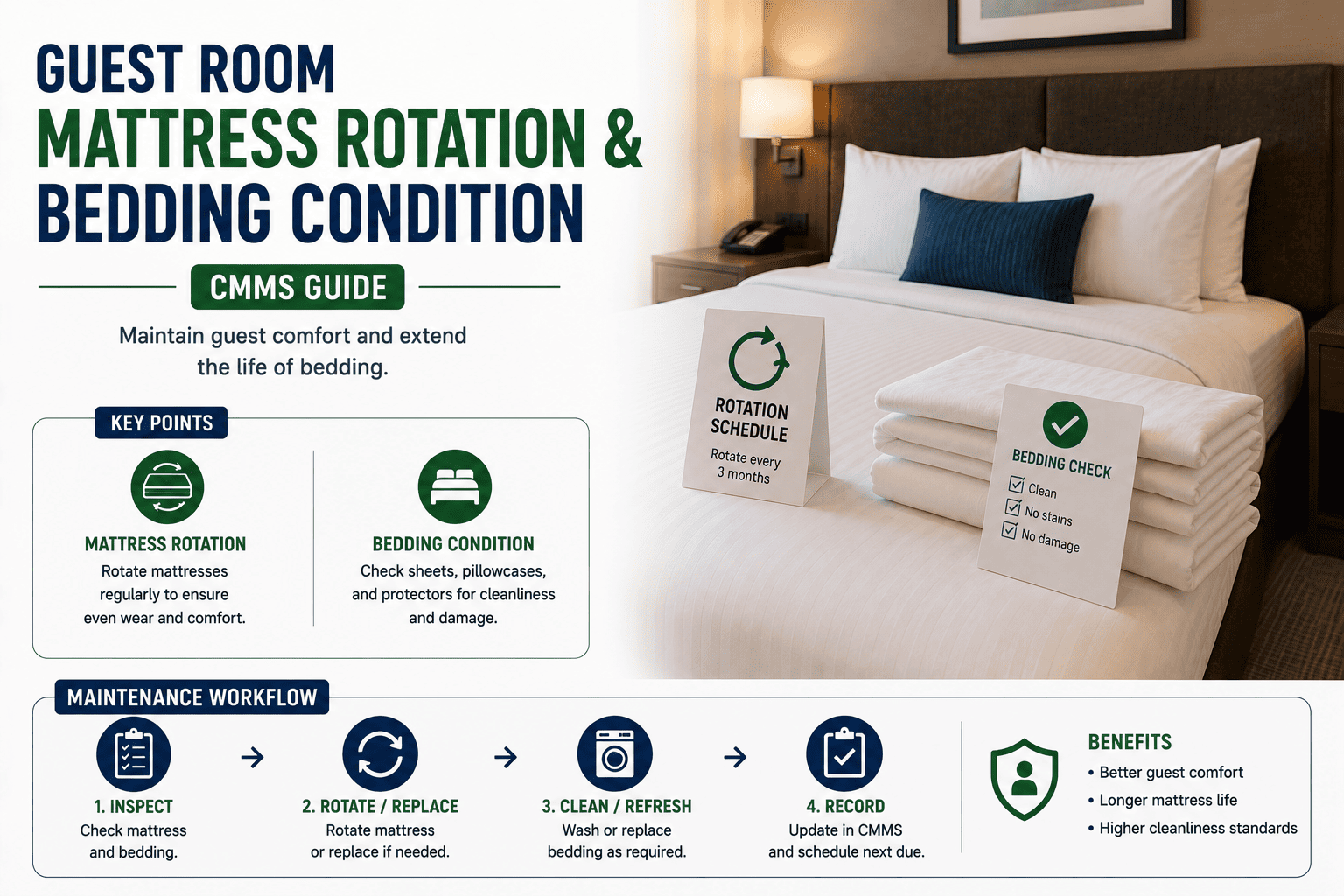
Mattress rotation and bedding condition sit in the top three of hotel guest complaint sources, yet both are almost entirely preventable with disciplined preventive maintenance scheduling. A 200-room property running without structured rotation typically replaces 30–40 mattresses per year on a reactive basis; the same property with a CMMS-driven rotation schedule extends asset life by 18–24 months and cuts replacement spend by roughly 35 percent. This guide covers the full bedding lifecycle: rotation intervals, wear-assessment thresholds, replacement triggers, and the digital work-order backbone that keeps every room consistent. Ready to operationalize it tonight? Start Free Trial and import your room inventory in under an hour.
Is one sagging mattress quietly eroding your RevPAR and your reviews?
A single 1.5-inch body impression triggers a negative review 3.4× more often than a slow check-in. Most hotels discover it after checkout — by then the room is offline for 48 hours, the replacement is a rush order, and the next guest is already checking in. A CMMS-driven rotation and condition schedule catches it 90 days earlier, at zero capital cost.
Bedding complaints convert to revenue loss at a measurable rate
Industry PMS data shows bedding- and mattress-related complaints generate 1.8–2.4 negative review points per 100 stays in unmanaged properties, versus 0.4–0.6 in properties with scheduled PM. The math is brutal because it compounds: one negative review depresses conversion on the next 60 booking decisions.
A 12-month mattress rotation cycle, mapped to a CMMS work-order calendar
Head-to-foot every 90 days, full 180° flip every 180 days (where mattress construction permits). The CMMS auto-generates each work order 7 days ahead, routes it to the assigned housekeeping or maintenance technician, and captures a condition photo before the room returns to sellable status.
Head-to-foot rotation
Day 90 · 8 min/room
Strip bed, rotate mattress 180° on the long axis, inspect for body impressions exceeding 1.0 inch, photograph corners, log condition score 1–5 in CMMS mobile app.
Head-to-foot + flip
Day 180 · 14 min/room
Rotate 180° and flip (double-sided units only). Check edge-support stitch integrity, deep-clean the foundation, replace protector if laundering cycle exceeds 50 washes.
Head-to-foot rotation
Day 270 · 8 min/room
Repeat long-axis rotation. CMMS flags any mattress scoring ≤3 for two consecutive quarters and queues a pre-emptive replacement work order before peak season.
Full flip + annual audit
Day 365 · 22 min/room
Final rotation, full condition audit, photo set uploaded to asset record. CMMS exports lifecycle forecast for next-year capex planning — replacements batched, not reactive.
A five-point scoring rubric that triggers replacement — not gut feel
Every quarterly rotation logs a 1–5 condition score across five dimensions. A composite score of 12 or below, or any single dimension scoring 1, auto-triggers a replacement work order. This removes subjective judgment and creates a defensible capex trail for ownership and asset managers.
| Assessment Dimension | Score 5 (Excellent) | Score 3 (Monitor) | Score 1 (Replace) | CMMS Action |
|---|---|---|---|---|
| Surface evenness | Flat, no visible impression | 0.5–1.0 inch body impression | >1.5 inch permanent sag | Flag for replacement |
| Edge support | Firm, no roll-off | Slight softening at sit edge | Collapsed border wire | Flag for replacement |
| Surface staining | Clean, no discoloration | Minor surface marks, cleanable | Permanent stains, odor | Immediate replacement |
| Structural noise | Silent under load | Occasional coil creak | Persistent noise, coil failure | Flag for replacement |
| Protector condition | Intact, <50 wash cycles | 50–80 wash cycles, minor wear | >80 washes, torn, waterproofing failed | Replace protector only |
From room scan to capex forecast — the asset lifecycle, numbered
Each mattress enters the CMMS as a unique asset with a QR code affixed to the frame. Every rotation, inspection, and replacement feeds a single lifecycle record that ownership, GM, and housekeeping can all read from the same dashboard.
Asset onboarding
Scan QR, record make, model, purchase date, warranty terms, room assignment. CMMS auto-calculates expected retirement date based on a 7-year service life benchmark and quarterly rotation compliance.
Scheduled PM generation
System generates head-to-foot work orders at day 90/270 and flip work orders at day 180/365, routed to the on-duty technician 7 days before due date with photo-capture requirement enabled on the mobile form.
Condition scoring + photo log
Technician completes 5-dimension rubric, uploads 3 photos (surface, edge, label), submits. Scores below threshold trigger automated escalation to the director of housekeeping within 60 minutes.
Replacement forecasting
CMMS aggregates scores across the portfolio, ranks assets by retirement risk, and exports a quarterly capex request with grouped purchasing discounts — replacing 18 mattresses in one PO, not 18 rush orders.
A 200-room hotel: reactive vs. CMMS-managed bedding program
Consider a 200-room full-service property averaging 74% occupancy. Without scheduled rotation, mattresses average 4.8 years before reactive replacement and generate 41 bedding-related complaints per year. With CMMS-driven PM, the same assets reach 6.6 years and complaints drop to 9. The numbers below assume a $650 mattress unit cost and $85 protector set.
Net result: $12,000 saved annually, 32 fewer complaint tickets, and an estimated 0.5-point review-score lift that compounds into roughly $85,000 in incremental RevPAR. Payback on the CMMS subscription: under 45 days.
What disciplined bedding PM looks like from the GM's chair
"Before OxMaint we were replacing mattresses reactively — usually after a guest already slept on a bad one. Within six months of the rotation schedule going live, our bedding complaints dropped from four or five a week to maybe one. The director of housekeeping now sees the full retirement forecast for all 184 rooms on one screen, and capex conversations with ownership are 20 minutes instead of two hours."
Stop replacing mattresses after the bad review is already written.
Import your room inventory, generate the first 90-day rotation schedule, and capture your first condition scores this week. Your next guest sleeps on a CMMS-managed mattress.
Mattress rotation & bedding CMMS — the questions every GM asks
How often should hotel mattresses actually be rotated?
Head-to-foot every 90 days and a full 180° flip every 180 days for double-sided units. Single-sided pillow-top mattresses still get the 90-day head-to-foot rotation but skip the flip — the CMMS tracks construction type per asset and automatically suppresses the flip work order where it does not apply. The 90-day cadence aligns with the point where body impressions begin to set permanently in mid-grade hotel foam.
When is a mattress actually due for replacement versus another rotation?
Replace when any single dimension on the 5-point rubric scores a 1, or when the composite score across all five dimensions drops to 12 or below. In practice this maps to a permanent sag exceeding 1.5 inches, collapsed edge support, persistent coil noise, or permanent staining that survives a deep-clean cycle. The CMMS auto-generates the replacement work order the moment the technician submits the score — no manager judgment required. You can Book a Demo to see the threshold logic configured live.
How long does it take to onboard 200 rooms into the CMMS?
A 200-room property typically completes full asset onboarding in 4–6 hours: QR labels applied, make/model/purchase date recorded, room assignments set, and the first 90-day rotation schedule generated. A housekeeping team of three can scan and log 35–40 rooms per hour using the mobile app. The first rotation cycle then runs normally, and condition data starts feeding the retirement forecast within 30 days.
Does the CMMS track bedding and protectors, or only mattresses?
Every bedding asset is tracked: mattress, box spring or platform, protector, pillow pair, and duvet. Each has its own lifecycle benchmark — protectors retire at 80 wash cycles, pillows at 24 months or 50 washes, duvets at 36 months. The CMMS links all bedding assets to the room record so a single dashboard shows the complete bedding health of every sellable room, not just the mattress in isolation.
What is the realistic ROI timeline for a CMMS-managed bedding program?
Most properties recover the CMMS subscription cost within 45–60 days through eliminated rush-order premiums and reduced replacement frequency. Full payback — including the 18–24 month service-life extension on the existing mattress inventory — typically lands at 4–7 months for a 150+ room property. The secondary return, a 0.4–0.6 point review-score lift, compounds into incremental RevPAR that usually dwarfs the direct replacement savings. Start Free Trial to model your property's specific numbers.
Your next guest review shouldn't be about a sagging mattress.
Deploy a CMMS-driven rotation and condition program this week. Import rooms, generate work orders, capture scores, and forecast capex — all from one dashboard your housekeeping team can actually use.
Free 14-day trial · No credit card