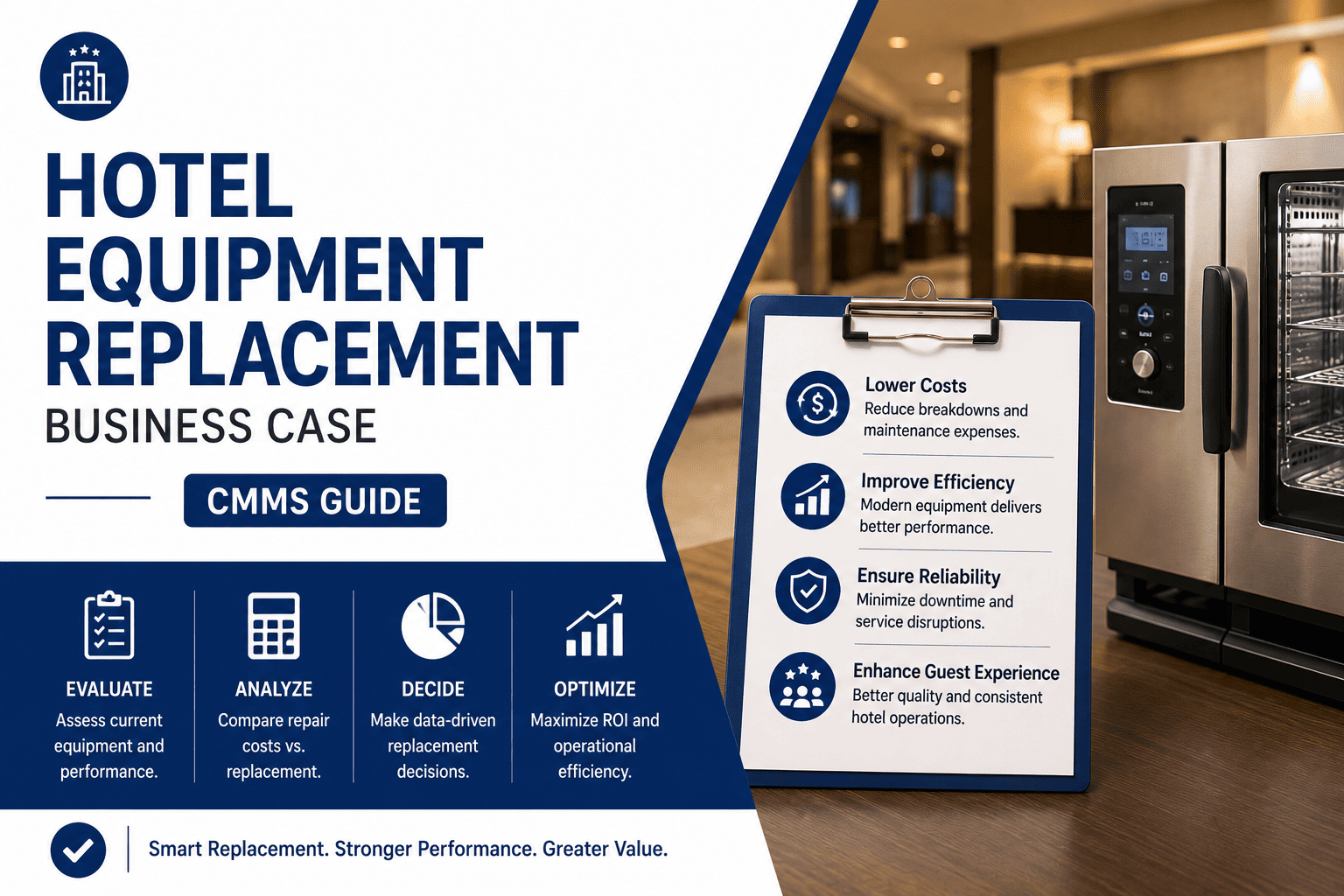
Efficient Hotel Asset Lifecycle Management: Make Smarter Replacement Decisions
By Mark Strong on April 9, 2026
Every hotel asset — from a rooftop chiller to a guest room PTAC unit — has a lifecycle. The difference between a profitable property and a budget-strained one often comes down to whether replacement decisions are made on data or on crisis. Most hotel engineering teams only replace equipment after it fails, paying 3 to 5 times more than a planned swap. Book a demo to see how Oxmaint tracks hotel asset lifecycles and drives smarter capital decisions.
Efficient Hotel Asset Lifecycle Management: Make Smarter Replacement Decisions7 min read
What Deferred Replacement Actually Costs Hotels
3–5x
Higher cost of emergency asset replacement vs. planned capital swap
62%
Of hotel capital requests rejected due to insufficient condition evidence
7%
Annual compounding cost increase when asset replacement is deferred
88%
Capital request approval rate when backed by CMMS condition data
Quick Answer
Hotel asset lifecycle management through a CMMS tracks every asset from installation through end-of-life — logging maintenance costs, condition scores, and remaining useful life to replace equipment at the right time, not after it fails. This shifts capital planning from gut-feel estimates to data-backed forecasts that owners and management companies actually approve.
The Lifecycle Gap Most Hotels Ignore
How Hotels Currently Decide
Equipment breaks down during peak occupancy
Emergency vendor called at premium rates
Unplanned capital spend disrupts annual budget
Capital request submitted without condition evidence — rejected
How CMMS-Driven Hotels Decide
Remaining useful life visible on every asset dashboard
Replacement scheduled during low-occupancy window
Planned capital spend included in annual budget cycle
Data-backed capital request approved at 88% rate
The Five Lifecycle Stages Oxmaint Tracks
01
Commissioning
Asset registered with install date, warranty terms, manufacturer specs, and baseline condition score. First PM schedule auto-generated from asset class templates.
02
Active Service
PM completions, repair costs, and downtime events logged continuously. Condition score updated with each maintenance action. Cumulative maintenance cost tracked against asset replacement value.
03
Aging Threshold
When maintenance cost exceeds 40% of replacement value, Oxmaint flags the asset for lifecycle review. Condition score trends visualized over time to confirm deterioration pattern.
04
Replacement Planning
Oxmaint generates a replacement forecast with estimated timing, budget figure, and vendor lead time. Capital request exports directly from the platform formatted for ownership review.
05
Decommission and Handover
Retired asset archived with full maintenance history. New asset registered in the same location with inherited maintenance templates. No documentation gap between asset generations.
Know When Every Asset Needs Replacing — Before It Fails
Oxmaint tracks condition, cost, and remaining useful life across your entire hotel asset portfolio — turning capital planning from reactive crisis management into scheduled, budgeted decisions.
Facility Condition Index scores calculated from real maintenance spend versus replacement value — not manual assessments. Ownership sees exactly which assets are approaching economic end-of-life.
Rolling 10-Year Forecast
Auto-generated capital replacement timeline showing which assets need replacement in each fiscal year — built from asset condition data, not spreadsheet assumptions from five years ago.
One-Click Export for Owners
Capital request packages formatted for ownership and management company review — including asset history, condition score trend, replacement cost estimate, and risk of deferral. No manual compilation.
Before and After: Asset Replacement Decisions
Without Lifecycle Tracking
✗No visibility into remaining useful life — replacement triggered by failure, not forecast
✗Capital requests based on verbal estimates — 62% rejected by ownership for lack of evidence
✗Deferred maintenance compounds asset deterioration at 7% annually — replacement cost grows every year
✗Emergency replacements during peak occupancy cause guest complaints and revenue loss
With Oxmaint CMMS
✓Remaining useful life dashboard visible per asset — replacement planned 12 to 24 months in advance
✓FCI-backed capital requests approved at 88% rate — ownership has the data to say yes
✓Rolling 10-year forecast lets finance teams budget capital accurately each fiscal year
✓Replacements scheduled during low-occupancy windows — zero guest impact, planned contractor access
Oxmaint uses actual cumulative maintenance cost data combined with manufacturer-defined useful life and asset class benchmarks. As repair spend accumulates against an asset, the system continuously recalculates the cost-to-replace ratio and updates the remaining useful life estimate — reflecting real degradation, not theoretical depreciation schedules.
FCI is the ratio of deferred maintenance cost to current asset replacement value. An FCI below 0.05 indicates good condition; above 0.10 signals urgent replacement need. Oxmaint calculates FCI scores automatically from work order cost data and displays them per asset, per department, and across the full property — giving ownership the same metric used by institutional property managers.
Yes. Oxmaint auto-generates rolling 10-year capital replacement forecasts by asset class. Each forecast includes the asset's condition score, maintenance cost trend, estimated replacement cost, and recommended replacement window. The package exports in a format suitable for ownership meetings and management company budget reviews.
Yes. Hotel groups managing multiple properties see asset condition scores, FCI rankings, and replacement forecasts across the entire portfolio from one dashboard. Capital allocation decisions can be prioritized across properties based on objective condition data rather than which GM escalates the loudest.
Replace Assets at the Right Time — Not After They Fail
Oxmaint tracks condition, cost, and remaining useful life across every hotel asset — so capital decisions get made on data, not emergencies. Live in 14 days, no consultant fees.