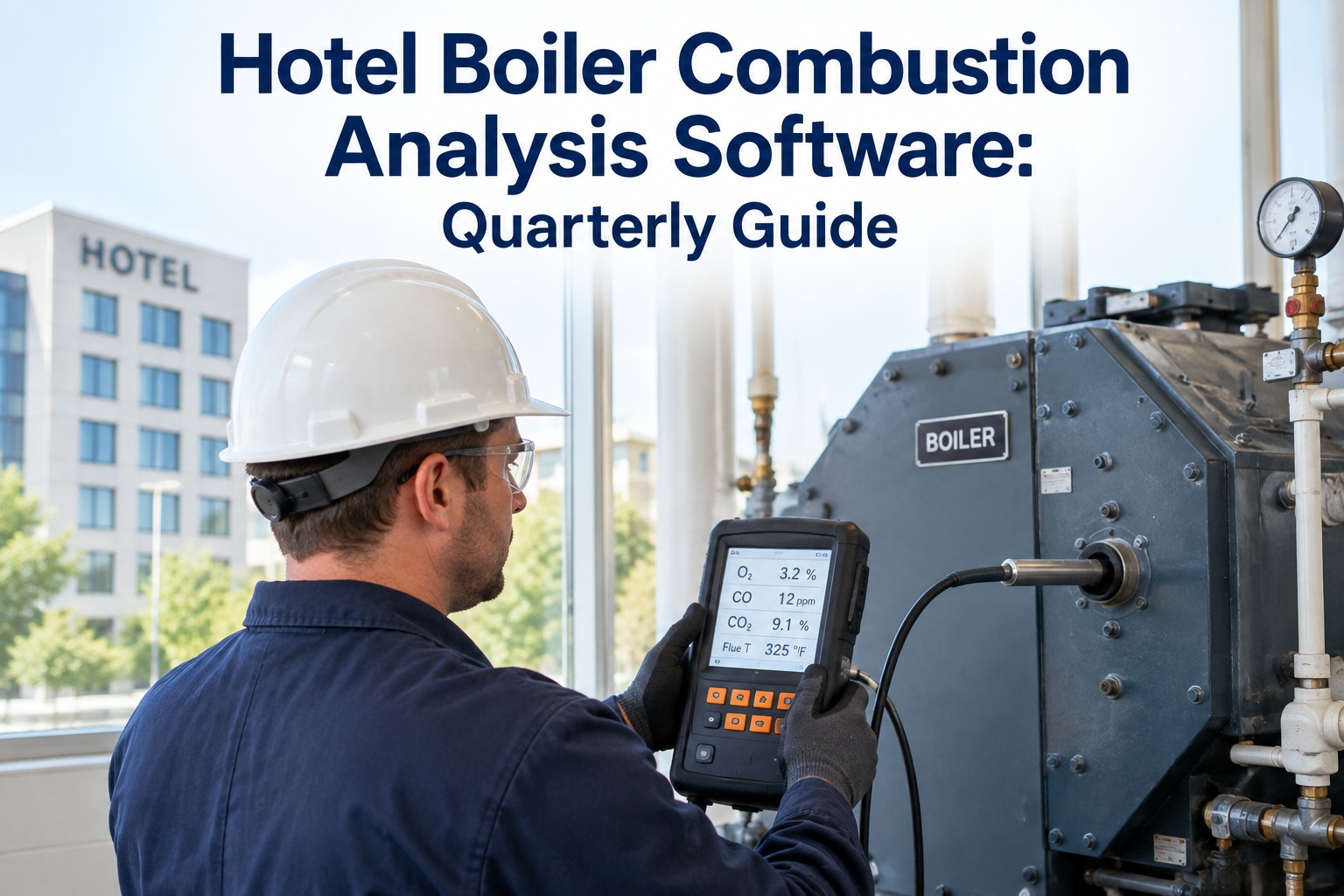
A boiler that hasn't had a combustion analysis in 18 months isn't just running less efficiently — it's very likely burning 10–15% more fuel than it needs to, quietly, with nobody watching the number. The physics is simple: too little excess air and combustion turns incomplete, producing dangerous carbon monoxide; too much excess air and the burner spends fuel heating surplus nitrogen and oxygen that go straight up the stack. The target band for a natural gas boiler sits at just 2–4% excess O2 in the flue gas — narrow enough that ambient temperature, humidity, and normal burner wear can push a properly tuned system out of range well before the next scheduled service. This guide covers the O2/CO readings that actually define combustion efficiency, the quarterly analysis cadence that catches drift early, and what a hotel engineering team should be logging every time a technician takes a flue gas reading. Book a Demo to see how OxMaint tracks combustion readings and flags drift across every boiler on property.
Hospitality · Boiler & Plant Engineering · 2026 Software Guide
Hotel Boiler Combustion Analysis Software: The Quarterly Guide
O2, CO, and stack temperature don't drift on a schedule — they drift with weather, load, and wear. Here's how to track them before the fuel bill tells you something's wrong.
2–4%
Optimal excess O2 range for natural gas boiler combustion
92–96%
Achievable combustion efficiency when tuned to the optimal O2 band
78–82%
Typical efficiency after 18+ months without combustion analysis
10–15%
Fuel waste typically recoverable from a poorly tuned burner
Reading the Flue Gas — The Zone That Matters Is Narrower Than You'd Think
Every combustion analyzer reading falls somewhere on this scale — and the "safe zone" is a much tighter band than most engineers assume. Start a free workspace and log your next reading directly against this scale.
CO Risk ZoneBelow 1% O2
Optimal Zone2–4% O2 · 92–96% efficiency
Excess Air LossAbove 7% O2 · below 88% efficiency
Even a burner tuned correctly in cool, dry fall air can drift out of this band by summer — ambient conditions alone shift the actual air-fuel ratio delivered at every damper position.
The Quarterly Combustion Analysis Cadence
A single annual tune-up captures one afternoon's conditions. The cadence below catches drift in between, so a boiler never quietly runs six months out of tune before anyone notices.
Q1
Winter Peak-Load Check
Verify O2/CO at high firing rate during heaviest seasonal demand.
Q2
Post-Winter Full Analysis
Full multi-point analysis and linkage inspection as heating load drops off.
Q3
Low-Load Drift Check
Confirm the burner still holds target O2 at reduced summer firing rates.
Q4
Pre-Season Full Tune-Up
Complete analyzer calibration check and burner tune ahead of winter demand.
Continuous Monitoring Doesn't Replace the Tune-Up — It Tells You Where to Point It
O2/CO trend logging catches drift between scheduled service visits; the quarterly technician visit still handles physical inspection and linkage adjustment that data alone can't perform. OxMaint keeps both records in one place.
What Untracked Drift Actually Costs a Property
The efficiency loss compounds every hour the burner runs untuned — and on a hotel boiler running most of the year, that adds up fast.
Fuel Waste
A burner running even a few points of excess air above target typically loses 1–5% combustion efficiency, compounding across every hour of run time through the heating season.
Unmeasured CO Risk
Excess air pushed too low to save fuel risks incomplete combustion — carbon monoxide production that goes undetected without regular flue gas readings.
Compliance Exposure
Many state air permits require documented annual combustion tune-ups — a missed or unlogged analysis is a permit gap, not just an efficiency one.
Logbook vs. OxMaint — Tracking Combustion Data That Actually Gets Used
"
We assumed our annual boiler tune-up was enough because our fuel bill hadn't changed dramatically year over year. Once we started logging quarterly O2 and CO readings against a target band instead of just doing the yearly service, we found one of our three boilers had drifted to nearly 6% excess O2 by mid-summer — nobody had touched it, it had just wandered out of tune from seasonal conditions. Catching it before the next winter season instead of after meant we weren't paying for six months of wasted fuel on top of the eventual fix.
Chief Engineer · Full-Service Hotel, Central Plant
Frequently Asked Questions
What's the ideal O2 reading for a commercial natural gas boiler?
The optimal range is typically 2–4% excess O2 in the flue gas, delivering 92–96% combustion efficiency. Readings below 1% risk carbon monoxide production, while readings above 7% indicate excess air dilution that drops efficiency below 88%.
How often should combustion analysis actually be done?
Best practice is monthly analysis for boilers running year-round, or at minimum at the start and end of each heating season for seasonal units — quarterly is a reasonable middle ground most hospitality properties can sustain operationally.
Does continuous O2/CO monitoring replace the need for an annual tune-up?
No. Continuous monitoring and trim systems catch drift between scheduled visits and tell the technician where to focus, but physical inspection, analyzer calibration checks, and mechanical linkage adjustment still require a hands-on annual service.
How much fuel can a proper combustion tune recover?
A poorly tuned burner typically wastes 10–15% of fuel compared to one held at its target O2 band — on a boiler running most of the year, that's a meaningful recurring cost, not a one-time saving.
Can OxMaint track combustion readings across multiple boilers on one property?
Yes. Every boiler is logged as an asset with its own O2/CO/stack-temperature history, and the dashboard flags any unit approaching its quarterly analysis due date or showing a drift trend.
Is combustion analysis a compliance requirement, or just best practice?
Many state air permits require documented annual combustion tune-ups, and industry guidance (including ASHRAE) recommends logging O2, CO, and stack temperature trends to catch degradation before it becomes a compliance issue.
Stop Finding Out Your Burner Drifted Out of Tune From the Fuel Bill.
OxMaint logs every combustion reading, flags overdue quarterly analysis, and keeps a permit-ready record for every boiler on property — one dashboard instead of a stack of paper logs.