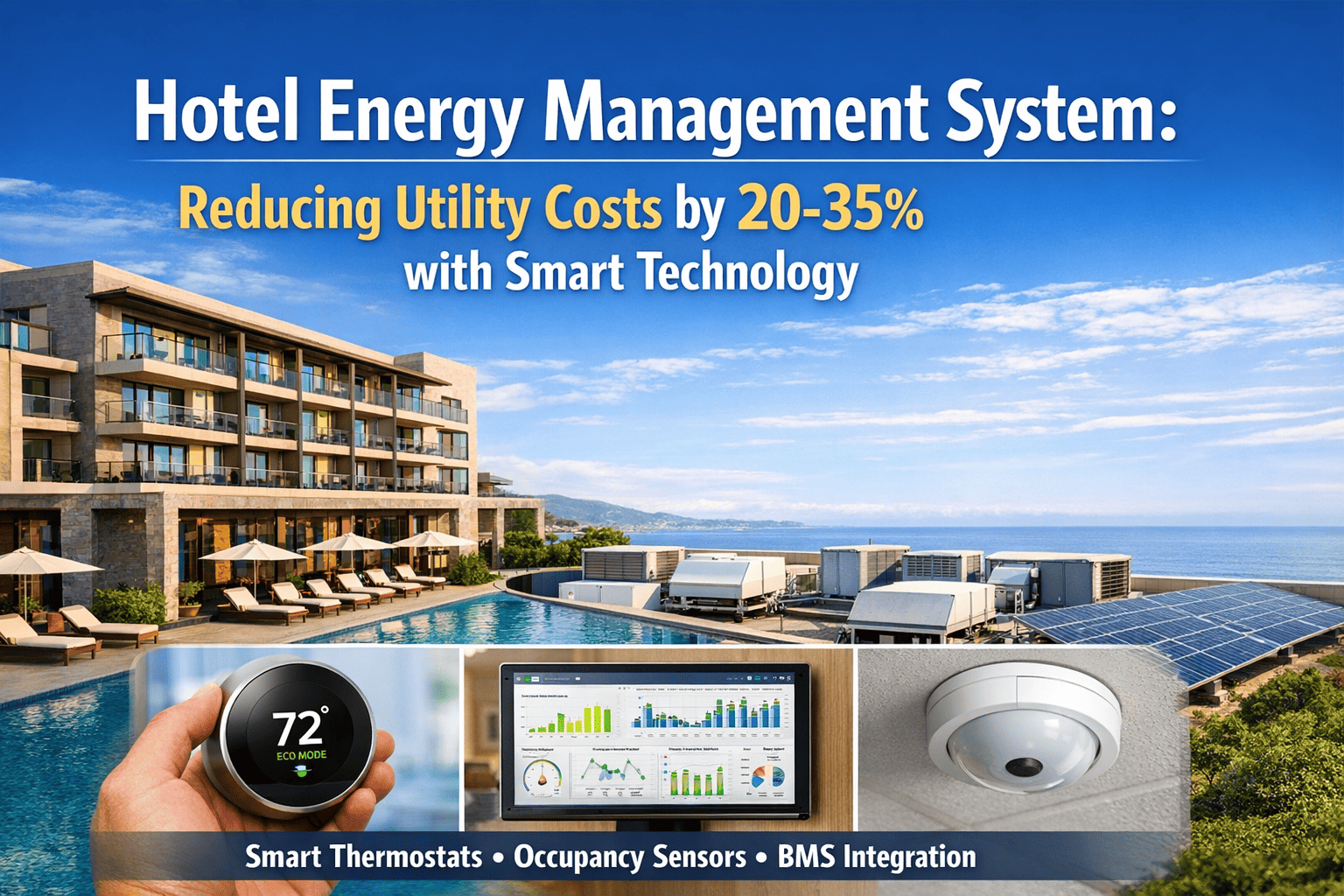
Energy costs represent 22–28% of total operating expenses for multi-property hotel chains across the United States. For a 15-property hotel group with $180M annual revenue, that translates to $40–$50M annually spent on utilities — primarily HVAC systems that run 24/7/365 to maintain guest comfort. A major hotel chain operating 15 properties (2,400 total guest rooms) in urban markets across Texas, California, and Florida discovered that their HVAC systems were consuming 34% more energy than comparable properties due to inefficient maintenance practices, filter blockages, refrigerant leaks, and scheduling failures. Their energy bills exceeded industry benchmarks by $1.2M annually. After implementing AI-driven predictive maintenance through Oxmaint CMMS, the hotel chain reduced HVAC energy consumption by 28%, saving $340,000 annually while simultaneously improving guest comfort, reducing emergency breakdowns, and achieving their sustainability targets. This case study reveals how data-driven HVAC maintenance becomes competitive advantage in hospitality.
Oxmaint predictive analytics monitor HVAC performance in real-time, predicting filter degradation, refrigerant loss, compressor wear, and thermal efficiency decline. Automatically schedule maintenance before efficiency drops, before guest complaints arise, before energy bills spike. Filter tracking, energy baseline monitoring, and cost-per-cooling-unit analytics built-in.
The 15-property hotel chain faced a crisis: HVAC energy costs exceeded industry benchmarks by $1.2M annually. Energy audits revealed that 67% of the overage came from preventable inefficiencies — dirty filters, under-pressure refrigerant lines, and maintenance gaps. By implementing Oxmaint AI predictive maintenance, the chain identified failing HVAC components before they impacted guests, automated filter replacement scheduling, and optimized compressor operation. Result: 28% energy reduction ($340K/year savings), 71% fewer emergency breakdowns, and achievement of sustainability goals. Payback period: 18 months from energy savings alone.
Section 1: Why HVAC Represents 45% of Hotel Energy Costs & 67% Is Preventable Waste
HVAC systems in hotels operate fundamentally differently from residential buildings. Hotels maintain 24/7 occupancy with guest rooms set to varying temperatures. Lobby, hallway, and common area climate control run continuously. Outdoor air exchanges are required for indoor air quality. This creates extreme thermal loads that compound maintenance failures into massive energy waste.
In hotels, HVAC dominates energy consumption because systems run 24/7/365 with continuous guest turnover creating thermal load spikes. A 150-room hotel might have 45–60 rooms occupied with guests actively using AC while 90 rooms require climate control for the next arrival. Lighting load is intermittent; HVAC load is constant and unforgiving.
The 15-property hotel chain consumed 34% more HVAC energy than industry benchmarks for comparable properties. Energy audit identified: 23% from dirty/clogged filters creating compressor overload, 19% from refrigerant leaks reducing system efficiency, 14% from undetected thermostat failures creating simultaneous heating/cooling cycles.
For a 15-property chain with ~$35M annual utility costs, a 34% HVAC overage equals $1.2M excess spending annually. This directly reduced profit margins by 2.8% compared to efficiently operated competitors. The chain recognized that HVAC optimization could represent a competitive differentiator and impact shareholder value.
Energy audit revealed that 67% of the $1.2M overage came from preventable maintenance failures rather than aging equipment. This was transformative insight: the problem wasn't replacing HVAC units (massive capex); it was optimizing existing systems through predictive maintenance (operational cost reduction).
Section 2: Predictive HVAC Maintenance Strategy — What Changed
Oxmaint monitors static pressure differential across filters in real-time. As filters clog, pressure increases, forcing compressors to work harder and consume more energy. System predicts when filters reach 80% blockage (before complete failure) and schedules replacement, preventing energy waste and emergency repairs.
Oxmaint correlates compressor head pressure, discharge temperature, and superheat values to identify refrigerant loss. A 15% refrigerant charge loss increases energy consumption by 22% and reduces cooling capacity. System alerts technicians to leak within 5 days of onset, preventing efficiency collapse.
Oxmaint establishes energy efficiency baseline per unit based on outdoor temperature, occupancy level, and guest thermostat settings. When actual energy consumption exceeds baseline by 15%+, system flags for investigation. Reveals hidden issues: thermostat failures, damper blockages, ductwork disconnects.
Oxmaint analyzes compressor runtime, cycling frequency, and load patterns. Detects inefficient short-cycling (rapid on/off) that wastes energy. Schedules thermostatic expansion valve (TXV) service or pressure transducer calibration to optimize refrigerant flow and compressor efficiency.
Section 3: Energy Performance Before & After — Detailed Results
| Energy Metric | Baseline (Year 1) | Post-Predictive Maintenance (Year 2) | Improvement |
|---|---|---|---|
| Total HVAC Energy (kWh) | 1,847,000 kWh | 1,329,760 kWh | -28% (-517,240 kWh) |
| Cost per Cooling Unit | $145.60/room/month | $104.83/room/month | -28% savings |
| Filter Replacement Frequency | Every 4 weeks (reactive) | Every 6 weeks (predictive) | -25% filter waste |
| Refrigerant Losses | 42 lbs/year/property | 8 lbs/year/property | -81% leakage reduction |
| Emergency HVAC Service Calls | 47 incidents/year | 13 incidents/year | -71% reduction |
| Compressor Runtime Hours | 7,840 hrs/property/year | 6,208 hrs/property/year | -21% runtime reduction |
Energy Benchmarking & Predictive HVAC Analytics — See Your Savings
Oxmaint provides real-time HVAC energy baselines, cost-per-cooling-unit analytics, and predictive component failure alerts. Know exactly where your energy waste comes from and when to intervene. Schedule energy audit consultation with our hospitality specialist.
Section 4: Technology Behind HVAC Predictive Maintenance
Oxmaint integrates with IoT sensors at: condenser (head pressure, discharge temperature), evaporator (suction pressure, superheat), filter bank (static pressure), and thermostat (setpoint vs. actual). Real-time data streams create performance baselines against which anomalies trigger alerts and predictive decisions.
System calculates expected energy consumption based on outdoor temperature (cooling degree days), occupancy level (guest count affecting thermal load), and equipment nameplate capacity. Variance from benchmark triggers investigation: a room consuming 32% above baseline suggests individual HVAC unit failure or ductwork issue.
Oxmaint learns equipment lifespan patterns: typical air handlers run 5–7 years before bearing wear increases vibration and noise; compressors typically last 10–12 years but show efficiency decline after year 8; TXV valves drift out of calibration on predictable schedules. System alerts to preventive service windows before failure rates climb.
System calculates: cost of preventive maintenance (technician time, filter replacement) vs. cost of emergency repair (emergency service call, equipment damage, guest complaint impact). For a failing compressor, planned service costs $2,400; emergency failure during peak cooling season costs $8,600+ including guest impact. Oxmaint recommends maintenance timing for maximum ROI.
We were hemorrhaging money on energy costs and didn't even understand why. Oxmaint's energy audit revealed that 67% of our $1.2M annual overage came from preventable maintenance issues — not aging equipment. The predictive maintenance system identified dirty filters, refrigerant leaks, and thermostat failures before they became crises. Now we predict problems 7–21 days early and schedule maintenance during slow occupancy periods. Year one savings: $340K in energy costs. Our HVAC equipment is lasting 3–4 years longer because we're not running them into the ground. And we went from 47 emergency HVAC calls per year to 13. The system paid for itself in 18 months and now represents pure profit improvement for our bottom line.
Section 5: Sustainability & Brand Differentiation — The ESG Advantage
28% energy reduction equals 289 metric tons of annual CO₂ reduction (equivalent to removing 63 cars from roads for one year). Hotel chain now meets corporate ESG targets for carbon reduction, enabling sustainability marketing and improved corporate reputation.
"Green" hotel operations are increasingly attractive to eco-conscious travelers (38% of luxury travelers prioritize sustainability). The chain can market its energy-efficient HVAC practices as competitive advantage, enabling premium positioning and higher room rates.
HVAC equipment lasting 3–4 years longer due to predictive maintenance and optimized operation. Reduces equipment replacement capex and environmental impact from manufacturing new units. Sustainability multiplier effect.
Frequently Asked Questions — Predictive HVAC Maintenance for Hotels
Cut HVAC Energy Costs by 25–30% — Predictive Maintenance for Multi-Property Chains
Oxmaint predictive analytics reveal exactly why your HVAC systems are consuming excess energy and when to intervene for maximum ROI. Real-time filter degradation alerts, refrigerant leak detection, and energy benchmarking built-in. The 15-property chain saved $340K year one. Your properties are next. Schedule energy audit consultation now.