Hotel energy costs represent 6 to 10 percent of total operating revenue — and in a portfolio of 18 properties running identical HVAC equipment, that percentage tells you almost nothing about where the waste actually is. When a hotel management company audited its utility bills against occupancy data, it found that energy spend per occupied room was 47% higher at its worst-performing properties than at its best. The equipment was the same. The gap was entirely operational. This case study documents how IoT sensor integration, HVAC optimization scheduling, and an Energy Analytics Dashboard brought that gap to under 8% — and cut the group's total energy bill by 30%. Sign up free to explore OxMaint's IoT integration module, or book a demo with a hospitality energy specialist.
Case StudyHow a Hotel Management Company Cut Energy Costs by 30% Using IoT, HVAC Optimization, and a Live Energy Analytics Dashboard11 min read
Portfolio Profile
Hotel Management Co. · 18 properties · 4,200 rooms · mid-scale to upper-upscale
Baseline Problem
$4.2M annual energy spend · 47% per-room cost variance · zero IoT visibility · reactive HVAC only
Solution Deployed
IoT sensor integration · HVAC optimization engine · Energy Analytics Dashboard · predictive maintenance alerts
Primary Result
30% energy cost reduction · $1.26M saved annually · per-room variance below 8% · ROI in 4.1 months
30%
Reduction in total energy costs across all 18 properties within 13 months
$1.26M
Annual energy savings — recovered from $4.2M baseline spend across the portfolio
44%
Reduction in HVAC-related reactive work orders — predictive alerts catching degradation before failure
4.1mo
Full ROI payback on total deployment investment across 18 properties and 4,200 rooms
Case Summary
A hotel management company operating 18 mid-scale to upper-upscale properties deployed OxMaint's IoT integration layer, HVAC optimization scheduling engine, and Energy Analytics Dashboard to address a 47% per-room energy cost variance across the portfolio. Within 13 months, total energy spend fell 30%, HVAC reactive work orders dropped 44%, and per-room energy cost variance collapsed from 47% to under 8% — all documented through a live dashboard visible to the corporate engineering team in real time.
The Problem: Same Equipment, Wildly Different Energy Bills
The management company's corporate VP of Engineering commissioned a cross-portfolio energy audit after noticing that three properties with identical HVAC specifications were producing energy bills that differed by up to $180,000 per year. The audit revealed four systemic failures that no amount of equipment standardisation would fix on its own. Book a demo to see how OxMaint's Energy Analytics Dashboard surfaces these failures in real time.
01
HVAC Running Vacant Rooms
Without occupancy-linked HVAC scheduling, systems ran at full capacity 24 hours a day regardless of room status. On average, 31% of conditioned rooms were vacant at any time — representing direct energy waste with no guest benefit.
02
Degraded Units Burning Double
HVAC units with fouled coils, blocked filters, or refrigerant loss consume 25 to 40% more energy reaching setpoint. Without sensor monitoring, degraded units ran undetected for months — pulling excess energy while underperforming on guest comfort.
03
No Visibility Into Where the Bill Came From
Monthly utility invoices arrived as a single number. Engineering teams had no way to attribute energy consumption to specific systems, floors, or operating conditions — making targeted intervention impossible and waste invisible until the invoice arrived.
04
Reactive HVAC Maintenance Only
Engineering teams responded to HVAC failures after guests complained — typically 2 to 4 weeks after energy consumption had already spiked. The average time between a unit beginning to degrade and a work order being raised was 23 days.
Why OxMaint Was Selected
The VP of Engineering evaluated four platforms. Two were rejected: one was a standalone building management system requiring full BMS infrastructure replacement at $2.8M; another lacked CMMS work order integration. OxMaint was selected on four criteria that no other platform met simultaneously.
IoT Integration Without BMS Replacement
OxMaint connects to existing HVAC controllers via plug-in IoT nodes — no BMS replacement, no structural wiring. Installed on 340 units across 18 properties in 6 weeks.
HVAC Optimization Engine
Occupancy-linked HVAC scheduling driven by PMS data. Units in vacant rooms set back automatically. Alerts fire when a unit exceeds its baseline energy consumption by 15% or more.
Energy Analytics Dashboard
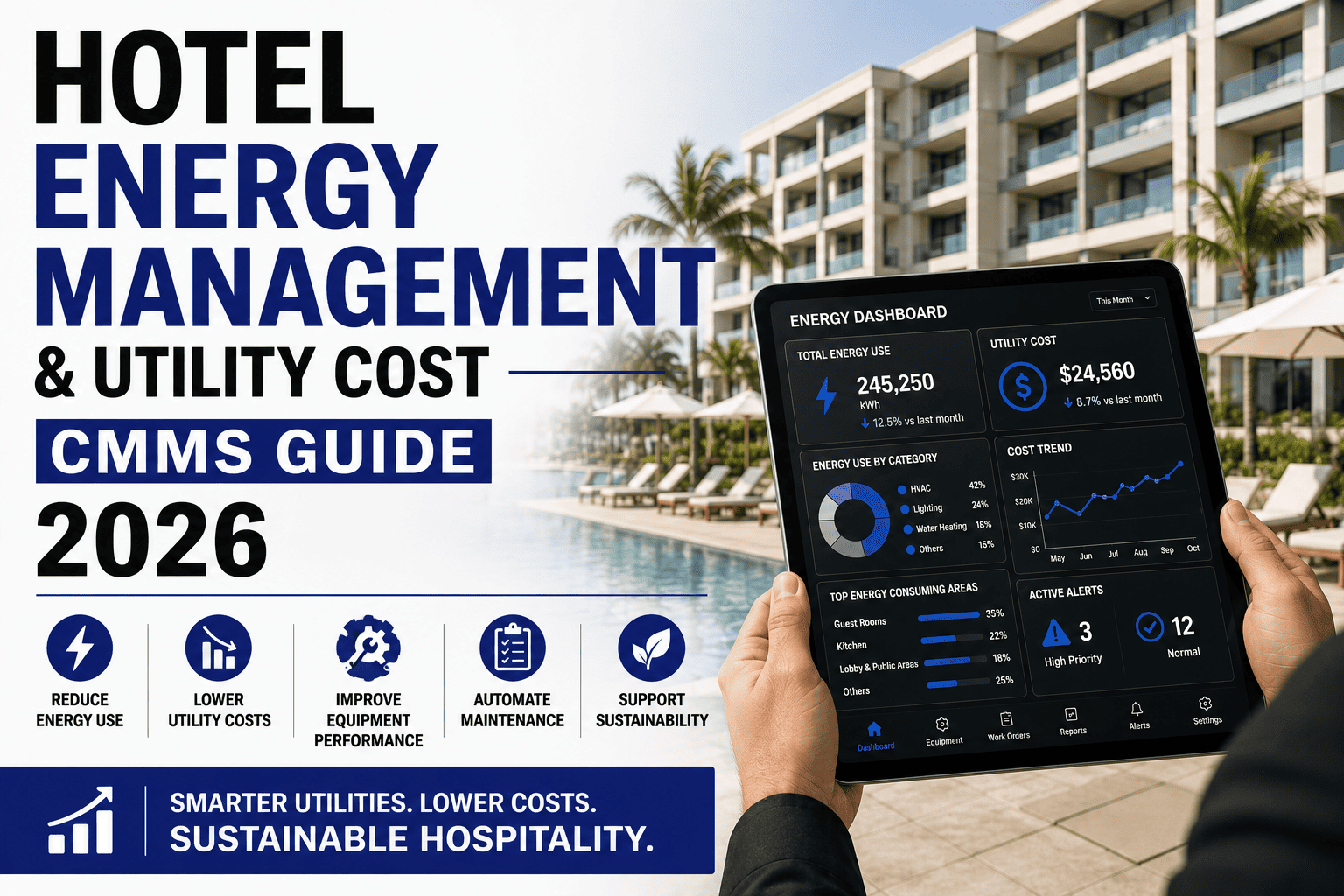
Live energy consumption by property, floor, system, and room type. Cost-per-occupied-room benchmarked across the portfolio daily — not monthly after the invoice arrives.
CMMS Work Order Integration
IoT energy anomalies auto-generate CMMS work orders with the unit ID, consumption deviation, and suggested resolution — closing the gap from detection to technician dispatch to under 2 hours.
See How OxMaint Cuts Hotel Energy Costs by 30%
IoT integration, HVAC optimization, and a live Energy Analytics Dashboard — deployed across your full property portfolio without replacing existing building infrastructure.
Implementation: 6 Weeks to Live Energy Intelligence
Weeks 1–2
Energy Baseline Audit and Asset Registry
All 340 HVAC units across 18 properties registered in OxMaint with manufacturer specs, install dates, and historical maintenance records. Utility bill data imported to establish 12-month energy baseline per property. IoT node installation begun at the three highest-cost properties simultaneously.
Weeks 3–4
IoT Node Deployment and PMS Integration
IoT nodes installed on all 340 HVAC units chain-wide. PMS occupancy data feed connected to OxMaint's HVAC optimization engine at all 18 properties. Setback schedules configured: vacant rooms set to 78°F cooling / 65°F heating. Live energy consumption feed active within 72 hours of node installation.
Week 5 — The Discovery That Changed Everything
11 Units Identified Consuming 38% Above Baseline — Guests Had Not Complained
The Energy Analytics Dashboard flagged 11 HVAC units across 4 properties running at 28 to 41% above their modelled energy consumption baseline. Engineering inspection found: 6 units with severely fouled evaporator coils, 3 with refrigerant loss, 2 with failed economisers. All 11 had received satisfactory maintenance sign-offs on paper 60 days earlier. Combined excess energy spend: $34,200 in the prior 90 days. Resolution cost: $8,800. The 11 units were the single biggest driver of the per-property energy cost variance.
Week 6
Energy Analytics Dashboard Live — Portfolio-Wide Visibility
Full Energy Analytics Dashboard live for the VP of Engineering and all 18 property directors. Real-time cost-per-occupied-room by property. Daily energy anomaly alerts active for all 340 units. Automated work orders firing to engineering teams within 2 hours of a consumption anomaly breaching the 15% threshold.
Months 3–13
Optimization Compounds — 30% Reduction Confirmed at Month 13
Occupancy-linked setback alone delivered 14% energy reduction in month one. Predictive HVAC maintenance alerts prevented 12 unit failures that would have required emergency replacement. By month 13, total energy cost reduction reached 30% against the 12-month baseline — $1.26M in documented annual savings.
Results: 13-Month Outcomes Across 18 Properties
Energy Cost Reduction
30%
Total portfolio energy spend fell from $4.2M to $2.94M — $1.26M in documented annual savings
Per-Room Cost Variance
<8%
Down from 47% variance at baseline — the portfolio now operates within a consistent energy efficiency band
HVAC Work Order Reduction
44%
Reactive HVAC work orders fell 44% as predictive alerts caught degradation 18 to 30 days before failure
$34.2K
Excess energy spend recovered from the 11 Week 5 anomaly units alone — in the first 90 days
14%
Energy reduction in month one from occupancy-linked setback scheduling alone — before any maintenance optimisation
12
HVAC unit failures prevented by predictive alerts — avoiding an estimated $290K in emergency replacement and guest disruption costs
2 hrs
Average time from IoT energy anomaly detection to technician on-site — down from 23-day reactive detection lag
Before and After: Key Metrics
| Metric |
Before OxMaint |
After 13 Months |
| Annual energy spend |
$4.2M — no attribution by system |
$2.94M — 30% reduction documented |
| Per-room energy cost variance |
47% between best and worst property |
Under 8% — portfolio operating consistently |
| HVAC anomaly detection time |
23 days average — after guest complaint |
Under 2 hours — IoT alert to work order |
| Vacant room HVAC setback |
None — full conditioning 24 hours |
Automatic occupancy-linked setback active |
| Reactive HVAC work orders |
Baseline volume — 100% reactive |
44% fewer — majority now predictive |
| Energy visibility |
Monthly invoice — single number, no attribution |
Live dashboard — by property, floor, unit, room type |
| HVAC emergency replacements |
Untracked — absorbed into maintenance budget |
12 failures prevented — $290K cost avoided |
Total Deployment Cost
$430,000
IoT nodes, OxMaint licence, installation, and training across 18 properties
Year 1 Documented Savings
$1.55M
$1.26M energy reduction + $290K avoided emergency HVAC replacement costs
Full Payback Period
4.1 months
Week 5 anomaly discovery alone recovered $34K — validating ROI before full deployment completed
"Our finance team had been looking at a $4.2 million energy line for three years and accepting it as a fixed cost of operating 18 hotels. It was not a fixed cost — it was a management failure. The OxMaint dashboard showed us, within the first week, that 11 of our HVAC units were running nearly 40% above their designed consumption. Those 11 units had all been signed off by maintenance as in good condition. The gap between what the paper said and what the IoT data showed us was the most important thing we learned in that entire first year."
VP of Engineering
Hotel Management Company — 18 Properties, 4,200 Rooms
Platform Features for Hotel Energy Management
IoT Integration Layer
Connects to existing HVAC controllers via plug-in nodes. No BMS replacement required. Live consumption data from 340 units flowing within 72 hours of installation.
HVAC Optimization Engine
PMS-linked occupancy setback active on every vacant room. Anomaly alerts at 15% above baseline consumption. Predictive maintenance work orders generated automatically.
Energy Analytics Dashboard
Live cost-per-occupied-room across the full portfolio. Benchmarked daily — not monthly. Per-room variance collapsed from 47% to under 8% using dashboard-driven interventions.
Automated Energy Work Orders
IoT anomaly triggers work order with unit ID, consumption deviation percentage, and suggested action — dispatched to technician within 2 hours. Zero manual detection required.
Sustainability Reporting
Carbon equivalent calculations from energy consumption data. Month-on-month and year-on-year energy intensity reports exportable for ESG disclosure, franchise reporting, and investor briefings.
Cross-Property Benchmarking
Energy cost per occupied room ranked and compared across all portfolio properties daily. Underperforming properties surfaced automatically — enabling targeted intervention before the monthly invoice.
Energy Compliance and Sustainability Coverage by Region
| Region |
Applicable Frameworks |
OxMaint Coverage |
| USA |
ENERGY STAR for Hotels, ASHRAE 90.1, DOE Building Energy Codes, EPA ENERGY STAR Portfolio Manager |
ENERGY STAR score tracking, ASHRAE 90.1 baseline benchmarking, EPA Portfolio Manager data export |
| UK |
ESOS Phase 3, MEES regulations, EPC requirements, SECR reporting, net zero pathway documentation |
ESOS audit data package, MEES compliance tracking, SECR energy intensity reporting, EPC asset records |
| EU |
EU Energy Efficiency Directive (EED), CSRD energy disclosure, EU Taxonomy climate criteria |
EED audit data, CSRD energy consumption metrics, EU Taxonomy alignment documentation for ESG reporting |
| UAE & KSA |
Dubai Green Building Regulations, Estidama Pearl, Saudi Vision 2030 sustainability targets, DEWA requirements |
Pearl rating compliance records, DEWA consumption tracking, green building performance documentation |
| Australia |
NABERS Energy, NCC Section J, CBD Program disclosure requirements, State energy efficiency obligations |
NABERS data package, Section J compliance records, CBD Program consumption reporting, state disclosure export |
| India |
BEE Energy Conservation Building Code (ECBC), star rating programme, Bureau of Energy Efficiency audits |
ECBC compliance tracking, BEE star rating data, energy audit documentation for mandatory BEE submissions |
OxMaint's Energy Analytics Dashboard produces audit-ready energy consumption records for ENERGY STAR, ESOS, CSRD, NABERS, and BEE frameworks — from the same IoT data feed your engineering team uses for daily HVAC optimization.
Frequently Asked Questions
What Hotel Engineering Teams Ask Before Deploying IoT Energy Management
QDoes OxMaint's IoT integration require replacing existing HVAC equipment or building management systems?
No existing equipment needs to be replaced. OxMaint's IoT nodes are plug-in devices that connect to existing HVAC controllers via standard communication protocols — including BACnet, Modbus, and direct sensor tap points. The 18-property deployment in this case study installed nodes on 340 units without replacing a single HVAC unit, BMS controller, or building automation component. Installation per unit takes 20 to 45 minutes depending on access and controller type. Total installation cost across the portfolio was $148,000 — compared to the $2.8M BMS replacement quote the company had received from a competing platform.
Sign up free to review the IoT node compatibility list, or
book a demo to assess compatibility with your existing HVAC infrastructure.
QHow does the HVAC optimization engine know when a room is occupied without installing in-room sensors?
OxMaint's HVAC optimization engine connects directly to the property management system via API to read real-time room status — checked-in, checked-out, or reserved. Room status drives automatic setback scheduling without requiring any in-room occupancy sensors, motion detectors, or keycard interlock hardware. For properties that want a higher granularity occupancy signal, OxMaint also integrates with keycard door systems and in-room thermostat data where these exist. In this case study, all 18 properties used PMS integration only — no additional in-room hardware was installed.
Book a demo to see the PMS integration configuration for your system.
QHow does the Energy Analytics Dashboard handle multi-rate utility tariffs and seasonal rate variations?
OxMaint's Energy Analytics Dashboard accepts utility rate schedules including time-of-use tariffs, peak and off-peak rates, demand charges, and seasonal rate bands — configured per property based on the actual utility contract. Energy consumption data from IoT sensors is multiplied against the applicable rate for the relevant hour and demand period, producing a cost-per-unit figure that reflects your actual bill rather than a generic kWh average. This means the dashboard cost figures reconcile directly with monthly utility invoices rather than requiring a manual conversion step. For portfolios with properties in multiple utility jurisdictions — as in this case study — each property runs its own rate schedule independently.
Sign up free to explore the rate configuration module.
QWhat happens when an IoT node detects a consumption anomaly — what does the engineering team actually see and do?
When a unit breaches the consumption anomaly threshold — set at 15% above baseline in this case study — OxMaint automatically generates a work order with the unit asset ID, room number, current consumption reading, percentage deviation above baseline, and a suggested diagnostic action based on the anomaly pattern. Common patterns are pre-loaded: high current draw with normal airflow suggests coil fouling; high runtime with low temperature differential suggests refrigerant loss; normal consumption with temperature setpoint failure suggests thermostat or controls issue. The work order is pushed to the engineering technician's mobile device within the alert-to-dispatch window — 2 hours in this case study. The technician arrives with a diagnosis hypothesis rather than starting from scratch.
Book a demo to walk through a live anomaly alert to work order scenario.
QCan OxMaint's energy data be used for ESG reporting and sustainability disclosures to hotel franchise groups?
Yes. OxMaint's sustainability reporting module converts IoT energy consumption data into the standard metrics required for ESG disclosure — including energy intensity per square metre, energy intensity per occupied room, total Scope 2 carbon equivalent emissions, and year-on-year energy reduction percentage. Reports are exportable in formats accepted by ENERGY STAR Portfolio Manager, GRESB Hotel Assessment, and the major franchise sustainability programmes including IHG Green Engage, Marriott Serve360, and Hilton Travel with Purpose. The hotel management company in this case study used OxMaint energy data for their first formal sustainability disclosure in year two — the data was already structured and attributed, requiring no additional compilation effort.
Sign up free to explore the sustainability report templates, or
book a demo to confirm compatibility with your franchise reporting requirement.
30% Energy Cost Reduction. $1.26M Saved. Your Portfolio Is the Starting Point.
IoT integration, HVAC optimization, and a live Energy Analytics Dashboard — deployed across your full property portfolio in 6 weeks without replacing existing building infrastructure or management systems.
Free hotel energy cost audit included with every demo — bring your last 12 months of utility bills and we will model your savings potential.
IoT Integration
HVAC Optimization
Energy Analytics Dashboard
Predictive Maintenance Alerts
Sustainability Reporting