Energy is the second-largest controllable expense in hotel operations — after labor — and most properties are managing it the same way they managed it in 2005. Manual thermostat overrides, HVAC running in vacant rooms, lighting circuits on 24-hour timers, no correlation between occupancy data and energy dispatch. The result: energy costs running 4–6% of total revenue at select-service properties and up to 10% at full-service luxury hotels. Properties using Oxmaint's energy monitoring and BMS integration consistently achieve 20–35% utility cost reductions within 12 months of deployment — without capital-intensive equipment replacement.
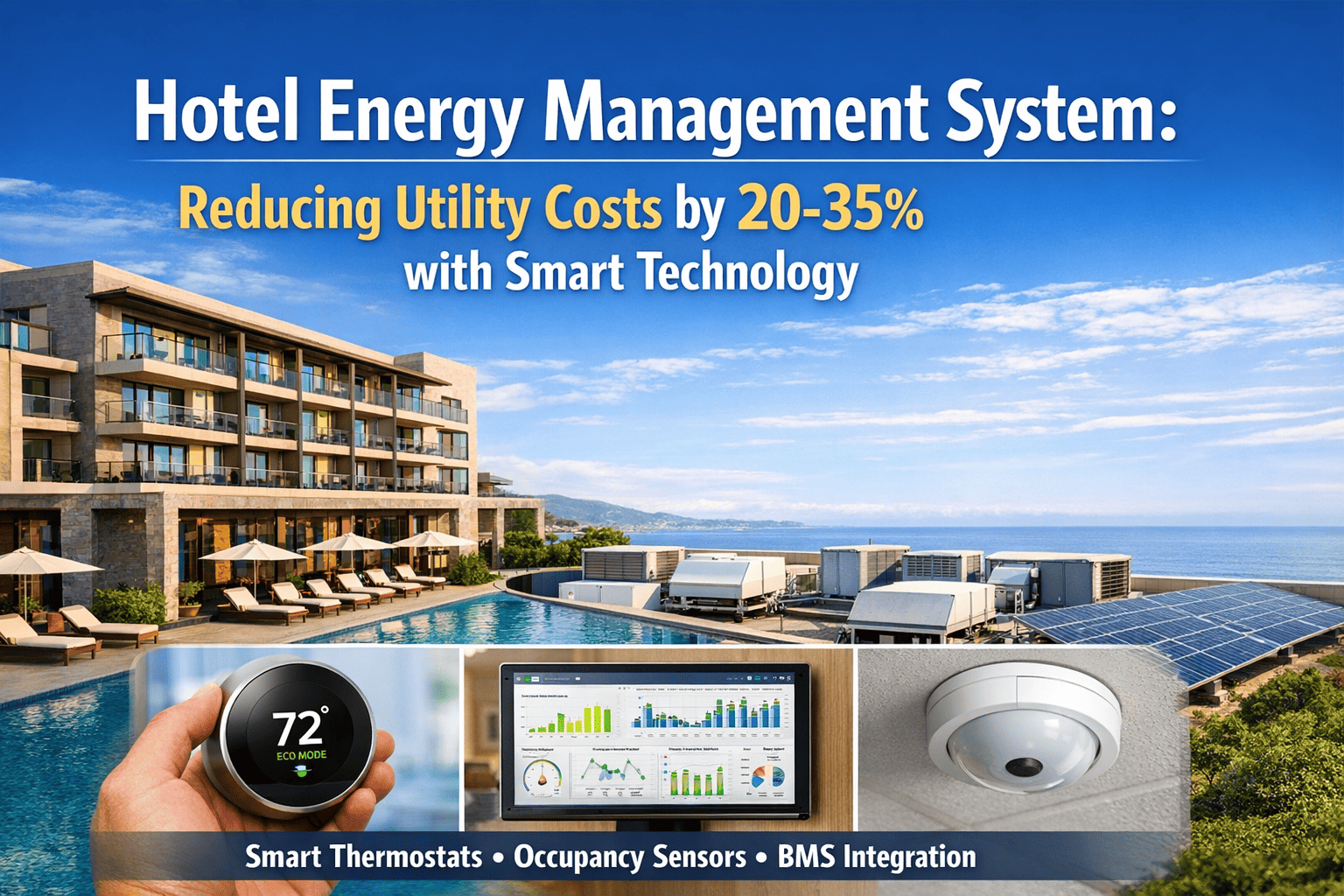
Hotel Energy Management System: Reducing Utility Costs by 20–35% with Smart Technology
Occupancy sensors, smart thermostats, BMS integration, and real-time monitoring — the four technologies that eliminate the 30–40% of hotel energy spend that currently goes to heating, cooling, and lighting rooms that have no guests in them.
Hotel Energy Cost Breakdown by System
Understanding which systems consume the most energy is the prerequisite to reducing costs intelligently. The distribution below reflects industry averages for full-service hotels — properties without sub-metering often discover their actual distribution differs significantly from these benchmarks, which itself is actionable data. Sign up to see your property's real distribution in Oxmaint's energy dashboard.
The Four Technologies That Deliver 20–35% Savings
No single technology achieves 20–35% savings. The compounding effect comes from integrating all four — occupancy data feeding thermostat setbacks, BMS coordinating system-wide dispatch, sub-metering identifying outlier systems, and a monitoring dashboard surfacing the anomalies that manual management misses entirely.
Passive infrared (PIR) sensors detect the presence or absence of guests in real time. When a room is vacant, they trigger an immediate HVAC setback — typically to 65°F in summer, 80°F in winter — and dim or extinguish lighting automatically. When a guest enters, the room returns to comfort setpoint within 8–12 minutes. This single technology eliminates the estimated 35% of HVAC energy consumed by rooms that housekeeping or the previous guest left conditioned but which remain unoccupied for 4–8 hours between arrivals.
A smart thermostat connected to the Property Management System knows when a room is assigned, when a guest is expected to check in, and when checkout is confirmed. Rather than reacting to occupancy after the fact, the system pre-conditions rooms 30–45 minutes before scheduled arrival — maintaining guest comfort while eliminating the extended conditioning of empty rooms. When checkout is confirmed at the front desk, the thermostat immediately sets the room to a holding setback without waiting for housekeeping to visit. The energy savings compound across the entire room inventory every day.
A BMS integrates all building mechanical systems — HVAC, lighting, elevators, domestic hot water, and pool plant — into a single control layer. When properly programmed with occupancy and demand data, a BMS executes coordinated load-shedding strategies during peak utility pricing windows, sequences equipment startups to prevent demand spikes, and provides system-wide fault detection that prevents energy waste from malfunctioning equipment running undetected for weeks. Oxmaint connects to existing BMS platforms via API, pulling consumption data into the maintenance dashboard so engineers correlate energy anomalies with equipment work order history automatically.
A single utility meter tells you what you spent. Sub-metering tells you where you spent it — by floor, by system, by time of day. Hotels with sub-metering discover patterns invisible on aggregate bills: a kitchen exhaust fan running overnight when the restaurant is closed, a walk-in cooler compressor cycling twice as often as expected, a guest floor consuming 40% more energy than comparable floors for no apparent reason. Oxmaint's energy monitoring module surfaces these anomalies as maintenance alerts — connecting the energy data directly to the work order system so the issue is investigated the same day it appears.
For a 200-room property, that's $440,000 per year in energy spend before a single efficiency measure is applied. A 25% reduction — consistently achieved within 18 months of smart system deployment — returns $110,000 annually on an investment that typically costs $80,000–$140,000 to deploy. The payback period for most hotel energy management projects falls between 12 and 24 months. After payback, the savings compound indefinitely against rising utility rates. Start monitoring your property's energy spend in Oxmaint — free.
What Changes When You Deploy a Hotel Energy Management System
The differences between managed and unmanaged hotel energy are not marginal. They compound daily across every system in the building — and they appear in the monthly utility bill before any other operational metric reflects them.
| Operational Area | Without Energy Management | With Smart EMS + Oxmaint | Typical Saving |
|---|---|---|---|
| Vacant Room HVAC | Rooms conditioned at full setpoint 24/7 regardless of occupancy | Setback triggered within 5 minutes of confirmed vacancy | 25–35% |
| Corridor Lighting | Full illumination 24 hours on time-clock circuits | Occupancy-dimmed to 30% at night; full level on motion | 40–55% |
| Check-In Pre-Conditioning | Room conditions at whatever the last guest or housekeeper set | PMS-triggered pre-conditioning 30 minutes before arrival | 15–22% |
| Fault Detection | Malfunctioning equipment found weeks later via guest complaint | Anomalous energy draw generates Oxmaint work order within 24 hours | 8–15% |
| Peak Demand Charges | Uncoordinated equipment startups create demand spikes at full rate | BMS sequences startups to stay below demand threshold | 10–18% |
| Pool and Amenity Energy | Variable speed pumps and heaters on fixed 24-hour schedules | Demand-linked operation tied to facility usage hours and occupancy | 30–40% |
| Combined system-level savings consistently deliver 20–35% total utility cost reduction within 18 months. Book a demo to see how Oxmaint tracks savings against your baseline. | |||
From Baseline Audit to 20–35% Savings: A 12-Month Deployment Sequence
Most hotel energy management projects stall at the planning stage because the full scope feels overwhelming. The sequence below breaks deployment into four sequential phases — each with a defined deliverable and measurable outcome — so progress is visible at every step.
Establish consumption baselines by system using utility data and temporary sub-metering where permanent meters are not yet installed. Identify the top three energy waste sources. This audit data becomes the benchmark against which all future savings are measured and reported to ownership.
Install PIR occupancy sensors and smart thermostats in all guest rooms, beginning with high-occupancy floors where the savings impact is highest. Connect thermostats to the PMS for arrival and departure-linked setback. The first utility bill after full deployment typically shows 15–20% HVAC savings.
Connect the BMS to Oxmaint's monitoring layer. Configure demand management schedules for peak utility pricing windows. Set up automated equipment sequencing to prevent startup demand spikes. Define energy anomaly thresholds that generate Oxmaint work orders when consumption exceeds expected ranges.
Compare utility spend against pre-deployment baseline for each system. Identify remaining savings opportunities and refine setback schedules based on 6 months of actual occupancy pattern data. Produce a savings report for ownership with system-level attribution. Most properties reach 20–35% total savings by month 12. Oxmaint generates savings reports automatically from your energy monitoring data.
What Oxmaint Adds to Your Energy Management System
Consumption by system, by floor, and by hour — all visible in one dashboard alongside work order status and PM schedules. Engineers see energy anomalies the same day they appear, not at the next utility bill.
When a system draws more energy than its baseline profile predicts, Oxmaint generates a maintenance work order automatically — routed to the on-call engineer with the anomaly data and asset history attached. The fault is investigated the same day, not the same month.
Every utility bill is compared against the pre-deployment baseline automatically. Ownership reports show savings by system with attribution — HVAC savings from occupancy sensors, lighting savings from LED and sensor retrofit, demand charge reductions from BMS sequencing. The data is always ready, never assembled manually.
Oxmaint connects to major BMS platforms — Siemens Desigo CC, Johnson Controls Metasys, Honeywell EBI, and others — as well as PMS platforms including Oracle Opera, Mews, and Cloudbeds. Occupancy data, system status, and energy consumption flow into a single platform without manual data entry or separate dashboards. Book a demo to confirm integration with your existing systems.
We were spending $380,000 a year on energy across 165 rooms. After deploying occupancy sensors in all rooms and connecting our BMS to Oxmaint's monitoring layer, our first full-year utility cost was $268,000. That's $112,000 back. The payback period on our total investment was 14 months. Our chief engineer now spends about 20 minutes a week reviewing the energy dashboard instead of the 4 hours a week he used to spend manually pulling data from four different systems to build a report nobody could act on anyway.