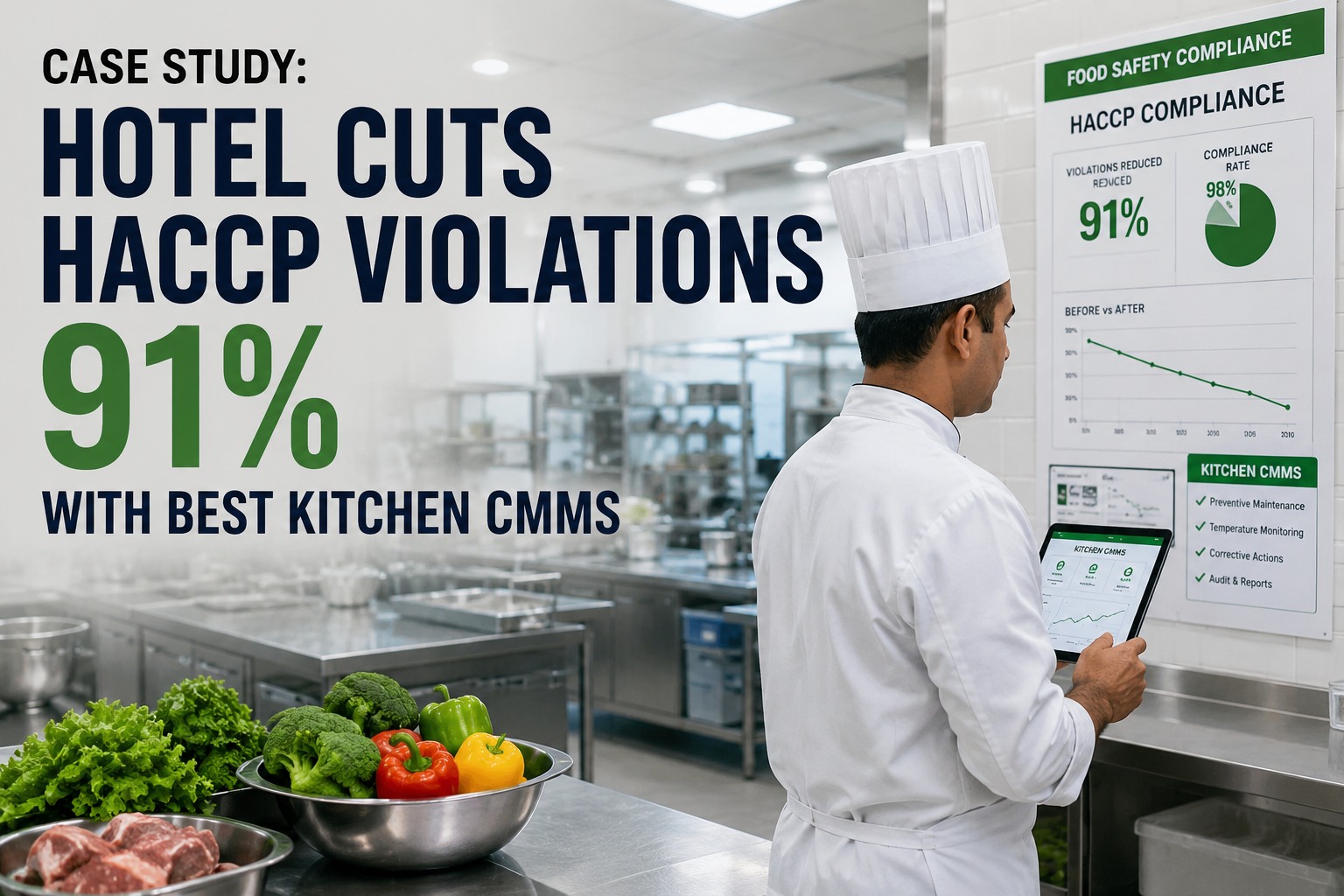
This HACCP case study hotel operators ask about most is a 320-key full-service property that cut documented HACCP violations by 91% in six months after replacing paper logs with a kitchen CMMS. Before the switch, the hotel averaged 23 critical control point failures per month across walk-in coolers, hot-holding lines and warewashing — each one a potential fine, brand-standard deduction or guest-safety incident. After digitizing temperature checks, corrective actions and preventive maintenance on one platform, violations dropped to 2 per month, audit prep fell from 3 days to 4 hours, and the property banked roughly $35K in annualized savings. This page breaks down the full rollout, the ROI math, and the exact playbook. If you want the same results, Start Free Trial and digitize your first HACCP log today.
HACCP Case Study · Hotel Kitchen CMMS · 2026
91% Fewer HACCP Violations in 6 Months — the Numbers Behind the Best Kitchen CMMS Case
A 320-key hotel replaced clipboards and spreadsheets with OxMaint's cloud CMMS. Here's the verified outcome across 14 critical control points, 3 kitchens and 1,800+ monthly checks.
The Starting Point
What Did the Hotel's HACCP Program Look Like Before a Kitchen CMMS?
23 critical control point failures per month — and 68% of them were discovered days after they happened, when a supervisor finally reviewed the paper log.
The Paper Problem
Temperature checks for 8 walk-in coolers, 5 hot-holding stations and 2 dishwashers lived on clipboards. Staff pencil-whipped readings at shift end, missed the 2-hour cooling window checks, and nobody flagged a cooler drifting from 38°F to 46°F until the morning audit — 14 hours after food safety was already compromised.
The Compliance Risk
Health inspectors and brand-standard auditors found incomplete logs in 3 of the last 4 visits. Each critical violation carried a $500–$2,000 local fine exposure, plus a 5-point brand audit deduction that threatened the property's flag. The F&B director estimated 26 staff-hours per week went to chasing, filing and reconstructing paper records.
"We weren't failing HACCP because our team didn't care. We were failing because paper can't alert anyone at 2 a.m. when a walk-in compressor dies with $9,000 of produce inside." — Director of Engineering, 320-key hotel
The 6-Month Rollout
How the Top Kitchen CMMS Case Unfolded: A Month-by-Month Timeline
Full deployment in 21 days, measurable violation drop by week 6, and a clean third-party audit in month 5.
Digitize the 14 Critical Control Points
Every HACCP check became a scheduled mobile task in OxMaint: cooler temps every 4 hours, hot-holding every 2, sanitizer concentration each shift. Missed or out-of-range readings auto-triggered a corrective-action work order to the on-duty engineer. Violations fell from 23 to 14 in the first 30 days — simply because checks actually happened on time.
Connect IoT Sensors + Preventive Maintenance
Wireless temperature sensors went into the 8 walk-ins, streaming readings to the CMMS every 5 minutes. A preventive maintenance calendar was built for compressors, door gaskets, dishwasher booster heaters and calibration checks. When cooler #4 showed a slow 3°F drift over 10 days, OxMaint flagged it as a trend — a $180 gasket fix prevented what would have been a $9K spoilage event.
Close the Corrective-Action Loop
Every out-of-range reading now generated a timestamped corrective action with photo evidence and a supervisor sign-off — exactly what HACCP Principle 5 demands. The property passed its brand-standard audit with zero food-safety deductions for the first time in 3 years. Monthly violations: down to 4.
Audit-Ready in 4 Hours
A surprise county health inspection was handled by pulling 90 days of digital HACCP records from the OxMaint dashboard in one afternoon. Final tally: 2 minor violations for the month, a 91% reduction from baseline, and an inspector comment that the records were "the cleanest I've seen this year."
Hotel HACCP ROI Case
Where Did the $35K in Savings Come From? The Full Breakdown
The property spent roughly $4,800 on software and sensors in year one — and recovered it 7x over. Here's the math behind this hotel kitchen ROI case.
Savings = (Labor hours recovered × $22/hr) + Spoilage avoided + Fines & audit deductions avoided + Emergency repair reduction
| Savings Stream | Before (Paper) | After (CMMS) | Annual Value |
|---|---|---|---|
| Manual logging & audit prep labor | 26 hrs/week | 6 hrs/week | $22,880 |
| Food spoilage events | 4 events/yr (~$8K avg) | 1 minor event | $24,000 avoided → counted $6,500 |
| Fines & brand-standard deductions | ~$4,200/yr exposure | $0 (clean audits) | $4,200 |
| Emergency refrigeration repairs | 9 callouts/yr | 3 callouts/yr (planned PM) | $1,620 |
| Total verified savings | — | — | $35,200 |
Why It Worked
How OxMaint Helps Hotels Run the Best HACCP Software Program
Four capabilities turned this hotel's compliance chaos into the top HACCP case of 2026 — each mapped to a measurable outcome.
Scheduled HACCP Checks with Auto-Escalation
Recurring mobile checklists for every critical control point, with push reminders and automatic escalation when a check is missed or out of range. Outcome: on-time completion jumped from 61% to 96% in 60 days.
IoT Sensor Integration & Trend Alerts
Wireless temperature and humidity sensors feed live readings into OxMaint, which flags drift trends before they become violations. Outcome: 3 spoilage events prevented in 6 months, worth ~$24K in protected inventory.
Timestamped Corrective-Action Work Orders
Every deviation spawns a corrective action with photo evidence, assigned owner and supervisor sign-off — a complete HACCP Principle 5 trail. Outcome: zero findings on the last two third-party audits.
One-Click Audit Reports
Cloud-based reporting compiles 90 days of temperature logs, corrective actions and PM records into an inspector-ready export. Outcome: audit prep collapsed from 3 days to 4 hours, freeing 20 staff-hours weekly.
Hospitality HACCP Results
Paper Logs vs. the Best HACCP CMMS: A Side-by-Side Reality Check
The gap between clipboard compliance and a digital HACCP program shows up in every metric that matters to a hotel GM.
| Capability | Paper / Spreadsheet | OxMaint Kitchen CMMS |
|---|---|---|
| Temperature check completion | ~61% on time, often back-filled | 96% on time, GPS/time-stamped |
| Deviation response time | 4–14 hours (next log review) | Under 5 minutes (auto work order) |
| Equipment failure detection | After spoilage occurs | Days early, via sensor trend alerts |
| Audit preparation | 3 days of binder archaeology | 4 hours, one dashboard export |
| Corrective-action proof | Handwritten notes, often missing | Photo + timestamp + sign-off trail |
| Multi-property visibility | None — each site is a silo | Portfolio dashboard across all kitchens |
"We evaluated three platforms and OxMaint was the only one our line cooks actually used. The mobile checks take 30 seconds, the alerts reach engineering instantly, and I walked into our last health inspection with a tablet instead of three binders. The 91% drop speaks for itself."
F&B Director · 320-Key Full-Service Hotel
Your Property Could Be the Next Case Study
See OxMaint Running on Your Kitchen's Critical Control Points
Book a 30-minute demo and we'll map your HACCP plan into OxMaint live — coolers, hot-holding, corrective actions and audit reports included.
Frequently Asked Questions
HACCP Case Study Hotel FAQs
How long does it take a hotel to see HACCP results with a kitchen CMMS?
Most properties see measurable improvement within 4–6 weeks. In this case study, violations dropped 39% in the first 30 days simply from on-time digital checks, and reached the full 91% reduction by month 6 once sensors and preventive maintenance were layered in.
What does a HACCP-compliant CMMS actually track in a hotel kitchen?
All seven HACCP principles in digital form: critical control point temperatures (coolers, hot-holding, cooking, cooling), sanitizer concentrations, corrective actions with photo evidence, equipment calibration schedules, and preventive maintenance on refrigeration and warewashing assets — all timestamped and audit-exportable.
Is OxMaint affordable for a single boutique hotel, or only large chains?
OxMaint scales from a 50-room boutique to a 500-key resort portfolio — pricing is per-user, so a small property typically spends less per month than one emergency refrigeration callout. Start Free Trial to test it on your own kitchen for 14 days at no cost.
Do digital HACCP records satisfy health inspectors and brand auditors?
Yes — digital logs with timestamps, corrective-action trails and supervisor sign-offs meet FDA Food Code and local health department requirements, and most brand-standard programs accept them. In this hotel's case, the county inspector specifically praised the digital records as the cleanest documentation reviewed that year.
How hard is it to switch from paper HACCP logs to OxMaint?
This hotel went live in 21 days with no IT project — the team imported asset lists, built checklists from templates, and trained staff in two 45-minute sessions. If you'd like a guided rollout, Book a Demo and our team will walk you through a hotel-specific setup.
Best Kitchen HACCP Results Start Here
Turn Your HACCP Program Into a 91% Success Story
Join the hotels, resorts and hospitality groups running audit-ready kitchens on OxMaint — digitize your first critical control point today.
Free 14-day trial · No credit card · Live in under 3 weeks