At 3:22 AM on a November night, a 12-story hotel in Atlanta received a fire alarm activation on the 9th floor. The chief engineer arrived at the fire alarm control panel in 4 minutes. The panel showed a single smoke detector in room 912 — but the zone map on the panel was handwritten on a laminated card taped to the inside of the cabinet door, outdated since a renovation 14 months earlier. He could not confirm whether the adjacent stairwell pressurization system had activated. The PA system microphone produced static. Forty-one guests were evacuated into a November night while the fire department cleared a burnt bag of microwave popcorn. The evacuation took 22 minutes. Standard for a clear event is 8. No injury occurred — but the after-action review found that four of the seven emergency systems tested that night had undocumented maintenance gaps. Any one of them could have been the system that failed when it was not a bag of popcorn. Build your hotel emergency system maintenance program in Oxmaint — free to start.
The Seven Hotel Emergency Systems — What Each Does and What Happens When It Fails
The fire alarm control panel is the central nervous system of every hotel emergency response — it receives signals from every smoke detector, pull station, sprinkler flow switch, and duct detector in the building, processes them against its zone programming, and triggers notification to guests, staff, and the monitoring station. A panel with outdated zone maps, failed initiating device circuits, or a monitoring connection that has lapsed produces the exact failure scenario in the Atlanta incident: an activated panel that cannot be correctly read by the responding engineer.
NFPA 72 requires annual testing of all initiating devices, notification appliances, and the monitoring connection — with quarterly testing of supervisory signals and visual inspection of the panel itself. The zone map inside the panel cabinet must be current — updated whenever detector locations change due to renovation or layout modification. Track FACP inspection as a named asset with annual and quarterly test records in Oxmaint.
The voice evacuation system is the primary communication tool during any emergency requiring coordinated guest movement. A PA system with amplifier degradation, corridor speaker failures, or a microphone that produces static — as in the Atlanta incident — cannot deliver the clear, intelligible voice instructions that reduce evacuation time and prevent stairwell crowding. NFPA 72 Chapter 24 requires annual testing of all speakers for intelligibility and adequate sound pressure level in all areas of the building. Schedule annual PA system testing in Oxmaint — sign up free.
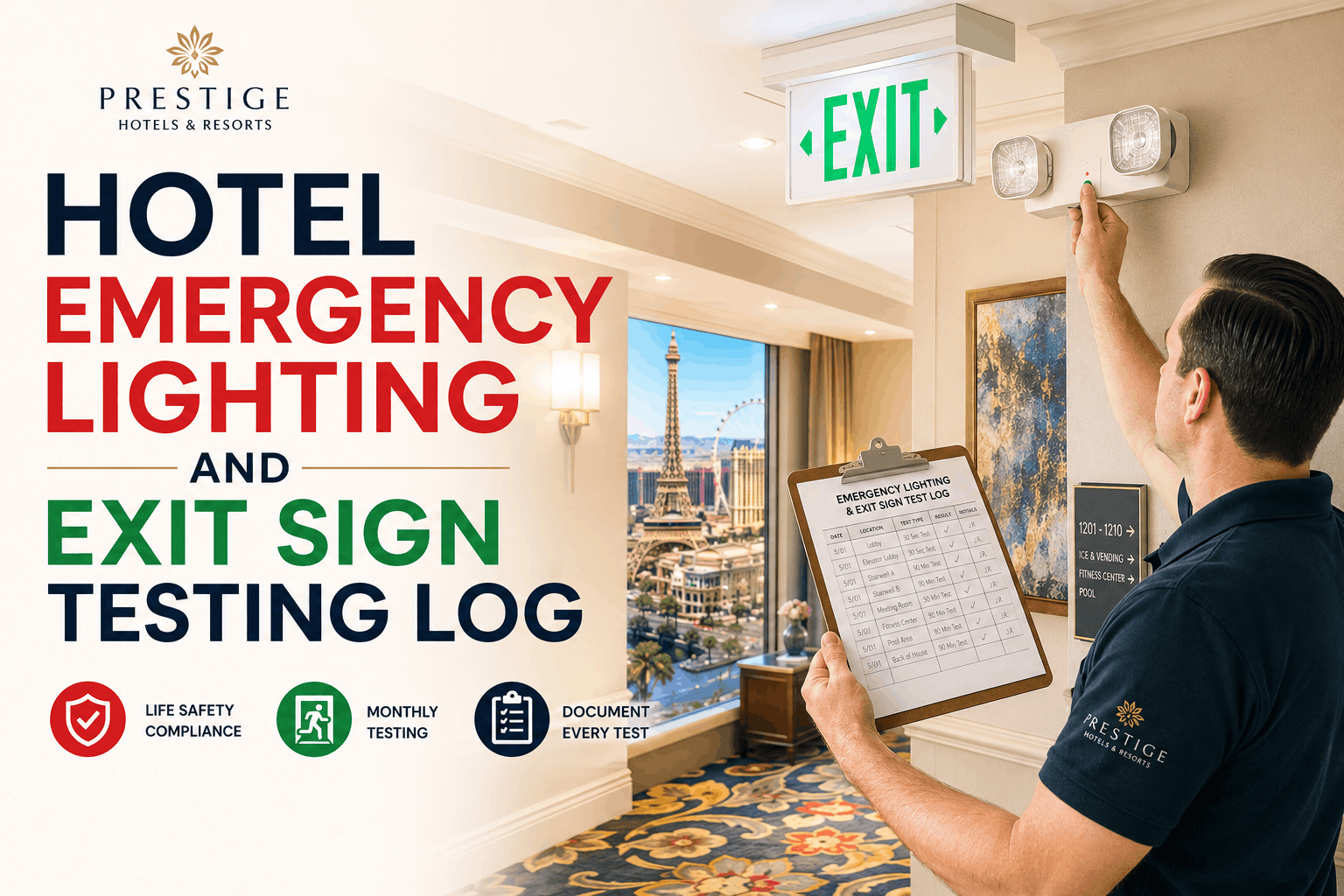
Emergency lighting illuminates the path from guest rooms to exits when normal power fails. Exit signs mark the route. Both are powered by battery backup that activates within 10 seconds of power loss. NFPA 101 requires monthly 30-second battery tests and annual 90-minute full discharge tests for every unit in the building. A hotel with 180 rooms has 60–90 emergency lighting and exit sign units — each on its own battery backup, each with its own test record requirement. The annual 90-minute test is the one most frequently deferred and most frequently cited in NFPA 101 enforcement. See how Oxmaint schedules and documents the annual 90-minute test for every unit — book a demo.
Stairwell pressurization systems maintain positive air pressure in enclosed stairwells during a fire event — preventing smoke infiltration into the evacuation path. In a high-rise hotel, a stairwell contaminated with smoke becomes an unusable egress route. The pressurization system is one of the least-tested emergency systems in hotel maintenance programs because it requires a specialized contractor and a building-wide test that disrupts operations. Annual testing is required by NFPA 92 and IBC — and the test record must confirm that the specified pressure differential is achieved with all stairwell doors closed and with representative doors open in the fire zone. Track stairwell pressurization as a named system asset in Oxmaint with annual test scheduling.
The sprinkler system is the primary life safety system in any hotel — it suppresses or controls fire spread before evacuation is complete and before the fire department arrives. NFPA 25 requires weekly visual inspection of control valves (verifying open position), quarterly waterflow alarm testing, and annual internal inspection of the system. A single closed control valve — found in 12% of NFPA 25 inspections at hotel properties — renders an entire zone of the sprinkler system non-functional without triggering any alarm. Weekly valve inspection takes 10 minutes and is the single most important weekly inspection task in hotel fire safety. Book a demo to see weekly sprinkler control valve inspection scheduling in Oxmaint.
Elevators must respond to fire alarm activation with automatic Phase I recall — returning to the designated recall floor and disabling normal operation. A Phase I recall failure means guests and staff may attempt to use elevators during an active fire event. Monthly testing of Phase I and Phase II recall, combined with annual testing of the elevator cab emergency communication system (the "call for help" button that connects to a monitoring station), is required by ASME A17.1 and local elevator code. The communication system test must confirm a live connection to the monitoring center — a disconnected monitoring subscription that nobody noticed failed this test at 31% of hotel properties in a 2023 audit survey. Log monthly elevator recall tests as recurring tasks in Oxmaint free.
The emergency generator powers all life safety systems when utility power fails — emergency lighting, the fire alarm panel, the PA system, stairwell pressurization, elevator recall, and the monitoring station connection. NFPA 110 requires monthly 30-minute loaded exercise of the generator under at least 30% of nameplate rating, and annual full-load testing for a minimum of 2 hours. A generator that starts during monthly exercise but fails under full load — a condition that occurs in 15–20% of generators that have never been annual full-load tested — is invisible to the monthly test program. The annual full-load test is the only test that reveals this failure mode. See how Oxmaint schedules NFPA 110 monthly exercise and annual full-load test with automatic completion documentation — book a demo.
What the First 30 Minutes of a Hotel Fire Evacuation Demand from Your Maintenance Program
Every second in a hotel emergency event corresponds to a specific action by a specific system or person. The maintenance program determines whether those actions are possible — not whether they are practiced. A fire drill tests whether staff know the procedure. A maintenance program determines whether the equipment cooperates when the procedure is executed. Oxmaint maintains every system so the equipment is ready when the drill becomes reality.
Fire alarm control panel receives signal and activates notification appliances throughout the building. PA system delivers pre-recorded emergency announcement on all floors. Sprinkler system begins flow if heat threshold is reached. The FACP must identify the activation zone correctly — requiring a current zone map and all initiating device circuits functional.
Automatic transfer switch detects utility power status and transfers emergency circuits to generator if power is disrupted. Stairwell pressurization system activates — fans must reach design pressure differential within 60 seconds of activation. Emergency lighting activates on battery backup within 10 seconds of normal power loss. All three of these activations are automatic — and all three fail silently if the underlying equipment has a maintenance deficiency.
The chief engineer or on-call maintenance technician arrives at the fire alarm control panel. They must be able to immediately identify the activation zone, confirm which notification circuits are active, and communicate the location to the fire department dispatcher by radio. This is the step that failed in the Atlanta incident — the zone map was outdated. A panel with a current, laminated, post-renovation zone map takes 30 seconds to read. A panel without one takes as long as the engineer needs to figure it out. See how Oxmaint links FACP documentation to the asset record — book a demo.
Guests self-evacuate through exit-marked stairwells illuminated by emergency lighting, pressurized against smoke infiltration, with elevator recall preventing elevator use. Elevator lobbies must have working Phase I recall indicators. Stairwell doors must have functional self-closing hardware — a stairwell door held open by a doorstop eliminates the pressure differential that keeps smoke out of the evacuation path. Doorstop removal and stairwell door self-closer inspection is a quarterly maintenance task that costs 15 minutes and prevents a smoke-contaminated egress route.
Industry standard for full hotel evacuation with functioning emergency systems is 8 minutes for properties up to 300 rooms. When any of the seven systems has a maintenance gap, evacuation time extends — the Atlanta incident at 22 minutes reflects four systems with undocumented gaps. Every minute beyond 8 is attributable to a specific system that was not maintained and tested on its required interval. Build the seven-system maintenance program that keeps your evacuation time at 8 minutes — start free in Oxmaint.
Fire Drills and Tabletop Exercises: What They Test and What They Don't
Fire drills test procedure. Maintenance programs test equipment. Both are required — and neither substitutes for the other. A hotel with excellent drill scores and poor emergency system maintenance is a hotel whose staff knows exactly what to do with equipment that may not cooperate. Oxmaint maintains the equipment side of emergency preparedness — sign up free.
How Oxmaint Manages Your Hotel's Emergency System Maintenance Program
Each emergency system — FACP, PA, emergency lighting bank, stairwell pressurization, sprinkler, elevator, and generator — is a named asset in Oxmaint with its own inspection schedule, service history, and regulatory test record. When the fire marshal asks for the generator's NFPA 110 test history, the complete record exports in 60 seconds. Create your emergency asset inventory free.
Weekly sprinkler valve checks, monthly generator exercises, monthly 30-second emergency lighting tests, quarterly elevator recall tests, and annual full-system tests — all scheduled at their correct intervals in Oxmaint with advance alerts 7 days and 1 day before due date. No interval is missed because it was not tracked. See interval scheduling in a live 30-minute demo.
Every test is completed from mobile with photo documentation — the generator panel reading at load, the FACP in normal status after quarterly test, the exit sign during the 30-second battery check. Photo-documented tests are the standard that fire marshals and insurance inspectors expect. Paper logs without photos are accepted — but photo documentation eliminates disputes about whether the test was actually conducted. Start photo-documented emergency testing free in Oxmaint.
When the fire marshal arrives for the annual life safety inspection, the director of engineering exports the complete emergency system maintenance history for all seven systems — covering the past 12 months, all tests, all findings, and all corrective actions — from Oxmaint in under 5 minutes. Properties with comprehensive digital records consistently receive better fire marshal inspection outcomes than properties presenting paper binders or no records. Book a demo to see the fire marshal audit export.
After the Atlanta incident we reviewed every emergency system at all 11 properties in our portfolio. We found the same pattern everywhere: tests were being conducted, but the records were handwritten, filed in binders, and not accessible to anyone outside the property. When we switched to Oxmaint, we found 3 properties with emergency lighting units that had never received the annual 90-minute test — they had been passing the 30-second monthly test for 3 years. Those units would have failed at minute 35 in an actual event. We found them during the digital audit before we needed them in a real one.