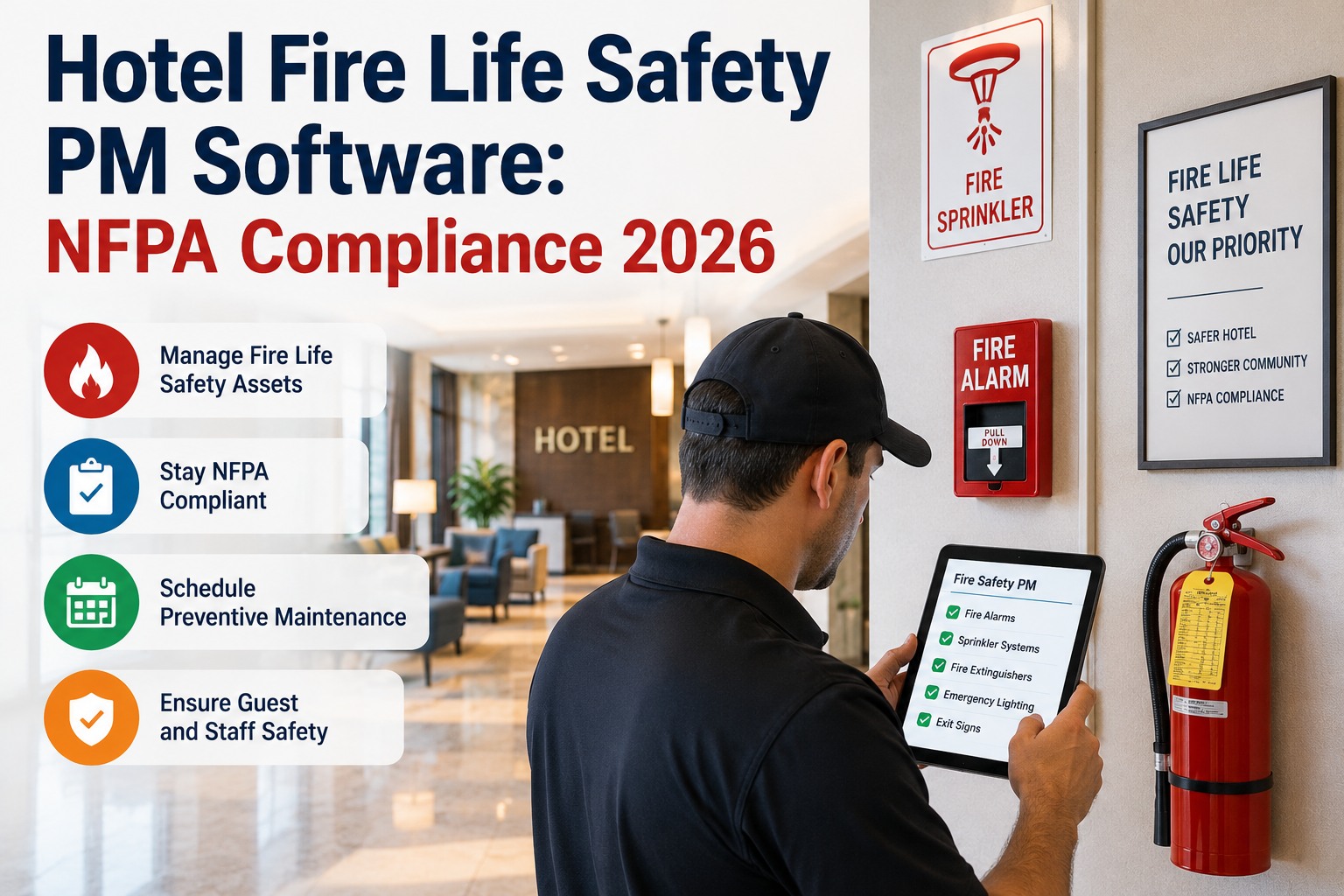
When a fire marshal or insurance underwriter walks your property, they don't ask whether your building is safe — they ask you to prove it, on paper, at the right interval, for four systems at once. The sprinkler waterflow test from last quarter. The alarm panel's annual certification. The emergency light 90-minute discharge log. The AED pad and battery expiry check. Miss the record — even for a test you actually performed — and it's cited the same as one you never ran. This guide shows how a hospitality-aware PM platform turns four separate paper trails into one audit-ready record stream. Start free or book a demo.
Hotel Fire Life Safety PM Software: One Record Stream for Every NFPA Interval
Sprinklers, alarms, emergency lights, and AEDs each answer to a different code and a different clock. OxMaint schedules every interval, captures every sign-off, and hands the auditor a complete history on demand.
The Real Problem Isn't Safety — It's Provable Safety
A hotel is classified as both assembly and residential occupancy, so multiple NFPA codes apply at once — each with its own testing cadence. Fire marshals don't grade the building; they grade the documentation. A sprinkler waterflow test completed 11 days past its 90-day interval is a violation, full stop — the same citation as a test never performed. The gap that sinks most hotels isn't neglected equipment. It's a real inspection that lives on a clipboard, a technician's phone, or a vendor's PDF nobody can produce when the inspector is standing in the lobby. Sign up free and every interval becomes a scheduled work order with a timestamped, technician-attributed record behind it.
- Test done, record lost on a clipboard or vendor PDF
- Interval missed by days — cited as never performed
- No proof of who tested, when, or the result
- Four systems, four disconnected logs, no single history
- Every interval auto-scheduled to the correct code
- Mobile sign-off required before a record can close
- Timestamp, technician, result, photo on every test
- One export covers all four asset classes at once
Four Asset Classes, Four Clocks — One Platform
The title of every hotel's compliance problem is that no single code covers everything. Sprinklers answer to NFPA 25, alarms to NFPA 72, emergency lights to NFPA 101, and AEDs to manufacturer and state guidance. Each runs on a different interval, and each generates the exact record an auditor opens first. Here's how the four lanes map — and what OxMaint tracks in each. Book a demo to see all four running on your property.
The Interval Matrix Every Compliance Calendar Rests On
Behind a defensible fire-safety program is a single truth: the right test, at the right interval, with the record to prove it. This matrix is the backbone OxMaint schedules from — each cell becomes a recurring work order with a due date, an assigned technician, and a completion record that can't be skipped. Start free and this whole matrix loads as your compliance calendar on day one.
The Inspection You Ran Perfectly Still Fails the Audit — If You Can't Find the Record.
Fire marshals cite documented-but-late and never-performed inspections identically. OxMaint schedules every NFPA interval automatically, requires mobile sign-off before any record closes, and produces a timestamped, device-level history the moment an inspector asks — across sprinklers, alarms, emergency lights, and AEDs.
The 90-Minute Test That Quietly Fails Every Hotel
Emergency lighting is the single most-cited fire-safety violation in hotels, and the reason is a trap in the physics of batteries. A degrading battery keeps passing the monthly 30-second test — sometimes for 18 months — while losing the capacity to sustain the full 90-minute discharge that NFPA 101 actually requires. The short test says "pass" right up until the annual test says "fail," and by then the citation is written. Because the 90-minute test means running the building on battery backup only, many hotels quietly skip or delay it. That gap is exactly what a scheduled, un-skippable work order closes. Book a demo to see the discharge test scheduled, logged fixture-by-fixture, and turned into remediation work orders automatically.
What the Auditor Actually Opens First
Inspectors and underwriters don't read the whole binder — they go straight to the records that reveal whether your program is real. OxMaint puts every one of these behind a QR-scannable asset with its full history attached, so producing them is a single export, not a two-day scramble. Sign up free and every fire-safety asset carries its own timestamped record from day one.
Set the schedule once, and every interval across four codes runs itself — sprinkler, alarm, emergency light, and AED records all landing in one defensible stream. Try OxMaint free or book a demo to see your property's compliance calendar built in minutes.
Our annual fire marshal visit used to cost two of us three days pulling vendor PDFs, matching them to intervals, and hoping nothing was late. Last year an emergency-light battery had been passing the monthly test for over a year — we only caught it because OxMaint forced the 90-minute discharge test and flagged four fixtures. The marshal asked for our sprinkler and AED records and I exported both from my phone in the lobby. We went from scrambling to done in ten minutes, and the one record that would have been a citation was already fixed.
Frequently Asked Questions
One Platform. Four Codes. Every Record Ready.
OxMaint schedules every NFPA interval, requires sign-off before any record closes, and produces a complete, timestamped fire-safety history the moment an auditor asks — across sprinklers, alarms, emergency lights, and AEDs. Start free — no credit card, unlimited users, forever. Or book a demo.