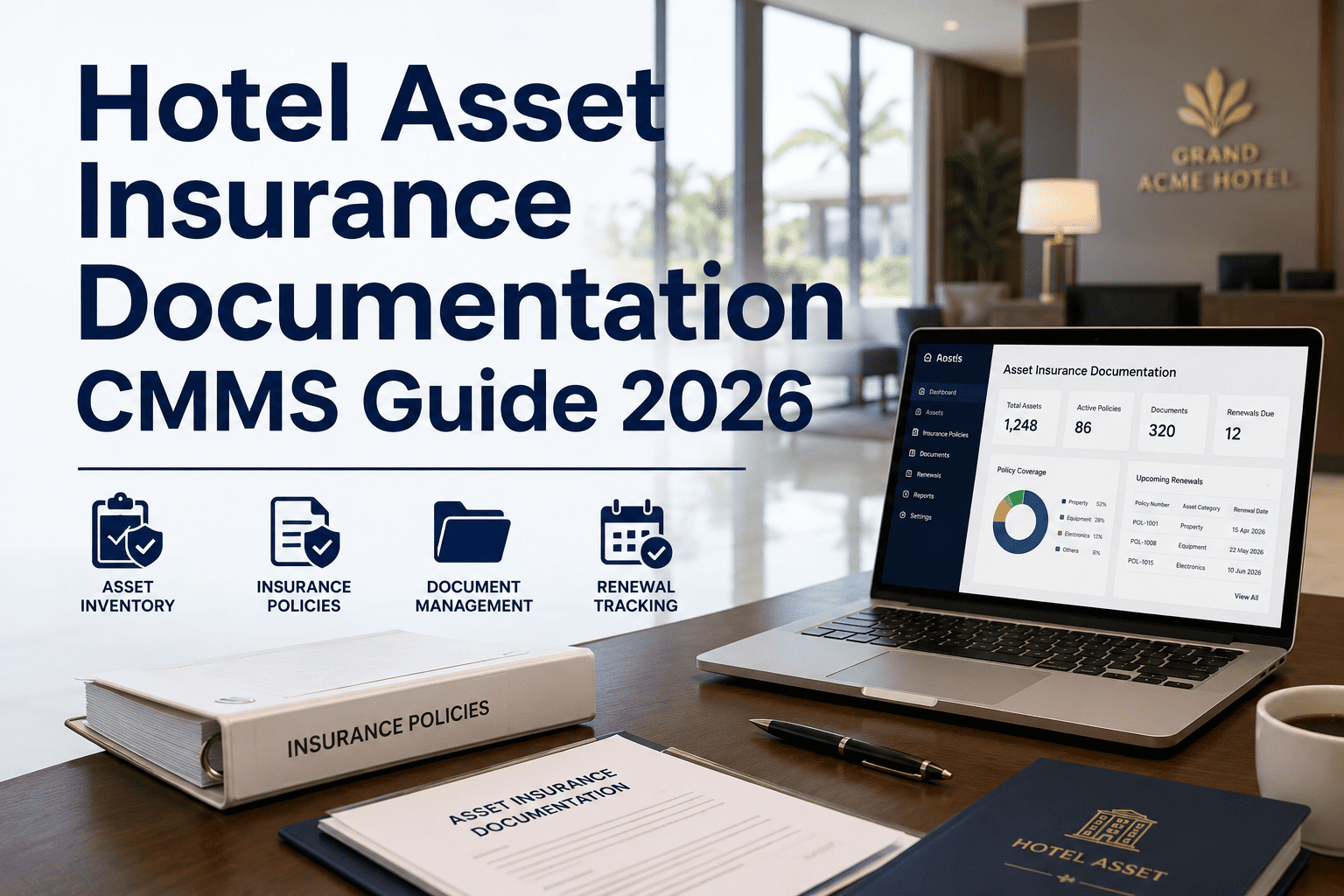
Hotel insurance premiums are not fixed costs — they are directly influenced by the quality of your maintenance documentation, inspection records, and risk management evidence. Yet most hotels hand their insurer a folder of paper logs and verbal assurances, then wonder why renewal rates climb year after year. Insurers price risk. When your documentation proves proactive maintenance, documented inspections, and a traceable repair history, they price accordingly. This guide shows exactly how hotels reduce claims, lower premiums, and survive audits using structured maintenance documentation and digital risk management tools. Start your free trial on Oxmaint or book a live demo to see how leading hotels are building insurer-grade documentation automatically.
Hotel Insurance and Risk Management:
Reduce Claims with Maintenance Documentation
Insurance Documentation · Risk Assessment Reports · Claim Prevention Analytics · Liability Reduction
When a guest files a claim, the first question your insurer asks is: what was the documented condition of that area before the incident? Without timestamped records, you have no defense — and no leverage in settlement negotiations.
Work done without a digital record might as well not have happened. Insurers assess risk on evidence, not assurances. Hotels that cannot produce inspection logs at audit time face higher premiums and reduced coverage terms.
Digital maintenance records with photo evidence and technician sign-offs shift the burden of proof in disputed claims. Documented "known condition" evidence is one of the most powerful tools in hotel liability defense.
The 4 Highest-Risk Areas in Hotel Insurance Claims
Each risk category below drives a disproportionate share of hotel insurance costs. Structured documentation in each area is not just good practice — it directly reduces your claim frequency, settlement exposure, and renewal premium.
01
Slip and Fall
Highest Claim Frequency · 35%+ of payouts
Slip, Trip and Fall Risk Documentation Checklist
Slip-and-fall claims account for over 35% of hotel liability payouts. Most are defensible — if the hotel can show documented inspection, prompt hazard correction, and consistent floor safety protocols. Sign up for Oxmaint to log floor inspections with geo-tagged photos and instant work order creation for any hazard found.
02
Property Damage
Highest Cost Per Claim · Water, HVAC, Structural
Property and Asset Protection Documentation Checklist
Property damage claims — water leaks, fire suppression failures, HVAC failures, and structural issues — are the most expensive category per event. Preventive maintenance records dramatically reduce both claim frequency and insurer liability exposure. Book a demo to see how Oxmaint builds your asset protection audit trail automatically.
03
Fire and Life Safety
Critical Liability · Largest Single-Event Payouts
Fire Safety Documentation for Insurance
Fire-related incidents trigger the largest single-event insurance payouts in hospitality. Documented fire system maintenance is your primary evidence of due diligence. Sign up for Oxmaint to maintain a complete fire safety inspection record with automatic scheduling.
04
Guest and Staff Liability
Litigation Exposure · First-Hour Documentation Critical
Liability Incident Documentation Protocol
How an incident is documented in the first hour determines how defensible it is in litigation two years later. Digital incident logs with timestamps are non-negotiable. Book a demo to see Oxmaint's incident documentation workflow.
Stop Paying for Risks You Have Already Fixed
Oxmaint builds a timestamped, photo-evidenced maintenance record across every risk area in your hotel — giving your insurer the documentation they need to price your risk accurately and giving you the defense record you need when a claim is filed.
No credit card required · Setup in under 10 minutes · Cancel anytime
Insurance Audit Readiness: What Insurers Actually Look For
When your insurer sends an auditor or requests documentation at renewal time, these are the six categories they evaluate. Hotels with digital systems retrieve every record in minutes. Hotels on paper spend days searching — and often cannot produce what is needed.
Proof that inspections happened on the stated schedule — with dates, inspector names, and signed records. A gap in the log is treated as a gap in the maintenance program.
Insurers want to see that issues found during inspections were addressed promptly. Open corrective actions with no closure date are a red flag that raises risk scores.
For every reported incident, insurers expect a timestamped record of the response — who attended, what was found, what action was taken, and how quickly the area was made safe.
Fire system certifications, elevator inspection certificates, and contractor sign-offs must be current. Expired third-party documentation is treated as a coverage gap by most insurers.
Timestamped photos of inspected areas, completed repairs, and cleared hazards provide the strongest possible documentation — showing condition at a specific point in time, not just a written entry.
Documented staff training — hazard awareness, incident response, fire evacuation — demonstrates a safety culture that insurers reward with more favorable risk classification and lower premiums.
Risk Assessment Benchmarks: Where Hotels Stand vs. Best Practice
These benchmarks reflect what leading hotel risk managers track to stay ahead of their insurer's expectations. A reading below the target range is an active premium driver — and a correctable one.
Hotels averaging below 90% scheduled inspection completion are considered high-risk by most commercial insurers during renewal assessments.
Open corrective actions older than 72 hours signal a systemic response failure to insurers — and represent ongoing liability exposure in the interim.
Incident reports filed more than 2 hours after an event are significantly harder to defend in litigation. Digital mobile logging closes this gap immediately.
Hotels where more than 50% of work orders are reactive are considered higher risk. Preventive-first operations demonstrate intent and reduce claim frequency.
When an insurer or attorney requests records, hotels using paper logs average 2 to 4 days to compile. Digital systems retrieve complete histories in seconds.
Photographic evidence attached to at least 80% of inspections and incident reports gives insurers the strongest possible risk documentation during both audits and claim disputes.
Documentation Impact: Manual Records vs. Digital Risk Management
The difference between paper and digital maintenance records is not just convenience — it is claim defensibility, premium pricing, and audit survival. This comparison shows what each approach delivers in practice.
What Oxmaint Delivers for Hotel Insurance and Risk Management
Insurance documentation is only as strong as the system generating it. Oxmaint connects inspection scheduling, digital record creation, risk reporting, and claim prevention analytics in one platform built for hotel operations.
Every inspection, repair, and corrective action is logged with date, technician name, photo evidence, and digital sign-off — automatically creating the insurer-grade documentation record your renewals depend on.
Generate property-wide risk reports on demand — showing inspection completion rates, overdue corrective actions, high-risk area status, and incident frequency — formatted for insurer submission and internal review.
Identify which areas, asset types, and maintenance gaps generate the highest incident frequency. Claim prevention analytics show where your next claim is most likely to come from — before it does.
Inspection tasks generate automatically on the correct frequency for each risk area. No deadline is missed, no area falls through, and the full schedule is documented in real time across every property.
Every inspection includes mobile photo capture with timestamps linked to the specific asset, location, and inspection record — giving you defensible condition evidence at any point in time.
Complete maintenance history for any asset, any area, or any date range — retrieved in seconds from any device. When your insurer or attorney calls, your documentation is ready before they finish the sentence.
Build the Insurance Documentation Record Your Hotel Actually Needs
From daily floor inspections to annual risk assessment reports — Oxmaint keeps every piece of evidence your insurer needs organized, timestamped, and retrievable at the moment you need it most.