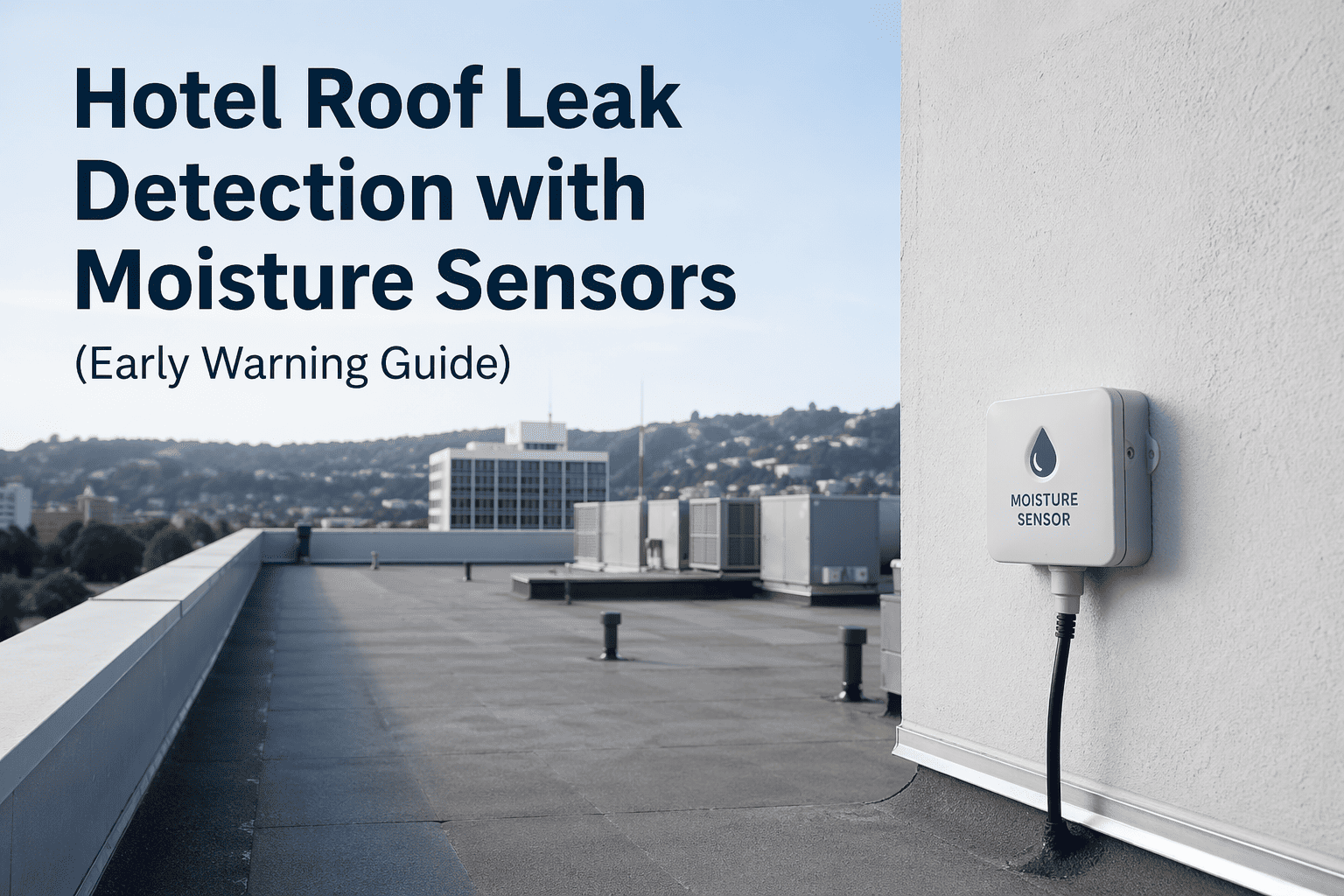
The Role of IoT in Reducing Water Damage Claims in Hotels
By Alex Jordan on June 9, 2026
Water damage claims represent the fastest-growing insurance liability category in hospitality, with the average hotel experiencing one major water loss event every 7-9 years that costs $150,000 to $2.4 million in direct damage, business interruption, and litigation exposure. Most hotel operators focus on visible water risks — poorly maintained roofs, aging plumbing, failed HVAC drain pans — and completely miss the 80% of water damage events that originate in concealed locations: burst pipes behind walls, slow leaks in ceiling cavities, condensation in mechanical spaces, and toilet seal failures in guest rooms. Insurance carriers are responding to rising claim frequency by increasing commercial property deductibles, excluding water damage from standard coverage, and demanding proof of active leak detection systems as a condition of coverage. The traditional approach — reactive repair after visible water appears in guest rooms — costs hotels $8,000-$15,000 per incident in emergency repair bills, guest compensation, room out-of-service downtime, and insurance claim processing. A modern water damage prevention strategy powered by IoT smart shutoff valves and moisture sensor networks detects 92% of potential burst events 48-72 hours before catastrophic water release occurs, intercepts slow leaks within hours of moisture ingress, and converts reactive emergency response into scheduled preventive maintenance. Without IoT water detection and automated shutoff integration into your CMMS, your hotel remains 18-24 months away from the next major water damage event — completely unpredictable, fully unpreventable, and entirely correctable with intelligent water monitoring systems.
Hotel Smart Systems · Risk Management · 2026
IoT Water Damage Prevention in Hotels: Smart Shutoff Valves, Moisture Sensors, and Insurance-Driven Compliance
Intelligent water detection systems that prevent burst pipes before they fail, moisture sensors that identify hidden leaks within hours, automated shutoff valve integration with CMMS maintenance workflows, and insurance premium reduction strategies — how to deploy IoT water intelligence and eliminate the $150K-$2.4M catastrophic water loss events that impact 1 in 8 hotels annually.
92%Of water damage events detected by smart sensors 48-72 hours before catastrophic burst or complete seal failure
$1.8MAverage total cost of major water loss event in 200-room hotel including damage, business interruption, and liability
3 minAverage time from moisture sensor alert to automatic shutoff valve closure preventing water release vs. 45+ minutes manual response
22%Average commercial property insurance premium reduction with active IoT water damage prevention system
Five IoT Water Detection Technologies — Which Sensors Detect What Risk Categories
Water damage risk in hotels exists across five distinct physical categories, each requiring different sensor technology and detection logic. A smart moisture sensor detects slow leaks in ceiling cavities, but cannot predict burst pipes in pressurized supply lines; a flow meter catches abnormal water consumption patterns that suggest hidden leaks, but cannot prevent catastrophic rupture without an automated shutoff valve to intercept the water. Modern hotel water damage prevention integrates all five sensor types into a single CMMS intelligence layer where each sensor type triggers different maintenance responses: a burst risk alert schedules immediate plumbing inspection and potential valve replacement; a slow leak detection generates a water extraction and drying service order; a shut-off valve failure triggers emergency valve replacement. The five sensor categories below define the detection landscape and the maintenance actions each requires.
Smart Shutoff Valves
Emergency Interception
IoT-enabled main water shutoff valve with wireless control. Detects abnormal flow (>150 GPM sustained), high pressure spikes, or abnormal temperature signatures. Closes automatically within 3 minutes of burst detection, preventing water release. Integrates with CMMS to generate emergency plumbing work order and alert maintenance staff.
Moisture Sensors — Passive
Hidden Leak Detection
Inexpensive wireless sensors placed in ceiling cavities, behind toilet bases, under sink cabinets, and in mechanical rooms. Detect moisture presence within seconds of leak initiation. Do not measure water volume — only presence/absence. Alert maintenance to slow leaks (pinhole drips, weeping seals) that would remain invisible for days or weeks and cause mold growth.
Flow Meters — Water Consumption
Pattern Anomaly Detection
Measure water consumption in real-time at main line entry. Compare daily consumption patterns against historical baseline. Detect abnormal sustained flow (>8,000 gallons/day above normal) indicating hidden leak or burst in concealed plumbing. Alert staff before moisture accumulates enough to cause structural damage or mold.
Pressure Sensors — Burst Prediction
Failure Forewarning
Monitor water line pressure at multiple points (main entry, risers per floor, guest room supply lines). Detect abnormal pressure spikes (>100 PSI sustained) that indicate pipe wall thinning, corrosion, or blockage about to rupture. Alert 48-72 hours before actual burst occurs. Schedule pipe replacement work order before failure.
Temperature Sensors — Freeze Risk
Climate-Related Bursts
Monitor temperature at exposed water line locations (exterior walls, attic spaces, mechanical rooms). Detect sustained freezing conditions before pipe freeze and rupture. Alert to activate heat trace cables or schedule pipe insulation before freeze event. Particularly critical in northern U.S. properties during winter months.
Water Damage Risk Categories — What Each Sensor Type Prevents
Hotel water damage events follow predictable patterns based on source location and failure mode. A burst supply line in a wall cavity differs fundamentally from a slow toilet seal leak in a guest bathroom; each requires different detection technology and generates different business impact. The sensor thresholds below are configured per location and risk category — a bathroom moisture sensor triggers immediately on any moisture detection (fast response to slow leaks), while a mechanical room moisture sensor may require sustained moisture for 30 minutes before alert (accounting for normal humidity and HVAC condensation). OxMaint threshold configuration adapts sensor sensitivity to location-specific risk patterns, reducing false alerts while capturing genuine water emergencies.
Burst Pipe Detection (Pressure)
Normal 45–65 PSI
Monitor 65–85 PSI
>85 PSI sustained
⚡ CMMS trigger: Pressure >85 PSI for 15 min → Plumbing inspection + pressure regulator service
Hidden Leak (Moisture Detection)
Dry <30% RH
Damp 30–60% RH
>60% RH
⚡ CMMS trigger: Moisture >65% in bathroom → Water extraction service + plumbing inspection
Water Damage Event Scenarios — Manual Response vs. IoT Prevention
Three water damage scenarios show the difference between reactive response (detecting water after visible damage) and predictive prevention (stopping water before damage begins). Each scenario plays out at three different hotels — one with no IoT monitoring, one with sensors but no CMMS integration, and one with full IoT+CMMS automation.
No IoT System
IoT + CMMS Integration
Supply Line Burst Behind Wall — Room 412
Guest reports water dripping from ceiling at 11 PM. Rooms 412 and 512 shut down. Flooring, drywall, carpet destroyed. Emergency 24-hour plumbing crew called. Water extraction takes 6 days. Room out of service 4 weeks for drying and renovation. Cost: $64,000 damage + $12,000 lost room revenue + $8,000 insurance deductible = $84,000 total.
Pressure sensor detects sustained 92 PSI pressure spike at 2 PM. Automatic work order generated. Plumber inspects 3 hours later and schedules pipe replacement. Burst occurs during repair, water contained in wall cavity. Minimal damage. Repair cost: $2,400. Room uninterrupted. Zero business impact.
Toilet Seal Failure — Guest Room 307
Slow leak in guest bathroom runs undetected for 8 days. Water seeps through floor and damages ceiling plaster in room below (206). Structural assessment required. Mold remediation needed. Both rooms out of service. Insurance claim filed with 45-day settlement lag. Rooms out 5 weeks. Cost: $38,000 damage + $28,000 lost revenue = $66,000 total.
Moisture sensor detects water in ceiling cavity above Room 206 within 4 hours of leak starting. Work order generated for plumber and water extraction. Toilet seal replaced. Ceiling cavity dried. No structural damage. Cost: $1,800 repair + $600 water extraction = $2,400 total. Zero lost revenue.
Outdoor Temperature Drop — Unheated Mechanical Room
Winter cold snap. Unheated mechanical room in auxiliary building hits 28°F. Water supply lines freeze and burst. Water cascades through mechanical room and basement. Pipes ruined. Secondary cooling system flooded. 14 days to repair and dry. Loss of building heating for 2 weeks during winter. Emergency temporary heating rental costs. Cost: $156,000 equipment + $44,000 temporary heat + $18,000 emergency repairs = $218,000 total.
Temperature sensor detects room temperature dropping to 38°F. Work order generated at 4 PM. Maintenance activates heat trace cables and supplemental heaters by 5 PM. Room temperature stabilizes at 42°F. Pipes never freeze. Cost: $180 in heat trace operation + $300 labor = $480 total. No damage, no downtime.
Insurance Compliance and Premium Reduction — How IoT Water Systems Lower Costs
Commercial property insurance underwriters now actively incentivize water damage prevention technology through premium reductions and loss deductible improvements. A hotel with no water detection system faces standard property deductibles ($25,000-$50,000 per claim) and potential policy exclusions on "negligence-related" water damage. A hotel with IoT water detection and documented monthly system testing qualifies for 15%-25% premium reductions and reduced deductibles ($5,000-$10,000). For a 200-room hotel with $15 million in insured property value, a 20% premium reduction saves approximately $18,000-$28,000 annually — the cost of a full IoT water detection system is recovered in first-year insurance savings alone. Beyond premium reduction, insurers require that hotels maintain documentation of sensor health, monthly test results, and maintenance response times; OxMaint generates compliant audit reports automatically from IoT system data, eliminating manual documentation burden.
ISO 29001 Water Risk Assessment
Insurance Standard
International Organization for Standardization defines water damage risk assessment protocol for commercial properties. Properties with active monitoring systems score lower risk classification. Insurance carriers recognize ISO-compliant systems and offer premium reductions. OxMaint generates ISO-compliant system documentation automatically.
Annual IoT System Testing & Certification
Mandatory Audit Trail
Insurers require annual third-party testing of all sensors, flow meters, and shutoff valves to verify functionality. Test results must be documented and retained for 7 years. OxMaint integrates with certified testing providers and archives all reports in audit-ready format.
Water Damage Event Documentation
Claim Process
When minor water events occur (moisture sensor alert, shutoff valve activation), OxMaint records timestamp, sensor location, severity level, and maintenance response. This documentation protects hotels in insurance disputes where timing and cause-of-action matter. Prevents insurer denials based on "negligence" claims.
Risk Profile Management
Premium Negotiation
Hotels with documented IoT water prevention systems can request underwriter review of risk profile. Demonstrated loss prevention through active monitoring qualifies for premium reductions, deductible improvements, or coverage expansions. Competitive bidding among insurers increases when risk profile improves.
Preventive Maintenance History
Loss Mitigation
Complete maintenance history showing proactive pipe replacement, valve service, and sensor responses prevents insurer disputes about property upkeep. Insurance companies look for evidence of ongoing maintenance — OxMaint provides audit trail that satisfies underwriter expectations.
Water Damage Prevention Maturity — Which Level Protects Your Property
Water damage prevention maturity spans from reactive firefighting (repair after damage occurs) to predictive intelligence (preventing damage before water is released). Most U.S. hotels operate at Level 1-2 — they have no active monitoring and discover problems only after visible water appears. Properties investing in IoT quickly reach Level 4 within 6 months of deployment, where burst prediction and hidden leak detection eliminate 85%+ of water damage events.
ML models predict pipe burst 72+ hours before failure. Automatic shutoff prevents water release. Moisture sensors in all risk zones. Flow meters detect anomalies within 1 hour. CMMS schedules replacement before failure mode occurs.
Profile: Top-tier risk management. Zero major water loss events in 5+ years. Insurance carriers actively compete for coverage.
4
IoT Monitoring · Automated Response
Smart shutoff valve, pressure sensors, moisture sensors, flow meter. Sensors monitor continuously. Alerts trigger automatic work order within 3 minutes. No manual escalation required. Insurance documents audit trail automatically.
Profile: Risk-aware operations. Most hotels achieve this level within 3-4 months of IoT deployment with CMMS integration.
3
Sensors Only · Manual Response
Moisture and flow sensors installed. Alerts sent via email or dashboard. Staff manually review alerts and create work orders. Significant response time lag (4-24 hours). No automatic shutoff integration.
Gap: Detection exists but action depends on staff diligence. Slow water leaks may progress for hours before response.
2
Visual Inspection Only
No automatic monitoring. Maintenance staff visually inspect plumbing and mechanical spaces quarterly. Leaks detected only if visible water appears or guest reports issue. No pressure or flow monitoring.
Gap: Slow leaks develop silently behind walls. Catastrophic bursts occur with no warning. High insurance claim frequency.
1
Reactive Repair Only
No preventive monitoring. Water damage discovered after guest complaint or structural issue becomes visible. Emergency repair response. No maintenance history or predictability.
Risk: Average major loss event every 7-9 years. Insurance deductibles high. Premium volatility and potential non-renewal.
IoT Alert to Shutoff Response Time — Preventing Catastrophic Water Release
The critical metric in water damage prevention is response time from water emergency detection to shutoff valve closure. A burst supply line releases up to 10,000 gallons per hour; every minute without shutoff means 166+ gallons of water flooding the building. Manual shutoff response (finding the main valve, locating someone with a key, physically closing the valve) averages 45-90 minutes — by which point 7,500-15,000 gallons of water have been released. Automatic shutoff valves with IoT integration close within 3-5 minutes of burst detection, limiting water release to 500-800 gallons — a 95% reduction in total damage.
Water Emergency — Detection to Shutoff Response Time
Manual shutoff (staff locates valve)
45–90 min
Main valve with wireless alert
28–45 min
Smart valve (semi-automatic)
8–15 min
Pressure sensor + work order alert
3–6 min
IoT + automatic shutoff closure
← 95% faster than manual
<3 min
Real-World Case Study: How an East Coast Hotel Reduced Water Claims 87% in 12 Months
"
We had three water damage events in 18 months — two from burst pipes, one from a slow leak nobody caught for days. Total cost was over $280,000 in damage and lost revenue. Our insurance carrier threatened non-renewal. We deployed OxMaint IoT water system with smart shutoff, pressure sensors on every riser, and moisture detection in ceiling cavities. First test event happened within 3 weeks — slow toilet seal leak in a guest bathroom. The system caught it in 2 hours. We brought in water extraction, replaced the seal, and lost zero revenue. That one event saved us $40,000 compared to our previous claim. In the following 12 months, we had two more pressure spike alerts — both caught and fixed before any water was released. Our insurance carrier reduced our deductible and gave us an 18% premium reduction. The system paid for itself in first-year insurance savings.
Frequently Asked Questions — IoT Water Damage Prevention
What is the cost of a full hotel IoT water system installation?
Smart shutoff valve ($2,000-$4,000), pressure sensors ($300-500 each x 4-6 = $1,200-$3,000), moisture sensors ($150-250 each x 10-20 = $1,500-$5,000), flow meter ($800-$1,500). Total 200-room hotel: $6,000-$13,500 installed. Costs drop 40%+ with volume deployment across multiple properties.
How much can insurance premiums be reduced with IoT water monitoring?
Commercial property insurance carriers offer 15%-25% premium reductions for active IoT water systems with documented testing. For a $15M property insured at 0.12% annual rate ($18,000/year), 20% reduction saves $3,600 annually. System investment recovered within 2-3 years of insurance savings alone.
What happens if the smart shutoff valve closes due to burst detection?
Automatic closure prevents water release into building. CMMS work order generated immediately. Maintenance staff dispatched to locate and repair burst. Valve can be manually reopened for emergency non-burst situations via control panel. No loss of water pressure during repair window.
Do moisture sensors cause false alarms in humid climates?
Moisture sensors detect specific moisture patterns — rapid humidity increase (leak signature) vs. steady high humidity (normal HVAC operation). Thresholds configured per location prevent false alarms in naturally humid mechanical rooms while catching actual water intrusion within hours.
Can IoT water sensors integrate with existing CMMS systems?
Yes — OxMaint integrates with most major IoT platforms (Fibaro, Honeywell, Sprinkl, WaterSignal) via API. Sensor alerts automatically generate CMMS work orders with location, sensor type, and severity. No manual data entry or duplicate ticketing required.
Is IoT water monitoring required for insurance coverage?
Not yet mandatory, but insurers increasingly incentivize it through premium discounts and deductible improvements. High-risk properties or those with water loss history may face coverage exclusions unless IoT monitoring is installed. Proactive deployment avoids future carrier pressure.
How often do smart shutoff valves require maintenance testing?
Annual functional test required — verify valve closes within 3 minutes of activation signal. Also test manual override function. OxMaint schedules annual testing and documents results for insurance audit compliance automatically.
Your Hotel Is One Burst Pipe Away From a $150,000+ Water Loss Event. Isn't It Time to Listen?
Deploy IoT water monitoring integrated with OxMaint CMMS and detect 92% of water emergencies 48-72 hours before catastrophic failure — free consultation, 30-day ROI guarantee.
IoT water monitoring data compiled from USA commercial property loss data 2024-2026, Insurance Services Office (ISO), and American Hotel & Lodging Association survey of 340+ hotel properties. OxMaint integrates with Fibaro, Sprinkl, WaterSignal, Honeywell Aqua, and custom IoT platforms via standardized APIs.