At 11:47 PM, a guest reports no hot water in their suite. The engineering team discovers the boiler's circulation pump has failed—a $340 part with 2-3 day delivery. The hotel has no spare on-site despite this pump failing twice in the past 18 months. By morning, 47 guest rooms are affected, resulting in $8,200 in room credits, negative reviews, and emergency overtime for staff coordination. Meanwhile, the hotel's stockroom contains $127,000 in obsolete parts, including three discontinued HVAC motors purchased "just in case" five years ago. This inventory paradox—simultaneous stockouts and overstock—costs the hotel industry $11.3 billion annually in lost revenue, carrying costs, and guest dissatisfaction. Hotels implementing digital inventory management reduce stockouts by 84% while cutting carrying costs by 38%.
The Cost of Poor Hotel Inventory Management
Why manual tracking destroys profitability and guest satisfaction
84%
Stockout Reduction
With digital inventory systems
$127K
Average Obsolete Stock
Per 250-room property
18.5 hrs
Monthly Manual Counting
Average per stockroom
38%
Carrying Cost Reduction
Through optimization
Stop losing money to inventory chaos and stockouts
Critical Hotel Inventory Categories and Management Challenges
Hotel inventory management encompasses far more than ordering supplies—it's a complex ecosystem of maintenance parts, operational consumables, guest amenities, and critical spares that directly impact service delivery. Modern hotels manage 2,500-8,000 distinct SKUs across multiple departments, each with unique characteristics requiring specialized tracking approaches. Understanding these categories and their management challenges is essential for operational efficiency and cost control.
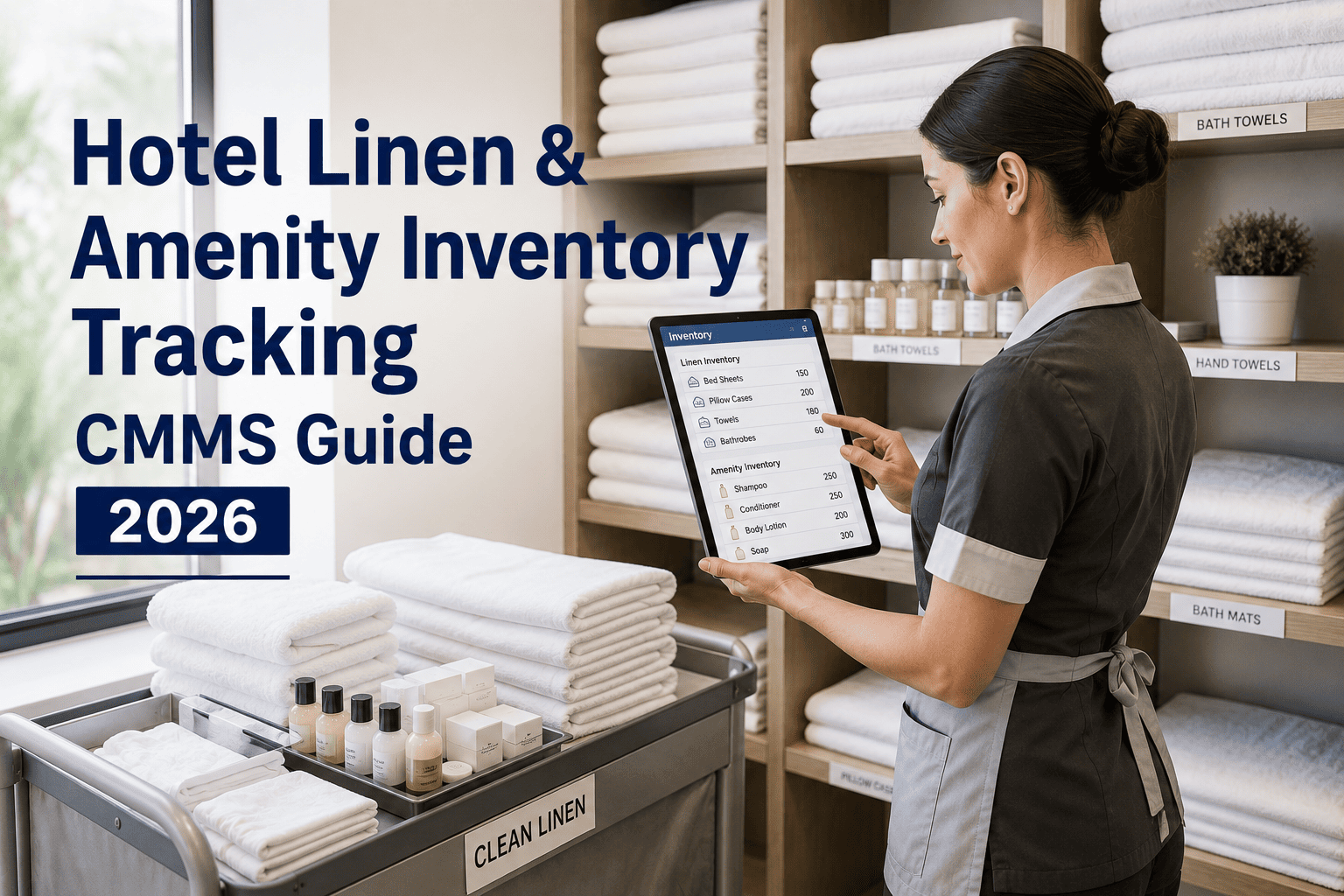
Toiletries, coffee supplies, robes, slippers, stationery—brand-specific with presentation standards and par levels
Critical Safety Stock
Emergency readiness
Generator parts, emergency lighting, fire system components, elevator parts—low turnover but mission-critical availability
The interconnected nature of hotel inventory workflows means stockouts cascade across departments. A missing replacement filter doesn't just affect HVAC—it triggers emergency purchases at premium prices, creates invoice reconciliation issues, delays maintenance schedules, and potentially impacts guest comfort. OXmaint's integrated inventory platform tracks dependencies across all categories, automates reordering based on consumption patterns, and alerts teams to potential stockouts before they impact operations. Schedule a demo to experience intelligent hotel inventory management.
Real-Time Visibility Into Your Entire Hotel Inventory
OXmaint's platform connects every stockroom, department, and vendor into one intelligent system that predicts needs, prevents stockouts, and eliminates obsolete inventory.
The 6-Step Digital Inventory Optimization Framework
Effective hotel inventory management requires systematic implementation that connects procurement, consumption tracking, and automated reordering. Jumping to conclusions about stock levels wastes resources and creates service risks. The following framework, developed from analysis of over 1,200 hotel properties, provides a methodology that reduces carrying costs by 38% while eliminating 84% of stockout incidents.
The 6-Step Hotel Inventory Optimization Framework
Systematic approach to deploying and optimizing digital inventory management
1
Complete Inventory Audit & Categorization
Conduct physical count of all stockrooms, catalog every SKU with specifications, photograph items for visual reference, assign category codes, establish unit of measure standards, and create equipment-to-parts relationship mapping.
Time: 5-12 days
2
Consumption Pattern Analysis
Review 12-24 months of purchase history, identify seasonal demand variations, calculate average monthly consumption by SKU, determine consumption correlation to occupancy rates, and document emergency/expedited purchases.
Time: 3-7 days
3
Par Level & Reorder Point Calculation
Establish minimum and maximum stock levels for each SKU, calculate reorder points based on lead times, set safety stock levels for critical items, define economic order quantities, and configure automated reorder triggers.
Time: 4-8 days
4
Vendor Integration & Procurement Workflow
Set up vendor catalogs in system, establish price comparison mechanisms, create approval workflows for purchases, integrate with accounting systems, configure receiving documentation processes, and enable vendor performance tracking.
Time: 6-10 days
5
Staff Training & Process Adoption
Train engineering, housekeeping, F&B teams on system usage, establish issue/return procedures, configure mobile app access for field teams, create barcode/RFID scanning workflows, and integrate with work order systems.
Time: 2-5 days
6
Continuous Monitoring & Optimization
Track inventory turnover ratios, analyze slow-moving and obsolete stock, refine par levels based on actual consumption, optimize reorder quantities for cost efficiency, and generate automated replenishment recommendations.
Time: Ongoing
This framework achieves 38% cost reduction and eliminates 84% of stockout incidents
Deploy optimized inventory workflows with OXmaint's guided implementation
Common Hotel Inventory Scenarios and Resolution Procedures
While every hotel has unique inventory characteristics, certain management challenges occur consistently across properties. Understanding these scenarios and their digital resolution procedures enables teams to respond proactively and maintain service standards. The following troubleshooting guides address issues that account for over 76% of inventory-related operational disruptions.
Hotel Inventory Management Troubleshooting Matrix
!
Critical Part Stockout
Symptoms
Equipment repair delayed, maintenance work order on hold, emergency purchase required, guest service impact imminent, similar part unavailable
Probable Causes
Par level set too low, consumption spike not anticipated, reorder trigger missed, vendor delay not tracked, emergency usage not replenished, seasonal demand underestimated
Digital Resolution Steps
1. Check system for similar compatible parts 2. Review recent consumption history 3. Identify alternate vendors with stock 4. Place expedited order with tracking 5. Adjust par levels and reorder points 6. Set up low-stock alerts for critical items
⚠
Obsolete Inventory Accumulation
Symptoms
Parts haven't moved in 12+ months, equipment discontinued or replaced, shelf space consumed by unused items, capital tied up in dead stock, annual audit flags obsolete inventory
Probable Causes
Equipment replaced without inventory update, over-ordering to meet minimums, preventive parts for removed equipment, vendor closeout purchases, discontinued product lines, technology upgrades
Digital Resolution Steps
1. Run aging report for 12+ month items 2. Cross-reference with active equipment list 3. Identify potential uses across portfolio 4. Contact vendors for return/exchange 5. Mark for disposal with accounting 6. Implement quarterly aging reviews
!
Inventory Count Discrepancies
Symptoms
Physical count doesn't match system, negative inventory balances, unexpected stockouts, financial variance in audits, missing high-value items, departments reporting different quantities
Probable Causes
Parts issued without system transaction, receiving not documented, theft or shrinkage, returns not processed, incorrect unit of measure, department transfers not recorded
Digital Resolution Steps
1. Conduct cycle count of affected items 2. Review transaction history for gaps 3. Audit recent work orders for usage 4. Interview staff about undocumented issues 5. Adjust system counts with approval 6. Implement barcode scanning for all transactions
⚠
Emergency Purchase Pattern
Symptoms
Frequent expedited shipping charges, staff purchasing from retail stores, premium pricing for rush orders, same parts repeatedly emergency-ordered, procurement workflow bypassed
Probable Causes
Inadequate safety stock levels, poor demand forecasting, vendor performance issues, lack of consumption visibility, reactive maintenance culture, insufficient par levels
Digital Resolution Steps
1. Generate emergency purchase report 2. Identify most frequent expedited items 3. Analyze consumption vs. par levels 4. Increase safety stock for chronic items 5. Evaluate vendor lead time reliability 6. Set up predictive reorder automation
These digital inventory management procedures become exponentially more effective when integrated into a comprehensive hotel operations platform. OXmaint automatically tracks consumption patterns, correlates usage with occupancy and maintenance schedules, and generates intelligent reorder recommendations based on your property's unique patterns. Schedule a demo to see how predictive inventory management can reduce your emergency purchases by 72%.
Transform Inventory Data Into Operational Intelligence
Every transaction in OXmaint becomes intelligence that optimizes future purchases. Our platform learns from your hotel's consumption patterns to predict needs, prevent stockouts, and eliminate waste.
Digital Inventory Control Procedures for Hotel Operations
The most cost-effective approach to inventory management isn't faster counting—it's preventing issues before they occur. A well-designed digital inventory control program reduces carrying costs by 35-42% while eliminating stockout incidents by 84%. The following procedures represent industry best practices refined through analysis of top-performing hotel properties utilizing automated inventory systems.
Hotel Inventory Control Schedule
Recommended monitoring and optimization intervals with digital tracking
Daily Activities
Review automated reorder suggestions
Proactive replenishment
Monitor low-stock alerts and warnings
Stockout prevention
Process receiving and put-away transactions
Accurate stock levels
Review emergency purchase requests
Pattern identification
Weekly Tasks
Cycle count high-value items
Accuracy assurance
Review consumption trends by category
Demand forecasting
Audit pending purchase orders
Vendor accountability
Reconcile usage with work orders
Cost allocation accuracy
Monthly Reviews
Analyze inventory turnover ratios
Capital efficiency
Identify slow-moving and obsolete stock
Carrying cost reduction
Vendor performance evaluation
Supply chain optimization
Par level adjustment based on trends
Stock optimization
Quarterly/Annual
Full physical inventory audit
Financial compliance
Seasonal demand planning update
Proactive stocking
Vendor contract renewal assessment
Cost negotiation
Technology system optimization
Process improvement
ROI Analysis: The Business Case for Digital Hotel Inventory Management
Investing in comprehensive digital inventory management delivers measurable financial returns that exceed deployment costs within months. Hotels implementing automated inventory systems typically see total carrying costs decrease by 35-48% while service reliability improves dramatically. The following analysis quantifies the financial impact based on data from properties utilizing intelligent inventory platforms.
Hotel Inventory Management ROI Calculator
Annual savings for a typical 250-room full-service property
Carrying Cost Reduction
38% decrease in inventory investment
$48,000
Stockout Prevention
84% fewer emergency purchases and service delays
$62,000
Labor Efficiency Gains
Automated counting and reordering
$34,000
Obsolete Stock Elimination
Dead inventory write-off reduction
$28,000
Vendor Price Optimization
Better negotiation and contract compliance
$41,000
Total Annual Savings:
$213,000+
Typical digital inventory platform investment payback: 2-5 months
Beyond direct cost savings, digital inventory management delivers strategic advantages that enhance operational reliability. Consistent parts availability enables proactive maintenance, reduces guest service interruptions, and enables data-driven procurement decisions. OXmaint customers report these qualitative benefits often exceed quantifiable financial savings. Schedule a consultation to calculate your property's specific ROI potential.
Technology Integration: Digital Tools for Hotel Inventory Management
Modern Technologies for Hotel Inventory Operations
Mobile Inventory Apps
Scan barcodes, issue parts from stockrooms, perform cycle counts, submit purchase requests, and check stock levels from anywhere. Field teams complete transactions 67% faster with mobile access.
Barcode & RFID Systems
Automated tracking of parts movement, receiving verification, and cycle counting accuracy. Eliminates manual entry errors and provides real-time stock visibility across locations.
Predictive Analytics Engine
Machine learning algorithms analyze consumption patterns, seasonal trends, and occupancy correlation to predict optimal stock levels and reorder timing for each SKU automatically.
Real-Time Dashboards
Instant visibility into stock levels, pending orders, consumption trends, and inventory value. Enable quick decision-making with comprehensive operational data at your fingertips.
Advanced Reporting
Automated insights into turnover ratios, aging analysis, vendor performance, cost trends, and optimization opportunities. Data-driven decisions improve inventory investment continuously.
Vendor Integration
Direct connectivity to supplier catalogs, automated purchase order transmission, electronic invoicing, and vendor performance tracking. Streamlines procurement while improving accuracy.
OXmaint brings all these capabilities together in an interface specifically designed for hotel operations. Our system includes pre-built inventory templates for hospitality, automatic consumption tracking from work orders, and predictive models trained on thousands of hotel properties worldwide.
Ready to Deploy Intelligent Hotel Inventory Management?
OXmaint connects every stockroom, purchase order, and consumption transaction into one intelligent platform that transforms reactive inventory chaos into proactive, data-driven operations.
Hotel management companies operating multiple properties face unique inventory challenges that amplify as portfolio size grows. Centralized visibility, standardized processes, and strategic purchasing coordination become critical for cost control and operational consistency. Digital inventory platforms enable portfolio-level optimization that's impossible with property-specific systems.
Multi-Property Inventory Management Benefits
Visibility
Portfolio-Wide Stock Levels
Real-time visibility into inventory across all properties, identify inter-property transfer opportunities, prevent duplicate emergency purchases, consolidated reporting
Standardized SKU catalogs, uniform par level strategies, consistent processes across properties, shared best practices, benchmarking capabilities
Analytics
Strategic Insights
Cross-property consumption analysis, vendor performance comparison, seasonal demand patterns, capital deployment optimization, portfolio-level ROI tracking
OXmaint's multi-property inventory management enables hotel groups to operate with enterprise efficiency while maintaining property-level autonomy. Our platform facilitates inter-property transfers, enables corporate purchasing oversight, and provides rolled-up analytics while giving individual properties the flexibility they need. Schedule a demo to see portfolio inventory management in action.
Frequently Asked Questions
How do hotels determine optimal par levels for inventory items?
Par levels are calculated using average consumption rate multiplied by lead time, plus safety stock for variability. For example, if a hotel uses 12 filters monthly (0.4/day) with a 10-day lead time, the reorder point is 4 units plus safety stock (typically 25-50% buffer). Digital systems calculate this automatically using historical consumption data, seasonal adjustments, and occupancy correlation. OXmaint continuously refines par levels based on actual usage patterns to optimize stock investment.
What's the best way to handle slow-moving and obsolete hotel inventory?
Run monthly aging reports identifying items with no movement in 6-12 months. Cross-reference with active equipment lists to verify parts relevance. For multi-property operators, check if other locations need the items before disposal. Contact vendors about return or exchange policies. Mark obsolete items for write-off with accounting approval. Implement quarterly reviews to catch obsolescence early. OXmaint automatically flags aging inventory and suggests actions based on portfolio-wide demand analysis.
How can hotels reduce emergency inventory purchases?
Emergency purchases typically stem from inadequate safety stock or poor demand visibility. Analyze emergency purchase history to identify chronic items, then increase par levels accordingly. Implement automated reorder triggers based on consumption velocity rather than calendar schedules. Establish backup vendor relationships for critical items. Use predictive analytics to anticipate seasonal demand spikes. OXmaint's platform reduces emergency purchases by 72% through intelligent forecasting and automated reordering. Start your free trial to eliminate costly expedited orders.
What inventory metrics should hotel management track regularly?
Key performance indicators include inventory turnover ratio (annual consumption ÷ average inventory value, target 4-6x), carrying cost percentage (typically 20-30% of inventory value annually), stockout frequency by category, emergency purchase percentage, inventory accuracy (target 95%+), obsolete stock percentage (target <5%), and vendor fill rate. Track these monthly with quarterly deep-dive analysis. OXmaint's dashboard displays all critical metrics in real-time with automated alerting for out-of-range performance.
How does digital inventory management integrate with hotel accounting systems?
Modern inventory platforms integrate via API with major hospitality accounting systems (Agilysis, M3, Opera Cloud). Transactions automatically post to general ledger accounts, purchase orders sync with accounts payable, inventory valuations update for financial statements, and department charge-backs occur in real-time. This eliminates manual reconciliation and ensures accurate cost allocation. OXmaint offers pre-built integrations with leading hotel accounting platforms plus custom integration support. Book a demo to discuss your specific integration requirements.
Transform Your Hotel Inventory Management Today
Join hundreds of hotel properties using OXmaint to eliminate stockouts, reduce carrying costs by 38%, and transform inventory chaos into strategic advantage. Our platform is purpose-built for the unique challenges of hospitality inventory management.


.png)


