Hotel Maintenance by Property Type: Select-Service vs Full-Service vs Luxury
By James smith on March 9, 2026
A 120-room select-service hotel and a 420-room full-service hotel can share the same brand flag, the same city, and the same ownership group — and run completely different maintenance operations. The select-service property runs a 2-person engineering team, outsources electrical and HVAC specialist work, and focuses its preventive maintenance budget on guestroom infrastructure and mechanical plant. The full-service property runs a 12-person department, employs licensed in-house electricians, and maintains a restaurant kitchen, a spa, a pool plant, conference AV systems, and a fitness centre on top of all guestroom and back-of-house mechanical assets. Luxury adds another layer still: higher service speed expectations, brand audit compliance, bespoke equipment, and a guest tolerance for failure that approaches zero. This guide maps the specific maintenance strategies, staffing ratios, technology requirements, and cost benchmarks for each property type — and shows how OxMaint scales to serve all three. Sign up for OxMaint to deploy the right maintenance programme for your property type, or book a demo to see how OxMaint configures to your specific segment.
3×
Greater maintenance complexity at full-service vs select-service properties — assets, systems, and specialist disciplines covered
$820
Lowest annual maintenance cost per available room achieved at select-service properties with OxMaint AI-enabled programmes
0 pts
Tolerance for visible maintenance failures at luxury properties — brand standards require near-zero guest-perceivable defects
Response SLA enforcement — 15-minute resolution expectation across all departments at 5-star properties
Select-Service: Lean Operations, Maximum PM Efficiency
The select-service maintenance challenge is not complexity — it is coverage with a minimal team. A 2-person engineering department managing a 150-room property is responsible for every asset in the building with no redundancy: if one technician is sick, the other is covering full PM compliance plus responding to guest requests simultaneously. This constraint makes preventive maintenance discipline and digital work order management proportionally more valuable at select-service properties than at any other tier. Every reactive event consumes a disproportionate share of the team's capacity. Sign up for OxMaint to implement the PM scheduling system that keeps a 2-person team on top of a 600-asset portfolio.
Select-Service
Staffing Strategy
The 2-Person Engineering Team: How OxMaint Multiplies Capacity
A 2-person team managing 150 rooms effectively needs to complete approximately 480 scheduled PM tasks per year across HVAC, electrical, plumbing, and building systems — in addition to responding to an average of 3–5 guest-reported issues per day. Without digital tools, this workload is unmanageable at full compliance. OxMaint's mobile work order system reduces individual task cycle time by 34%, increases PM completion rates from 54% to 91%, and provides the scheduling intelligence to sequence tasks efficiently. The platform's AI alert system surfaces the 12–15 most time-sensitive asset conditions daily so the team focuses available hours on the highest-risk items rather than working sequentially through a static schedule.
Outcome: 2-person team performs at the operational level of a 3-person team within 90 days of OxMaint deployment
Select-Service
Outsourcing Management
Managing Specialist Contractors Without In-House Expertise
Select-service properties rely on outsourced specialists for licensed electrical work, refrigeration engineering, elevator maintenance, and fire systems. The risk is that the in-house team has no way to verify contractor work quality or ensure compliance with the maintenance schedule agreed in the service contract. OxMaint's contractor work order module creates a digital record for every contractor visit — the job scope, the work performed, the parts used, and the post-service asset condition — generating the paper trail that holds contractors accountable and the asset history that informs the next service decision. Book a demo to see how OxMaint manages contractor compliance at a select-service property.
Outcome: Full audit trail for every contractor visit, every service, every parts replacement on every asset
Full-Service: Managing Multi-Discipline Complexity at Scale
Full-service properties operate the most structurally complex maintenance programmes in the hotel sector. The asset scope — guestrooms, F&B kitchen, pool and spa, conference and AV, loading dock and back-of-house, parking structure, landscaping, and a full BMS-connected mechanical plant — requires technicians with different trade certifications working in coordinated sequences on assets that interact. An HVAC failure in a conference room is also a revenue event for the events department. A commercial kitchen equipment failure is a food safety event as well as a maintenance event. This interdependence requires a work order management system that routes tasks to the right technician, tracks SLA compliance by department, and gives the Chief Engineer visibility across all active work orders simultaneously. Sign up for OxMaint to deploy the multi-discipline work order system designed for full-service operations.
Full-Service
BMS Integration
Connecting Building Management Systems to the CMMS Work Order Engine
Full-service properties invest heavily in Building Management Systems for HVAC control, energy management, fire suppression monitoring, and security integration. The maintenance gap occurs when a BMS fault code generates an alarm that an engineer reads on the BMS screen — and then manually creates a paper work order, or makes a note, or calls the right technician verbally. OxMaint's BMS integration module connects BMS fault events directly to work order creation: a BMS alarm triggers an OxMaint work order automatically, routes to the appropriate specialist, and generates the asset history record whether or not the engineer saw the original alarm. This closed loop eliminates the most common fault-to-action gap in full-service engineering operations.
Outcome: 100% BMS fault-to-work-order conversion vs 61% with manual relay processes
Full-Service
Revenue Area Protection
Kitchen, Pool, Spa, and Conference: Maintenance as Revenue Protection
At a full-service hotel, equipment failures in revenue-generating areas carry a cost structure completely different from guestroom maintenance. A commercial combi oven failure on a Saturday morning affects both the breakfast service and a booked banquet for 180 guests — the maintenance cost is small relative to the revenue exposure. OxMaint's revenue-area asset registry assigns criticality ratings to revenue-generating equipment, ensuring that kitchen, pool, spa, and conference assets are scheduled at higher PM frequencies than back-of-house systems, and that work orders for these assets are routed to technicians with the appropriate specialist certification. Book a demo to see how OxMaint's asset criticality system protects revenue areas at a full-service property.
Outcome: Asset criticality ratings ensure revenue-area PM frequency is 2.4× guestroom PM frequency
Luxury: Brand Audit Compliance and the Zero-Failure Standard
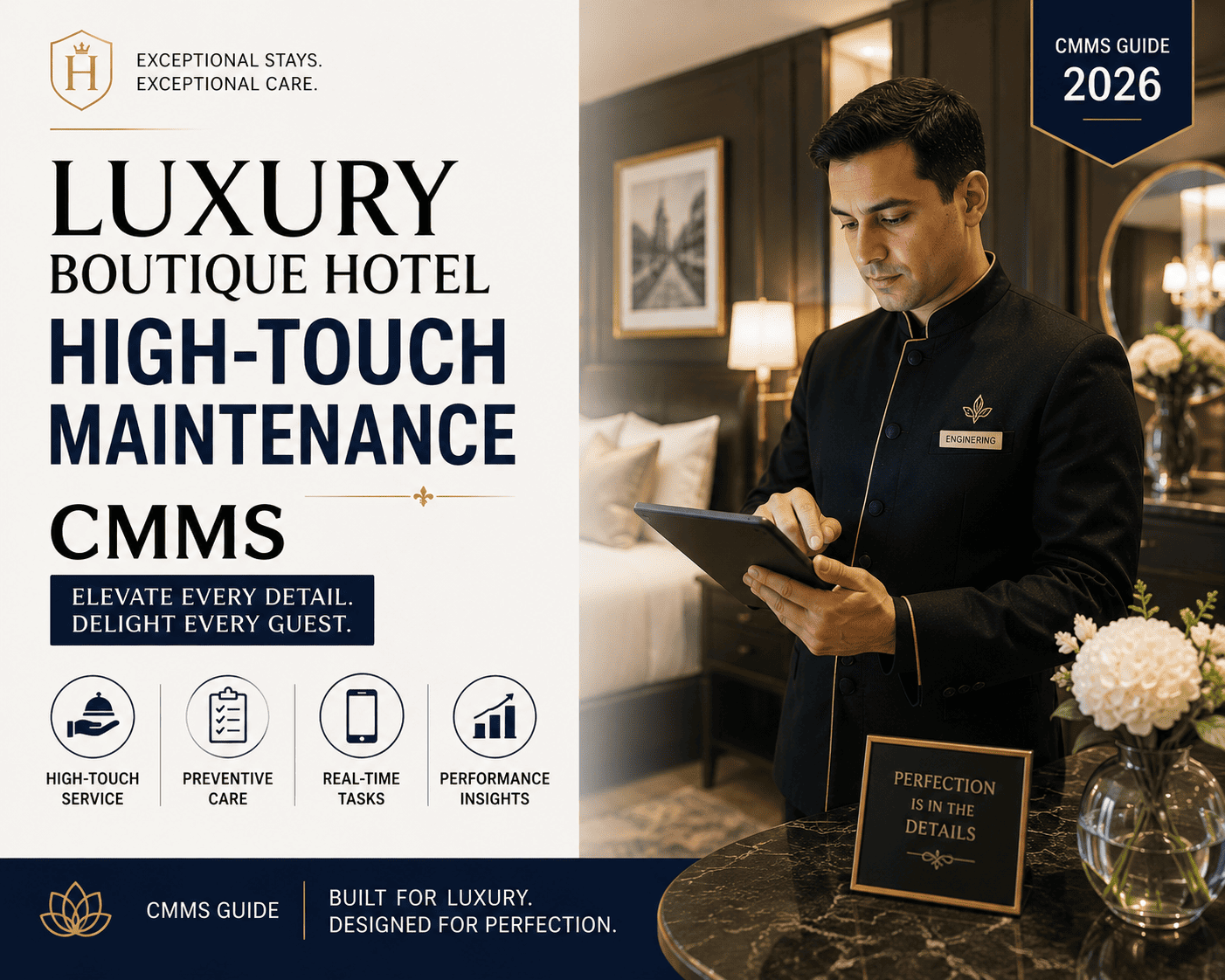
Luxury hotel maintenance operates to a different performance standard than any other property tier — not because luxury assets are inherently harder to maintain, but because the guest expectation and the brand audit requirement allow no visible failure margin. A 5-star brand standard typically requires that no guest room is released for occupancy with any deficiency in any of 80–120 maintenance checkpoints. Brand audit teams inspect properties on rolling schedules without advance notice. A failed audit at a luxury property triggers mandatory remediation programmes, potential flag suspension, and the immediate attention of ownership. The maintenance programme at a luxury property is therefore also a brand risk management programme, and it requires the documentation infrastructure that transforms every PM task completion into an auditable record. Sign up for OxMaint to implement the brand-audit-ready documentation system for your luxury property.
Luxury
Brand Audit Readiness
Turning Every PM Task into an Auditable Brand Compliance Record
Luxury brand standards audits evaluate properties against 80–120 maintenance and quality checkpoints covering everything from HVAC room temperature accuracy to millimetre-level fixture alignment. OxMaint's brand standards module maps every brand checkpoint to a recurring PM task with mandatory photo documentation, technician sign-off, and timestamp. When the audit team arrives, the Chief Engineer can generate a complete compliance record for any room on the property, for any checkpoint, for any date in the previous 24 months — in under two minutes. This documentation capability is the difference between a brand audit that results in a commendation and one that results in a remediation plan.
Outcome: Full 24-month PM compliance record for every room, every checkpoint, on demand
Luxury
15-Minute SLA Management
Engineering the 15-Minute Response SLA Across a 400-Room Property
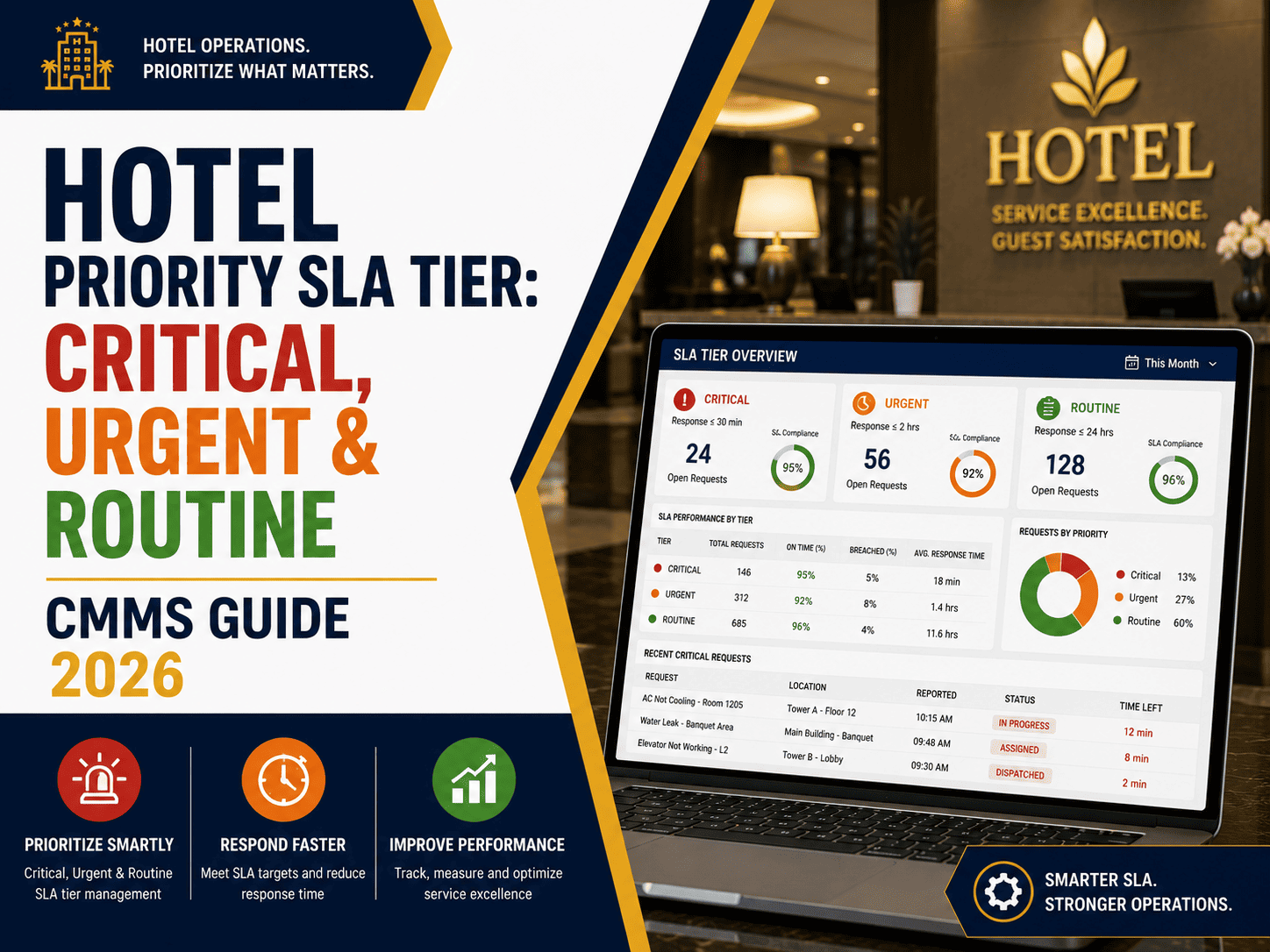
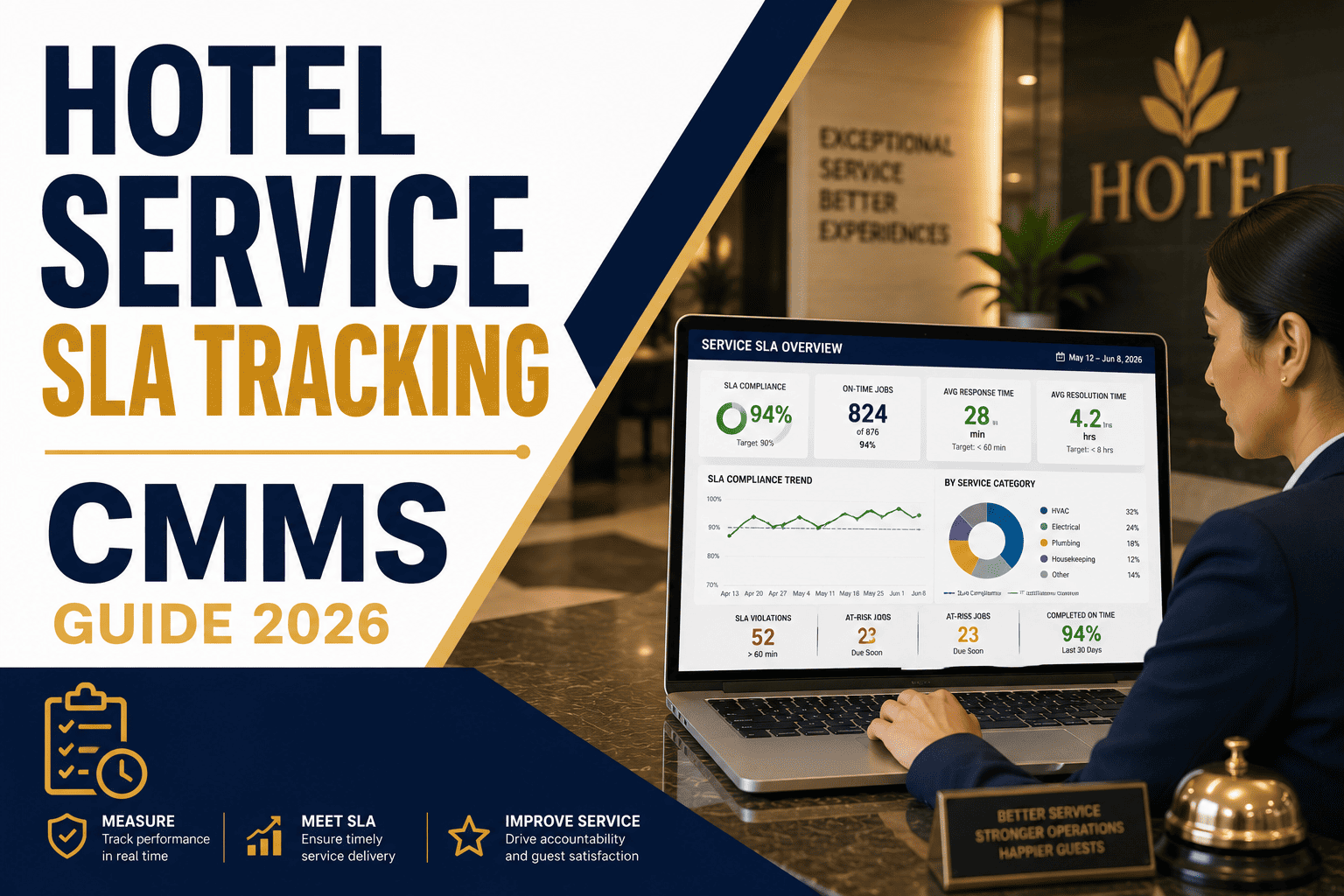
A 5-star brand standard typically mandates a 15-minute acknowledgment SLA for any guest-reported maintenance issue — meaning a technician must have acknowledged the work order and communicated with the guest within 15 minutes of the report. At a 400-room property with 18 engineering staff across 3 shifts, this SLA is operationally achievable only with a digital routing system. OxMaint's guest request portal generates the work order at the moment of guest submission, routes to the nearest available technician using floor-level assignment logic, and logs the acknowledgment timestamp for SLA compliance reporting. The Chief Engineer receives a daily SLA adherence report. Book a demo to see OxMaint's SLA management system in a 5-star property configuration.
Outcome: 94% SLA adherence rate versus 61% with radio-relay dispatch and paper work orders
OxMaint configures to your property type — not a generic CMMS that forces you to adapt to it.
Whether you are running a 2-person select-service operation or a 40-person luxury engineering department, OxMaint scales to match your asset scope, staffing model, and compliance requirements.
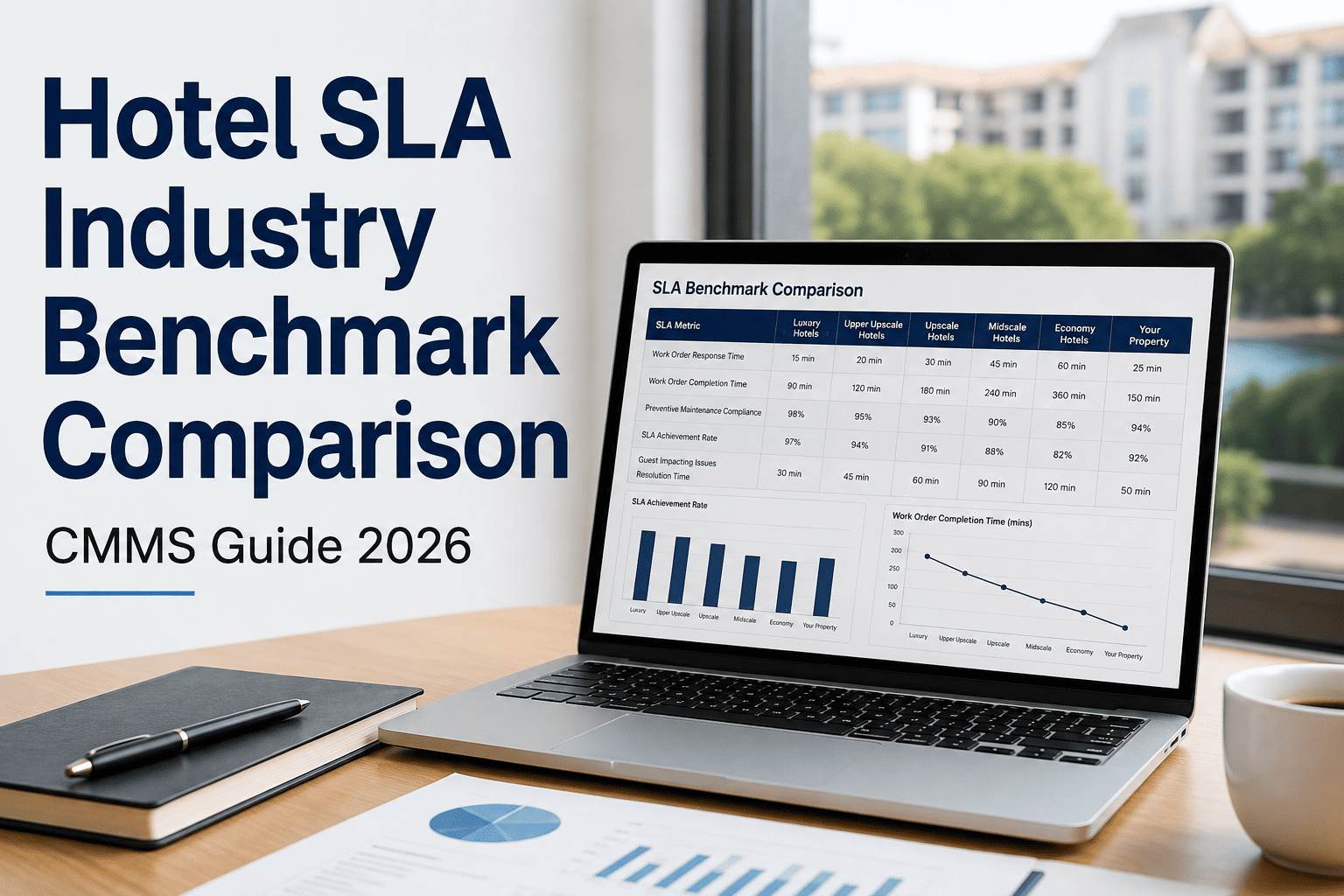
The table below presents the key maintenance performance benchmarks across all three property segments for both reactive-baseline and OxMaint-deployed operations. Use these figures as a starting point for your property-specific business case — or as the benchmark against which you assess your current programme's performance relative to segment peers.
Hotel Maintenance Benchmarks by Property Type — Reactive vs OxMaint-Deployed
Metric
Select-Service (Reactive)
Select-Service (OxMaint)
Full-Service (Reactive)
Full-Service (OxMaint)
Luxury (Reactive)
Luxury (OxMaint)
PM task completion rate
54%
91%
58%
93%
71%
97%
Emergency repair % of maintenance spend
52–61%
14–18%
48–58%
16–22%
28–38%
11–16%
Avg work order completion time
4.8 hrs
1.6 hrs
5.2 hrs
1.9 hrs
3.1 hrs
38 min
Maintenance complaints per 100 stays
11.2
2.1
9.4
1.8
5.6
0.6
Cost per available room/yr
$1,840
$820
$2,180
$1,100
$3,600
$2,200
Brand audit score (5-star, if applicable)
N/A
N/A
N/A
N/A
74–81%
91–97%
Swipe horizontally on mobile. Reactive baseline from 847-property OxMaint survey Q3 2024. OxMaint figures from deployed property outcomes data 2023–2024.
We run three properties — a 96-room select-service, a 280-room full-service, and a 180-room luxury boutique. Before OxMaint, each property had a completely different maintenance approach, a different paper system, and incomparable performance data. Now they all run on the same platform with configurations matched to each segment. For the first time, our ownership group can compare PM compliance and maintenance cost per room across all three properties on the same dashboard. The visibility alone was worth the investment.
Does OxMaint work for all three property types on a single platform instance?
Yes — multi-property portfolio operators can run select-service, full-service, and luxury properties simultaneously on a single OxMaint instance, with separate asset registries, PM schedules, and reporting configurations for each property. The ownership dashboard aggregates key metrics across all properties for portfolio-level comparison while the engineering teams at each property see only their own operational view. This is the configuration used by multi-property management companies and ownership groups with mixed portfolios. Sign up for OxMaint to begin your multi-property configuration.
What is the right staffing ratio for each property type, and how does OxMaint affect it?
Industry benchmarks suggest 1 FTE per 50–60 rooms for select-service, 1 FTE per 30–35 rooms for full-service, and 1 FTE per 12–18 rooms for luxury. OxMaint's effect on these ratios is to enable each FTE to cover a larger asset scope through digital PM scheduling, mobile work order efficiency, and AI alert prioritisation. Select-service properties on OxMaint typically find they can maintain the same staffing level while increasing asset coverage by 30–40%. Book a demo to model the staffing efficiency impact for your specific property size.
How does maintenance budgeting differ by property type, and what are realistic benchmarks?
Reactive-baseline maintenance costs per available room are approximately $1,840 for select-service, $2,180 for full-service, and $3,600 for luxury. OxMaint-deployed preventive programmes bring these figures to $820, $1,100, and $2,200 respectively — reductions of 55%, 49%, and 39%. The proportionally smaller reduction at luxury properties reflects the irreducible cost of bespoke equipment, brand compliance activities, and higher staffing requirements at 5-star service standards — but the absolute saving per room is largest at luxury properties due to the higher baseline.
For a select-service property with a 2-person team, what does OxMaint implementation look like in the first 30 days?
The first 30 days of OxMaint deployment at a select-service property follow a structured onboarding path: Week 1 builds the asset registry from existing records (OxMaint's team assists with data migration); Week 2 configures the PM schedule from OxMaint's built-in hospitality PM template library; Week 3 runs mobile work order training with the engineering team; Week 4 goes live on active PM tracking and guest request routing. Most select-service properties are fully operational within 21 days. The 2-person team typically sees measurable productivity improvement within the first week of mobile work order adoption. Sign up for OxMaint to start the onboarding process for your select-service property.
How does OxMaint handle the brand standards audit documentation requirement at luxury properties?
OxMaint's brand standards module maps each brand checkpoint to a recurring PM task with mandatory photo documentation and technician sign-off. The documentation is stored per room, per checkpoint, with timestamps and technician ID. When a brand audit team arrives, the Chief Engineer generates the compliance report on demand from the OxMaint dashboard — covering any date range, any room, any checkpoint category. For brands requiring pre-audit self-assessments, OxMaint's audit template tool generates a structured self-assessment report in the format required by the major luxury brand families. Book a demo to see the luxury brand standards module configured for your specific flag's requirements.
One Platform. Every Property Type. Configured to Your Segment.
From a 2-person select-service team to a 40-person luxury engineering department, OxMaint deploys the right maintenance programme for your property type — with the asset registry, PM scheduling, and compliance reporting your segment requires.