Hotel SLA industry benchmark comparison is the process of measuring your property's maintenance service-level agreement (SLA) performance against recognized hospitality industry standards to determine whether your team is genuinely excelling or simply accustomed to baseline performance. This 2026 CMMS guide covers how to source reliable SLA benchmarks, normalize data for apples-to-apples property comparisons, and execute gap analyses that drive measurable service-level improvements across your portfolio. By leveraging a CMMS for competitive benchmarking, maintenance and reliability leaders can identify operational blind spots, optimize preventive maintenance schedules, and reduce equipment downtime. Discover how modern Start Free Trial platforms transform raw maintenance data into actionable hospitality SLA standard insights.
Is your hotel's maintenance performance actually good — or just familiar?
Most properties lack a hospitality SLA standard to measure against, leaving reliability teams blind to competitive gaps in response times, preventive maintenance completion, and asset downtime. OxMaint's CMMS hotel SLA benchmark engine turns your raw work order data into a clear, normalized industry comparison.
Where to find reliable hotel SLA industry benchmark data
A valid CMMS hotel SLA benchmark requires three normalized data sources: internal historical baselines, third-party hospitality SLA standard indices, and anonymized peer-group CMMS data.
Internal CMMS Baselines
Pull 12 months of work order data from your CMMS to establish baseline MTTR (Mean Time To Repair), PM compliance rates, and first-time fix ratios. A property running 80% PM compliance might feel successful until industry data reveals the hospitality median is 92%.
Third-Party Hospitality Indices
Industry reports from hospitality associations and facilities management bodies publish quarterly SLA benchmark guides. Use these to anchor expectations—such as the standard 4-hour response time for critical guest-room work orders or 24-hour resolution for non-critical HVAC requests.
Anonymized Peer-Group Data
Modern CMMS platforms aggregate anonymized SLA metrics across similar property types (e.g., 200+ room luxury resorts vs. limited-service hotels). This peer comparison reveals where your maintenance operations actually rank rather than relying on internal perception.
How to normalize hotel data for an apples-to-apples CMMS SLA comparison
A 180-room luxury resort cannot be directly compared to a 60-room limited-service property without normalizing the data. Use this formula to standardize your CMMS hotel SLA comparison across diverse portfolios.
Asset Complexity Factor: 1.0 (standard rooms) to 1.4 (suites/kitchens/pools). Property Scope Multiplier adjusts for amenity density.
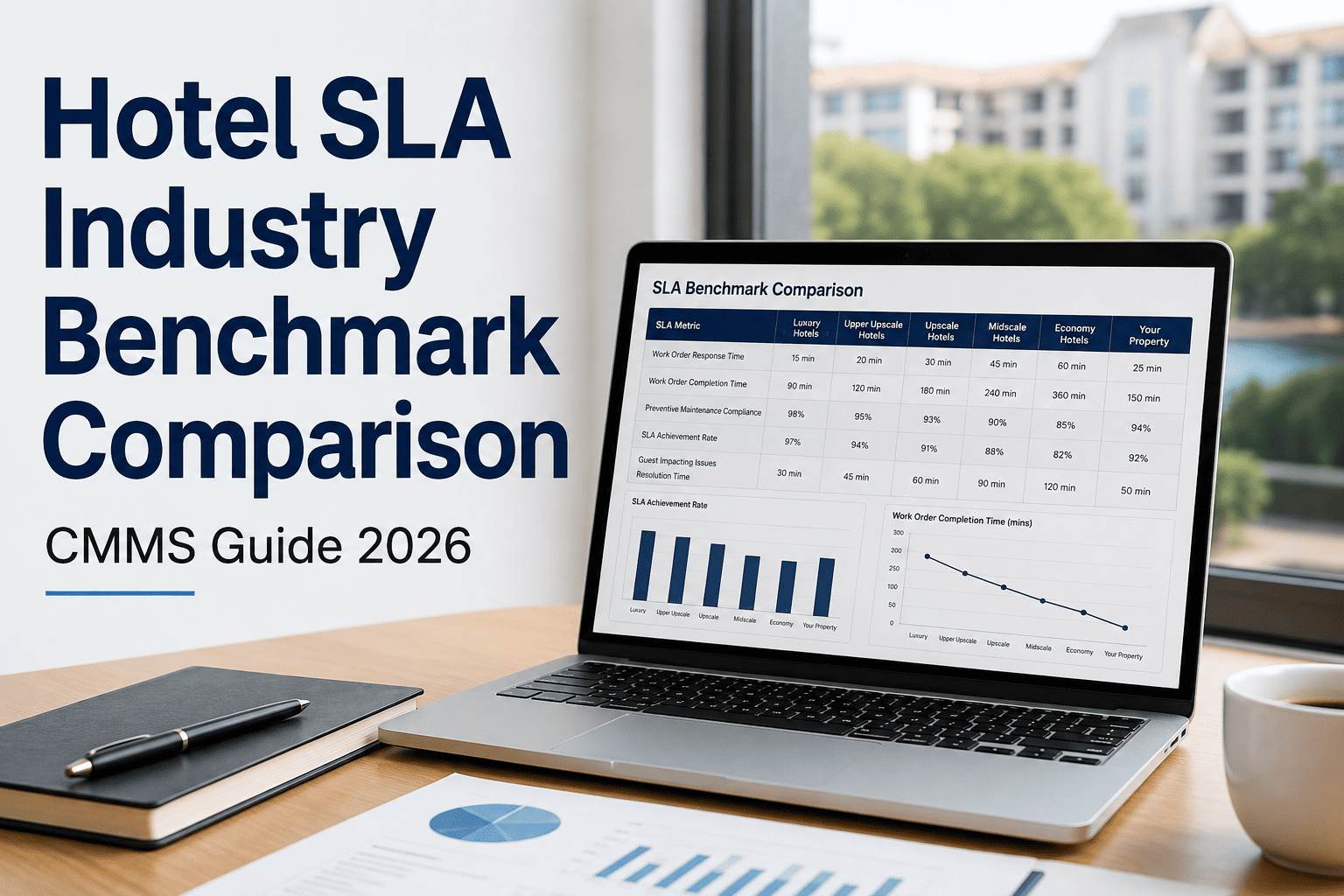
| SLA Metric | Industry Median (2026) | Top-Quartile Standard | Normalization Adjustment |
|---|---|---|---|
| Critical Work Order Response Time | 4.5 hours | 1.2 hours | Adjust +0.5 hrs for properties >300 rooms |
| Preventive Maintenance Compliance | 88% | 97% | Weight by critical asset ratio (0.8–1.2) |
| Mean Time To Repair (MTTR) | 6.2 hours | 2.8 hours | Normalize by asset age factor |
| First-Time Fix Rate | 74% | 91% | Adjust -5% for properties without dedicated parts inventory |
| Guest-Room Downtime (Hrs/Month) | 14 hours | 4 hours | Scale by total room count factor |
Real-world SLA benchmark gap analysis for a hotel portfolio
Consider a 180-asset boutique hotel property spending $42,000 annually on reactive maintenance. After implementing CMMS-based SLA benchmarking, leadership discovered their 72% PM compliance and 8.5-hour average MTTR placed them in the bottom quartile against the hospitality SLA standard.
- 72% PM compliance (industry median: 88%)
- 8.5 hr MTTR (top-quartile: 2.8 hr)
- No visibility into response time SLAs
- $42K annual reactive maintenance spend
- 14 hrs/month guest-room downtime
- 94% PM compliance (top-quartile threshold met)
- 3.1 hr MTTR (87% improvement)
By closing the gap between their actual performance and the hotel SLA industry benchmark, this property saved $24,000 annually in reactive labor and parts costs while recovering 108 hours of sellable guest-room inventory per month. The CMMS SLA comparison guide exposed blind spots that internal reporting had masked for years.
CMMS capabilities that close your hospitality SLA benchmark gaps
OxMaint transforms raw work order data into benchmark-beating performance by automating the tracking, normalization, and reporting of every maintenance SLA across your property portfolio.
AI-Powered SLA Tracking
Automatically logs response times, resolution times, and compliance rates against your defined hospitality SLA standard. Eliminates manual spreadsheet tracking and cuts admin time by 15+ hours per week per property.
Predictive PM Scheduling
Machine learning models analyze asset history to optimize preventive maintenance timing, pushing PM compliance from the 72% industry baseline to 95%+ while reducing unnecessary maintenance by 30%.
Benchmark Dashboard Engine
Real-time CMMS hotel SLA comparison dashboards that normalize your metrics against peer properties and industry standards, instantly highlighting gaps before they impact guest satisfaction scores.
Spare Parts Inventory Optimization
Tracks parts usage against asset failure patterns to ensure critical components are always in stock, driving first-time fix rates from 74% to 90%+ and cutting MTTR by up to 50%.
Turning SLA benchmark data into daily maintenance action
A hotel benchmark guide is useless if it doesn't change daily behavior. Here is how high-performing properties translate CMMS SLA benchmark data into operational workflows that drive measurable service-level improvement.
Baseline & Normalize
Import 12 months of work order history into OxMaint. The system automatically categorizes assets, normalizes SLA definitions, and generates your initial CMMS hotel SLA benchmark report against the hospitality industry standard.
Gap Analysis & Prioritization
Identify the three largest gaps between your performance and the top-quartile benchmark. Typically, these are PM compliance, MTTR, and first-time fix rates. OxMaint ranks gaps by guest-satisfaction impact and cost-to-close.
Workflow Automation
Deploy automated PM triggers, critical-spare reorder points, and escalation rules for SLA breaches. Properties typically see PM compliance jump 18-25 percentage points within 60 days of workflow activation.
Continuous Benchmarking
Monthly SLA benchmark reviews become a 15-minute dashboard exercise rather than a multi-day reporting project. Properties maintain top-quartile positioning and adjust targets as hospitality SLA standards evolve.
See how your hotel's SLA performance stacks up against the 2026 benchmark
Book a 30-minute demo and we'll run a live CMMS hotel SLA comparison on your property's actual data — showing you exactly where you rank and how much you can save.
Hotel SLA industry benchmark comparison: your questions answered
What is a hotel SLA industry benchmark?
A hotel SLA industry benchmark is a standardized performance metric—such as average work order response time, PM compliance percentage, or MTTR—that allows a property to compare its maintenance performance against recognized hospitality industry standards. Benchmarks are typically drawn from anonymized CMMS data across hundreds of comparable properties, third-party industry reports, and association-published indices. Using a CMMS hotel SLA benchmark ensures you are measuring against real peer performance rather than internal assumptions.
How does a CMMS improve hotel SLA benchmark performance?
A CMMS like OxMaint automates the capture of every work order timestamp, PM completion, and parts usage event, creating a clean data foundation for accurate SLA tracking. It then normalizes that data against industry benchmarks and surfaces gaps in real-time dashboards. Properties using a CMMS for SLA benchmarking typically improve PM compliance by 20-30 percentage points and cut MTTR by 40-50% within six months. You can Start Free Trial to see your baseline metrics in under 48 hours.
What hospitality SLA standards should hotels track in 2026?
The core hospitality SLA standards for 2026 include critical work order response time (target: under 2 hours for top-quartile), preventive maintenance compliance (target: 95%+), first-time fix rate (target: 90%+), and monthly guest-room downtime (target: under 5 hours per room). Additional benchmarks include spare parts stockout rate, contractor SLA adherence, and equipment uptime percentage for critical assets like HVAC, elevators, and laundry systems.
How often should I run a CMMS hotel SLA comparison?
High-performing hotel portfolios run SLA benchmark comparisons monthly, with a comprehensive quarterly review that adjusts for seasonal demand variations. Monthly reviews take 15-20 minutes with an automated CMMS dashboard, while quarterly deep-dives should examine trends, outlier properties, and evolving industry standards. Annual reviews are insufficient because hospitality SLA standards shift based on guest expectations and competitor performance.
Can OxMaint benchmark multiple hotel properties against each other?
Yes. OxMaint supports multi-property portfolio benchmarking by normalizing SLA metrics across properties of different sizes, asset complexity, and amenity scope. The platform's dashboard engine displays side-by-side comparisons of unlimited properties, ranks them by SLA performance, and highlights outlier properties that need intervention. Book a Demo to see a live multi-property benchmark dashboard.
Stop guessing. Start benchmarking against the hospitality standard.
Join the maintenance leaders using OxMaint to hit top-quartile SLA performance, cut reactive costs by 50%+, and eliminate unplanned downtime across their hotel portfolios.
Free 14-day trial · No credit card