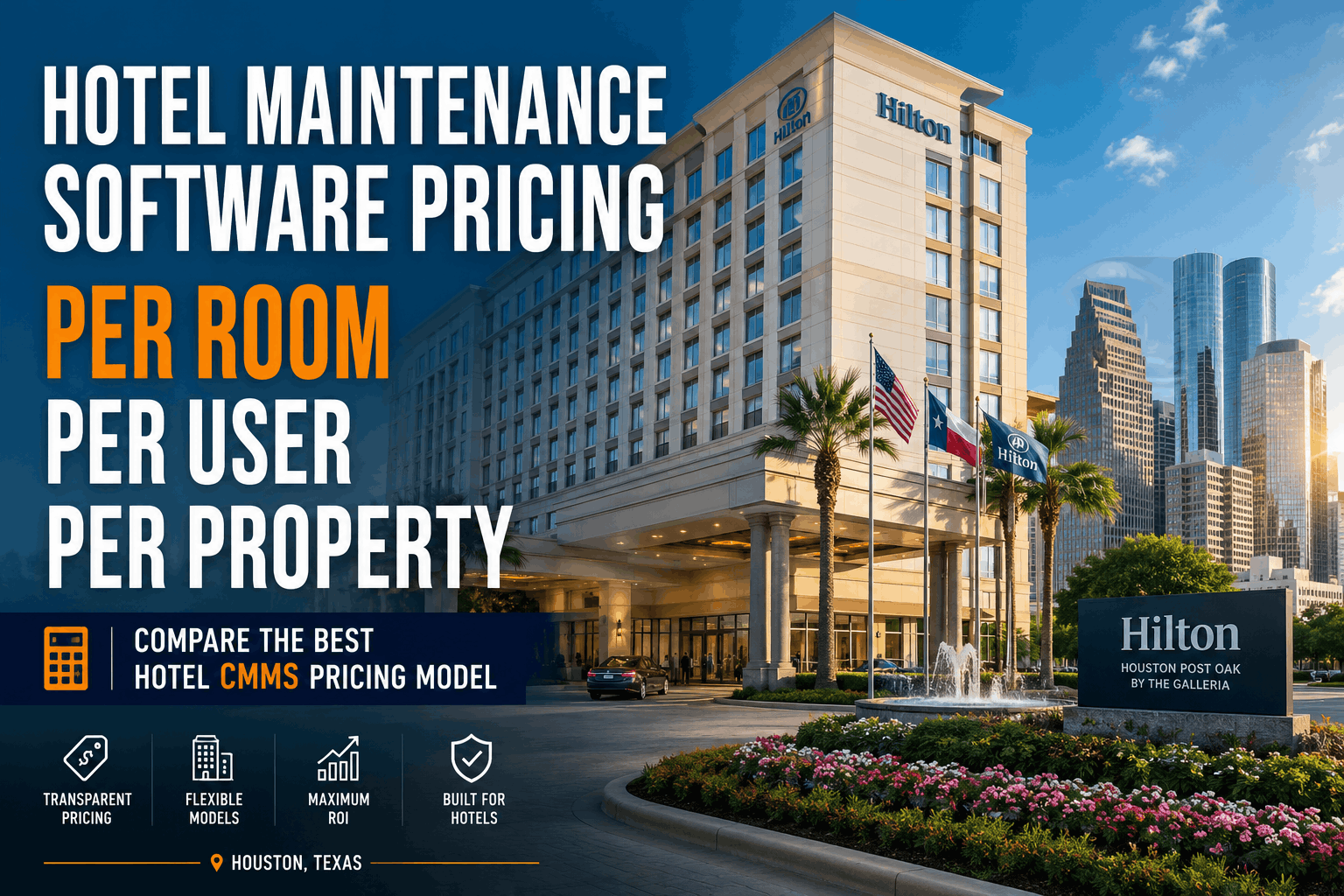
Hotel maintenance software pricing varies more dramatically than most enterprise software categories because properties differ so much — a 60-room boutique hotel, a 250-room full-service property, and a 500-room resort all manage facilities differently, employ different staffing models, and generate completely different maintenance demand patterns. Pricing that makes sense for one property type creates budget nightmares for another. Industry-standard CMMS platforms often quote per-user or per-property pricing without explaining how occupancy rates, asset age, or staffing complexity affect the actual cost. Hotel owners and GMs end up comparing apples to oranges, underestimating true deployment cost, and making vendor decisions based on incomplete financial pictures. Understanding hotel maintenance software pricing — the different models available (per room, per user, per property), the hidden costs vendors rarely quote upfront, and the total cost of ownership across 36 months — is essential for building accurate budgets and justifying software investment to ownership and regional management. Book a pricing consultation to see what different CMMS models would actually cost for your specific property.
Why Hotel Maintenance Software Pricing Is More Complex Than Other Enterprise Platforms
Hotel maintenance software pricing complexity stems from fundamental differences in how properties scale. A 200-room hotel with 8 maintenance staff and a 200-room resort with 22 maintenance staff have identical occupancy, but completely different staffing requirements, asset complexity, and maintenance cost. Generic per-user pricing penalizes larger teams; per-room pricing ignores staffing reality. Most CMMS vendors quote initial pricing without transparently including implementation costs, training expenses, PMS integration setup, or customization work — making true deployment cost 40–70% higher than initially quoted. OxMaint's transparent pricing model includes implementation support, training, integrations, and updates in your base license, eliminating surprise costs and enabling accurate budget forecasting. See our pricing structure designed specifically for hotel operations.
Three Pricing Models Explained: Per Room, Per User, Per Property — What Each Actually Costs
Hotel maintenance software vendors use three primary pricing approaches, each creating different financial outcomes depending on your property profile. Understanding the math behind each model is essential for comparing vendors transparently and identifying which model minimizes your actual cost burden. Most importantly, understanding what's included (or excluded) from quoted pricing reveals why your actual cost will be dramatically higher than the number vendors lead with. Use OxMaint's pricing calculator to compare models specific to your hotel size and staffing.
Per-Room Pricing: Ideal for Boutique Hotels, Expensive for Larger Properties
Per-room pricing charges a monthly fee multiplied by total room count. This model is popular with boutique hotels because cost scales naturally with property size. A 75-room property at $8/room/month costs $600/month; a 150-room property costs $1,200/month. But per-room pricing heavily penalizes mid-size and large properties: a 300-room property paying $8/room = $2,400/month, but staffing and maintenance demand don't scale linearly with rooms. Resort properties often have economies of scale that per-room pricing ignores. Per-room pricing also creates perverse incentives — vendors discourage you from being transparent about occupancy challenges or operational complexity because cost is already locked to room count.
Per-User Pricing: Flexible for Scaled Teams, but Discourages Adoption
Per-user pricing charges based on the number of active platform users (typically technicians + supervisors + admins). A 150-room hotel with 8 maintenance staff at $25/user/month = $200/month. This model is attractive because cost is directly tied to team size, not facility scale. But per-user pricing creates organizational friction: you're incentivized to minimize platform access, discouraging desk workers, supervisors, or facility managers from using the system for visibility. Many hotels using per-user pricing never achieve full adoption because cost increases with each additional user added. Enterprise CMMS platforms use per-user pricing specifically because it creates revenue growth incentive (more users = higher fees), even if it discourages adoption that would benefit your operations.
Per-Property Pricing: Predictable for Portfolios, Scalable Regardless of Size
Per-property pricing charges a flat monthly fee per facility, regardless of room count or staff size. A 100-room hotel, 200-room hotel, or 500-room resort all pay the same monthly fee ($1,200–$2,500 typical range). This model works exceptionally well for hospitality because it aligns incentive with outcomes — you're not penalized for adding staff, growing occupancy, or becoming more operational. Portfolio operators love per-property pricing because multi-property cost is simply number-of-properties × monthly-fee. OxMaint's per-property model includes unlimited users, unlimited work orders, and all features in base price — eliminating hidden add-on costs that other per-property vendors use to inflate true pricing.
What Vendors Don't Tell You About Implementation, Training, Integration, and Support
All three pricing models suffer from the same hidden cost problem: vendors quote per-unit pricing without transparency on implementation scope. PMS integration setup ($2K–$8K), data migration and cleaning ($1.5K–$5K), team training and change management ($2K–$6K), and initial configuration work ($1K–$4K) are almost never included in quoted pricing. Your true first-year cost is 35–70% higher than the per-unit pricing suggests. OxMaint's transparent pricing includes implementation support, training, integrations, and 24/7 support as standard — enabling accurate budget forecasting without surprise invoices during deployment.
Real Pricing Scenarios: What You Actually Pay Across Hotel Types and Sizes
Pricing scenarios across property types reveal why selecting the wrong model can inflate your CMMS cost by 40–60%. Let's compare how different pricing models affect your total cost across 36 months for properties of varying sizes. This shows why OxMaint's per-property pricing with transparent total cost provides significant budget certainty compared to industry-standard pricing approaches.
| Property Profile | Rooms / Staff | Per-Room Model Cost | Per-User Model Cost | Per-Property Model Cost (OxMaint) | Winner |
|---|---|---|---|---|---|
| Boutique Hotel | 75 rooms / 3 staff | $2,700/yr → $8,100 (36mo) | $900/yr → $2,700 (36mo) | $4,200/yr → $12,600 (36mo) | Per-User |
| Mid-Size Hotel | 150 rooms / 8 staff | $5,400/yr → $16,200 (36mo) | $2,400/yr → $7,200 (36mo) | $4,200/yr → $12,600 (36mo) | OxMaint |
| Full-Service Hotel | 250 rooms / 14 staff | $9,000/yr → $27,000 (36mo) | $4,200/yr → $12,600 (36mo) | $4,200/yr → $12,600 (36mo) | OxMaint Tie |
| Resort Property | 400 rooms / 24 staff | $14,400/yr → $43,200 (36mo) | $7,200/yr → $21,600 (36mo) | $4,200/yr → $12,600 (36mo) | OxMaint |
| Hotel Portfolio | 5 properties (1,200 rooms avg) / 45 staff | $43,200/yr → $129,600 (36mo) | $13,500/yr → $40,500 (36mo) | $21,000/yr → $63,000 (36mo) | Per-User |
Total Cost of Ownership: The Complete Picture Including Implementation, Training, Integration, and Support
Comparing base pricing alone creates misleading financial analysis. True cost of ownership includes implementation, training, integration work, and ongoing support costs — which often exceed the software license itself in the first year. Most hotels discover this too late when they're mid-implementation and facing unexpected invoices. OxMaint's transparent total cost model includes everything in your base license: implementation support, team training, PMS integration, data migration, and 24/7 support. This transparency enables accurate budgeting and eliminates surprise costs. Let's compare realistic 36-month total cost across vendors for a representative 150-room hotel using three different CMMS approaches.
Understanding Hidden Costs That Make Quoted Prices Meaningless
Industry-standard vendor quotes include base software pricing but exclude everything that actually costs money during implementation. These hidden costs vary by vendor but consistently represent 40–70% of total first-year deployment cost. Understanding where hidden costs hide helps you negotiate better deals and avoid surprise budget overruns.
PMS Integration and Custom Connector Development
Vendors quote per-unit pricing for software license but not integration. If your hotel uses a non-standard PMS or requires custom integration (API development, data mapping, testing), vendors charge $3K–$8K separately. OxMaint's API-first architecture and pre-built PMS connectors eliminate this cost for 95% of hotels.
Data Migration and Historical Record Import
Switching from legacy systems requires exporting work order history, asset master records, and maintenance schedules — then importing and validating in new software. Data migration services cost $1.5K–$5K depending on data volume and complexity. OxMaint includes data migration support for all customers; enterprise vendors charge separately.
Implementation and Project Management Services
Enterprise vendors require implementation consultants to configure software, design workflows, and coordinate deployment — typically 6–12 weeks at $1.5K–$3K/week. This cost is rarely included in quoted pricing. OxMaint's hotel-native configuration and cloud-native simplicity typically require 2–4 weeks of implementation support (included in base price).
Training and Change Management for Your Team
Complex enterprise systems require extensive training — classroom sessions, online modules, role-based certification. Training cost typically runs $2K–$6K depending on team size. OxMaint's mobile-native design and hospitality-specific workflows make adoption intuitive; included training covers typical needs without additional fees.
Customization, Configuration, and Post-Launch Adjustments
During and after implementation, you inevitably discover workflow tweaks, report additions, or integration adjustments needed. Enterprise vendors charge time-and-materials for post-launch customization ($2K–$10K typical). OxMaint's hotel-native templates and configuration flexibility typically eliminate expensive customization needs; adjustments are made through admin settings without consulting fees.
Negotiating Hotel CMMS Pricing: What Leverage You Have, What You Should Demand
Most hotel GMs accept vendor pricing without negotiation, treating enterprise software procurement like utility billing. Reality is different. CMMS vendors have significant margin and flexibility; most quoted prices include 30–50% overage for negotiation room. Understanding what you can legitimately demand helps you optimize total cost without sacrificing implementation quality or platform capability. OxMaint's sales team is transparent about pricing structure and willing to accommodate different hotel scenarios without hidden add-ons.
Frequently Asked Questions: Hotel CMMS Pricing and Cost Structure
Is hotel CMMS software priced per room, per user, or per property, and which model is most cost-effective for hotels?
Pricing varies: per-room benefits boutique hotels, per-user benefits small teams, per-property (flat fee) benefits all hotel sizes equally. OxMaint's per-property pricing is most cost-effective for 95% of hotels because cost doesn't penalize growth or staffing changes, and you get unlimited users and features regardless of property size.
What hidden costs should I expect when budgeting for hotel CMMS implementation beyond the quoted software price?
Typical hidden costs: PMS integration ($3K–$8K), data migration ($1.5K–$5K), implementation/project management ($6K–$15K), training ($2K–$6K), customization ($2K–$10K). OxMaint includes implementation support, training, integrations, and updates in base price — eliminating most hidden costs that other vendors charge separately.
How much should I expect to spend on total cost of ownership (TCO) for hotel CMMS software over 36 months for a 150-room property?
Realistic range: $37K–$80K over 36 months depending on vendor and model chosen. Per-room pricing typically costs $38K–$45K; per-user costs $25K–$35K; OxMaint's transparent per-property pricing averages $37K–$40K with all costs included. Cheapest isn't best if it excludes implementation or forces expensive add-ons later.
What's the difference between the software license cost vendors quote and the actual total deployment cost I need to budget for?
Quoted software license is 30–50% of actual first-year cost for most hotels. Total cost includes implementation, integration, training, and support — most of which vendors don't include in initial quotes. OxMaint's transparent pricing includes all these costs in the license, making quoted price equal to actual cost.
Can I negotiate hotel CMMS pricing with vendors, or is pricing fixed and non-negotiable?
Absolutely negotiate. Most vendors include 30–50% overage in quoted pricing for negotiation room. Demand fixed implementation cost (not time-and-materials), multi-year volume discounts, and all-inclusive pricing (no feature add-ons). OxMaint's pricing is transparent and fair — we price based on value delivered, not artificially inflated to create "negotiation room."
Is per-room pricing or per-user pricing cheaper for a boutique 75-room hotel versus a 300-room full-service property?
For boutique hotels, per-user pricing is typically cheapest (small teams = low user cost). For mid-size and resort properties, per-property flat-fee pricing (like OxMaint) is cheapest because cost doesn't scale with room count or staff size. Using wrong model can inflate cost 40–60%.
Do hotel CMMS vendors include training, support, and updates in their quoted pricing, or are these charged separately?
Enterprise vendors typically charge separately — training, support, and updates often require additional subscription fees. OxMaint includes everything: training, 24/7 support, monthly updates, integrations, and implementation support in base price. This transparency eliminates surprise costs and simplifies budgeting.
What's the typical payback period for hotel CMMS investment, and how does pricing affect ROI timeline?
Payback period typically ranges 12–18 months when CMMS enables preventive maintenance discipline. Lower-cost platforms (like OxMaint) achieve payback faster because your software investment is smaller and cost savings accumulate quicker. A 150-room hotel investing $12,600/year in OxMaint typically sees $28K–$35K annual savings, hitting payback in month 5–6.