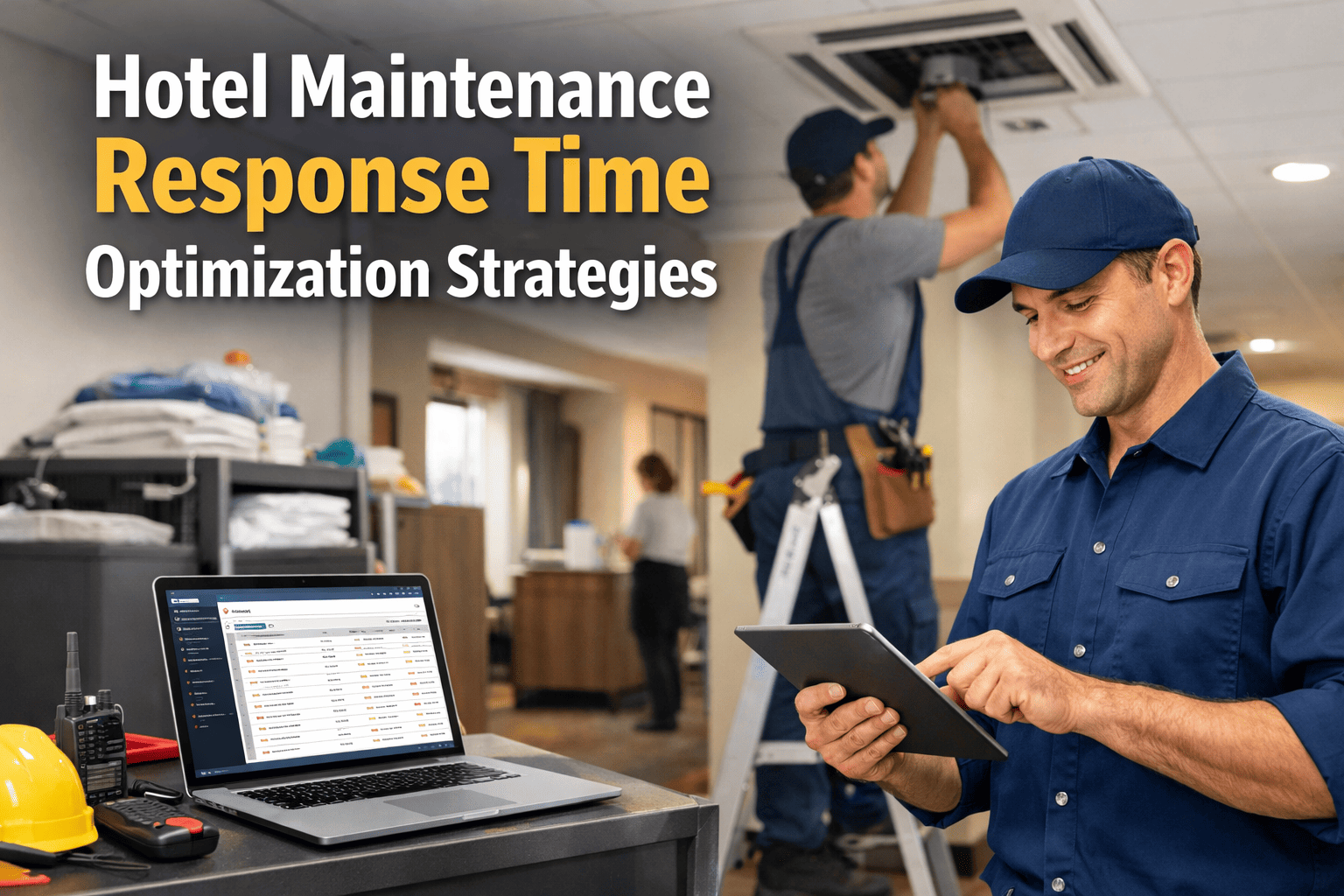
A guest with no air conditioning at 3 PM on a 95-degree day does not become a one-star review because the repair took 90 minutes. She becomes a one-star review because nobody told her anyone was coming, nobody updated her when the part turned out to be in the wrong storeroom, and the engineer who finally fixed it had no idea three other guests had reported the same unit in the past three weeks. The repair time was the symptom. The system failure — no priority dispatch, no status visibility, no asset history — was the cause. Improving hotel maintenance response time is not about making engineers move faster. It is about removing every structural delay between the moment a fault is reported and the moment a qualified engineer has everything they need to fix it.
Hotel Maintenance Response Time Optimization Strategies
Seven data-backed strategies engineering directors, GMs, and operations managers are using to cut average maintenance response time — and what each one requires from your systems, processes, and team.
Why Response Time Is the Wrong Metric to Optimise in Isolation
Hotel engineering teams are typically measured on response time — how long from fault report to engineer arrival. But the metric most hotel operations actually suffer from is resolution time: how long from fault report to confirmed repair. An engineer can arrive in 12 minutes and spend 55 more minutes hunting for the right part, discovering the fault was actually reported three weeks ago on the same unit, and calling the front desk twice to get room access. The arrival metric looked fine. The guest experience was not.
True hotel maintenance response time optimization compresses every stage of the repair workflow simultaneously — intake speed, dispatch quality, parts availability, technician skill match, and resolution documentation. The seven strategies below address each stage. Book a demo to see how Oxmaint implements all seven in a single platform.
Seven Strategies to Optimize Hotel Maintenance Response Time
These strategies are ordered by implementation speed — the first two deliver measurable improvement within days of adoption. The later strategies compound the gains of earlier ones. Each strategy includes the specific system capability it requires so you can evaluate whether your current tools support it. Start implementing all seven in Oxmaint — free.
Implement Priority-Based Dispatch — Not First-In, First-Out
Most hotel engineering queues operate on arrival order. The front desk call at 8:02 AM (lobby flower arrangement looking droopy) gets dispatched before the guest call at 8:04 AM (no hot water in Room 511). Priority-based dispatch assigns a criticality tier to every work order at submission and routes it to the queue position its SLA demands — not the position its timestamp earned. Four tiers — Critical, High, Standard, Planned — with defined response windows create a system where guest-impacting faults are always addressed before non-urgent tasks, regardless of arrival sequence. Hotels that implement priority dispatch as their first structural change report average response time for critical faults dropping by 55–65% within the first two weeks.
Consolidate All Request Channels Into a Single Digital Intake Point
The average hotel has four to six independent maintenance request channels operating simultaneously: front desk phone, radio call, housekeeping verbal report, engineer self-identification, PMS alert, and possibly a guest app. Each channel has a different latency, a different failure mode, and a different documentation quality. Consolidating all channels into a single digital intake — where every submission, regardless of origin, produces a work order with a timestamp and an asset link — eliminates the relay delay that accounts for 40–60% of total response time in radio-based systems. The fastest hotels are not the ones with the fastest engineers. They are the ones where the fault information reaches the engineer fastest. Sign up to configure multi-channel intake in Oxmaint.
Dispatch to the Qualified Technician — Not the Nearest Available Radio
Proximity-based dispatch — sending whoever answers the radio first — produces fast arrivals and slow resolutions. An HVAC fault dispatched to a general maintenance technician without HVAC certification results in one of three outcomes: a temporary fix that recurs within days, a misdiagnosis leading to an unnecessary parts order, or a callback to a qualified engineer who effectively does the job twice. Skill-matched dispatch routes the work order to the technician whose certification profile includes the fault type. The HVAC fault goes to the HVAC-certified engineer. The electrical fault goes to the licensed electrician. The time-to-resolution for skill-matched dispatches is 35–45% shorter than proximity-based dispatches for complex faults, even when the skill-matched engineer takes longer to arrive. See Oxmaint's skill-matched dispatch configuration in a live demo.
Automate SLA Timers and Escalation Alerts — Remove Human Monitoring
Manual SLA monitoring — a supervisor periodically checking a whiteboard or radio channel to see if a job has been completed — fails in two ways. It is time-consuming for the supervisor and it is not real-time. A guest-impacting fault that has been open for 25 minutes without action needs an alert at minute 15, not when the supervisor next checks the board. Automated SLA timers start the moment the work order is created. When the timer crosses a threshold — typically 50–75% of the SLA window — an escalation alert fires to the supervisor. When it crosses 100%, it fires to the duty manager. This structure removes the human monitoring burden entirely and ensures no critical fault goes unescalated silently. Hotels implementing automated escalation report a 70% reduction in SLA breaches within 30 days, without any change in engineering headcount.
Eliminate Parts-Hunt Delays with Asset-Linked Inventory
The single most underestimated contributor to poor hotel repair response time is not dispatch speed — it is parts availability. An engineer who arrives at a fault in 12 minutes but spends 40 minutes locating the correct replacement part, discovering it is out of stock, and placing an emergency order has not improved the guest experience. Asset-linked inventory management connects your spare parts inventory to the specific assets that consume each part. When an HVAC work order is created for a specific fan coil unit, the system can confirm at dispatch time whether the required filter or capacitor is in stock and where it is located. Engineers arrive with parts, not just tools. Properties that implement asset-linked parts management report average repair time (not just response time) reducing by 28% in the first quarter. Set up asset-linked parts tracking in Oxmaint — free to start.
Eliminate the Overnight Information Gap with Structured Shift Handover
The highest-risk maintenance response window in any hotel is the 6–8 AM period when the overnight crew hands over to the day team. Verbal handovers miss open work orders. Paper logs do not convey urgency. An engineer who arrives at 7 AM to discover the pool pump fault reported at 2 AM was still open — because nobody connected the overnight verbal log to a formal work order — is starting their day three hours behind. Structured shift handover requires overnight staff to close every work order before sign-off, or formally escalate open items as carried-forward high-priority jobs. A digital shift log that auto-generates a morning brief eliminates the information gap entirely. The incoming day engineer sees every open job, every overnight escalation, and every asset that needs follow-up before the first guest complaint of the day arrives. Book a demo to see Oxmaint's shift handover and morning brief generation.
Run a Daily 15-Minute Response Time Review — Not Just After Incidents
The engineering director who reviews response time data only when a guest complaint arrives is always managing outcomes instead of preventing them. A daily 15-minute review of the previous day's work order data — average response time by priority tier, SLA breach count, recurring fault flags, and open overdue jobs — creates the feedback loop that makes all other strategies self-improving. When the review shows that Critical-tier response time crept from 14 minutes to 22 minutes over the past five days, the engineering director can investigate and correct before it produces guest impact. When it shows that three work orders on the same HVAC unit were closed in the past 10 days, the review triggers a root-cause PM before a fourth guest reports the same fault. Hotels that institutionalise the daily review as a non-negotiable 15-minute operational habit report the most sustained response time improvement across all strategy implementations combined — because the review catches process drift before it becomes a pattern. Access your hotel's daily response time dashboard in Oxmaint — free.
What Hotels Achieve When These Strategies Run Together
The strategies above are individually effective. Their compounding effect — when all seven run through the same platform — is where the largest improvements occur. These impact benchmarks are measured at 90 days post-implementation across hotel properties using Oxmaint's work order management and dispatch system.
Average Critical Response
From 47-minute average to 14-minute average for Critical-tier guest-reported faults. Primary driver: unified intake eliminating radio relay delay.
SLA Compliance Rate
Automated escalation alerts reduce SLA breach events by 70% in the first 30 days — without adding engineering headcount.
Average Repair Time
Asset-linked parts availability and skill-matched dispatch reduce time-to-resolution — not just time-to-arrival — by 28% in the first quarter.
Reactive-to-PM Ratio
Asset-intelligence from closed work orders enables targeted PM scheduling, reducing reactive callouts by 41% in the first operational year.
We tracked our response time manually for three months before implementing Oxmaint. Our average was 51 minutes for anything guest-reported, and we thought that was acceptable because we had no benchmark. After 60 days with structured dispatch and priority tiers, our average for Critical faults was 16 minutes. More importantly, our repeat fault rate — the same asset reported twice in 30 days — dropped from 23% to 6%. The response time improvement was visible. The asset intelligence improvement was transformative.
Frequently Asked Questions
What is a realistic hotel maintenance response time benchmark for a 200-room property?
How does skill-matched dispatch improve hotel repair response time?
Can hotel maintenance response time optimization be measured without specialised software?
How quickly can hotels see measurable response time improvement after implementing these strategies?
What is the connection between maintenance response time and guest satisfaction scores?
Cut Your Critical Fault Response Time from 47 Minutes to 14 — Starting This Week
All seven strategies run through a single platform. Oxmaint gives hotel engineering teams priority dispatch, skill matching, automated SLA escalation, asset-linked parts visibility, and shift handover management — with no IT project required to go live.