Hotel Parking Lot and Garage Maintenance Checklist for Safety Lighting and EV Charger Reliability
By Liam Neeson on March 24, 2026
A hotel parking lot is the first and last thing every guest experiences — yet it is the most consistently under-maintained facility on the property. Slip and fall accidents in parking lots generate 16% of all commercial property insurance claims and account for 26% of total settlement costs. Average settlements range from $30,000 to $120,000 per incident, and that number rises sharply when the property owner cannot produce documented inspection records proving the hazard was unknown. Poor lighting, uneven pavement, failed EV chargers, and broken barriers are all preventable with a structured maintenance program. They become expensive liabilities when there is no record of inspection. Sign up free to start tracking every parking asset on a scheduled PM cycle, or book a demo to see Oxmaint's parking facility maintenance workflow.
16%
Of all commercial property insurance claims originate from parking lot slip and falls
$120K
Upper end of average parking lot slip and fall settlements per incident
50,000
Car accidents occur in parking lots every year in the U.S.
40%
Of new hotel parking spaces in California must now support Level 2 EV charging per 2024 code
The Hotel Parking Facility: Five Maintenance Zones
Every hotel parking facility — surface lot, structured garage, or covered valet area — breaks down into five maintenance zones, each with its own risk profile, inspection frequency, and compliance obligation. The zone-based approach below ensures nothing is missed regardless of facility type or size. Book a demo to see how Oxmaint maps each zone to a PM schedule with mobile completion tracking.
01
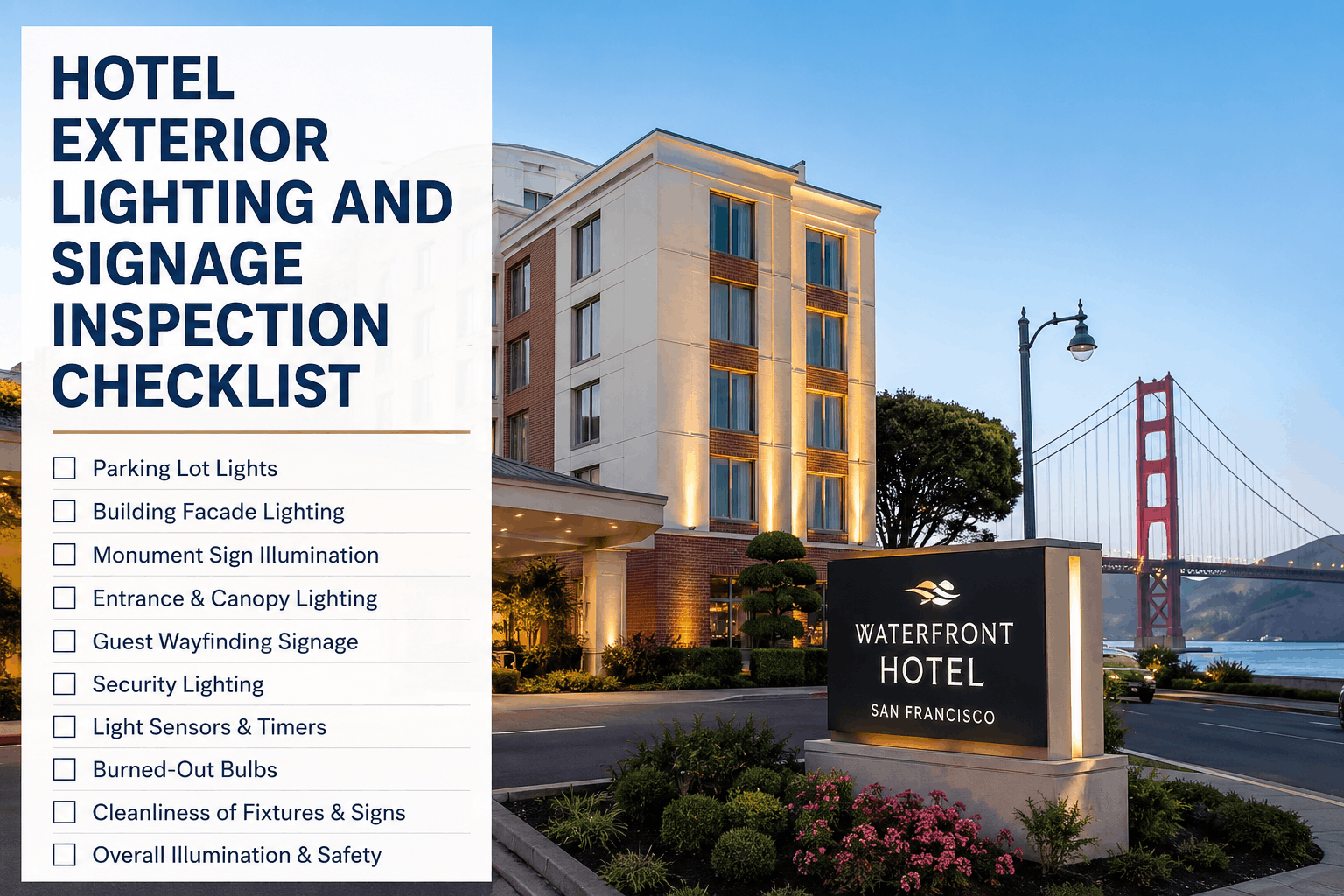
Lighting
Pole lights, wall sconces, garage ceiling fixtures, stairwell and elevator lighting
Poor lighting is the #1 cited condition in parking lot premises liability claims — inspection records are your legal defense
DailyMonthly
Walk all parking areas at night to identify dark zones, failed pole lights, damaged wall fixtures, and non-functioning stairwell or elevator lighting. Log every outage with location and date — this is the primary liability protection record.
Daily
Inspect parking structure ceiling lights, ramp lighting, and level-transition zones — areas where guests move from bright to dark suffer the highest incidence of trips and falls. Ensure minimum 1 foot-candle maintained throughout.
Weekly
Test all photocell and timer controls monthly — verify dusk-to-dawn activation is working correctly. A photocell that fails to activate at dusk leaves the entire facility dark during the highest guest arrival window.
Monthly
Inspect all pole bases, mounting brackets, and fixture housings for corrosion, physical damage, or loose connections quarterly. Poles with foundation corrosion require immediate engineering review before the next storm event.
Quarterly
Annual full lighting audit by a qualified electrician — lux level readings at all pedestrian walkways, crossings, and stairwells. Document and retain readings. Properties with no lux documentation face significantly higher liability exposure in slip and fall litigation.
Annual
Liability: Properties that cannot produce dated lighting inspection records face tripled settlement exposure when guests fall in dark areas.
Zone 2 — Pavement Surface and Garage Structure
Uneven surfaces, cracks, and potholes are the second-most cited cause of parking lot slip and fall claims
WeeklyAnnual
Walk the full surface weekly and mark all cracks wider than ¼ inch, potholes, surface heaving, and drainage failures. Mark hazards with cone or barrier immediately — a known hazard without a barrier is grounds for negligence in any slip and fall claim.
Weekly
Inspect all pedestrian crosswalks, ramps, and walkway transitions monthly for surface integrity and trip hazards. Ramp edges with broken or lifted edge bands are among the most common sources of guest falls in hotel parking structures.
Monthly
Inspect garage deck waterproofing membrane quarterly — water infiltration into a concrete parking structure causes rebar corrosion, spalling, and progressive structural failure. Visible spalling above a parking level below is a mandatory engineering review trigger.
Quarterly
Annual structural inspection by a licensed engineer for multi-level garages — post-tensioned deck integrity, expansion joint condition, column inspection, and drainage system function. File engineering report in facility asset record.
Annual
Known hazard rule: A pothole or crack documented in an inspection log but not repaired or barriered creates direct negligence exposure. Mark and act within 24 hours.
Zone 3 — Signage, Markings, and ADA Compliance
Faded lane markings and missing ADA signage are individually citable violations — ADA non-compliance carries federal civil rights exposure
MonthlyAnnual
Inspect all ADA parking spaces monthly — verify van-accessible space is present, correctly sized (11 feet minimum), access aisle is marked, and the International Symbol of Accessibility sign is present and visible at the correct height.
Monthly
Check all directional arrows, lane markings, stop bars, and crosswalk striping for visibility. Faded markings in areas of conflicting traffic flow (entry/exit, pedestrian crossing) are cited in both insurance investigations and ADA audits.
Monthly
Inspect all speed limit signs, no-parking zone signs, height restriction signs (for garages), and entry/exit signage for physical damage, fading, or obstruction by vegetation monthly. Replace any sign not legible from required viewing distance.
Monthly
Annual full signage and marking audit against current ADA Standards and local code — photograph all ADA spaces, access aisles, and required signage. Retain photos in facility compliance record as documentation for civil rights compliance.
Annual
ADA: Failure to maintain required accessible parking spaces and signage exposes the property to federal ADA Title III civil rights complaints.
Zone 4 — EV Charging Stations
A failed EV charger during a guest's stay generates direct negative reviews — and growing code mandates make EV uptime a compliance issue
WeeklyQuarterly
Test every EV charger weekly — plug in and verify charging initiates, session starts without error, and display or app confirmation is received. A charger that fails to initiate a session for an EV guest is a direct amenity failure generating review-visible complaints.
Weekly
Inspect all charging cables and connectors weekly — check for fraying, connector pin damage, and housing cracks. A damaged cable is both a guest safety hazard and a potential GFCI trip event that takes the charger offline until it is reset or replaced.
Weekly
Verify all EV station safety labels, instruction signage, and emergency stop button labeling are legible monthly. Check bollard protection around pedestals — a vehicle strike on an unprotected charger is a safety and insurance event.
Monthly
Quarterly preventive maintenance by a certified EV technician — electrical connection inspection, GFCI function test, ground fault verification, and firmware update check. Retain service report per unit in the EV asset record. Required for NEC Article 625 compliance documentation.
Quarterly
Verify ADA-accessible EV spaces meet minimum requirements — space dimensions, access aisle, approach route, reach range to controls (15–48 inches above ground), and accessible communication features quarterly.
Quarterly
2024 code: California now requires 40% of new hotel parking spaces to support Level 2 charging. Retrofitting costs 4–6x more than installing during construction.
Zone 5 — Safety Equipment, Barriers, and Gates
Entry and exit gate failures during peak check-in create guest experience incidents — barrier and bollard condition determines vehicle impact risk
WeeklyMonthly
Test entry and exit gate arms weekly — verify open/close cycle completes without hesitation, safety sensor stops gate when obstruction is detected, and manual release is accessible and functional. A gate that drops on a vehicle during check-in is an immediate insurance event.
Weekly
Inspect all wheel stops, bollards, and curb barriers monthly for displacement, cracking, or fading. Displaced wheel stops create tripping hazards — a wheel stop that has rolled away from its anchor is an immediate fall risk.
Monthly
Verify all security cameras in parking areas are operational and providing clear coverage monthly — camera outages during an incident are an evidence gap that significantly complicates insurance claims and incident investigations.
Monthly
Inspect all cable guardrails, concrete barrier walls, and top-deck perimeter cables on garages quarterly. Cable tension and anchor hardware condition should be verified by maintenance staff — any slack or corrosion at anchor points requires immediate engineering review.
Quarterly
Camera coverage: Operational cameras with retained footage are often the deciding factor in dismissing fraudulent or disputed parking lot claims.
Parking Asset TrackingLighting and Safety MonitoringEV Charger Management
From inspection log to liability defense — in one platform.
Oxmaint tracks every parking asset across all five zones — lighting, pavement, signage, EV chargers, and barriers — with timestamped inspection records that become your legal documentation in any premises liability claim. Book a demo to see it.