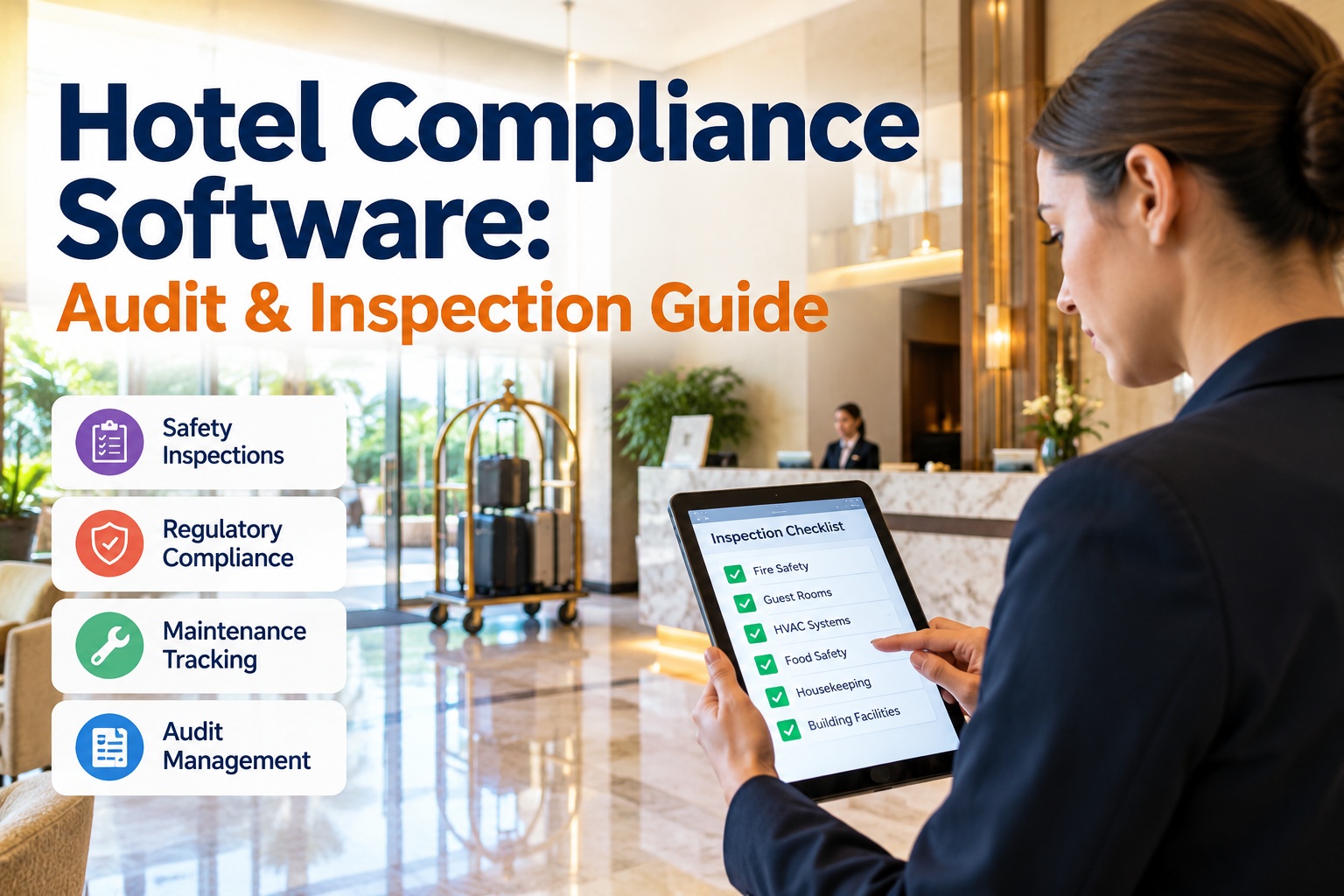
One missed fire inspection. One blocked exit route. One inaccessible guest room. Any of these can trigger fines, lawsuits, or forced closure — and in 2026, regulators are not giving hotels the benefit of the doubt. This guide breaks down exactly what OSHA, ADA, fire codes, and local regulations require from hotel operators, and how automated compliance tracking eliminates the gaps that put properties at risk. Sign up free to see how OxMaint maps your hotel's full compliance calendar from day one.
Stop Managing Compliance on Spreadsheets
OxMaint automates your OSHA, ADA, fire code, and local regulation schedules — with a compliance calendar, multi-regulation tracking, and automated audit scheduling built for hotel operations.
The Four Regulatory Frameworks Every Hotel Must Track
Hotel safety compliance is not a single checklist — it is four overlapping regulatory systems, each with its own inspection authority, documentation format, penalty structure, and inspection interval. Missing any one of them puts your property, your staff, and your guests at risk. Book a demo to see how OxMaint tracks all four frameworks in a single compliance dashboard.
OSHA Compliance: What Inspectors Actually Check at Hotels
OSHA does not have a single hotel-specific checklist, but general industry standards apply in full. Fall protection topped OSHA's most-cited violations list for the 15th consecutive year. Hazard communication ranked second. These are not abstract risks — they show up in hotel housekeeping operations, maintenance workflows, and chemical storage areas every day. Sign up free and let OxMaint automatically schedule every OSHA-required inspection and log it with full technician attribution.
ADA Compliance: The Hotel Areas Most Likely to Generate Violations
No hotel built after January 26, 1993 is grandfathered out of ADA compliance. Older hotels must remove barriers wherever readily achievable. The 2010 ADA Standards are the current benchmark — and enforcement activity rose 23% in 2025. The most common citations are not in obscure areas: they happen at check-in counters, in restrooms, and at elevator controls. Book a demo to see how OxMaint tracks ADA requirements per asset across your entire property.
Fire Safety Compliance: The NFPA Inspection Timeline Hotels Must Follow
Hotels are classified as assembly and residential occupancies under NFPA, meaning multiple codes apply simultaneously. Local fire marshals and insurance carriers require documented proof that systems have been maintained. Failing to produce records after an incident creates legal liability independent of whether a failure caused harm. Sign up free to get your NFPA inspection intervals scheduled automatically with zero manual setup.
Why Most Hotels Fail Compliance Audits — and How to Fix It
PM schedules in spreadsheets produce 41% completion rates. Without digital assignment, escalation, and sign-off, more than half of scheduled compliance tasks never get done — and there is no record to prove otherwise to an auditor.
An OSHA inspector or fire marshal arrives unannounced and requests maintenance records, calibration logs, and corrective action evidence. Manual systems require days to compile what a CMMS produces in minutes.
OSHA requirements sit in one binder. ADA compliance lives with the general manager. Fire inspection records are filed by the maintenance supervisor. None of these systems speak to each other — creating gaps and duplications that a unified compliance platform eliminates.
When experienced maintenance staff leave, the knowledge of what was inspected, when, and by whom leaves with them. Compliance programs built on tribal knowledge collapse at turnover. A CMMS stores that history permanently, independent of who is on staff.
How OxMaint Automates Hotel Compliance — Across Every Regulation
Compliance Calendar
Every required inspection across OSHA, ADA, NFPA, and local regulations is scheduled as a PM task with assigned technician, due date, and completion verification. The compliance calendar shows what is due this week, what is overdue, and what was completed — across your entire property. Audit-ready at any moment, without manual preparation. Sign up free to build your compliance calendar today.
Multi-Regulation Tracking
A single asset — your elevator, fire suppression system, or accessible restroom — may sit under OSHA, ADA, NFPA 72, and local health code requirements simultaneously. OxMaint tracks all applicable regulations per asset in one record, eliminating the siloed binders and disconnected tracking systems that create audit gaps. Book a demo to see multi-regulation tracking configured for your property.
Automated Audit Scheduling
Annual fire alarm tests, quarterly sprinkler inspections, and semi-annual detector checks are all scheduled automatically at correct NFPA intervals. OxMaint alerts the responsible team member before the deadline, escalates if incomplete, and generates timestamped completion records with technician sign-off — the exact documentation format required by fire marshals and OSHA inspectors. Sign up free and activate automated audit scheduling for your property within the first session.
Your Hotel Compliance Readiness: A Quick Self-Audit
Answer these six questions honestly. If any answer is no — or if you are not certain — your compliance program has a gap that a regulator will find before you do. Book a demo and our team will walk through your specific compliance profile with you.
Ready to Make Your Hotel Audit-Ready — Permanently?
OxMaint's Compliance Calendar, Multi-Regulation Tracking, and Automated Audit Scheduling eliminate the gaps that cost hotels six figures in fines and settlements. Get started free today or book a 30-minute demo with our hospitality compliance specialists — and see your entire compliance calendar built out before the call ends.
Frequently Asked Questions
What OSHA regulations apply specifically to hotels?
OSHA general industry standards apply to hotel operations in full — there is no hotel-specific OSHA code. The most relevant requirements cover emergency action and fire prevention plans, exit route maintenance, hazard communication (chemical labeling and SDS registers), PPE provision for housekeeping and maintenance staff, bloodborne pathogen exposure control, and OSHA 300 injury recordkeeping. In 2025, OSHA issued nearly 30,000 citations industry-wide, with willful violations now reaching $165,514 per violation. Sign up free to get every OSHA requirement tracked and documented in one place.
How many ADA-accessible rooms is my hotel required to have?
The minimum number of accessible rooms scales with your total room count under the 2010 ADA Standards. Hotels with 76–100 rooms must have at least 5 accessible rooms. Hotels with over 50 rooms must also include roll-in showers in a portion of those accessible rooms. Both mobility-accessible and communication-accessible rooms are required categories. No hotel built after January 26, 1993 is exempt — and no surcharge can be applied to accessible rooms.
How often must hotel fire alarm systems be inspected under NFPA?
NFPA 72 requires a semi-annual visual inspection of the fire alarm control panel and smoke detectors, and a full annual functional test of all detection devices, pull stations, notification appliances, and emergency communication systems including voice evacuation. A comprehensive battery replacement and detector sensitivity test is required every five years. All results must be documented and retained for inspection on demand by the fire marshal or AHJ.
What documentation must hotels keep for compliance audits?
Hotels must retain OSHA 300 injury logs, fire alarm and sprinkler inspection records (NFPA 72 Form or AHJ equivalent), PPE training records, hazard communication program documentation, SDS registers, ADA barrier removal assessment records, elevator inspection certificates, and food safety HACCP records where applicable. This documentation must be producible on demand — not assembled in advance of a known audit date.
How does OxMaint help hotels stay compliant across multiple regulations?
OxMaint schedules every required compliance inspection as a preventive maintenance task with assigned technician, due date, and completion verification. Its multi-regulation tracking links OSHA, ADA, NFPA, and local code requirements to the same assets — eliminating siloed records. The compliance calendar provides a unified view of what is due, what is overdue, and what was completed. Audit-ready exports are generated on demand with full timestamped technician attribution — the exact format inspectors require. Book a demo to see it configured for your hotel's specific regulatory footprint.