Ultimate Guide to Choosing Hotel Maintenance Software for Your Property
By James smith on March 9, 2026
Choosing the wrong hotel maintenance software costs more than the software itself — in failed implementations, staff abandonment, compliance gaps, and the operational debt of running two systems simultaneously while the new one sits unused. Hotels that evaluate CMMS platforms without a structured framework routinely select tools built for generic facilities management and discover 12 months later that the platform has no concept of room-type asset hierarchies, no PMS integration, and no hospitality-specific compliance reporting. This guide gives hotel operations leaders the complete evaluation framework — 40+ criteria, comparison methodology, and implementation checklist — to make a selection that delivers ROI within the first year. Explore Oxmaint's full hotel maintenance platform free — no credit card, operational in under 60 minutes.
67%
Of hotel CMMS implementations fail to reach full adoption within 18 months due to poor platform fit with hospitality workflows
4.8x
Higher cost of reactive vs. planned maintenance — the primary ROI driver for hotels selecting a purpose-built CMMS
40+
Evaluation criteria hotel operations leaders must assess before selecting a maintenance software platform
Why Generic CMMS Platforms Fail Hotels — The Hospitality Gap
Most CMMS platforms on the market are built for manufacturing plants, municipal facilities, or commercial real estate. They have robust work order engines and asset registries — but they treat a hotel guest room the same as a factory floor station. The result is a platform that works technically but fails operationally because it has no concept of room status tied to housekeeping, no understanding that the same chiller serves 120 rooms with different occupancy profiles, and no mechanism for linking maintenance history to guest complaint records.
Generic CMMS treats assets as standalone items. Hotels need Portfolio > Property > Floor > Room > System > Asset — so every work order carries the full location context and room revenue impact.
No PMS Integration
Without property management system integration, maintenance cannot see room occupancy, check-in times, or VIP guest flags — so engineers interrupt occupied rooms, schedule work during peak check-in, and miss the 2-hour window when rooms are vacant.
No Guest Impact Scoring
A broken HVAC in Room 412 with a checked-in guest is a different priority than the same fault in a vacant room. Generic platforms assign identical urgency to both. Hotel CMMS must factor occupancy, guest tier, and complaint risk into every priority calculation.
No Multi-Property Portfolio View
Hotel groups managing 3–50+ properties need cross-portfolio dashboards, standardized asset taxonomies, and consolidated CapEx forecasting. Generic CMMS treats each property as a separate installation with no shared intelligence layer.
Key Evaluation Insight
The right question is not "what does this CMMS do?" — it is "what does this CMMS do that is specific to how hotels operate?"
Every CMMS vendor will show you a work order screen and an asset list. The differentiator is depth: does the platform understand guest room status? Does it integrate with Opera, Mews, or Cloudbeds? Does it model CapEx at the portfolio level? Does it generate brand standard audit reports automatically? Evaluate on hospitality-specific depth, not feature count.
The 5 Evaluation Categories — 40+ Criteria Framework
Structured CMMS evaluation requires assessing platforms across five functional domains. Each domain contains must-have criteria that eliminate platforms that cannot perform, and differentiator criteria that separate good platforms from purpose-built hotel solutions. Use this framework to score every vendor you evaluate. See how Oxmaint scores across all five categories — start a free trial and evaluate with your own team.
CAT 1Asset and Space Management
The foundation of every CMMS evaluation. Assess whether the platform can model your property's full asset complexity — from portfolio level down to individual components — and whether condition scoring drives CapEx decisions.
+Condition scoring with remaining useful life calculations
+Asset history linking work orders, costs, and failures over time
+Room-type asset templates for rapid property onboarding
+QR code or NFC asset tagging for mobile field access
+Spare parts inventory linked to asset records
CAT 2Work Order and Scheduling
Work order management is the daily operational layer. Evaluate how work is created, assigned, prioritized, and completed — and whether the platform adapts scheduling to hotel-specific operating rhythms.
+Guest-impact priority scoring on reactive work orders
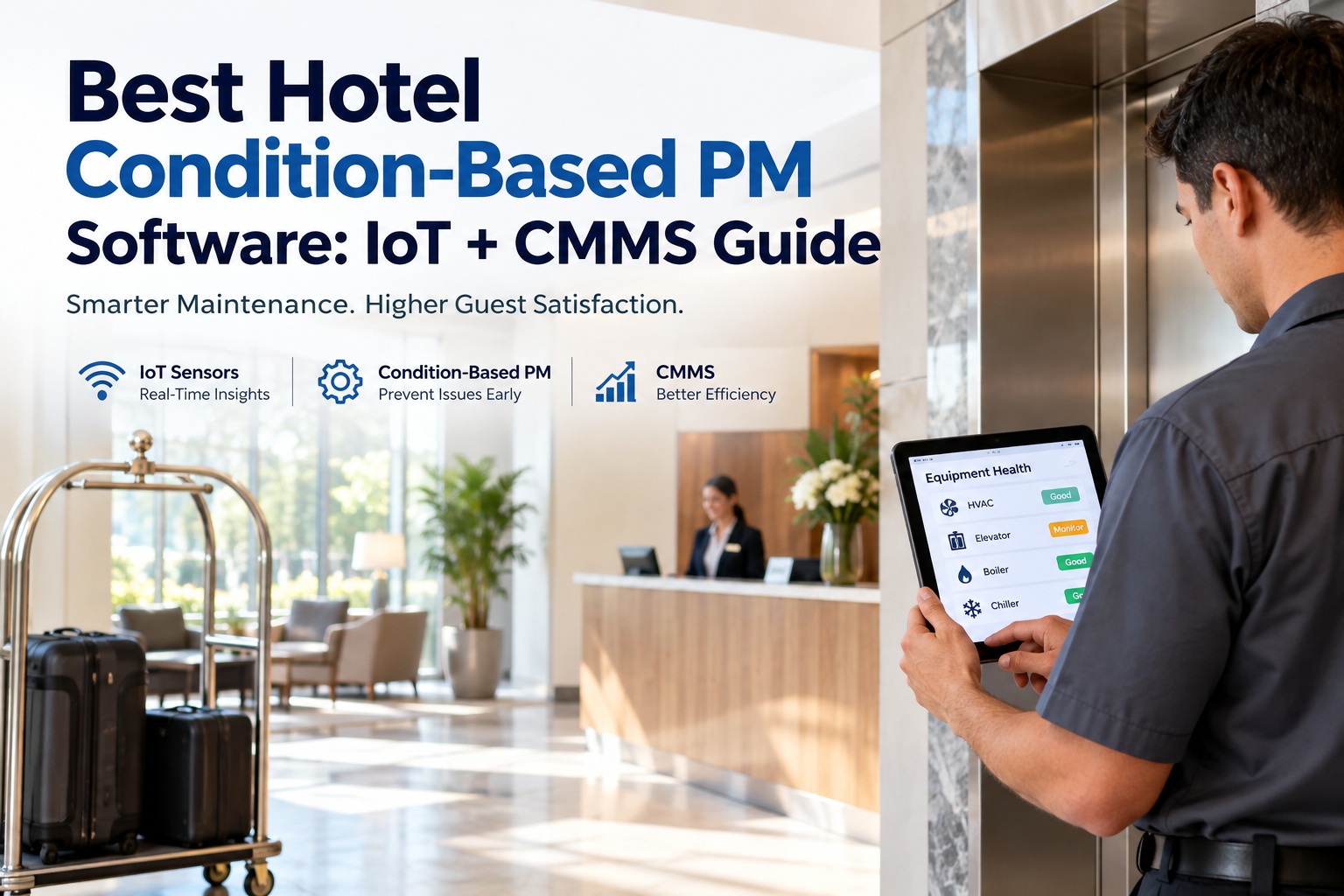
+Condition-based and production-based maintenance triggers
+Technician skill matching and certification verification
+Photo documentation with before/after pairing on work orders
+Mobile offline capability for basements and plant rooms
CAT 3Integration and Data Connectivity
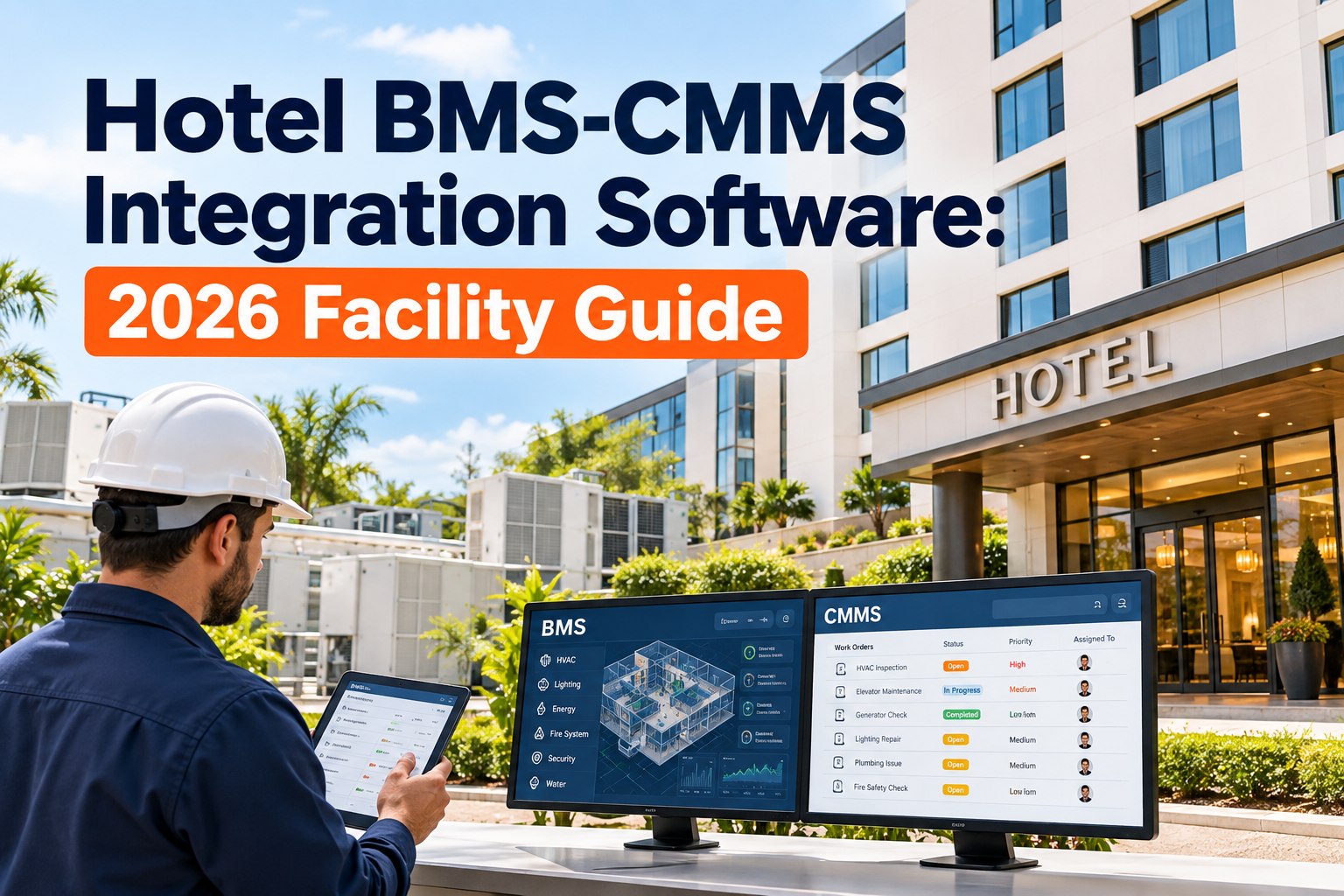
A maintenance platform that does not connect to your PMS, BMS, and IoT infrastructure creates data silos that guarantee suboptimal outcomes. Integration depth is a primary differentiator between hotel-ready and hotel-retrofitted CMMS.
Hotels face overlapping compliance obligations — brand standards, fire safety, food hygiene, building regulations, and local operating requirements. The platform must generate audit evidence automatically, not require manual compilation.
+Digital inspection forms with mandatory photo documentation
+Electronic signatures with audit-grade timestamping
+One-click compliance report export by date range and space type
+Brand standard checklist templates with automated scoring
+OSHA and fire safety inspection record retention
+Corrective action tracking from defect to verified closure
CAT 5Reporting and CapEx Forecasting
The strategic value of a CMMS is measured in the capital decisions it enables. Evaluate whether the platform generates investor-grade CapEx forecasts from real asset condition data — or just produces work order summary reports.
+Rolling 5–10 year CapEx forecasting from condition scores
+Portfolio-level dashboards across multiple properties
+Maintenance cost per room and per asset category tracking
+Reactive vs. planned maintenance ratio trending
+Technician performance and labor productivity reporting
+Board-ready CapEx presentation exports for ownership groups
CAT 6Implementation and Adoption
Platform capability means nothing if your team does not use it. Evaluate implementation requirements, onboarding timelines, and the realistic adoption path for a hospitality workforce with 40–60% annual staff turnover.
+Implementation timeline under 30 days for single property
+No IT infrastructure requirements or server installation
+Mobile app intuitive enough for non-technical maintenance staff
+Multi-language support for international hotel operations
+Template replication for multi-property portfolio rollout
+In-app onboarding that reduces training dependency
See how Oxmaint scores across all 40+ evaluation criteria. Purpose-built for hotel operations — not retrofitted from a factory floor CMMS. Multi-property hierarchy, PMS integration, condition-based CapEx forecasting, and audit-ready compliance out of the box.
Asset Inventory and Space Classification (Days 1–7)
Build your digital asset registry before configuring any workflows. Map every maintainable asset by property, floor, room, and system. Assign condition scores using physical walk-through data. For multi-property groups, establish the standardized asset taxonomy that will apply across all sites — this creates the consistent data structure that makes portfolio reporting meaningful.
2
PMS and BMS Integration Configuration (Days 5–14)
Configure the integration between your CMMS, property management system, and building management system. Test bidirectional data flow — room status updates flowing from PMS to maintenance scheduling, sensor alerts from BMS creating work orders in CMMS. Validate that occupied room protection logic prevents maintenance interruptions during active guest stays.
Import or build PM schedules for every asset, using condition scores and usage data to set intervals — not calendar defaults. Configure occupancy-aware scheduling rules that push PM work to lower-occupancy periods. Link PM schedules to asset records so every completed PM updates the asset condition score and flags any anomalies found during the service.
4
Team Onboarding and Mobile Deployment (Days 14–28)
Roll out mobile access to technicians with a supervised first-week protocol — a senior team member or department head works alongside each technician through their first 5–10 work orders. Given 40–60% annual turnover in hotel maintenance roles, build an in-platform onboarding checklist that new hires can complete independently within their first shift. Document all SOPs as in-app reference guides attached to asset records.
5
Inspection Templates and Compliance Configuration (Days 21–35)
Build digital inspection forms for every inspection type: guest room readiness, housekeeping supervisor rounds, fire safety, pool and spa, kitchen hygiene, and back-of-house equipment. Configure mandatory photo documentation requirements and corrective action auto-routing rules. Test the audit export workflow to confirm that your brand standard and regulatory reporting requirements are fully met before the next inspection event.
6
CapEx Reporting and Portfolio Dashboard (Days 30–60)
Once 30 days of operational data exists in the platform, configure your CapEx forecasting models and portfolio dashboards. Set the condition score thresholds that trigger capital replacement recommendations. Schedule monthly CapEx report generation for ownership and asset management stakeholders. After 90 days of operation, you will have enough asset history to run your first data-backed capital planning presentation — replacing the spreadsheet estimates that previously drove multi-million dollar decisions. Start the implementation process in Oxmaint today — free trial, no IT involvement required.
Oxmaint Platform Capabilities for Hotel Operations
Oxmaint is purpose-built for hotel operations — not adapted from a factory floor CMMS. Every feature is designed around the operational realities of hospitality: guest impact, occupancy cycles, multi-property portfolios, and brand standard compliance.
Full Asset Registry with Condition Scoring
Every asset from chillers to guest room door locks registered with full location hierarchy, condition scores, and maintenance history. CapEx decisions driven by real condition data — not age estimates.
Asset LifecycleCapEx Forecasting
Occupancy-Aware PM Scheduling
Preventive maintenance schedules that adapt to occupancy calendars. Work orders route to vacant periods automatically. VIP guest protection logic prevents maintenance interruptions during high-value stays.
PMS IntegrationPM Scheduling
Digital Inspections with Corrective Action Routing
Mobile inspection forms with mandatory photo documentation and automatic corrective action work order creation. Defect-to-work-order routing in under 45 seconds. Trend dashboards identify recurring issues before they become guest complaints.
Digital InspectionsCorrective Actions
Portfolio Dashboard for Multi-Property Groups
All properties in one platform. Cross-portfolio KPIs, standardized asset taxonomies, and consolidated CapEx reporting for ownership groups and asset managers. No siloed installations. No manual data compilation.
Portfolio ManagementInvestor Reporting
We evaluated six CMMS platforms over four months. Three of them had never integrated with a PMS before. Two required server installation. One quoted a six-month implementation timeline. Oxmaint was deployed across our 340-room property in four days, integrated with our Opera PMS on day three, and generated our first CapEx forecast at the end of week two. We went from spreadsheet capital planning to data-backed board presentations in under 30 days.
— Director of Engineering, 340-Room Luxury Hotel, Miami FL
Key Performance Metrics to Track After Implementation
Successful CMMS adoption is measured by operational outcomes, not platform usage statistics. Track these metrics monthly from day 30 onward to quantify ROI and identify where the platform is driving the greatest value for your property.
Reactive vs. Planned Ratio
Target: 30/70
Hotels on reactive maintenance average 70%+ reactive. The target after 6 months on a CMMS is 30% reactive or below — the inflection point where costs drop significantly
PM Completion Rate
Target: 95%+
PM completion below 85% indicates scheduling or staffing issues that the CMMS data will surface — enabling targeted intervention before assets fail
Mean Time to Repair
Track Monthly
MTTR measures the speed from fault detection to verified resolution. Hotels using digital work orders reduce MTTR by 35–45% in the first quarter through better routing and asset history access
Frequently Asked Questions
How long does it take to implement hotel maintenance software at a single property?
For a cloud-based platform like Oxmaint, single-property implementation takes 3–5 business days for initial deployment — asset registry setup, inspection template configuration, and team onboarding. Full operational maturity, where PM schedules are running condition-based and CapEx forecasting is generating meaningful data, takes 30–60 days. This is significantly faster than traditional CMMS platforms that require server installation and IT involvement — which typically extend implementation to 3–6 months. The hospitality-specific advantage is that Oxmaint includes pre-built templates for common hotel asset types and inspection scenarios, which eliminates much of the configuration time that generic platforms require. Start the implementation process today — free trial, operational in under a week.
What is the most important question to ask a CMMS vendor during evaluation?
Ask the vendor to demonstrate a live PMS integration with room status data flowing into maintenance scheduling. If they cannot show this live — or if they have to explain that "integration is available via middleware" — you are evaluating a generic CMMS being retrofitted for hospitality. The second most important question: show me how CapEx forecasting works from asset condition scores, not from a data export into Excel. A purpose-built hotel CMMS generates rolling capital forecasts automatically from the condition data that technicians capture during every PM and inspection. If the vendor cannot demonstrate this natively, you will be doing your capital planning in the same spreadsheet you are currently using. Book a demo to see both of these capabilities live in Oxmaint.
How do you handle CMMS adoption with high hotel staff turnover?
Hotel maintenance roles average 40–60% annual turnover — which means your CMMS needs to onboard new staff every 2–3 months without requiring dedicated training sessions. The platform selection criteria that matter most for high-turnover environments: mobile-first UX that is intuitive without training, in-app SOPs attached to assets so new technicians access instructions at the point of work, and digital asset history that eliminates dependence on institutional knowledge held by departing staff. Hotels using Oxmaint report new technicians completing their first work orders independently within 2–3 hours of access, without formal training sessions. Build your asset records and SOPs comprehensively during implementation — that investment pays dividends every time you onboard a replacement technician.
Can a single CMMS platform support both single properties and multi-property portfolios?
It depends entirely on the platform architecture. Generic CMMS platforms are typically licensed per-site with separate databases — meaning multi-property portfolio reporting requires manual data exports and Excel consolidation. Purpose-built hotel CMMS platforms like Oxmaint use a native multi-property architecture where Portfolio > Property > Asset is a core data model, not an add-on. This means portfolio-level KPIs, consolidated CapEx forecasting, and cross-property benchmarking are available as standard features from day one. For hotel groups starting with one property and planning to expand, this architectural distinction is critical — migrating from a single-property CMMS to a portfolio-capable platform mid-growth is significantly more disruptive than selecting portfolio-capable architecture from the start. Book a demo to see Oxmaint's multi-property architecture in action across a live portfolio.
What ROI should hotels expect from maintenance software in the first year?
The primary ROI drivers in Year 1 are: reduction in emergency repair spend (reactive repairs cost 4.8x more than planned), reduction in audit preparation labor (from 18 staff-hours to under 2 per audit event), and CapEx deferral through condition-based replacement decisions (hotels routinely defer 15–25% of budgeted capital spend when replacement decisions are driven by real condition data rather than calendar age). A 150-room hotel with $2,800/month in unresolved rework and 4 brand standard audits annually will typically see $40,000–$60,000 in measurable first-year savings — before accounting for CapEx deferral, which can exceed the software investment by 10–20x in the first capital planning cycle. Start building toward that ROI today — free trial, no credit card required.
The Right Hotel Maintenance Software Pays for Itself Within 12 Months.
Full asset registry with condition scoring. Occupancy-aware PM scheduling with PMS integration. Digital inspections and corrective action routing. Rolling 5–10 year CapEx forecasting. Mobile-first, multi-site portfolio management. Audit-ready compliance from day one. Purpose-built for hospitality — not retrofitted from a factory floor CMMS. Deployed in under a week, without IT involvement.