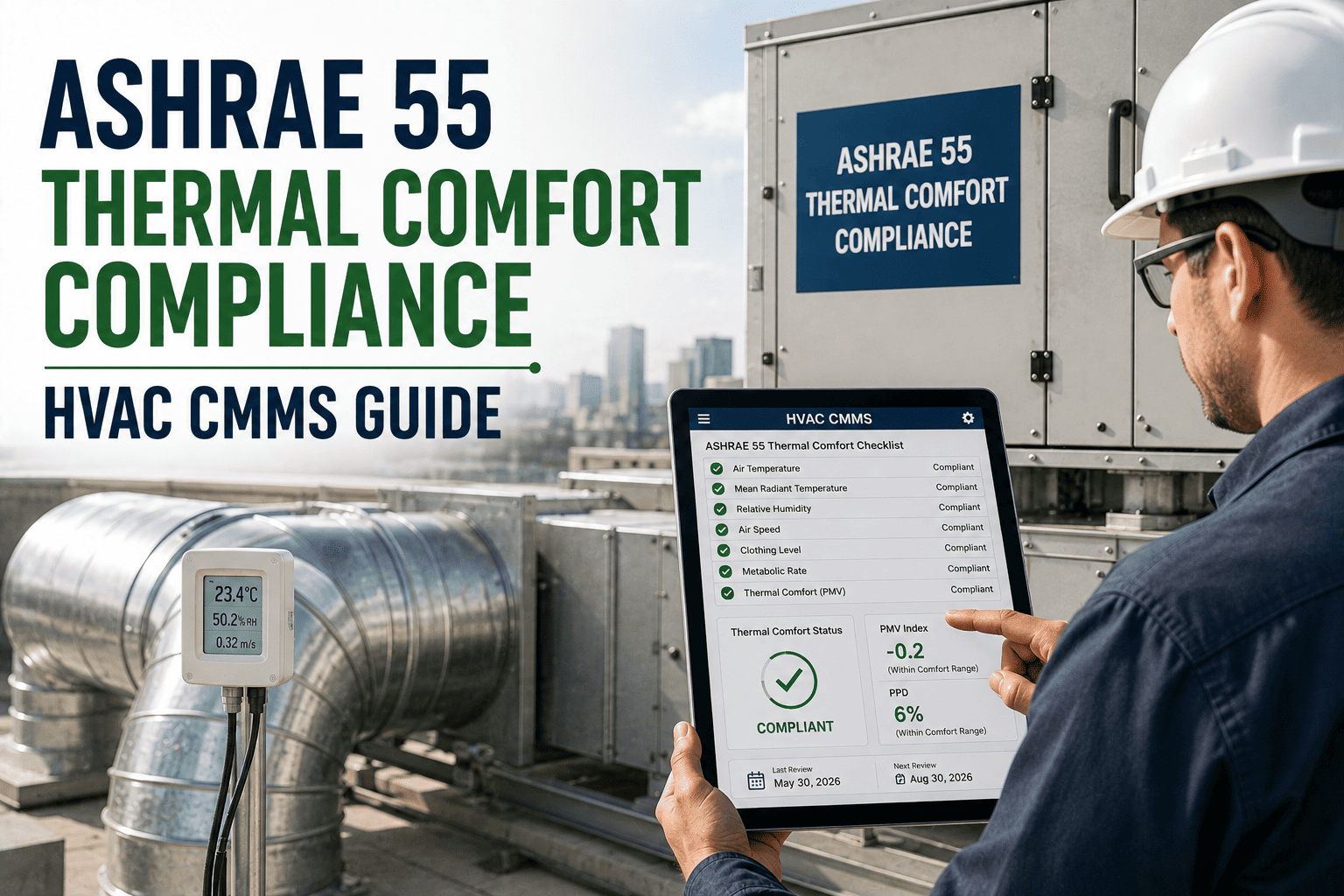
ASHRAE 55 thermal comfort compliance requires HVAC teams to maintain indoor temperature, humidity, and airspeed within defined ranges that satisfy at least 80% of occupants — and proving it demands accurate sensor data, documented drift detection, and auditable maintenance records. For maintenance and reliability leaders, the challenge is not simply setting a thermostat; it is ensuring that every RTU, VAV, and humidity sensor across a facility stays calibrated, that comfort drift is caught before complaints escalate, and that every preventive task is traceable for an audit. This guide walks through the sensor accuracy requirements, drift detection strategies, and CMMS-based compliance workflows that keep buildings inside the ASHRAE 55 comfort envelope — and shows how an AI-powered platform like OxMaint turns thermal comfort HVAC compliance from a manual fire-drill into a predictable, automated process. Ready to see it on your assets? Start Free Trial or read on for the full compliance playbook.
Is your building actually inside the ASHRAE 55 comfort zone — or are you just hoping it is?
Most facilities lose thermal comfort compliance not from a single failure, but from slow sensor drift no one catches until the complaint log fills up. OxMaint automates comfort drift detection, sensor calibration scheduling, and audit-ready documentation so every zone stays provably compliant.
What ASHRAE 55 requires from your HVAC maintenance program
ASHRAE Standard 55-2023 (and the upcoming ASHRAE 55 2026 revision) defines thermal comfort as the condition of mind expressing satisfaction with the thermal environment — and it is quantified using six primary factors that maintenance teams directly control or monitor.
Air temperature
Dry-bulb temperature must stay within the PMV-model comfort band (roughly 20–24°C in winter, 23–26°C in summer for typical office clo-value). Sensor accuracy class shall be ±0.5°C or better.
Mean radiant temperature
Wall, ceiling, and window surface temperatures affect comfort as much as air temp. Drift in HVAC output that changes operative temperature beyond 2°C pushes zones outside the 80% satisfaction threshold.
Relative humidity
ASHRAE 55 recommends 30–60% RH. Humidity sensor drift of just 5–8% RH can create mold-risk conditions or dryness complaints — and invalidate your compliance documentation.
Airspeed
Indoor air velocity above 0.2 m/s (winter) or 0.15 m/s (summer) causes draft complaints. Dirty filters and unbalanced VAV boxes are the most common root causes — both are maintenance-driven.
Metabolic rate & clothing
While facility teams do not control occupant clo/met values, ASHRAE 55 compliance assumes seasonal clothing levels. Maintenance must adjust setpoints seasonally to match the standard's winter/summer assumptions.
Local discomfort factors
Vertical air temperature gradient, radiant asymmetry, and floor temperature must each stay within ASHRAE 55 limits. Detecting these requires periodic functional testing of diffusers and reheat coils.
ASHRAE 55 sensor accuracy requirements for HVAC compliance
You cannot prove thermal comfort compliance with sensors that have drifted out of tolerance. The table below consolidates the accuracy classes and calibration intervals most HVAC maintenance programs adopt to stay audit-ready.
| Sensor type | Required accuracy | Drift threshold | Calibration interval | Compliance impact if exceeded |
|---|---|---|---|---|
| Zone air temperature | ±0.5°C (Class A) | ±0.3°C from last cal | 12 months | PMV error up to 0.4 — comfort band breach |
| Duct air temperature | ±0.8°C (Class B) | ±0.5°C | 12 months | Discharge-air setpoint deviation |
| Relative humidity | ±3% RH (10–90% range) | ±5% RH | 6–12 months | Mold-risk, condensation, invalid PMV calc |
| Globe / radiant temp | ±0.5°C | ±0.5°C | 24 months | Operative temp unknown — false compliance |
| Airspeed (hot-wire anemometer) | ±0.05 m/s | ±0.03 m/s | 12 months | Undetected draft complaints |
| CO₂ (occupancy proxy) | ±50 ppm | ±75 ppm | 12 months | Incorrect metabolic-rate assumptions |
The hidden cost: A 250,000-sq-ft office with 60 uncalibrated zone sensors can rack up 40–60 comfort complaints per quarter, triggering $8K–$15K in reactive HVAC service calls — plus tenant dissatisfaction and potential lease-concession exposure. OxMaint's preventive maintenance engine schedules and tracks every calibration automatically so no sensor drifts past its tolerance window.
How to detect thermal comfort drift before complaints start
Comfort drift is gradual by nature — a zone sensor that was accurate in January may read 0.7°C high by July. The following four-step timeline shows how a CMMS-driven drift detection program catches the problem early and keeps you ASHRAE 55-compliant year-round.
Baseline & tag
Log every comfort-related sensor in OxMaint's asset registry with its accuracy class, last-calibration date, and ASHRAE 55 tolerance window. The CMMS auto-generates the first round of calibration work orders.
Continuous trend monitoring
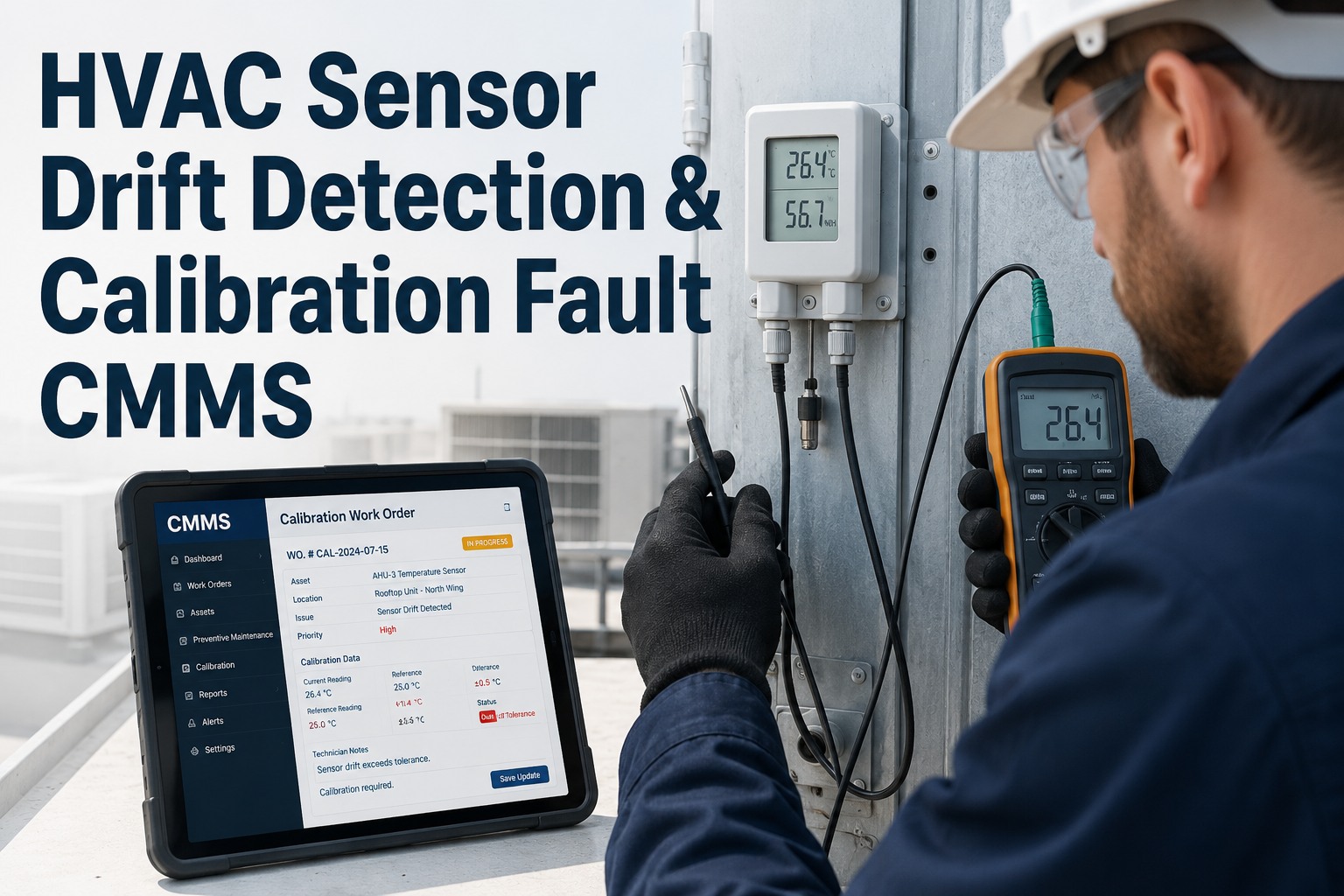
OxMaint ingests BAS/BMS trend logs (or manual readings) and flags any sensor whose output deviates more than 0.3°C from a verified reference — before the drift reaches the compliance threshold.
Predictive drift alert
OxMaint's AI models extrapolate each sensor's drift curve and predicts when it will exceed ±0.5°C. A pre-emptive calibration work order is generated 30 days before the predicted breach date.
Audit-ready documentation
Every calibration, reading, and corrective action is stored against the asset record. When an ASHRAE 55 compliance audit or tenant complaint arises, you export a full history in one click.
Building an ASHRAE 55 CMMS compliance workflow
Thermal comfort HVAC compliance lives or dies on documentation. A CMMS-based workflow replaces clipboards and spreadsheets with a closed-loop system that ties every comfort parameter to a scheduled task, a responsible technician, and an auditable record.
Asset tagging & hierarchy
- Every RTU, AHU, VAV, reheat coil, and sensor tagged as a distinct asset
- Parent-child hierarchy maps each sensor to the zone it serves
- Accuracy class, range, and tolerance stored as asset attributes
- Photos, manuals, and O&M specs attached to each record
Preventive maintenance triggers
- Calendar-based PMs for 6- and 12-month sensor calibrations
- Runtime-based PMs for filter changes and coil cleaning
- Seasonal setpoint-adjustment tasks tied to ASHRAE 55 clo-values
- Conditional PMs triggered by drift-alert thresholds from BMS data
Work order execution
- Mobile work orders with step-by-step calibration checklists
- Before/after readings captured in the field on phone or tablet
- Pass/fail tolerance logic auto-flags out-of-spec sensors
- Failed calibrations auto-generate a replacement work order
Audit & reporting
- One-click ASHRAE 55 compliance report per zone, floor, or building
- Calibration certificates, trend graphs, and corrective-action logs included
- Compliance dashboard shows real-time % of sensors within tolerance
- Historical trail satisfies ISO 55000 asset-management audit requirements
How OxMaint automates ASHRAE 55 thermal comfort compliance
OxMaint maps each ASHRAE 55 requirement to a concrete CMMS capability with a measurable outcome — so compliance is not a quarterly scramble but a daily byproduct of your maintenance routine.
Predictive comfort drift detection
OxMaint's AI analyzes sensor trend data and predicts drift breaches 30+ days before they occur, auto-generating calibration work orders. Outcome: cut comfort complaints by 40–60% and eliminate reactive HVAC service calls.
Automated PM & calibration scheduling
Calendar- and runtime-based PMs ensure every temperature, humidity, and airspeed sensor is calibrated on its required interval. Outcome: 100% calibration compliance with zero manual spreadsheet tracking.
One-click audit documentation
Every reading, calibration, and corrective action is timestamped and stored against the asset. Generate a full ASHRAE 55 compliance report in seconds. Outcome: audit prep time drops from days to minutes.
Mobile work orders with tolerance logic
Technicians capture before/after readings on mobile devices; pass/fail logic auto-flags out-of-spec sensors and creates follow-up work orders. Outcome: eliminate paper work orders and reduce missed defects by 70%.
A 180-asset commercial office portfolio in the Midwest was spending $42K/year on reactive HVAC service calls and losing two tenants over comfort complaints. After deploying OxMaint's ASHRAE 55 compliance workflow — sensor tagging, automated calibration PMs, and predictive drift alerts — the team cut comfort complaints by 52% in the first six months, reduced reactive HVAC spend by $19K annually, and passed their first ISO 55000 audit with zero findings on the HVAC compliance module. Payback period: under four months.
See OxMaint on your assets — book a 30-min demo
Watch how automated drift detection, calibration scheduling, and one-click compliance reports transform your ASHRAE 55 program from reactive to audit-ready.
ASHRAE 55 thermal comfort compliance — frequently asked questions
What is ASHRAE 55 thermal comfort compliance for HVAC?
ASHRAE 55 thermal comfort compliance means maintaining indoor environmental conditions — air temperature, radiant temperature, humidity, and airspeed — within ranges that satisfy at least 80% of occupants, as defined by the standard's PMV-PPD model. HVAC teams achieve and prove compliance through properly calibrated sensors, seasonal setpoint adjustments, and documented preventive maintenance that keeps equipment operating inside the comfort envelope.
How often should HVAC sensors be calibrated for ASHRAE 55 compliance?
Zone temperature sensors should be calibrated every 12 months (Class A, ±0.5°C), humidity sensors every 6–12 months (±3% RH), and globe/radiant temperature sensors every 24 months. A CMMS like OxMaint automates these intervals by generating calibration work orders on schedule and tracking before/after readings so you can prove every sensor was within tolerance during an audit. Start Free Trial to automate your calibration schedule today.
What is comfort drift detection and why does it matter?
Comfort drift detection is the process of monitoring sensor readings over time to identify gradual deviation from calibrated values — before the drift pushes a zone outside the ASHRAE 55 comfort band. Because sensor drift is slow and often invisible until complaints spike, predictive drift detection using AI trend analysis can flag a breach 30 days in advance, saving $200–$500 per avoided reactive service call and preventing tenant dissatisfaction.
Can a CMMS help with ASHRAE 55 compliance audits?
Yes — a CMMS is the single most effective tool for ASHRAE 55 audit readiness. It stores every sensor's accuracy class, calibration history, PM records, and corrective actions in one asset record, then generates compliance reports on demand. OxMaint goes further by integrating predictive analytics, so you can show auditors not just what happened, but that you proactively prevented drift breaches before they occurred.
What changes are expected in ASHRAE 55 2026?
The ASHRAE 55 2026 revision is expected to refine the adaptive comfort model for naturally conditioned spaces, expand requirements for localized thermal discomfort (draft and radiant asymmetry), and strengthen documentation expectations around sensor accuracy and calibration traceability. Maintenance teams should prepare now by ensuring every comfort-related sensor is tagged in a CMMS with its tolerance class and calibration interval. Book a Demo to see how OxMaint future-proofs your compliance program.
Stop guessing. Start proving ASHRAE 55 compliance.
Join the maintenance teams using OxMaint to automate sensor calibration, catch comfort drift before complaints, and walk into every audit with a one-click compliance report.
Free 14-day trial · No credit card