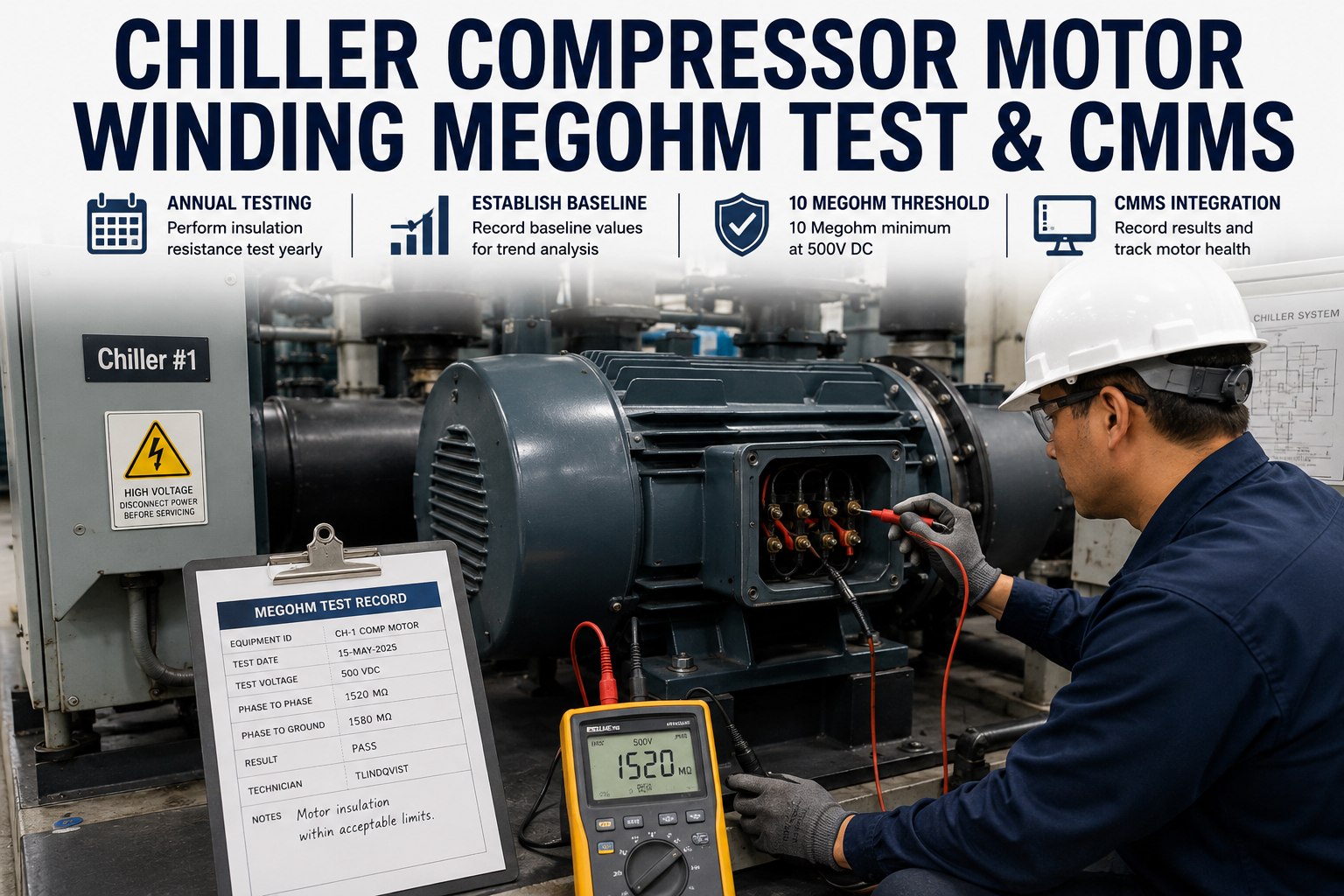
Annual megohm testing of chiller compressor motor windings is the single most predictive insulation health check available to facilities teams — a 10 megohm reading at 500V DC can flag a winding failure weeks before a catastrophic short turns a $4,000 rewind into a $28,000 emergency motor replacement. Most plants log readings on paper or scattered spreadsheets, losing the year-over-year baseline that makes trend analysis actually work. When those readings live inside a CMMS like Oxmaint, technicians get automated alerts the moment insulation resistance drops 20 percent below baseline, and supervisors see the full motor history on one dashboard. The result is fewer unplanned chiller outages, longer motor life, and a defensible maintenance record for auditors — you can Start Free Trial to set up your first motor baseline in under ten minutes.
Is your chiller motor one season away from an unplanned ground fault?
A single megohm test at 500V DC takes under five minutes per motor — yet 67 percent of plants skip it until a compressor trips on overcurrent. By then, the rewind cost has already tripled. Build a defensible baseline in your CMMS and catch the slide before it costs you a cooling season.
What the megohm reading actually tells you about motor health
Insulation resistance is measured between each phase winding and ground using a megohmmeter (commonly called a megger) at 500V DC for motors up to 1,000V nameplate. A brand-new chiller compressor motor typically reads 1,000 megohms or higher. The industry-accepted minimum safe operating threshold is 10 megohms — below that, the motor is one moisture event or thermal cycle away from a phase-to-ground fault.
A factory-fresh chiller compressor winding typically reads above 1,000 MΩ at 500V DC. This becomes your installation baseline.
Normal aging range. Log the reading in your CMMS every quarter and watch for a 20 percent drop between tests.
Below 10 MΩ the winding is unsafe to run. Dry the motor, re-test, and if readings do not recover, schedule a rewind or replacement.
Worked example: A 350-ton centrifugal chiller in a data center recorded 480 MΩ in May, 220 MΩ in August, and 9 MΩ by the following March. The 81 percent decline over ten months pointed to moisture ingress through a failed shaft seal. Because the trend was logged in the CMMS, the seal was replaced and the motor dried during a planned shutdown — avoiding an estimated $31,500 in emergency rewind and lost-cooling costs.
The 8-step megohm test every technician should follow
This sequence matches IEEE 43 recommended practice and takes roughly 12 minutes per motor once the chiller is locked out. Record every reading inside the CMMS motor record so the baseline is never lost to staff turnover.
Lock out and isolate the motor
Open the disconnect, apply your lockout-tagout, and verify zero voltage phase-to-phase and phase-to-ground with a calibrated multimeter.
Discharge stored winding capacitance
Ground each phase for at least four times the test duration. Large compressor windings can hold a lethal charge for minutes after the megger is removed.
Disconnect electronic protections
Isolate or short-out PT-100 sensors, anti-condensation heaters, and any VFD control boards to prevent 500V DC from damaging sensitive electronics.
Select 500V DC test voltage
For chiller motors with nameplate voltage up to 1,000V, IEEE 43 specifies 500V DC. Higher-voltage insulation classes may use 1,000V — confirm with the OEM manual.
Test phase A to ground (B and C shorted)
Connect the megger positive lead to phase A and the negative lead to the motor frame. Short phases B and C to ground. Hold the test for 60 seconds and log the stabilized reading.
Repeat for phases B and C
Rotate the positive lead to phase B with A and C grounded, then to phase C with A and B grounded. All three readings should be within 25 percent of each other for a healthy winding.
Discharge and re-test after 10 minutes
A dielectric absorption ratio (DAR) compares the 60-second reading to the 30-second reading. A DAR below 1.25 signals moisture or contamination even when the megohm value looks acceptable.
Log readings in the CMMS motor record
Enter all three phase readings, test voltage, winding temperature, and ambient humidity. The CMMS auto-graphs the trend and triggers alerts at the 20 percent decline threshold.
What a missed megohm trend really costs your plant
A 180-asset commercial facility running 12 chillers averages $42,000 per year on unplanned motor repairs when insulation testing is reactive. The same plant with quarterly CMMS-tracked megohm readings typically spends under $9,000 — a 78 percent reduction driven entirely by early detection.
That is a 79 percent cost reduction, achieved with the same headcount and the same motors — the only change is moving megohm readings from a clipboard into a CMMS that flags the trend.
Turn every megohm reading into a tracked asset health signal
Oxmaint stores the full insulation resistance history for every chiller motor in your plant — baseline, quarterly trend, DAR ratio, and automated decline alerts — on one dashboard your whole team can read.
How motor winding data lives inside your maintenance system
A megohm reading written in a notebook helps no one. The same reading entered into a CMMS motor record becomes a trended health indicator that drives work orders, spare-part staging, and capital replacement planning.
| CMMS Feature | What It Does For Motor Windings | Impact On Reliability |
|---|---|---|
| Motor Asset Record | Stores nameplate, baseline megohm, test history, DAR ratio, and photos per motor | Single source of truth — no lost paper logs |
| Automated Trend Graph | Plots every reading on a time axis with the 10 MΩ floor and 20 percent decline marker | Visual early warning before failure |
| Decline Alert | Triggers a notification when a reading drops 20 percent below the established baseline | Converts a number into an action |
| Scheduled Test Work Order | Auto-generates a quarterly or annual megohm test task tied to each chiller | Eliminates missed test cycles |
| Spare Part Linkage | Connects declining trend to the correct rewind kit or replacement motor SKU | Cuts emergency parts lead time by 60% |
| Audit-Ready Export | One-click PDF of the full motor insulation history for insurance and compliance | Defensible maintenance record |
Megohm testing and CMMS — what teams ask first
Why is 10 megohms the minimum threshold for chiller compressor motors?
IEEE 43 establishes 10 MΩ as the lowest safe insulation resistance for machines rated below 1,000V. Below that value, the insulation can no longer reliably hold off line voltage, and any moisture surge or voltage transient can punch through to the stator iron — causing a ground fault that trips the chiller and often destroys the winding. Reading in the 10 to 100 MΩ range is technically operable but should trigger a re-test within 30 days and an investigation into moisture, contamination, or thermal degradation.
How often should I megohm-test chiller compressor motors?
Most OEM service manuals recommend an annual insulation resistance test at minimum. For mission-critical chillers in data centers, hospitals, and process plants, a quarterly test gives a meaningful trend without excessive winding stress. Always re-test after any motor gets wet, after a refrigerant leak, or after a protective trip event. You can schedule these cycles automatically in your CMMS — set it up in minutes when you Start Free Trial.
What test voltage should I use — 500V or 1,000V DC?
For chiller compressor motors with a nameplate voltage up to 1,000V, IEEE 43 specifies 500V DC. Using 1,000V on a 460V motor over-stresses aged insulation and can actually accelerate failure. Motors rated above 1,000V typically use 1,000V DC. Always confirm the test voltage against the motor nameplate and the OEM service manual, and record the voltage alongside every reading so year-over-year comparisons stay valid.
How do I establish a baseline megohm reading for a new motor?
Test the motor immediately after commissioning, once it has reached stable operating temperature and before any significant runtime. Record all three phase-to-ground readings, the test voltage, winding temperature, and ambient humidity in the CMMS motor record. This becomes your reference point — every future test is compared against it, and a 20 percent decline is the standard early-warning trigger that prompts investigation before the reading approaches the 10 MΩ floor.
Can a CMMS really prevent chiller motor failures, or is it just record-keeping?
The CMMS itself does not prevent failure — the trend it surfaces does. When insulation resistance readings are logged consistently, the system graphically shows a declining curve weeks or months before the motor hits the 10 MΩ danger zone. That visibility lets you plan a shutdown, stage a spare, and fix the root cause (moisture, contamination, bearing wear) on your schedule instead of the motor's. To see the dashboard on your own assets, Book a Demo and we will walk through a live chiller motor record.
Start tracking every megohm reading today
Set up your chiller motor baselines, schedule the first quarterly test, and watch the trend dashboard fill in — all in a single afternoon.
Free 14-day trial · No credit card