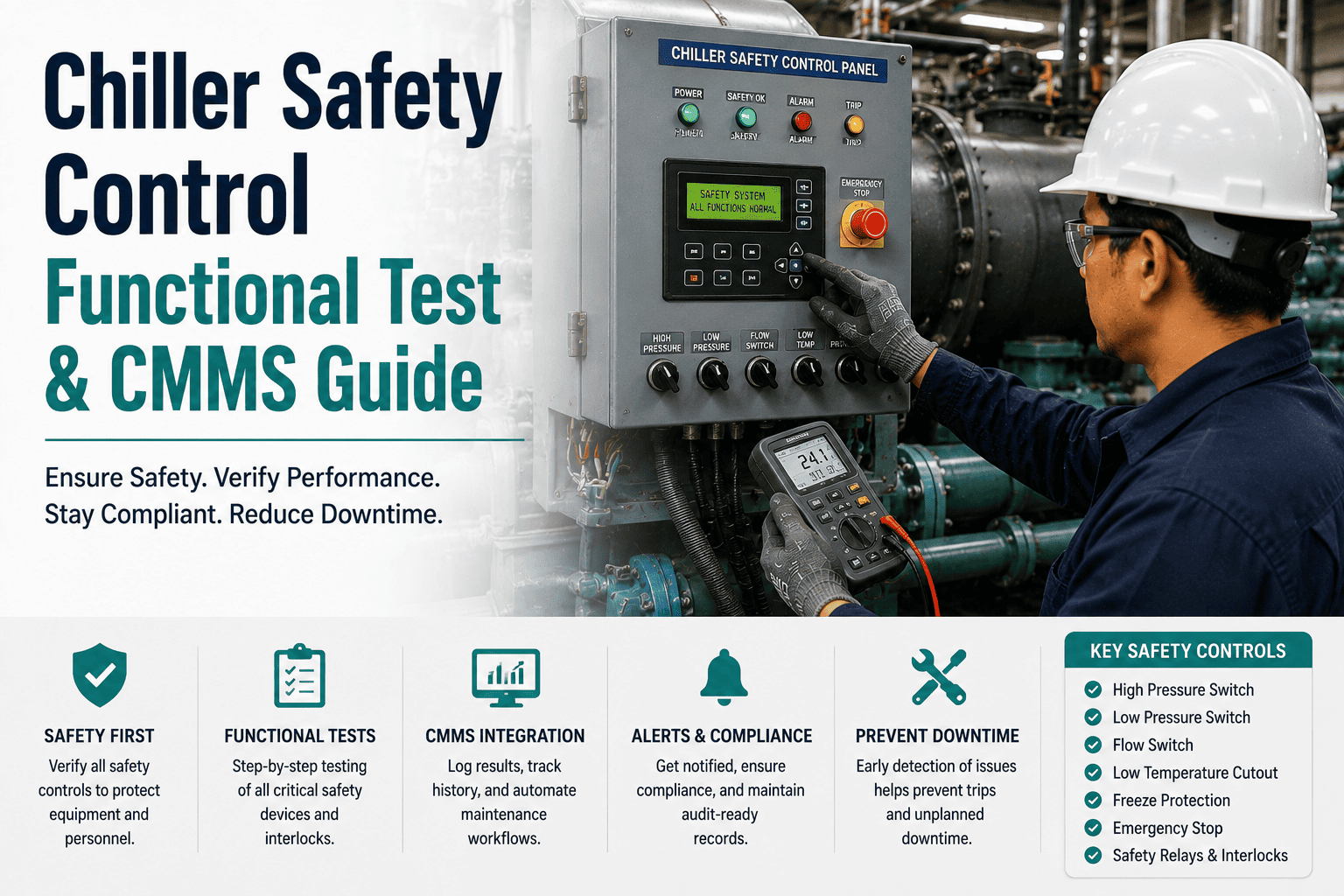
A chiller safety control functional test verifies that every critical cutout, sensor and overload on your chiller will trip the compressor before a dangerous condition becomes a catastrophic failure. This chiller safety testing guide covers the high-pressure cutout, low-pressure cutout, freeze protection and motor thermal overload tests, plus how a CMMS for chiller safety automates scheduling, documentation and audit readiness. Reliability teams that standardize these procedures with OxMaint typically cut chiller-related unplanned downtime by 30–50% and avoid six-figure compressor rebuilds. Ready to modernize your maintenance program? Start Free Trial and see how automated safety-test work orders work in practice.
Is one untested chiller safety cutout putting your plant at risk this season?
Over 60% of catastrophic chiller compressor failures trace back to a safety control that never tripped during the last functional test — because the test was skipped, undocumented or run with the wrong method. OxMaint makes chiller safety functional testing systematic, scheduled and audit-ready.
Essential chiller safety controls to functionally test every quarter
A complete chiller safety control test inspects seven distinct cutout and protection circuits. Each one defends a specific failure mode — and missing any of them can void equipment warranties, trigger OSHA citations or send a compressor to the scrap yard. Use this checklist as the backbone of every preventive maintenance work order.
High-Pressure Cutout (HPC)
Simulate a condenser-fouling or lost-cooling-water scenario. Ramp the discharge pressure toward the cutout setpoint (typically 425–450 psig for R-134a) and confirm the compressor locks out within 2 seconds. Record the actual trip pressure and compare to the manufacturer tolerance band.
Failure mode: burst pipe / relief valveLow-Pressure Cutout (LPC)
Close the chilled-water valve or simulate a low refrigerant charge to drive suction pressure down. Verify the LPC trips at the setpoint (commonly 18–25 psig for R-134a) and that the anti-short-cycle timer holds the compressor off for at least 3 minutes before re-start.
Failure mode: compressor burnoutFreeze Protection Control
Lower the chilled-water temperature setpoint and confirm the freeze stat trips at 38–39°F (3.3°C). The chiller must shut down the compressor and energize the alarm relay. This single test prevents the most expensive evaporator-tube rupture event in HVAC.
Failure mode: cracked evaporatorMotor Thermal Overload
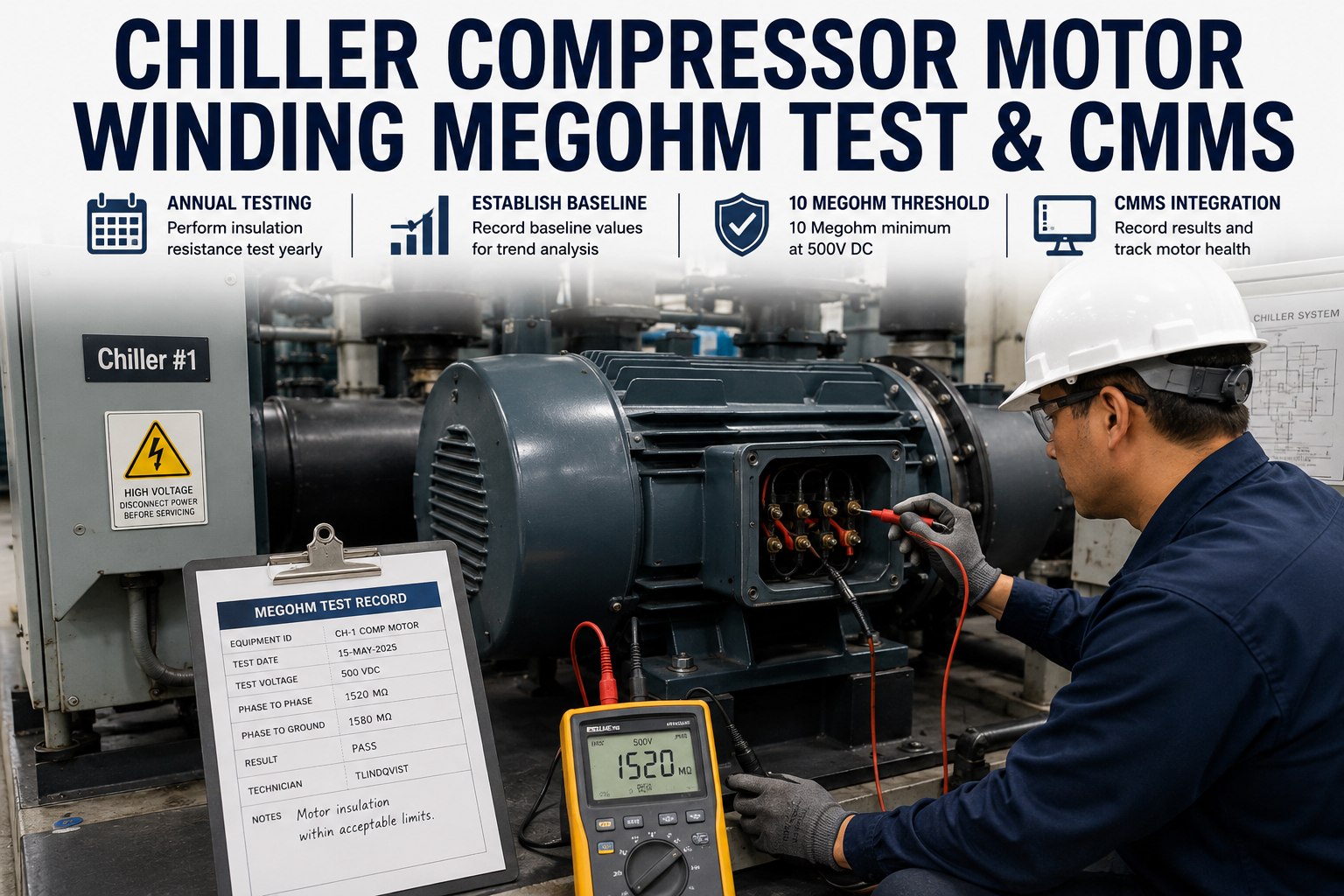
Inject a simulated overload signal or verify the motor-winding RTD trip setpoint (usually 110% of FLA for 60 seconds). Confirm the motor starter drops out and the fault latches in the BMS until manually reset by a qualified technician.
Failure mode: stator rewindOil Pressure Safety Switch
Confirm the oil-failure control trips when net oil pressure drops below 7–12 psig for the time-delay window (typically 45–120 seconds). This protects the compressor bearings from wipe-out during a transient low-oil event on start-up or load changes.
Failure mode: bearing failureFlow & Phase Voltage Safeties
Verify chilled-water and condenser-water flow switches open on low flow and that the phase-loss / phase-reversal relay trips the compressor. A failed flow switch is the #1 root cause of freeze-ups — test it every PM cycle, not just annually.
Failure mode: freeze / motor damageChiller cutout testing: setpoints, methods & pass criteria
Every chiller safety functional test needs a documented setpoint, a test method and a measurable pass criterion. The table below consolidates the industry-standard values technicians should record in their CMMS work order — so the next audit produces defensible, timestamped evidence in one click instead of a binder hunt.
| Safety Control | Typical Trip Setpoint | Test Method | Pass Criterion | Recommended Frequency |
|---|---|---|---|---|
| High-Pressure Cutout | 425–450 psig (R-134a) | Isolate condenser water, ramp discharge | Trips within 2 sec of setpoint | Quarterly |
| Low-Pressure Cutout | 18–25 psig (R-134a) | Close CHW valve, monitor suction | Trips + 3-min anti-recycle | Quarterly |
| Freeze Protection | 38–39°F (3.3°C) CHW | Lower setpoint, verify stat response | Compressor + alarm trip at setpoint | Monthly in season |
| Motor Thermal Overload | 110% FLA for 60 sec | Inject simulated overload signal | Starter drops out, latch holds | Semi-annual |
| Oil Pressure Safety | 7–12 psig net, 45–120 sec | Bypass oil pump, verify timer trip | Lockout on sustained low oil | Quarterly |
| Flow Switches | Open on low flow | Isolate valve, verify switch opens | Compressor stop within 5 sec | Monthly |
| Phase Loss / Reversal | Single-phase trip | Simulate phase loss at relay | Compressor lockout, fault code set | Annual |
How to run a chiller safety inspection in 7 steps
A structured chiller safety functional test follows a predictable workflow — from securing the permit-to-work to closing the CMMS work order with a digital test certificate. Skipping a step is where compliance gaps and liability creep in. Follow this sequence every time.
Secure Permit & Notify BMS
Issue a permit-to-work, place the chiller in manual/test mode and notify the BMS operator that safety trips are about to be simulated — preventing a building-wide alarm cascade.
Verify Baseline Operating Conditions
Record chilled-water and condenser-water temperatures, pressures, oil level and running amps. These baselines become the comparison data for trend-based predictive maintenance.
Test High & Low-Pressure Cutouts
Ramp or simulate conditions to each cutout. Record the actual trip pressure in the OxMaint work order — the mobile app timestamps it and attaches it to the asset history automatically.
Verify Freeze & Flow Protections
Lower the CHW setpoint to trigger the freeze stat and close the isolation valve to test the flow switch. Confirm both stop the compressor and latch an alarm.
Test Motor Overload & Oil Safety
Inject the simulated overload signal and verify the oil-pressure timer. Ensure the motor starter drops out and the fault requires a manual reset — not an auto-restart.
Restore Normal Operation
Return all setpoints to normal, remove test jumpers, release the permit-to-work and confirm the chiller stages up cleanly through its normal start sequence.
Close Work Order & Schedule Next Test
In OxMaint, close the work order with all test values, photos and signatures attached. The next quarterly chiller safety test auto-generates 90 days out — no calendar needed.
The hidden cost of skipping one chiller safety functional test
A 380-ton R-134a centrifugal chiller at a regional food processing plant had not had its freeze-protection control tested in 11 months. During a late-night load swing, a chilled-water valve stuck closed — and the freeze stat failed to trip at 39°F because its sensor bulb had corroded. The evaporator tubes ruptured before the operator noticed.
The result: a $62,000 compressor and evaporator rebuild, 14 hours of lost production and $8,000 in spoiled product — total impact roughly $70,000 from a single untested safety control. After implementing OxMaint, the plant now auto-schedules a full chiller safety functional test every 90 days, with every trip setpoint recorded and trended in the asset history. They caught a drifting low-pressure cutout on a second chiller six months later — before it could fail under load.
CMMS for chiller safety: how OxMaint automates compliance & prevents failures
Manual spreadsheets and paper checklists cannot guarantee that every chiller safety control test happens on time, gets documented correctly or survives an audit. OxMaint's AI-powered CMMS turns chiller safety compliance into a fully automated, fully traceable workflow — so your team can focus on reliability, not paperwork.
Automated Safety-Test Scheduling
Auto-generate quarterly, semi-annual and annual chiller safety functional test work orders based on asset type, runtime hours or calendar date. Never miss a test cycle again — OxMaint escalates overdue tests to supervisors automatically.
Outcome: 100% on-time complianceDigital Test Certificates
Every chiller safety inspection generates a timestamped, tamper-evident digital record with trip setpoints, pass/fail criteria, technician signatures and photos. Pull a full audit trail for any chiller in seconds — no binders, no missing pages.
Outcome: Audit-ready in one clickPredictive Drift Detection
OxMaint's AI engine trends every trip setpoint reading over time and flags a cutout that is drifting toward its failure threshold — before it misses a trip. Catch a slow high-pressure cutout weeks before it becomes a burst pipe.
Outcome: 30–50% less unplanned downtimeParts & Fail-Mode Linking
When a safety control fails its functional test, OxMaint auto-suggests the correct replacement part from inventory and links the corrective work order to the asset's failure history — so recurring issues surface in your reliability analytics.
Outcome: 40% faster repair turnaroundSee OxMaint on your chillers — book a 30-min demo
We will load your chiller asset list, build a sample safety-test work order template and show you the audit trail — live, on your data. No slides, no fluff.
Chiller safety control test: common questions answered
How often should chiller safety controls be functionally tested?
Most manufacturers and ASHRAE Guideline 4 recommend quarterly functional testing for high-pressure cutouts, low-pressure cutouts, oil-pressure safeties and flow switches. Freeze protection should be tested monthly during the cooling season, while motor thermal overload and phase-reversal relays are typically verified semi-annually or during major PM cycles. OxMaint can auto-generate each test on its correct interval so nothing slips — Start Free Trial to set up your schedule in minutes.
What is the difference between a high-pressure cutout and a low-pressure cutout on a chiller?
A high-pressure cutout (HPC) trips the compressor when discharge pressure exceeds a safe limit — usually caused by condenser fouling, lost cooling water or non-condensables — protecting against burst pipes and relief-valve discharges. A low-pressure cutout (LPC) trips when suction pressure drops too low, typically from low refrigerant charge or a closed chilled-water valve, preventing the compressor from running dry and burning out.
What temperature should a chiller freeze protection control trip at?
A chiller freeze protection control (freeze stat) should trip at approximately 38–39°F (3.3°C) measured at the chilled-water leaving sensor. This gives a safety margin before water reaches 32°F (0°C) and begins to freeze. The compressor must shut down immediately and latch an alarm that requires manual reset — this prevents the most expensive evaporator-tube rupture event in commercial HVAC.
How does a CMMS improve chiller safety compliance?
A CMMS like OxMaint automates the scheduling, execution and documentation of every chiller safety functional test. It generates work orders on the correct interval, captures trip setpoints and pass/fail data on a mobile device, attaches photos and signatures, and produces a timestamped audit trail that satisfies OSHA, insurance and internal QA requirements — eliminating paper binders and missed tests.
Can OxMaint predict when a chiller safety control will fail?
Yes. OxMaint's AI engine trends every trip setpoint reading over time. If a high-pressure cutout that used to trip at 445 psig starts tripping at 448, 450 and 452 psig across successive tests, the system flags the drift and generates a corrective work order before the control fails to trip at all — which is exactly when a catastrophic failure occurs. Book a Book a Demo to see predictive drift detection on your own chiller data.
Stop hoping your chiller safety controls work. Start proving it.
Join the maintenance teams using OxMaint to automate chiller safety functional testing, cut unplanned downtime by up to 50% and pass every audit without a single binder. Your first chiller safety work order template is live in under 15 minutes.
Free 14-day trial · No credit card