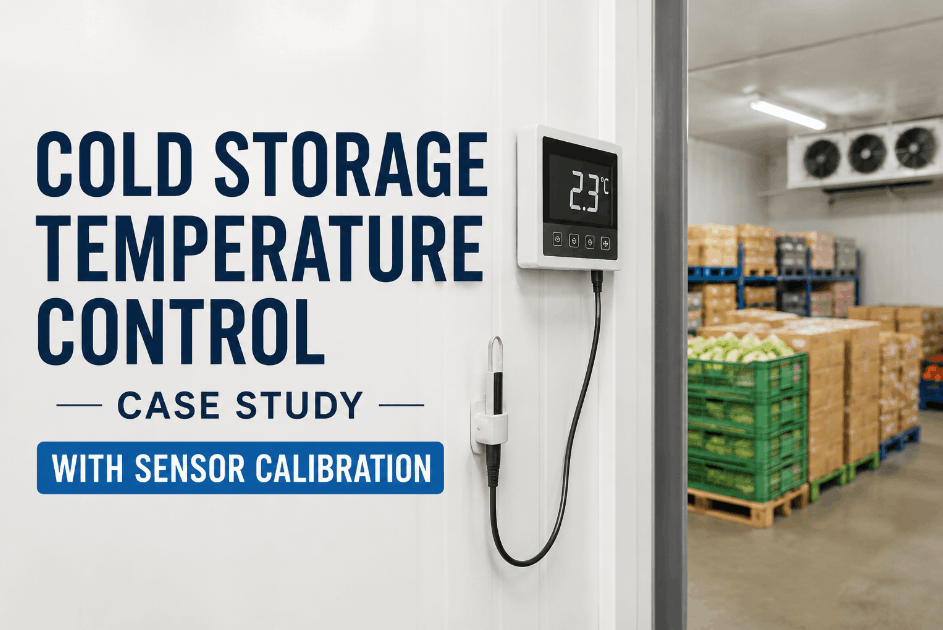
A regional cold storage operator managing 340,000 square feet of refrigerated warehouse space across four temperature zones — frozen at -18°C, chilled at 2–4°C, pharmaceutical at 2–8°C, and produce at 8–12°C — was running a calendar-based HVAC and refrigeration maintenance program that seemed adequate on paper. Six-month service intervals. Daily manual temperature logs. Reactive response protocols for alarm events. What the program could not detect was what it could not see: a compressor drawing 11% above baseline current for six weeks, an evaporator coil with early-stage refrigerant mist contamination, and a condenser fan motor developing bearing wear that produced no audible warning and no temperature deviation — until it failed at 2:47 AM on a Saturday in July, raising the chilled zone from 3°C to 11°C over four hours with $2.3 million in perishable inventory at risk. After deploying OxMaint's IoT-connected predictive maintenance platform, the facility went 18 months without a single temperature excursion — and documented $4.1 million in avoided inventory loss across three prevented major failures.
Case Study · Cold Storage · Predictive Maintenance · IoT Monitoring
Cold Storage HVAC Predictive Maintenance Prevents Temperature Loss
One temperature excursion at 2:47 AM. $2.3M in inventory at risk. 18 months later — zero excursions, three major failures prevented, $4.1M in documented avoided losses. Here is what predictive HVAC maintenance looks like when IoT monitoring replaces reactive response.
Facility Profile
Facility Type
Multi-zone cold storage warehouse — frozen, chilled, pharmaceutical, produce
Total Area
340,000 sq ft across 4 temperature-controlled zones
Inventory Value at Risk
$2.3M – $8M depending on zone and seasonal product mix
Previous Maintenance Model
Calendar-based PM every 6 months + daily manual temperature logs
OxMaint Deployment
IoT-connected predictive maintenance + CMMS work order automation
Outcome Period
18 consecutive months — zero temperature excursions
The Incident That Changed Everything
What a 4-Hour Temperature Rise Actually Costs
The July incident was not a catastrophic equipment failure. A single condenser fan motor bearing failed silently. The motor continued running at reduced airflow. Heat rejection from the condenser degraded. Zone temperature climbed 8°C in four hours. The alarm triggered at 7°C deviation — four hours after the bearing had failed. By that point, 18 pallets of chilled pharmaceutical product had exceeded their permitted temperature range. Calendar-based maintenance had serviced that motor six weeks earlier. Nothing in the service report indicated imminent failure.
Product write-off$248,000
Regulatory investigation & reporting$89,000
Emergency after-hours repair$51,000
Customer claims & relationship cost$24,000
Total incident cost: $412,000 — from a bearing that vibration monitoring would have flagged 3–4 weeks earlier
Before vs After
What Changed When Predictive Monitoring Replaced Calendar PM
Before — Calendar PM
Compressor condition checked every 6 months regardless of runtime or load
Fan motor bearings inspected visually — no vibration baseline tracking
Temperature alarms trigger response after excursion — damage already done
Refrigerant efficiency degradation invisible until energy bills rose
Emergency repairs at 2–3× planned cost; after-hours premium on top
After — Predictive Monitoring
Compressor current draw and discharge pressure tracked continuously
Fan motor vibration trending — bearing wear flagged 3–5 weeks before failure
Pre-alarm condition detection — intervention before temperature deviation begins
Refrigerant efficiency modeled against baseline — 2–3% delta triggers alert
All repairs planned in business hours at standard labor rates
3 Prevented Failures — 18 Months
What Predictive Monitoring Found — and What It Saved
Pharmaceutical Zone Compressor — Winding Insulation Degradation
OxMaint detected a 14% increase in compressor motor current draw over 11 days with no corresponding change in setpoint or ambient temperature. Cross-correlated with discharge temperature trending 4°C above baseline, this matched early-stage winding insulation breakdown. Insulation resistance measured at 2.8 megohms — below the 5-megohm warning threshold. Compressor replaced during planned downtime. Worst-case pharmaceutical zone inventory exposure if failed: $1.8M.
Signal: Motor current anomaly + discharge temperature deviation trending over 11 days
Frozen Zone Evaporator Fan Array — Bearing Wear Cascade
Vibration monitoring flagged Fan 3 with rising 1× vibration amplitude over 18 days — the classic bearing wear progression. Inner race fatigue confirmed on inspection. Maintenance history showed all 6 fans were installed as a batch — identical age and runtime. Preventive bearing replacement completed on all 6 fans in a single planned 4-hour window. Fan 3 failure would have reduced evaporator capacity 17%, triggering secondary compressor failure within weeks. Frozen zone inventory exposure: $1.4M.
Signal: 1× vibration amplitude rise on Fan 3 over 18-day window; batch inspection triggered for all 6 units
Chilled Zone Condenser Coil — Fouling and Refrigerant Contamination
OxMaint's energy model flagged the chilled zone compressor consuming 9% more energy per degree of cooling than its 90-day baseline — without any change in setpoint or load. Condenser coil inspection revealed heavy fouling with oil mist contamination from an upstream separator. Left unaddressed, this would have caused a compressor trip on high discharge pressure during peak summer load. Coil cleaning and separator repair completed. Annual energy saving: $38,000. Avoided peak-season inventory exposure: $900,000.
Signal: Energy efficiency ratio deviation trending 9% above baseline over 6-week window
18-Month Outcome Summary
0
Temperature excursions in 18 months
$4.1M
Documented avoided inventory loss across 3 prevented failures
71%
Reduction in emergency repair spend vs prior 18 months
$38K
Annual energy savings from condenser efficiency recovery alone
Your Cold Storage Inventory Is Protected by Sensors or It Isn't.
OxMaint connects IoT sensors to CMMS work order automation — so every compressor anomaly, fan motor vibration trend, and efficiency deviation generates a planned maintenance action before a temperature excursion begins. Book a demo to see how cold storage operators protect millions in inventory with predictive monitoring.
Expert Perspective
What Cold Chain Facility Managers Say About Predictive HVAC Monitoring
★★★★★
We had two temperature excursions in 14 months before OxMaint. After deployment we went 22 months without one. The difference was not better equipment — same refrigeration units. The difference was knowing what those units were doing between PM visits. A compressor that looks fine on a 6-month inspection can fail catastrophically 8 weeks later. Continuous monitoring is the only way to see what is actually happening.
TW
Thomas W.
Facility Director, 3PL Cold Storage Operation, USA
★★★★★
Our pharmaceutical clients require temperature excursion documentation and deviation reports. Every excursion costs us 40 to 60 hours of regulatory reporting time on top of the product loss. When OxMaint started catching failures before they became excursions, we saved the product, the reporting burden, and the client relationships that become very difficult after a deviation event.
NP
Neha P.
Operations Manager, GDP-Certified Cold Chain Warehouse, India
★★★★☆
The energy monitoring was the surprise benefit. We knew predictive maintenance would reduce failures. We did not expect it to find a 9% efficiency loss on a condenser coil that our team had visually inspected and cleared two months earlier. Visual inspection cannot see fouling inside the coil. Energy deviation trending caught what eyes could not. The annual energy saving alone covers most of the OxMaint subscription cost.
KM
Kevin M.
Chief Engineer, Multi-Zone Cold Storage Campus, Australia
Frequently Asked Questions
Cold Storage Predictive HVAC Maintenance — Common Questions
What sensors are required to implement predictive HVAC monitoring in a cold storage facility?
Core sensor requirements include compressor current transducers, suction and discharge pressure transducers, vibration sensors on fan motors and compressor bearings, zone temperature sensors with sub-minute sampling, and energy metering on the refrigeration circuit. Many cold storage facilities already have temperature and some pressure monitoring installed — OxMaint integrates with existing sensor infrastructure and adds targeted vibration and current monitoring where gaps exist. The facility in this case study added 34 sensors to supplement 18 existing monitoring points, deploying in 12 days without any refrigeration system shutdown.
Book a demo to map your existing sensor coverage and identify gaps for predictive monitoring.
How far in advance does predictive monitoring detect compressor and fan motor failures?
Bearing wear detected through vibration trending typically provides 3 to 5 weeks of lead time in cold storage fan motor applications — sufficient to plan and execute replacement during a scheduled 4-hour window. Compressor winding insulation degradation detected through motor current trending provided 11 days of lead time in this case study. Refrigerant system efficiency degradation typically develops over 4 to 8 weeks. All three failure modes are consistently undetectable by visual inspection and undetectable by traditional temperature alarm systems that only trigger after the zone is already out of specification.
Start a free trial to establish baseline profiles for your refrigeration equipment.
How does OxMaint connect IoT sensor data to CMMS work orders automatically?
OxMaint's IoT integration layer receives continuous sensor data and runs it against asset-specific baseline models built from the first 30 to 60 days of operation. When a sensor reading deviates from baseline by a configured threshold — or when a trending pattern matches a known failure signature — OxMaint automatically generates a CMMS work order containing the asset, the sensor evidence, the deviation magnitude, the recommended inspection scope, and the estimated risk if unaddressed. No manual step exists between detection and work order assignment. The maintenance team receives the work order on mobile before they would have otherwise noticed any symptom.
Book a demo to walk through the sensor-to-work-order pipeline for a refrigeration circuit.
What is the ROI timeline for predictive HVAC monitoring in cold storage?
ROI timeline is driven by inventory value at risk and failure frequency. Facilities storing high-value product — pharmaceutical, premium food, temperature-sensitive chemicals — typically recover the full platform investment with a single prevented temperature excursion. The facility in this case study recovered its full OxMaint investment in the first 3 months through the pharmaceutical compressor failure prevention alone. Facilities with lower inventory risk recover through reduced emergency repair costs and energy savings, typically within 9 to 18 months. Energy efficiency monitoring generated $38,000 in annual savings independent of failure prevention value.
Book a demo to model ROI for your specific cold storage inventory profile.