A mid-sized automotive parts manufacturer in the Southeast was losing an average of $84,000 per unplanned HVAC-related production stoppage. Not from catastrophic equipment failure — from compressor units running hot for weeks before anyone noticed, from AHU bearing wear that vibration logs would have flagged 30 days out, from cooling tower pumps degrading slowly under the noise of a busy production floor. The plant ran 18-hour shifts, six days a week. Every hour of unplanned downtime was a direct hit to output, delivery commitments, and customer relationships. Eight months after deploying OxMaint's Predictive Maintenance Console, unplanned HVAC-related downtime dropped 40%. Sign up free to see what condition-based HVAC monitoring looks like for your facility.
40%
Reduction in Unplanned Downtime
$84K
Avg. Cost Per Downtime Event
30 days
Early Warning Lead Time
18-hr
Daily Production Shifts Protected
Why Manufacturing HVAC Failures Hit Harder Than Any Other Sector
In manufacturing, HVAC is not a comfort system — it is a production system. Temperature and humidity directly affect product quality, equipment tolerances, and worker safety on the production floor. When an AHU fails mid-shift in a precision machining environment, the plant doesn't just get warm — it gets non-conforming parts, scrapped runs, and potential line shutdowns. Book a demo to see how OxMaint's Predictive Maintenance Console monitors your critical HVAC assets in real time.
01
Production Line Stoppage
$5K to $84K per event
Lost output during unplanned HVAC downtime. High-volume lines running near capacity feel every hour. Automotive, electronics, and food manufacturing report the highest per-event costs.
02
Product Quality Loss
Scrap and rework costs
Temperature and humidity excursions during HVAC failure produce non-conforming parts. Precision machining tolerances shift. Adhesives and coatings fail to cure correctly. The scrap rate spikes before anyone calls maintenance.
03
Emergency Labor Premium
3x to 5x planned cost
After-hours emergency HVAC technician dispatch costs 3 to 5 times more than a planned service call for the same repair. Weekend and holiday multipliers push this even higher for plants running extended schedules.
04
Cascade Equipment Damage
Secondary asset failures
A failed cooling tower pump overheats the compressor it serves. An overloaded AHU strains the electrical panel feeding it. In manufacturing environments, HVAC failures rarely stay isolated — they propagate through connected systems.
Before OxMaint: How the Plant's HVAC Maintenance Actually Worked
HVAC failures discovered when production floor overheated or equipment alarmed
PM visits scheduled by calendar, not equipment condition
Vibration and temperature anomalies went undetected between manual checks
No prioritization — all service calls treated equally regardless of criticality
Maintenance team reactive, always chasing problems rather than preventing them
No asset health history to support root cause or budget planning
Continuous condition monitoring catches failure signals 30 days before breakdown
Maintenance triggered by real-time asset health scores, not fixed intervals
Vibration, temperature, and pressure trends flagged automatically with alert thresholds
Work orders prioritized by production impact and failure probability score
Maintenance team plans interventions during scheduled breaks, not emergency calls
Full asset history drives smarter capital replacement decisions
How OxMaint's Predictive Maintenance Console Works in a Manufacturing Plant
Predictive maintenance in manufacturing is not about adding more sensors and hoping someone checks the dashboard. It is about connecting condition data to automated action — so the right person gets the right alert at the right time, with enough lead time to plan the repair without stopping the line. Sign up free and connect your first HVAC assets within days.
01
Condition Data Collection from Critical HVAC Assets
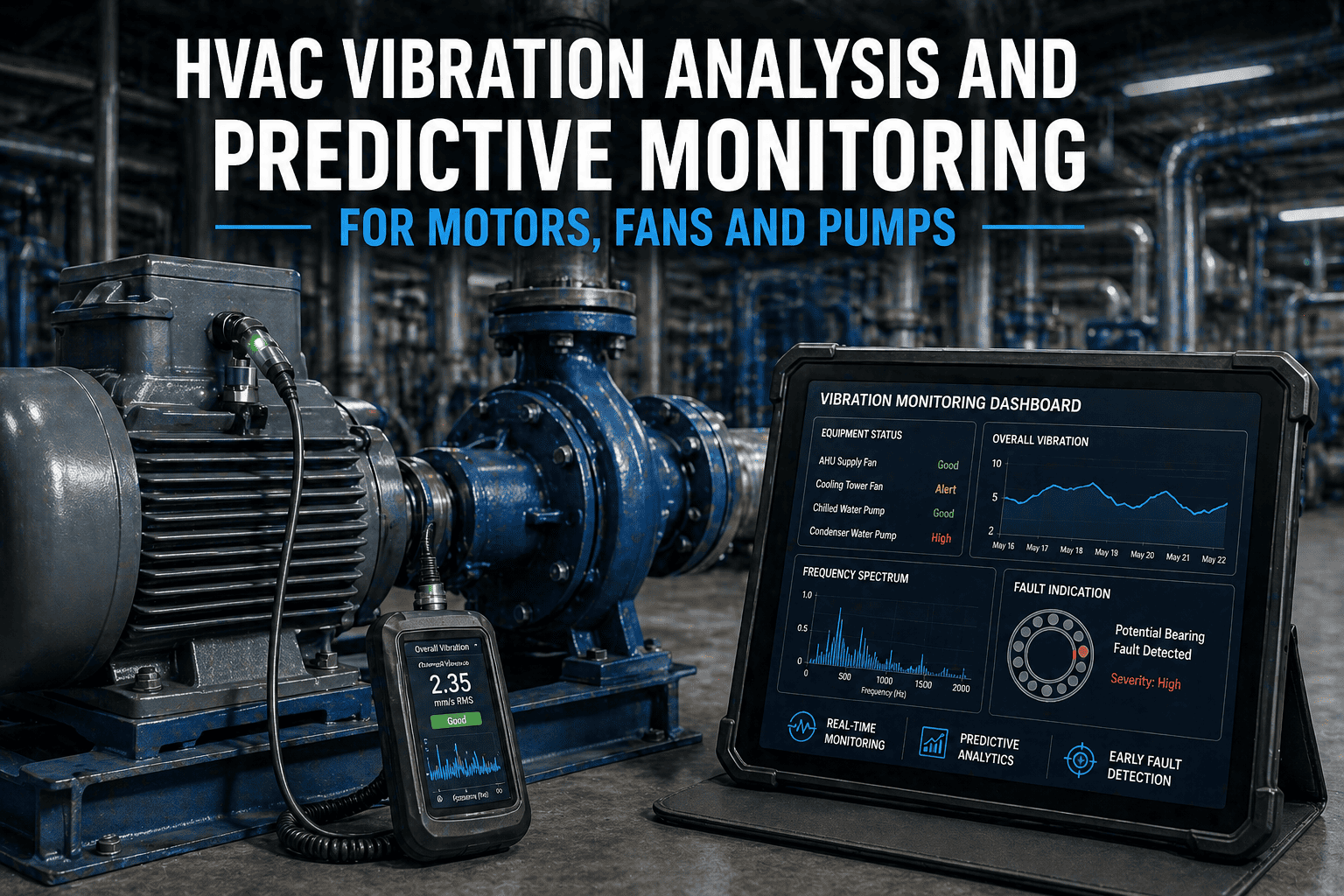
Vibration sensors on AHU fan motors and compressors. Temperature monitoring on cooling tower water circuits. Pressure differential tracking across air handling units. Runtime hour logging on all rotating equipment. Data streams continuously into OxMaint's Predictive Maintenance Console.
down
02
Anomaly Detection Against Healthy Baselines
OxMaint establishes normal operating envelopes for each asset during initial calibration. Deviations from baseline — a 12% vibration increase on a compressor bearing, a 4-degree temperature rise on a motor winding — trigger automated alerts before they reach failure thresholds.
down
03
Risk-Prioritized Work Orders Generated Automatically
Each flagged asset receives a health score and production-impact risk rating. High-risk assets generate work orders automatically, routed to the right technician with asset history, failure mode details, and recommended parts attached. No manual triage required.
down
04
Planned Intervention During Non-Production Windows
With 30-day lead time on failure signals, maintenance teams schedule repairs during shift changeovers, weekend windows, or planned downtime — not during peak production. The repair that would have cost $84,000 in lost output costs the price of a planned service call.
Stop Finding Out About HVAC Problems When the Line Stops
OxMaint's Predictive Maintenance Console gives manufacturing facility teams 30-day early warning on HVAC failures — so repairs happen during planned windows, not emergency shutdowns. Connect your assets and start monitoring within days.
Key Results: 8 Months After OxMaint Deployment
40%
Downtime Reduction
Unplanned HVAC-related production stoppages reduced within 8 months of predictive monitoring deployment
30 days
Avg. Warning Lead Time
Average advance notice before HVAC failure, enabling planned intervention instead of emergency response
68%
Fewer Emergency Calls
Reduction in after-hours emergency HVAC service dispatch events compared to the prior 12-month period
100%
Asset Visibility
Every critical HVAC asset monitored continuously — no blind spots between quarterly PM visits
HVAC Assets OxMaint Monitors in Manufacturing Facilities
Manufacturing environments run HVAC equipment harder and longer than almost any other building type. The assets below all have distinct failure signatures that predictive monitoring catches weeks before breakdown — but only if those assets are being watched continuously. Book a demo to walk through how OxMaint monitors each asset type at your facility.
Air Handling Units
Bearing wear
Belt degradation
Coil fouling
Detection lead time: 3 to 6 weeks
Compressors and Chillers
Refrigerant loss
Overheating
Vibration drift
Downtime cost avg: $20K to $84K
Cooling Towers
Pump cavitation
Scale buildup
Fan motor wear
Failure impact: Cascades to chillers
Exhaust and Ventilation Fans
Impeller imbalance
Motor overload
Duct restriction
Risk: Air quality and heat buildup
Boilers and Heat Exchangers
Pressure deviation
Tube corrosion
Burner fouling
Cost per incident: $50K to $300K
VFDs and Motor Controls
Overheating
Harmonic distortion
Capacitor aging
Risk: Silent degradation over months
The ROI of Predictive vs. Reactive HVAC Maintenance in Manufacturing
| Metric |
Reactive Maintenance |
OxMaint Predictive |
Improvement |
| Unplanned Production Stoppages |
4 to 6 per quarter |
2 to 3 per quarter |
Up to 40% reduction |
| Emergency Repair Cost per Event |
$20K to $84K |
$2K to $8K planned |
80 to 90% lower |
| HVAC Failure Detection Timing |
After breakdown occurs |
30 days before failure |
Proactive vs. reactive |
| Technician Dispatch Efficiency |
Schedule-based, any asset |
Condition-triggered, critical assets only |
60% fewer unnecessary visits |
| Asset Lifespan |
Standard manufacturer rating |
Extended with early intervention |
20 to 40% longer |
| Maintenance Budget Predictability |
Unpredictable, spike-driven |
Planned, data-driven |
Consistent quarterly spend |
OxMaint Predictive Maintenance Console: Built for Manufacturing Intensity
01
Real-Time Asset Health Scoring
Every monitored HVAC asset gets a live health score updated continuously. Dashboard shows which assets are healthy, which are degrading, and which need immediate intervention — without manual review.
02
Vibration and Thermal Analysis
Vibration signature trending on rotating equipment. Thermal baseline monitoring on motors and drives. OxMaint flags deviations from normal operating envelopes before they reach alarm thresholds.
03
Automated Work Order Generation
When an asset health score crosses a defined threshold, OxMaint creates a prioritized work order automatically — including asset history, failure mode details, and recommended parts — no manual trigger required.
04
Production Impact Prioritization
Work orders are ranked by the production impact of the failure they are preventing, not just the severity of the anomaly. Cooling systems serving active production lines always rank above warehouse ventilation.
05
Mobile-First Field Operations
Technicians receive alerts, review asset history, complete checklists, and log readings from mobile devices on the plant floor — even in low-connectivity areas. No paper logs, no deferred documentation.
06
Failure Trend Analytics
Track Mean Time Between Failures by asset type, maintenance cost per unit, and downtime frequency over rolling periods. Identify which HVAC assets are approaching end of economic life before they fail on the line.
Your Next HVAC Failure Is Already Showing Early Signs
OxMaint's Predictive Maintenance Console catches failure signals 30 days before your compressors, AHUs, and cooling towers break down — so your maintenance team acts on schedule, not in crisis. No new hardware required for initial deployment. Connect your existing sensor data and start monitoring within days.
Frequently Asked Questions
What sensors does OxMaint require to begin predictive HVAC monitoring in a manufacturing plant?
OxMaint is designed to work with the sensor infrastructure most manufacturing plants already have. At minimum, the platform ingests runtime hours, temperature readings, and maintenance records from your existing BAS or CMMS to begin condition trending. For full predictive capability, vibration sensors on rotating equipment and pressure differential monitoring on AHUs add the most value. OxMaint's onboarding team identifies which sensor additions will deliver the fastest ROI for your specific asset mix during the initial deployment session.
Sign up free to start the assessment.
How long before OxMaint starts generating predictive alerts for our HVAC equipment?
Most manufacturing deployments generate their first meaningful predictive alerts within 3 to 4 weeks. The first two weeks establish healthy operating baselines for each monitored asset. By week three, OxMaint begins flagging deviations from those baselines. Facilities with historical maintenance data available for import see useful trend analysis even faster, as the AI has more context to work from.
Book a demo to see a sample alert timeline from a comparable manufacturing deployment.
Does OxMaint integrate with existing plant SCADA, BAS, or CMMS systems?
Yes. OxMaint connects to existing SCADA systems, building automation platforms, historian databases, and IoT sensor feeds via standard APIs and data connectors. The platform does not require replacement of existing control systems — it layers on top, pulling condition data and pushing prioritized work orders to your maintenance team. For plants running older PLCs or non-networked equipment, OxMaint's integration team maps available data sources and recommends targeted connectivity upgrades only where the incremental predictive value justifies the cost.
How does OxMaint handle HVAC assets that serve multiple production zones with different criticality levels?
OxMaint's Predictive Maintenance Console allows each asset to be tagged with the production zones and lines it serves, along with a criticality rating that reflects the impact of its failure. When anomalies are detected, work orders are prioritized by the combined score of failure probability and production impact — so a cooling unit serving an active assembly line ranks ahead of one serving a storage area, even if both show similar degradation patterns. This ensures your maintenance team always addresses the highest-value risks first.
Sign up free to configure your first asset criticality matrix.
What is the typical payback period for predictive HVAC maintenance in a manufacturing facility?
Most manufacturing facilities see positive ROI within 6 to 12 months of deployment. The payback calculation is straightforward: one prevented unplanned stoppage at $84,000 typically covers a full year of OxMaint subscription costs for a mid-sized plant. Facilities with higher downtime frequency, longer shift schedules, or more critical production tolerances see faster payback. OxMaint's team builds a custom ROI projection for your facility during the demo session, based on your actual downtime history and maintenance spend.
Book a demo to get your facility-specific estimate.