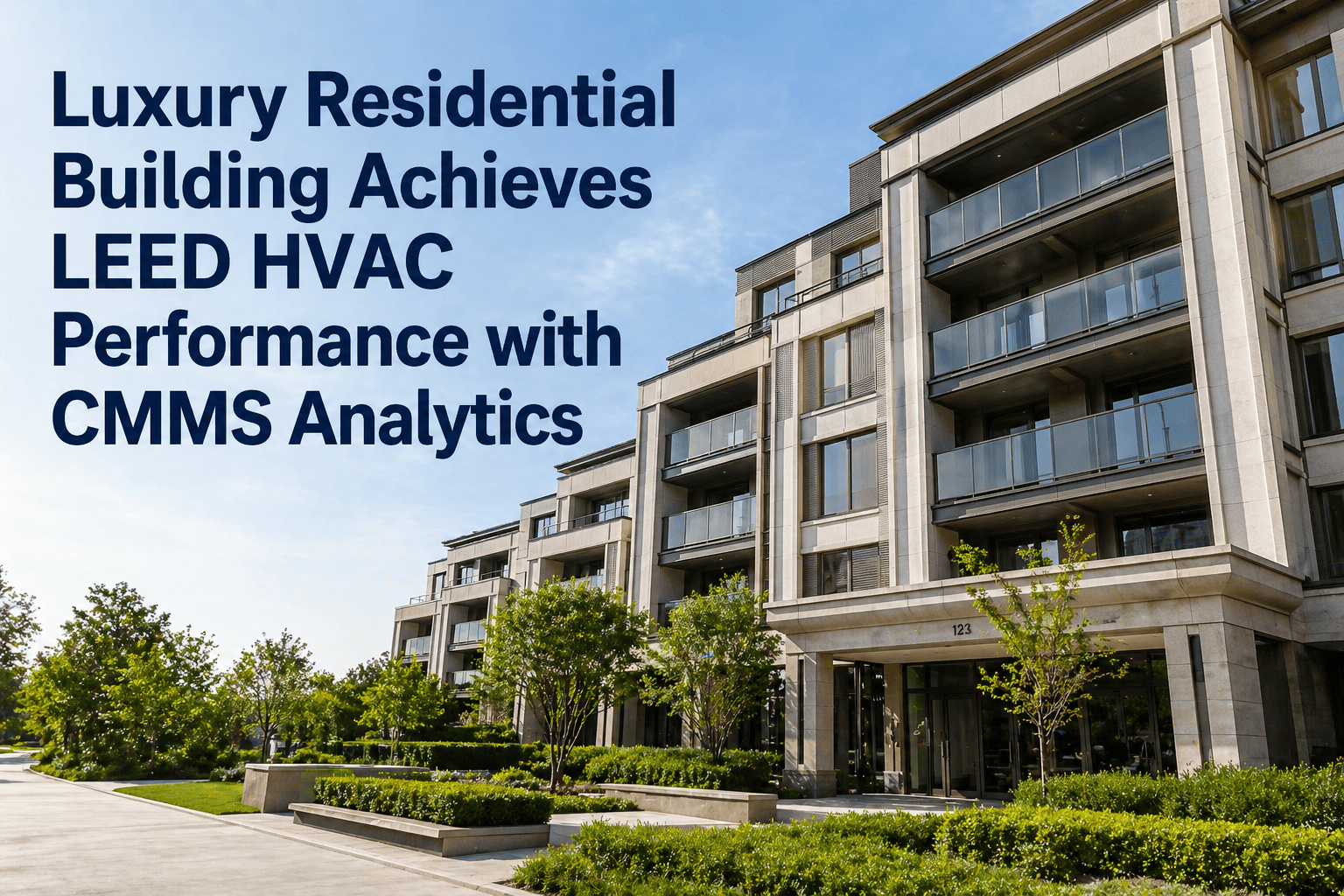
A regional hospital system in Ohio replaced its traditional HVAC service contract in 2023 with an HVACaaS subscription. The provider took ownership of all maintenance, parts, emergency response, and system upgrades — billing a flat monthly fee tied to a guaranteed indoor temperature range. In the first year, unplanned downtime dropped 71%. Energy bills fell 18%. The facilities director stopped managing HVAC vendors entirely. That shift — from equipment owner to comfort buyer — is what HVAC-as-a-Service does. And it is reshaping how buildings think about their single largest operating expense. If your team is still managing HVAC the old way, sign up free and see what a modern platform changes — or book a demo to walk through it with our team.
HVAC-as-a-Service: The Subscription Model Reshaping Building Comfort
From capital expense and reactive breakdowns to predictable monthly costs and guaranteed performance
$12.4B
Projected global HVACaaS market by 2030
34%
Lower total cost of ownership vs. traditional HVAC ownership
68%
Of facility managers cite unplanned HVAC breakdowns as top budget disruptor
2.1x
Faster issue resolution under managed HVACaaS vs. break-fix contracts
What Is HVAC-as-a-Service — And Why Is It Growing Fast?
HVACaaS converts building comfort from a capital investment into a monthly operating expense. Instead of buying equipment, hiring technicians, and managing vendor relationships, building owners pay a subscription for a defined outcome — typically a guaranteed temperature band, uptime percentage, or energy consumption target. The provider handles everything else: hardware, maintenance, parts, upgrades, and emergency response. Sign up to explore how OxMaint supports every tier of HVACaaS operations.
Traditional HVAC Ownership vs. HVACaaS Subscription
Traditional Model
Cost structure
High CapEx + variable OpEx
Equipment ownership
Building owner
Emergency repairs
Unpredictable expense
Upgrades
Separate capital project
Performance risk
Building owner bears it
Compliance burden
Internal team manages
HVACaaS Model
Cost structure
Flat monthly subscription
Equipment ownership
Provider
Emergency repairs
Included in contract
Upgrades
Provider-managed, included
Performance risk
Provider bears it
Compliance burden
Provider handles documentation
Still Running HVAC on CapEx and Guesswork?
See how OxMaint helps building owners and HVACaaS providers track costs, manage assets, and hit SLA targets — all without spreadsheets or manual follow-ups.
The Four HVACaaS Contract Structures
Not all HVACaaS agreements are identical. The subscription model spans a spectrum from basic maintenance coverage to full performance guarantees. Understanding which structure fits your building type determines whether HVACaaS delivers genuine value or simply repackages existing costs under a new billing arrangement.
HVACaaS Contract Structures: What Each Model Covers
Four levels of service — from basic subscription to full outcome guarantee
Tier 1
Maintenance Subscription
Scheduled preventive maintenance, filter changes, and inspection visits bundled into a monthly fee. Equipment still owned by building. Emergency repairs billed separately.
Covers
Planned PM visits on defined schedule
Parts under $500 per incident
Annual system tune-ups
Best for: Small commercial, retail, low-complexity facilities
Tier 2
Managed HVAC Service
Full maintenance plus emergency response and most parts included. Provider monitors system health remotely. Building owner retains equipment ownership but transfers operational risk.
Covers
24/7 remote monitoring and response
All parts and emergency labor included
Compliance documentation and reporting
Best for: Office buildings, healthcare clinics, multi-site operators
Tier 3
Equipment-as-a-Service
Provider owns, installs, and maintains all HVAC equipment. Building pays monthly for access to the equipment and all associated services. No CapEx, no ownership, full OpEx treatment.
Covers
Equipment procurement and installation
All maintenance, parts, and upgrades
End-of-life equipment replacement
Best for: Buildings seeking 100% OpEx structure, new builds
Tier 4
Performance Contract (CaaS)
Provider guarantees specific indoor comfort outcomes — temperature ranges, humidity bands, air quality targets, and energy consumption ceilings. Penalties apply if SLAs are missed. True Comfort-as-a-Service.
Covers
Guaranteed temperature and humidity SLAs
Energy consumption guarantee with shared savings
Financial penalties for SLA breaches
Best for: Healthcare, data centers, critical environments
Performance-Based Contracts: Where HVACaaS Gets Serious
Tier 4 performance contracts — true Comfort-as-a-Service — represent the most sophisticated form of HVACaaS and the fastest-growing segment of the market. Instead of paying for a provider's time and materials, building owners pay for a result. The provider's margin depends on delivering it efficiently. This alignment of incentives fundamentally changes how HVAC systems are operated, maintained, and upgraded. Want to see how OxMaint tracks these KPIs automatically? Book a demo and we will walk you through it live.
Inside a Performance-Based HVAC Contract: What Gets Measured
Key performance indicators that define SLA compliance and trigger financial consequences
Temperature Accuracy
+/- 1.5°F of setpoint
Continuous zone sensors, 5-min intervals
Out of range > 30 min
System Uptime
99.5% of occupied hours
BAS runtime monitoring, remote telemetry
Below 99.5% monthly
Energy Consumption
At or below baseline kWh
Sub-metered HVAC energy, monthly reporting
10%+ above baseline
Response Time
4-hour critical, 24-hour routine
Ticket timestamp to on-site arrival log
Any breach of response window
Air Quality (IAQ)
CO2 below 1,000 ppm occupied
IAQ sensors, continuous logging
Sustained exceedance > 2 hours
Shared savings clauses reward providers who outperform energy baselines — aligning provider profit with building owner efficiency goals
Who Benefits Most from HVACaaS?
HVACaaS Fit by Building Type
Where the subscription model delivers strongest financial and operational returns
Strong Fit
Healthcare Facilities
Joint Commission compliance, 24/7 uptime requirements, and high liability for comfort failures make guaranteed SLAs essential. HVACaaS transfers both operational and regulatory burden to the provider.
Avg. 29% reduction in HVAC-related compliance incidents
Strong Fit
Multi-Site Operators
Retail chains, restaurant groups, and property portfolios eliminate the complexity of managing HVAC vendors, parts procurement, and compliance documentation across dozens of locations under a single contract.
60-75% reduction in facilities staff time on HVAC coordination
Strong Fit
Class A Office Buildings
Tenant comfort SLAs in leases align directly with HVACaaS performance guarantees. Providers have financial incentive to resolve tenant complaints faster than any internal team would.
15-22% improvement in tenant comfort satisfaction scores
Moderate Fit
Light Industrial
Simpler HVAC systems and lower comfort criticality reduce the premium value of performance guarantees. Basic maintenance subscription tiers deliver cost predictability without full transfer of operational risk.
Maintenance subscription typically saves 12-18% vs. reactive repair
Managing HVAC Across Multiple Sites or Service Contracts?
OxMaint gives facility teams and HVACaaS providers the platform to track performance KPIs, manage compliance documentation, and deliver on SLA guarantees — all in one place. Whether you are the building owner or the service provider, the platform runs the data layer your contracts depend on.
The Role of CMMS in Delivering HVACaaS at Scale
HVACaaS providers cannot deliver on performance guarantees without the operational infrastructure to measure, manage, and prove performance. A CMMS platform is the engine underneath every credible HVACaaS contract — tracking every work order, PM completion, sensor reading, and corrective action across every building in the portfolio. Without it, performance-based contracts become educated guesswork. Sign up free to explore OxMaint's full CMMS capabilities, or book a demo to see it configured for your building type.
How CMMS Enables HVACaaS Performance Delivery
The operational capabilities a platform must provide to support subscription and performance contracts
01
Automated PM Scheduling
Preventive maintenance tasks assigned, tracked, and escalated automatically across every asset in every building — ensuring PM completion rates that keep SLAs achievable and document provider diligence for contract disputes.
02
Real-Time KPI Dashboards
Temperature compliance, uptime rates, response times, and energy benchmarks visible to both provider and building owner in real time — eliminating end-of-month reporting surprises and enabling proactive intervention before SLA breaches.
03
Compliance Documentation
Every maintenance action, inspection, and corrective event recorded with technician attribution and timestamps — creating the audit trail required for Joint Commission surveys, local building permits, and performance contract verification.
04
Multi-Site Asset Visibility
Equipment records, maintenance histories, and performance data consolidated across every building in the portfolio — allowing providers to identify systemic issues, share parts inventory efficiently, and deploy technicians where they are needed most.
05
Workforce Dispatch Tools
Mobile work orders, GPS dispatch, and technician skill matching ensure the right person reaches each site within SLA windows — with photo documentation and digital sign-off captured at the point of service rather than back at the office.
06
SLA Reporting and Billing Data
Automated monthly reports showing uptime percentages, response time compliance, and energy performance against contract baselines — providing the billing and penalty calculation data both parties need without manual spreadsheet compilation.
Your CMMS Should Do More Than Log Work Orders
OxMaint tracks SLA performance, automates PM scheduling, dispatches technicians, and generates compliance reports — giving HVACaaS providers and building owners the real-time visibility the subscription model demands.
Frequently Asked Questions
Is HVACaaS the same as a traditional HVAC service contract?
No. Traditional service contracts cover specific tasks at predetermined prices — a PM visit costs X, a compressor replacement costs Y. HVACaaS bundles all services into a monthly subscription with a defined outcome guarantee. The critical difference is risk transfer: under a service contract, the building owner pays for every event. Under HVACaaS, the provider absorbs operational risk and has a financial incentive to prevent problems rather than simply respond to them.
What is included in a typical HVACaaS monthly fee?
At minimum, maintenance subscriptions cover scheduled PM visits, standard parts, and basic emergency response. Mid-tier managed service contracts add 24/7 remote monitoring, all parts and labor, and compliance documentation. Full Equipment-as-a-Service contracts include equipment ownership, upgrades, and end-of-life replacement. Performance contracts additionally include guaranteed SLAs with financial consequences for non-performance. What is included depends entirely on the tier negotiated — always review the exclusions list as carefully as the inclusions.
How are HVACaaS performance contracts priced?
Pricing is typically based on square footage, equipment complexity, climate zone, occupancy profile, and the SLA tier selected. Most providers conduct a baseline energy audit and equipment assessment before quoting. Monthly rates for mid-size commercial buildings typically range from $0.08 to $0.25 per square foot depending on contract depth. Performance contracts with guaranteed energy savings may include shared savings provisions — where provider and building owner split energy cost reductions below the guaranteed baseline, creating upside incentive for both parties.
How does workforce training change under HVACaaS?
Building owner staff shift from hands-on HVAC troubleshooting to contract monitoring and performance oversight. Instead of training in refrigerant handling or AHU servicing, facility teams need skills in SLA tracking, KPI interpretation, and provider management. CMMS platforms play a central role here — internal teams use the same dashboard as the provider to monitor performance, flag anomalies, and initiate escalations. The workforce skills required shift from technical execution to data-driven oversight, which is why CMMS adoption is closely correlated with successful HVACaaS transitions.
Ready to Manage HVAC Performance Like a Contract — Not a Cost?
OxMaint provides the CMMS backbone that HVACaaS providers use to deliver on SLAs and that building owners use to hold them accountable. Track every asset, every PM, every KPI — across one building or one hundred — from a single platform built for subscription-model HVAC operations.


-by-city-2026-compliance-map-&-hvac-requirements.png)