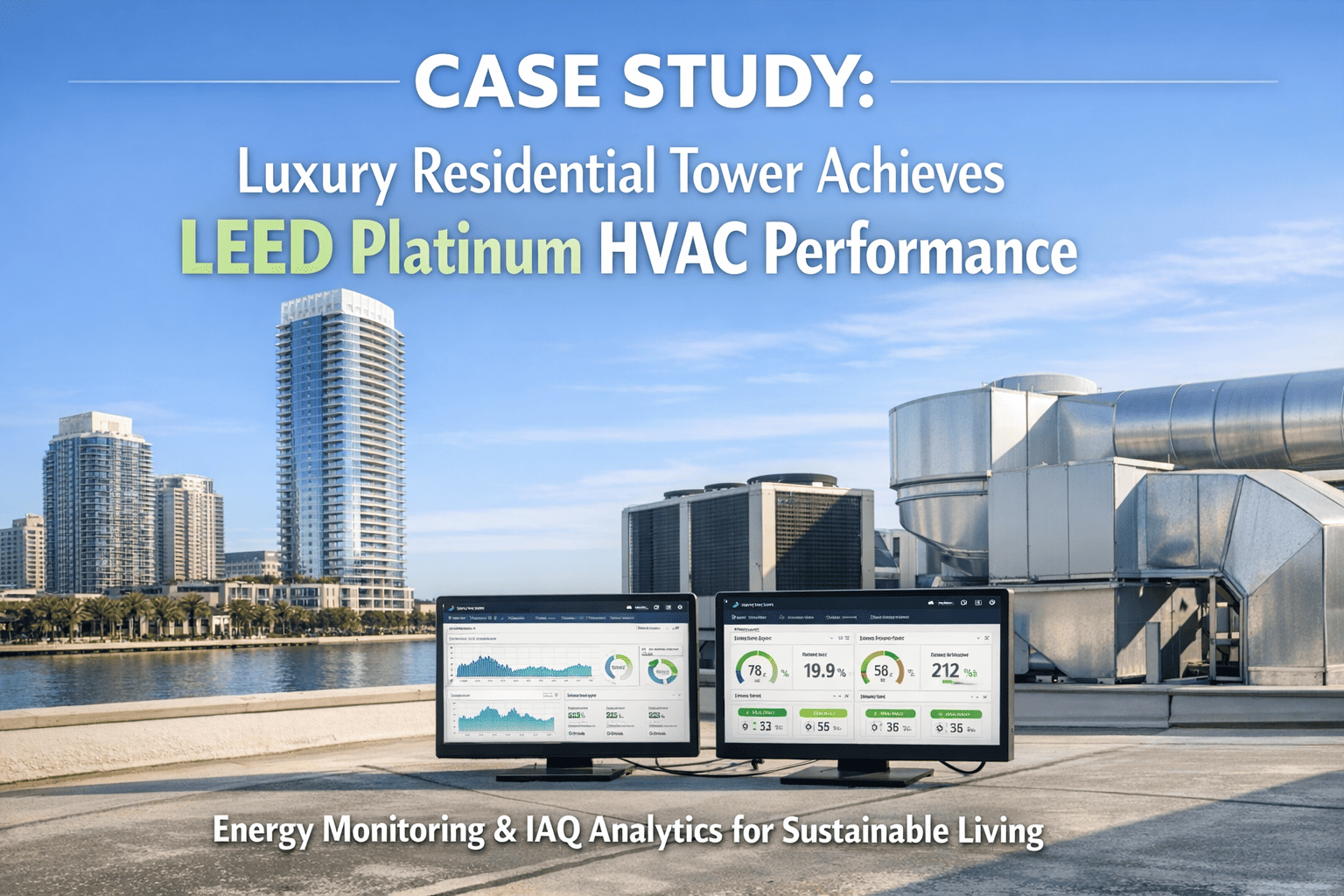
OxMaint helped a 42-story luxury residential tower achieve LEED Gold HVAC performance benchmarks — reducing energy consumption by 31%, cutting unplanned HVAC downtime by 84%, and generating the real-time ESG reporting data that satisfied both the building's sustainability certification body and its institutional investors. The property had best-in-class equipment: variable refrigerant flow systems, high-efficiency chiller plant, energy recovery ventilators, and smart thermostats in every unit. But without a unified analytics layer connecting those systems to a maintenance workflow engine, performance degradation went undetected, PM was reactive, and LEED documentation was assembled manually from scattered records. This case study covers the problem, the OxMaint deployment, and the measured results across energy, maintenance, and compliance outcomes.
Luxury Residential Building Achieves LEED HVAC Performance with CMMS Analytics
How a 42-story luxury tower transformed reactive HVAC maintenance into predictive performance management — achieving LEED Gold benchmarks, cutting energy costs by 31%, and automating ESG reporting.
Building Profile & Results
What Was Happening Before OxMaint
OxMaint Deployment Across 5 System Categories
Chiller Plant Analytics
OxMaint connected to the chiller BMS and logged kW/ton efficiency at 15-minute intervals. The system established a rolling baseline and alerted when approach temperatures or efficiency degraded beyond 5% — triggering tube-cleaning work orders 3 months before the annual service window.
VRF Fleet Monitoring
All 38 VRF outdoor units were connected via manufacturer API. OxMaint tracked refrigerant pressures, compressor amp draw, and zone-by-zone performance for every indoor unit — detecting low-charge and coil fouling conditions automatically and routing work orders before occupant impact.
ERV Performance Tracking
The 12 energy recovery ventilators were monitored for heat wheel effectiveness and airflow balance. Monthly effectiveness calculations replaced annual inspection — catching two units that had degraded to below 55% effectiveness from wheel fouling.
Automated PM Scheduling
OxMaint replaced all paper-based PM logs with digital work order schedules for every HVAC asset. Filter changes, coil cleaning, lubrication, and refrigerant checks were assigned to technicians with photo documentation and timestamped sign-off required for closure.
ESG & LEED Reporting Engine
OxMaint’s Energy & ESG module aggregated all energy consumption data, maintenance actions, and equipment performance into a LEED-compatible reporting format. What took 6 weeks to compile manually now generates in under 2 hours directly from the platform.
See How OxMaint Delivers LEED-Grade HVAC Performance Tracking
Book a 20-minute demo and we will show you the energy analytics, ESG reporting, and PM automation that delivered LEED Gold for this residential tower — live for your building.
Performance Results — 18 Months After OxMaint Deployment
Full Outcome Metrics — 18-Month Measurement Period
| Metric | Before OxMaint | After OxMaint | Change |
|---|---|---|---|
| Chiller plant efficiency | 0.72 kW/ton | 0.58 kW/ton | 19% improvement |
| Total HVAC energy consumption | Baseline | −31% vs baseline | $216,000/yr saved |
| Unplanned HVAC downtime | 412 hours/yr | 66 hours/yr | −84% |
| Reactive vs PM work order ratio | 67% reactive | 18% reactive | −49 points |
| VRF refrigerant losses detected | 0 (undetected) | 3 units identified & repaired | Compressor failures prevented |
| ERV units below 60% effectiveness | 2 units (undetected) | Both cleaned, >72% restored | Energy recovery restored |
| LEED certification | Not achieved | LEED Gold awarded | First attempt success |
| Resident HVAC complaints | #1 complaint category | Dropped to #4 | 68% reduction |
| Annual maintenance cost | $841,000 | $623,000 | −$218,000 (26%) |
| LEED documentation prep time | 6 weeks per cycle | <2 hours per cycle | 97% time reduction |
How OxMaint Supported Each LEED Energy & Atmosphere Credit
OxMaint’s continuous kW/ton tracking and energy benchmarking provided the measured performance data required to demonstrate EUI improvement against the ASHRAE 90.1 baseline. Real operational data replaced energy model projections in the LEED submission.
OxMaint’s PM records, sensor calibration logs, and equipment performance history satisfied Monitoring-Based Commissioning (MBCx) pathway requirements, demonstrating ongoing systems performance verification rather than one-time commissioning documentation.
OxMaint tracked refrigerant additions by unit, maintained cumulative leak rate calculations per EPA 608, and provided the equipment-level refrigerant service records required to demonstrate responsible refrigerant management across the VRF fleet.
OxMaint’s Energy & ESG reporting module calculated actual building HVAC carbon intensity based on measured energy consumption, enabling accurate Scope 2 emissions reporting for both LEED and institutional investor ESG disclosure.
LEED HVAC Monitoring — Common Questions
Can OxMaint generate LEED-compatible energy and maintenance reports?
How does OxMaint connect to VRF systems in residential buildings?
What ESG metrics does OxMaint track for residential building investors?
How long does OxMaint deployment take for a large residential building?
Achieve LEED HVAC Performance for Your Residential Building
OxMaint delivers the predictive maintenance, energy analytics, and ESG reporting that turns high-performance HVAC equipment into certified, documented, measurable performance — for LEED, for investors, and for residents.