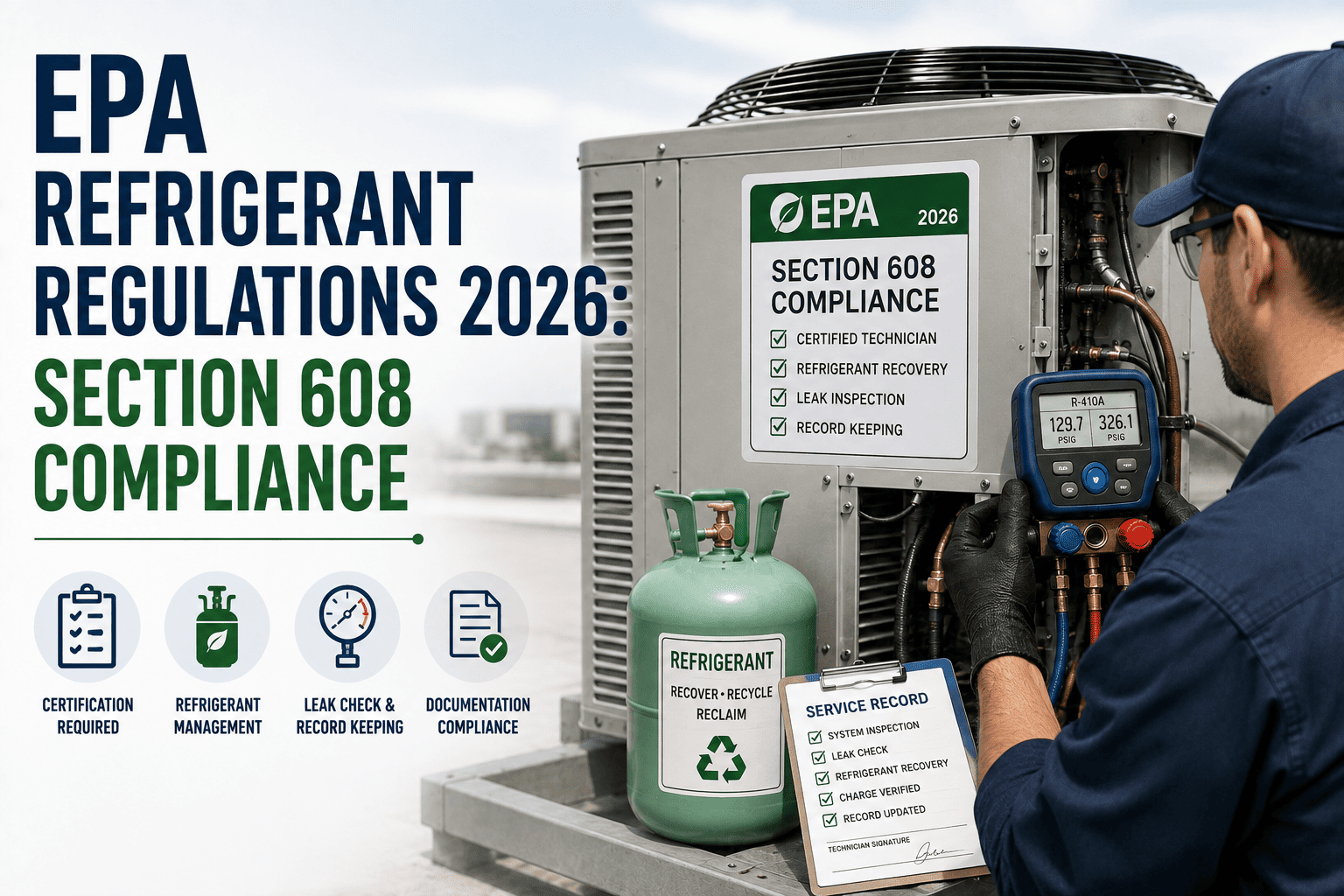
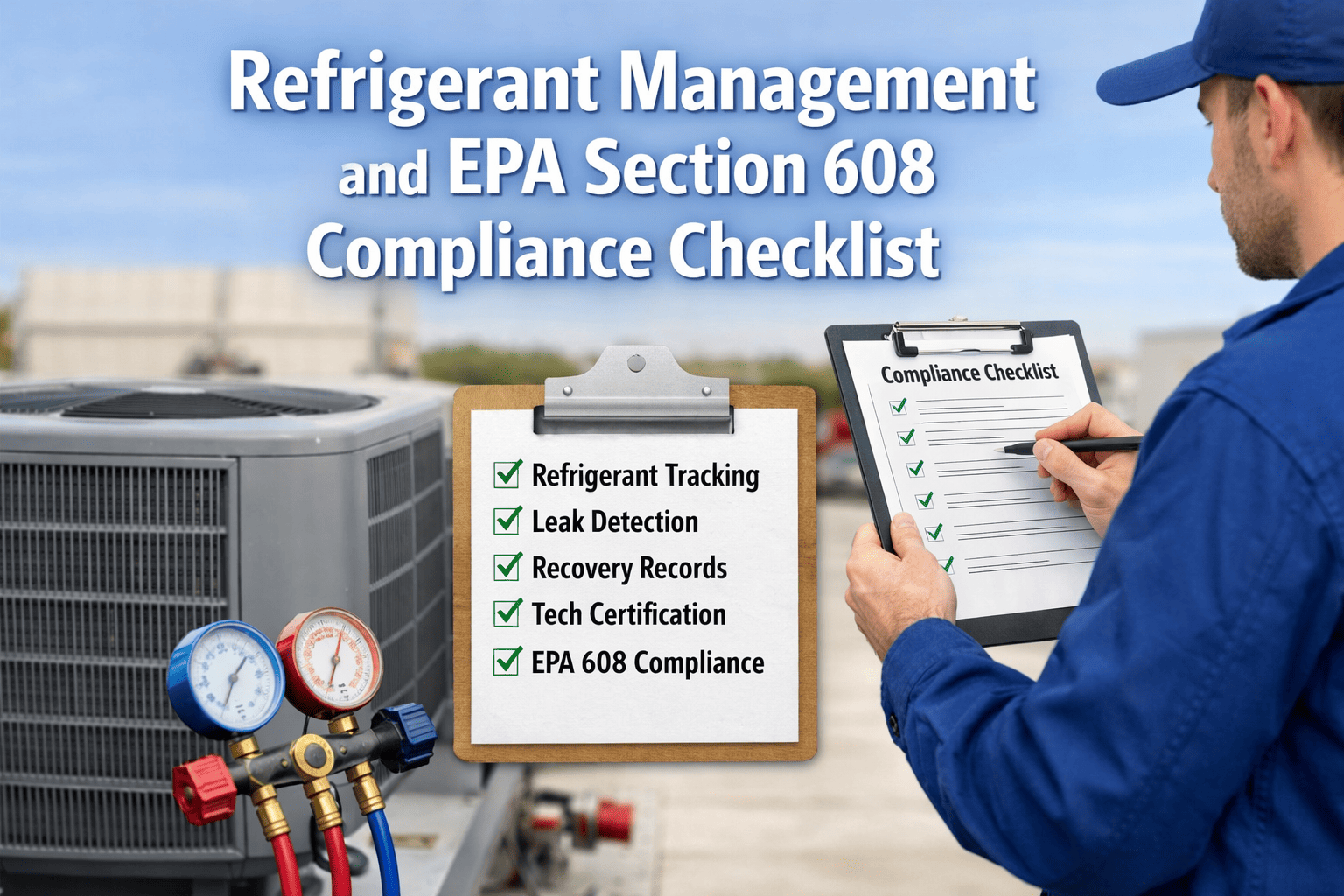
Every time a technician connects a gauge manifold to an HVAC system, federal law demands they hold valid EPA Section 608 certification. Yet in 2024, refrigerant recovery violations accounted for over 30% of all EPA penalties—making technician credentialing and refrigerant handling documentation the single largest compliance failure category in the HVAC industry. With the January 2026 AIM Act expansion lowering regulatory thresholds from 50 pounds to just 15 pounds of HFC refrigerant, facilities now face unprecedented scrutiny. The question isn't whether your technicians are certified, but whether you can prove it instantly during an EPA audit. Digital certification tracking has shifted from convenience to survival strategy.
The 2026 Regulatory Shift: What Changes January 1
The EPA's AIM Act Subsection H represents the most significant expansion of refrigerant regulations in decades. Understanding these changes is critical for avoiding penalties that now reach $60,000 per violation per day.
Threshold Drop to 15 Pounds
Systems containing 15+ pounds of HFC refrigerants with GWP over 53 now fall under federal regulations—down from 50 pounds. This captures residential split systems and commercial rooftop units previously exempt.
Automatic Leak Detection
New systems with 1,500+ pounds of HFCs must include automatic leak detection. Existing systems installed 2017-2025 must retrofit by January 1, 2027.
Reclaimed Refrigerant Mandate
Supermarket systems, refrigerated transport, and commercial ice makers must use reclaimed refrigerants starting 2029. Documentation of reclaimed product meeting 15% virgin content standard required.
These changes mean manual logs and paper certificates no longer suffice. Sign up to automate compliance tracking before the January 2026 deadline.
Understanding EPA Section 608 Certification Categories
Not all technician certifications are equal. The EPA defines four distinct certification types, and assigning the wrong technician to equipment violates federal law—even if that technician holds other valid credentials.
Small Appliances
Appliances manufactured, charged, and hermetically sealed with five pounds or less of refrigerant. Includes refrigerators, freezers, room air conditioners, and dehumidifiers.
High-Pressure Systems
Appliances using high-pressure refrigerants including 410A, 22, 407C, and 404A. Covers most commercial HVAC systems and split heat pumps.
Low-Pressure Systems
Appliances using low-pressure refrigerants primarily including R-11, R-123, and R-113. Common in large commercial chillers and industrial process cooling.
All System Types
Technicians passing Core, Type I, II, and III exams. Universal certification requires proctored Core exam—open-book Core tests cannot qualify for Universal status.
Critical Distinction: Core tests taken as open-book exams cannot be used to obtain Universal Certification. The Core test must be taken as a proctored exam to attain Universal Certification—a common compliance trap that invalidates technician credentials during audits.
Leak Rate Thresholds and Repair Mandates
Once a system exceeds specified leak rates, the clock starts ticking. Facilities must repair leaks within 30 days or submit approved retrofit/retirement plans within 120 days. Missing these deadlines triggers automatic violations.
Calculating leak rates requires precise charge history tracking. Book a demo to see automated leak rate monitoring that alerts before thresholds are breached.
Avoid $60,000 Per Day Penalties
Recent EPA enforcement actions show escalating fines: Gristedes paid $400,000+ in 2024 for leak repair failures, while historical cases like Trader Joe's faced $500,000 civil penalties plus $2 million in mitigation costs. Automated compliance tracking prevents violations before they occur.
Recordkeeping That Survives EPA Audits
EPA auditors don't just check current compliance—they examine historical documentation. Inadequate recordkeeping transformed Gristedes' minor leaks into major violations. Understanding documentation requirements prevents paper trails from becoming liability trails.
Technician Credentials
- Certification type and expiration (though EPA certifications don't expire, employer verification records should be current)
- Proctored vs. open-book Core exam documentation for Universal certification
- Apprentice supervision logs (apprentices may work only under direct certified technician supervision)
Service Records
- Quantity of refrigerant added or removed by date
- Leak inspection reports with technician identification
- Repair dates and verification test results
- Retrofit or retirement plans for chronically leaking appliances
Disposal Documentation
- Recovery levels achieved before disposal
- Reclamation certificates from certified reclaimers
- Equipment serial numbers and refrigerant types
- Final disposer certification for small appliances
Digital documentation systems timestamp entries automatically, creating tamper-proof audit trails that paper records cannot match. Sign up to secure your compliance documentation.
Real-World Enforcement: Lessons from Recent Cases
EPA enforcement patterns reveal that compliance failures rarely stem from intentional violations—they result from disconnected systems and documentation gaps that allow small issues to compound into major penalties.
Gristedes Supermarkets
Failure to repair refrigeration leaks above allowable thresholds, inadequate documentation of repair attempts, and missing leak monitoring protocols. The case demonstrates how documentation failures amplify technical violations.
Trader Joe's
$500,000 civil penalty plus $2 million mitigation payment for failure to identify and repair leaks exceeding 25% annual leak rate across multiple locations. Established pattern that multi-site operators face escalated scrutiny.
Costco Wholesale
$335,000 penalty plus $2 million equipment upgrade requirement. Case emphasized that penalties extend beyond fines to mandated capital expenditures for compliance infrastructure.
Beyond monetary costs, public enforcement announcements create reputational damage that affects customer trust and investor relations. Book a demo to implement preventive compliance monitoring.
From Paper Certificates to Digital Compliance
Traditional certification management—file cabinets, spreadsheet trackers, and calendar reminders—collapses under regulatory pressure. The 2026 expansion to 15-pound thresholds means most facilities will manage 3-5x more regulated equipment, making manual tracking operationally impossible.
Real-Time Credential Verification
Instant confirmation that assigned technicians hold current, appropriate certifications for specific equipment types. Prevents dispatching Type I technicians to high-pressure systems—a violation that occurs frequently during emergency service calls.
Automated Leak Rate Calculations
Continuous monitoring of refrigerant additions against system charge sizes, automatically flagging when annual leak rates approach 10%, 20%, or 30% thresholds. Eliminates calculation errors that plague manual tracking.
Chronic Leak Reporting
Automatic identification of systems leaking 125% or more of full charge annually, triggering mandatory March 1 reporting requirements. Prevents missed deadlines that result in automatic violations.
Audit-Ready Documentation
Timestamped, tamper-proof records of all refrigerant handling activities with technician credentials attached. Reduces audit preparation from weeks to minutes.
90-Day Compliance Implementation
Preparing for January 2026 requires immediate action. Facilities that delay implementation risk non-compliance from day one of the new regulations.
Inventory and Assessment
Audit all equipment to identify systems now falling under 15-pound threshold. Verify current technician certifications and identify gaps where Universal certification may be required for mixed equipment portfolios.
Digital Infrastructure Deployment
Implement certification tracking platform with mobile technician access. Migrate historical service records to create baseline leak rate calculations. Configure automated alerts for threshold approaches.
Workflow Integration and Training
Integrate compliance tracking with work order management. Train technicians on digital documentation requirements. Establish protocols for apprentice supervision documentation.
Sign up to begin your 90-day compliance implementation with guided onboarding.
Frequently Asked Questions
Do EPA Section 608 certifications expire?
Technician certifications under Section 608 do not expire. However, employers must maintain current verification records, and technicians should stay updated on regulatory changes. The 2026 AIM Act expansion introduces new requirements that technicians must understand regardless of certification date. Digital tracking systems ensure employer verification records remain current even though the underlying EPA credentials are permanent.
What is the difference between Type II and Universal certification?
Type II certification allows technicians to service high-pressure appliances including most commercial HVAC systems using 410A, 22, and similar refrigerants. Universal certification covers Type I (small appliances), Type II (high-pressure), and Type III (low-pressure) equipment. Critically, Universal certification requires passing the Core exam in a proctored setting—open-book Core exams cannot qualify for Universal status. Technicians frequently believe they hold Universal certification when they actually hold Type II plus open-book Core, creating compliance violations when they service low-pressure chillers.
How do I calculate leak rates for EPA compliance?
Annual leak rate is calculated by dividing the total refrigerant added to a system during a calendar year by the total full charge of that system. For example, adding 15 pounds to a 100-pound system equals a 15% leak rate—triggering the 30-day repair requirement for comfort cooling equipment. Accurate calculation requires tracking every refrigerant addition, including "top-offs" during routine maintenance. Digital tracking systems automate these calculations and alert when thresholds approach, preventing the calculation errors common in manual tracking.
What records must I keep for EPA Section 608 compliance?
Required documentation includes: technician certification records (type and exam method for Universal), quantity of refrigerant added or removed by date, leak inspection reports, repair dates and verification tests, retrofit or retirement plans for chronically leaking appliances, and reclamation certificates for disposed equipment. Records must be maintained for three years and provided to EPA upon request. Starting 2026, additional documentation includes automatic leak detection system installation records for applicable systems and reclaimed refrigerant usage logs.
Can apprentices work on refrigerant systems without certification?
Apprentices may perform refrigerant handling activities only when closely and continually supervised by a certified technician. The supervising technician must be physically present and directly oversee the apprentice's work. Employers must maintain documentation of the supervisory relationship. Apprentices cannot perform unsupervised work, and the supervising technician assumes liability for compliance violations. Digital tracking systems should log apprentice assignments and supervisory verification to defend against EPA allegations of unsupervised work.
What are the penalties for EPA Section 608 violations?
EPA may assess civil penalties up to $60,000 per violation per day for knowing violations including improper venting, failure to repair leaks within required timeframes, and inadequate recordkeeping. Criminal penalties apply for intentional venting. Recent enforcement actions show actual penalties ranging from $335,000 to $2.5 million depending on violation scope and duration. The 2024 Gristedes case ($400,000+) demonstrates that documentation failures compound technical violations, while historical cases show multi-site operators face escalated scrutiny and penalties.
Prepare for 2026 Regulations Now
The January 2026 expansion to 15-pound thresholds will capture equipment previously exempt from federal oversight. Facilities that implement digital compliance tracking before the deadline will avoid the rush and ensure continuous compliance from day one.