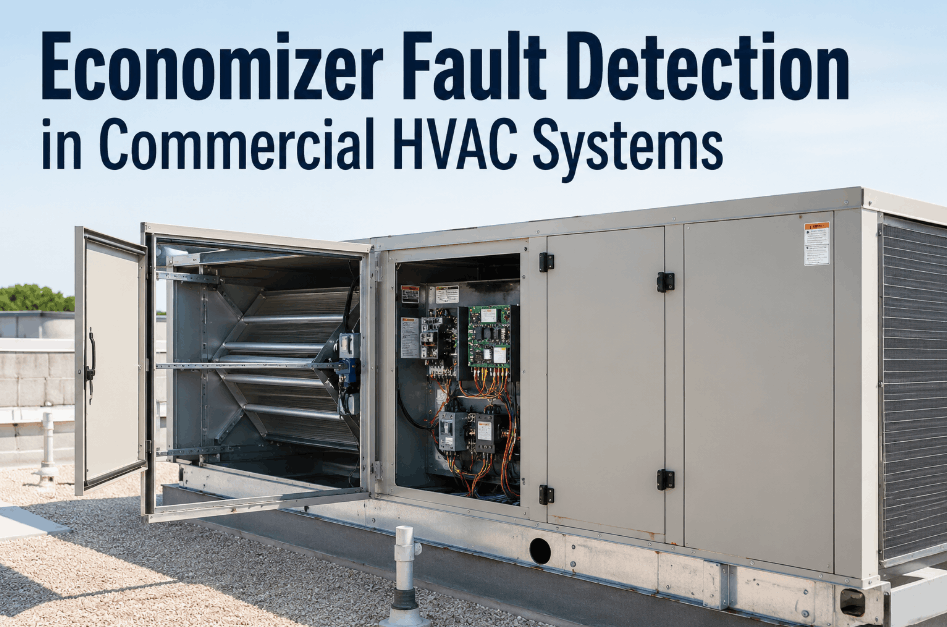
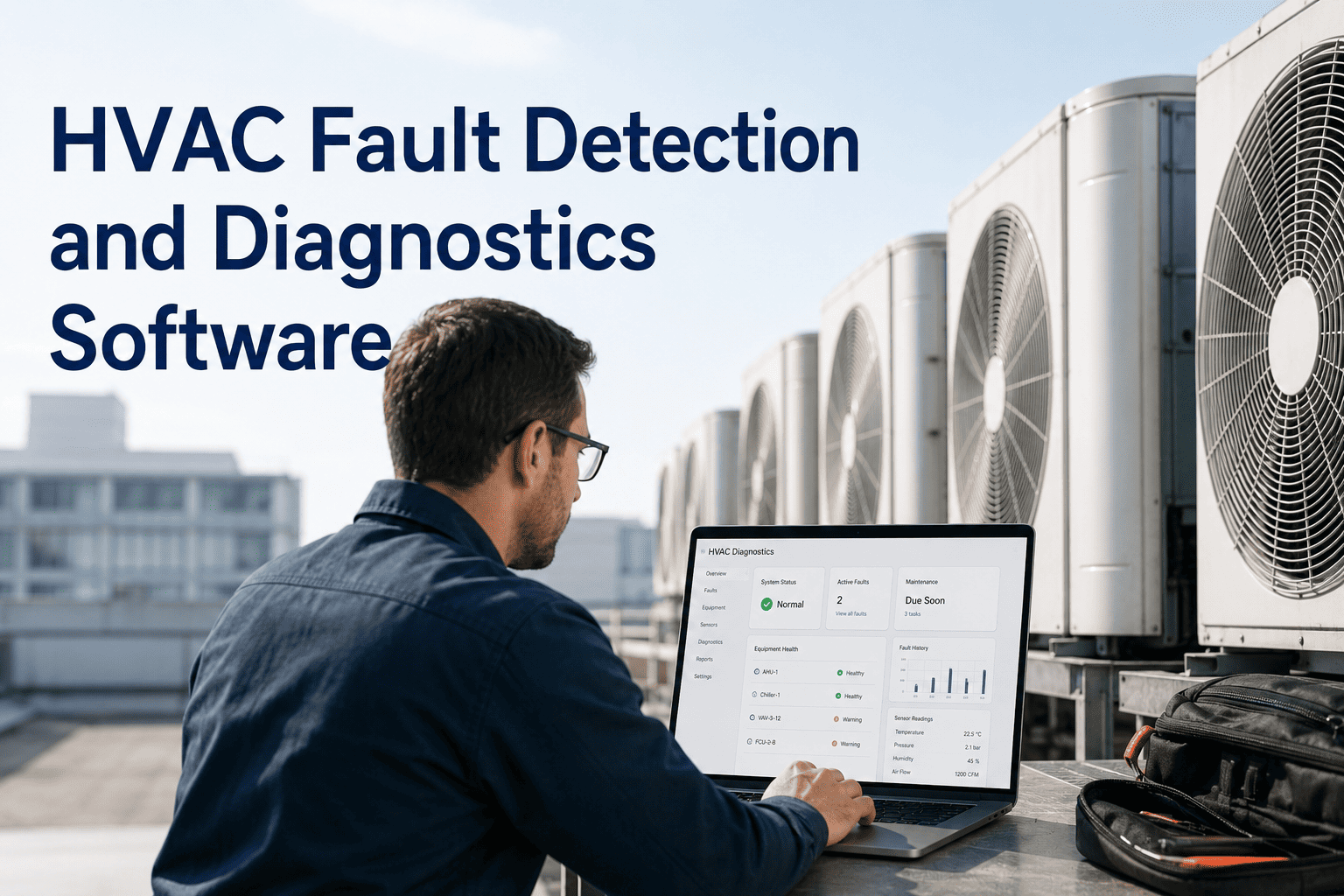
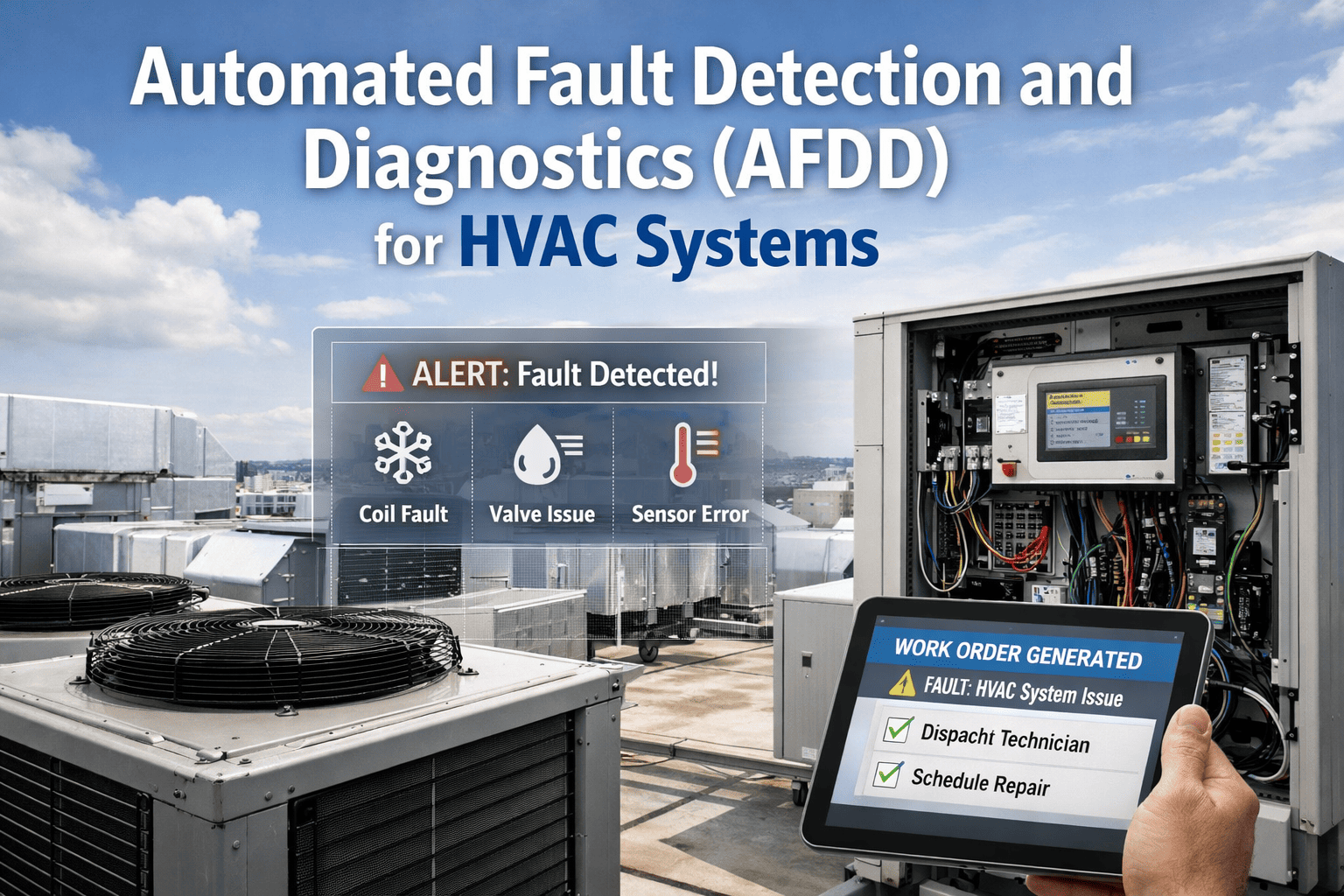
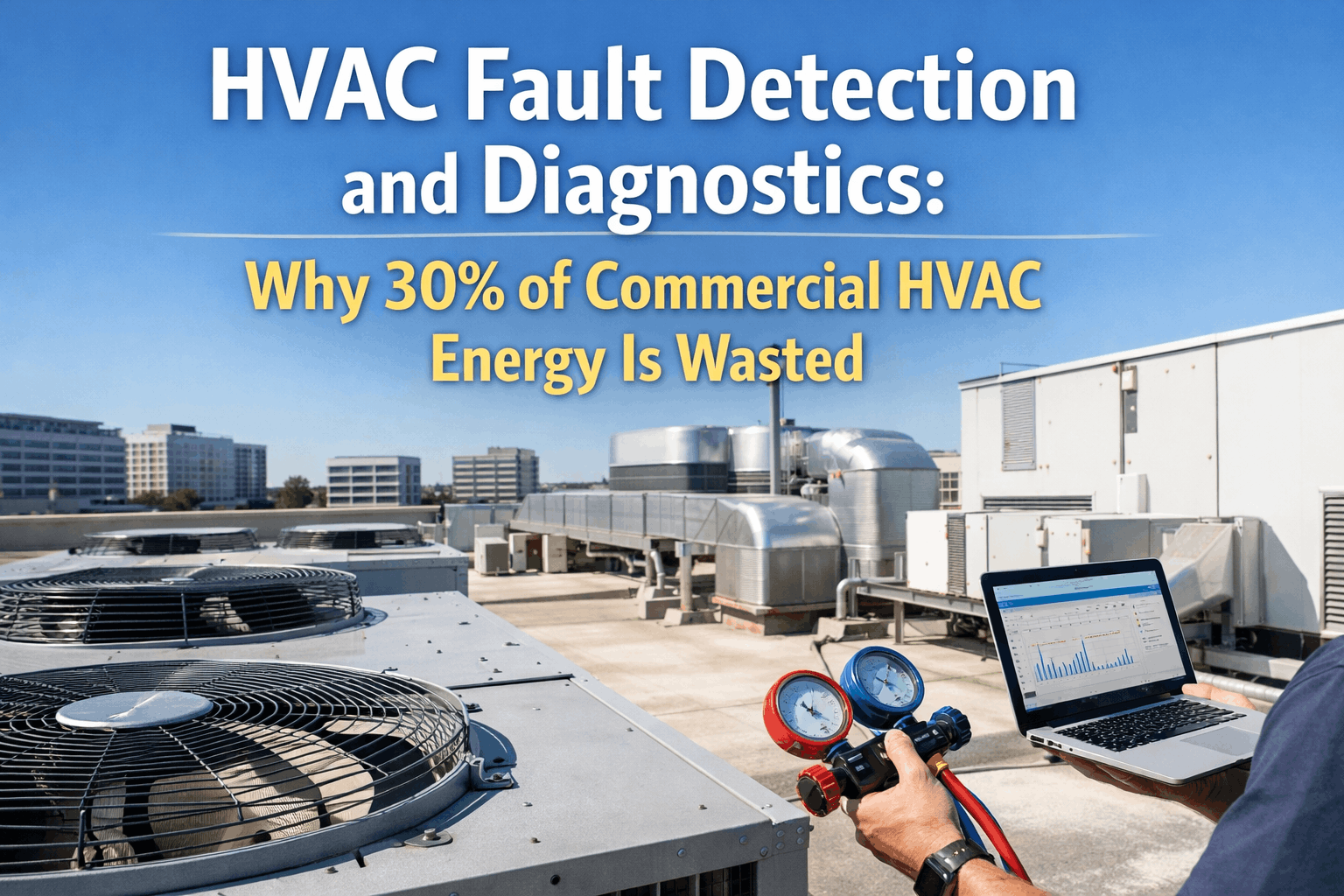
Automated Fault Detection and Diagnostics (FDD) is the systematic identification of what is wrong in an HVAC system — and why — before it causes energy waste, comfort failures, or equipment breakdown. On any given day, 40% of air handling units in commercial buildings are operating with at least one active fault. Most go undetected for months. This guide covers exactly how FDD works, which faults it catches, the energy and maintenance impact of acting on findings, and how OxMaint’s Predictive Maintenance Console closes the loop from fault detection to resolved work order — automatically.
Detect HVAC Faults Before They Cost You
OxMaint’s Predictive Maintenance Console continuously monitors your HVAC systems, identifies fault patterns across AHUs, chillers, and RTUs, and auto-generates prioritised work orders — from your existing BAS data, from day one.
Why HVAC Faults Are a Silent Energy and Operations Crisis
HVAC systems consume 40–50% of commercial building energy — yet research across more than 60,000 pieces of equipment consistently finds that 15–30% of that energy is wasted due to operational faults that go undetected because no one is continuously watching. Simultaneous heating and cooling runs unnoticed for weeks. Dampers drift out of position. Sensors bias gradually. Control sequences malfunction silently. Each fault burns energy, degrades comfort, and accelerates equipment wear — not because the problem is hidden, but because there is no system watching for the pattern.
FDD is that system. It continuously analyses operating data from your BAS — comparing real-time performance against learned baselines — and flags deviations that indicate a developing fault, often weeks before a threshold alarm would fire. The difference between an FDD platform and a BAS alarm is the difference between a symptom checker and a diagnosis. Sign up free and connect OxMaint to your BAS data today.
FDD vs BAS Alarms vs Reactive Maintenance: The Performance Gap
Understanding what FDD does — and what it does not — requires placing it against the two approaches it replaces or supplements.
| Capability | Reactive Maintenance | BAS Alarms Only | FDD-Driven (OxMaint) |
|---|---|---|---|
| Fault visibility timing | After failure or complaint | After threshold crossed | Weeks before impact |
| Root cause identification | Manual troubleshooting | None — threshold only | Automated with confidence score |
| Energy waste from faults | 15–30% ongoing | 10–20% ongoing | Reduced to 5–10% |
| Annual energy savings vs baseline | — | Minimal | 9–10% median (LBNL) |
| Emergency repair frequency | High — unpredictable | Moderate | 40–60% reduction |
| Work order generation | Manual after failure | Manual from alert | Automatic on fault detection |
| Investment payback period | N/A | N/A | 2 years median (LBNL study) |
The Four HVAC FDD Mechanisms That Drive Results
Baseline Learning & Anomaly Detection
FDD establishes a normal operating profile for each asset — the expected relationship between supply air temperature, coil valve position, ambient conditions, and energy draw. When real-time data deviates from that profile, the system flags an anomaly before any threshold is crossed.
- Asset-specific baselines, not generic thresholds
- Detects gradual drift invisible to static alarms
- Adapts automatically to seasonal operating changes
Multi-Sensor Root Cause Diagnostics
A single sensor reading is a symptom. FDD cross-references multiple sensor streams simultaneously — supply temp, valve position, coil pressure drop, ambient conditions — to distinguish between a fouled coil, a stuck valve, a sensor bias, and a control logic error that all produce similar output symptoms.
- Distinguishes between similar-symptom fault types
- Confidence score attached to every diagnosis
- Eliminates unnecessary troubleshooting dispatch
Energy Impact Quantification
FDD does not just detect faults — it quantifies their cost. A simultaneous heating and cooling fault running undetected for 6 weeks has a calculable energy penalty. Attaching a dollar value to each detected fault transforms the priority queue from a technical list into a business decision.
- Energy waste per fault estimated in kWh and cost
- Prioritisation by financial impact, not just severity
- Builds ROI evidence for ongoing programme investment
Automated Work Order Generation
FDD insights only deliver value when someone acts on them. OxMaint closes the loop automatically: when a fault crosses the confidence threshold, a work order is created in the CMMS — pre-populated with asset ID, fault description, diagnostic evidence, recommended action, and parts list. Zero manual translation.
- Work order created before fault causes impact
- Full diagnostic context pre-populated
- Linked to asset record and maintenance history
The Most Common HVAC Faults FDD Detects — and Their Real Energy Cost
ASHRAE Project RP-1312 identified 31 distinct air handling unit fault types. LBNL research covering over 60,000 units found that 21 AHU faults were reported on 20% or more of units — and 18 of those faults persisted for more than 20% of the monitoring period. These are not rare edge cases. They are the daily operating reality of most commercial HVAC systems.
HVAC FDD Performance Benchmarks
These outcomes reflect documented results from commercial building FDD deployments in the LBNL research dataset, peer-reviewed studies, and OxMaint customer implementations across office, healthcare, and institutional portfolios.
| Performance Metric | Without FDD | With FDD (OxMaint) | Improvement |
|---|---|---|---|
| Whole-building energy savings | Baseline | 9–10% median annual savings | 5–30% depending on fault load |
| Investment payback period | N/A | 2 years median | Driven by energy savings alone |
| Emergency repair frequency | High — unpredictable | 40–60% fewer events | Reactive to planned shift |
| Fault prediction accuracy | — | 88–97% at model maturity | At 6+ months of baseline data |
| AHU faults with active fault on any day | 40% of fleet | Detected and queued for repair | From hidden to actioned |
| Fault root cause time-to-identify | Hours of manual troubleshooting | Automated — minutes | Right repair, first visit |
| False positive rate | N/A | Below 10% at model maturity | Drops from 15–25% in first 90 days |
The 9–10% median energy savings figure comes from LBNL analysis of commercial buildings in the office and higher education sectors with a documented two-year simple payback. This is the conservative benchmark — buildings with higher fault loads or older equipment see savings at the upper end of the 5–30% documented range. Book a demo to see how these benchmarks apply to your specific building portfolio.
Three FDD Approaches: Rule-Based, Data-Driven, and Hybrid
Rule-Based FDD
Engineering rules codify known fault conditions. Fast to deploy, interpretable, zero baseline data required. Cannot detect faults not explicitly programmed — including novel failure modes and gradual multi-variable degradation. Best as a starting layer.
Data-Driven (ML) FDD
Machine learning models learn the normal operating profile of each asset. Detects novel and complex fault patterns invisible to rules. Requires 3–6 months of baseline data before full effectiveness. False positive rate high in early months, then drops below 10%.
Hybrid FDD — OxMaint Approach
Pre-trained rule-based fault models deploy immediately — no baseline waiting period. ML anomaly detection activates in parallel and matures over 3–6 months. Both layers feed the same work order generation pipeline. Immediate value plus continuous improvement.
FDD Without CMMS Integration
FDD dashboards that require manual review and manual work order creation capture only a fraction of their energy savings potential — because faults that require human action before a work order is created are routinely deprioritised or missed. The action loop is where value is lost.
BAS Integration Depth
Effective FDD requires native integration with BAS data — BACnet/IP, Modbus, and major platform APIs. OxMaint connects to Tridium, Siemens, Johnson Controls, Honeywell, and Schneider without hardware replacement. Most buildings already have the sensor coverage FDD needs.
How to Deploy FDD Across Your HVAC Portfolio: A 5-Step Roadmap
Connect BAS Data — No Hardware Replacement Required
OxMaint integrates with existing BAS data streams via BACnet/IP, Modbus TCP, and REST API connections to all major platforms. Most commercial buildings installed after 2000 already have the sensor coverage FDD requires — the gap is not hardware, it is connecting that data to a platform that can act on it. Start with your highest-impact assets: largest AHUs, central chillers, and RTUs serving critical zones. Expect the first known-fault alerts within 1–2 weeks of connection.
Activate Pre-Trained Fault Models from Day One
Pre-trained rule-based fault models for HVAC chillers, AHUs, RTUs, VAV systems, and fan coil units deploy immediately upon BAS connection. These models detect known fault patterns — simultaneous heating and cooling, stuck dampers, valve faults, sensor bias — without waiting for baseline data. In most deployments, 5–15 existing faults are identified within the first week of connection, providing immediate ROI evidence and early wins to build organisational commitment to the programme.
Build Asset-Specific Baselines Over 3–6 Months
As operating data accumulates, ML models build equipment-specific normal operating profiles that account for seasonal variation, occupancy patterns, and equipment-specific behaviour. False positive rates fall below 10% as models mature. Remaining Useful Life predictions begin appearing for major components — feeding predictive maintenance scheduling. At 6 months, anomaly detection coverage extends to fault types not explicitly programmed in rule-based models.
Act on Every Fault via Automated Work Orders
The difference between an FDD dashboard and an FDD programme is the action rate. OxMaint auto-generates a prioritised CMMS work order for every fault that crosses the confidence threshold — with asset ID, fault diagnosis, supporting sensor data, recommended corrective action, and parts list pre-populated. Technicians receive a specific instruction, not a vague alert. Building operators can filter the work order queue by energy impact, urgency, and asset criticality — ensuring the highest-value faults are actioned first.
Measure, Report, and Scale Across the Portfolio
Once FDD is delivering measurable results on priority assets, expand sensor coverage and BAS integration to secondary equipment and additional buildings. OxMaint’s portfolio dashboard shows fault status, energy impact, and work order completion rates across all buildings in a single view. Quarterly programme reviews compare energy consumption against pre-FDD baselines — generating the documented savings evidence needed to justify ongoing investment and scale to additional sites.
What to Look For in an HVAC FDD Platform
Not all FDD tools deliver on their potential. The gap between a dashboard that shows faults and a programme that resolves them lies in five capability areas. Book a demo to see how OxMaint addresses every one of them.
Automatic Work Order Generation
FDD alerts that require manual review and manual work order creation are systematically underactioned. Every hour between fault detection and work order creation is an hour of continued energy waste and continued fault degradation.
- Work orders auto-generated on fault detection
- Pre-populated with diagnosis, asset, parts, action
Native BAS Integration
FDD is only as good as the data it receives. A platform that requires manual data export or supports only proprietary sensor hardware cannot scale to a multi-building portfolio without disproportionate implementation cost.
- BACnet, Modbus, OPC-UA, and major BAS APIs
- Works with sensors you already have
Energy Impact Quantification
Fault priority queues based on technical severity alone produce poor resource allocation. Attaching an energy and cost estimate to each fault transforms the priority decision from engineering judgement to financial evidence.
- kWh and cost impact per detected fault
- ROI evidence generated automatically
Turn Your BAS Data into HVAC Fault Intelligence
OxMaint’s Predictive Maintenance Console connects your existing BAS data to pre-trained HVAC fault models, automated work orders, and portfolio-wide energy impact reporting — with no hardware replacement and no waiting for baseline data. See results in the first week of connection.
Frequently Asked Questions: HVAC Fault Detection and Diagnostics
What is the difference between HVAC FDD and a BAS alarm?
A BAS alarm triggers when a measured value crosses a predefined threshold — after the fault has already reached a significant level. FDD detects the pattern of degradation leading up to that crossing, often weeks earlier, by comparing real-time operating data against a learned baseline of normal behaviour. FDD also identifies root cause — distinguishing between a fouled coil, a stuck valve, and a sensor bias that all produce similar symptoms but require completely different repairs. BAS alarms tell you something is wrong; FDD tells you what it is, why it happened, and what to do about it.
How much energy can HVAC FDD realistically save?
LBNL research across commercial buildings consistently documents 5–30% energy savings from FDD programmes, with median savings of 9–10% in office and higher education buildings. The key variable is action rate — FDD savings are only realised when detected faults are corrected. Buildings that integrate FDD with automated work order generation achieve significantly higher savings than those relying on dashboard review, because more faults are actioned promptly. For a building spending £500,000 annually on energy, the 9% median saving represents £45,000 per year — against a typical FDD platform investment of £15,000–£50,000 annually, delivering a sub-two-year payback.
What HVAC equipment does FDD apply to?
FDD applies to any HVAC equipment with sensor coverage — which in most commercial buildings means air handling units (AHUs), chillers, rooftop units (RTUs), VAV systems, fan coil units (FCUs), cooling towers, and boilers. ASHRAE RP-1312 identified 31 distinct AHU fault types alone. OxMaint’s pre-trained models cover all of these equipment categories, with fault libraries built from academic research datasets and real-world deployment data. Equipment without existing BAS connectivity can be instrumented with wireless IoT sensors in 15–30 minutes per unit.
What data does HVAC FDD need to work?
Effective FDD requires continuous time-series data from BAS sensors — typically supply and return air temperatures, coil valve positions, damper positions, pressure readings, fan status, and setpoints. Most commercial BAS systems already log this data; OxMaint connects to the BAS data stream via BACnet, Modbus, or API integration. Wireless IoT sensors can supplement coverage for older equipment with limited instrumentation. Meaningful FDD can begin with the basic sensor package already present in most commercial HVAC systems installed after 2000.
How long does it take for FDD to show results?
Pre-trained rule-based fault models activate immediately on BAS data connection — most deployments identify 5–15 existing faults within the first week. These early detections provide immediate ROI evidence. ML anomaly detection matures over 3–6 months as asset-specific baselines develop. False positive rates drop below 10% by month six. Full programme ROI — measurable energy savings, reduced emergency repairs, and documented payback — is typically demonstrable within 8–14 months of deployment.
Can OxMaint FDD work on my existing HVAC without replacing equipment?
Yes. OxMaint connects to existing BAS data streams via BACnet/IP, Modbus TCP, and REST API — integrating with Tridium Niagara, Siemens Desigo, Johnson Controls Metasys, Honeywell, and Schneider EcoStruxure without hardware replacement. For equipment without BAS connectivity, wireless IoT sensors can be retrofitted in 15–30 minutes per unit. Full sensor replacement is not required to begin benefiting from FDD — rule-based fault detection delivers immediate value from existing BAS data coverage. Book a demo to see the integration path for your specific systems.