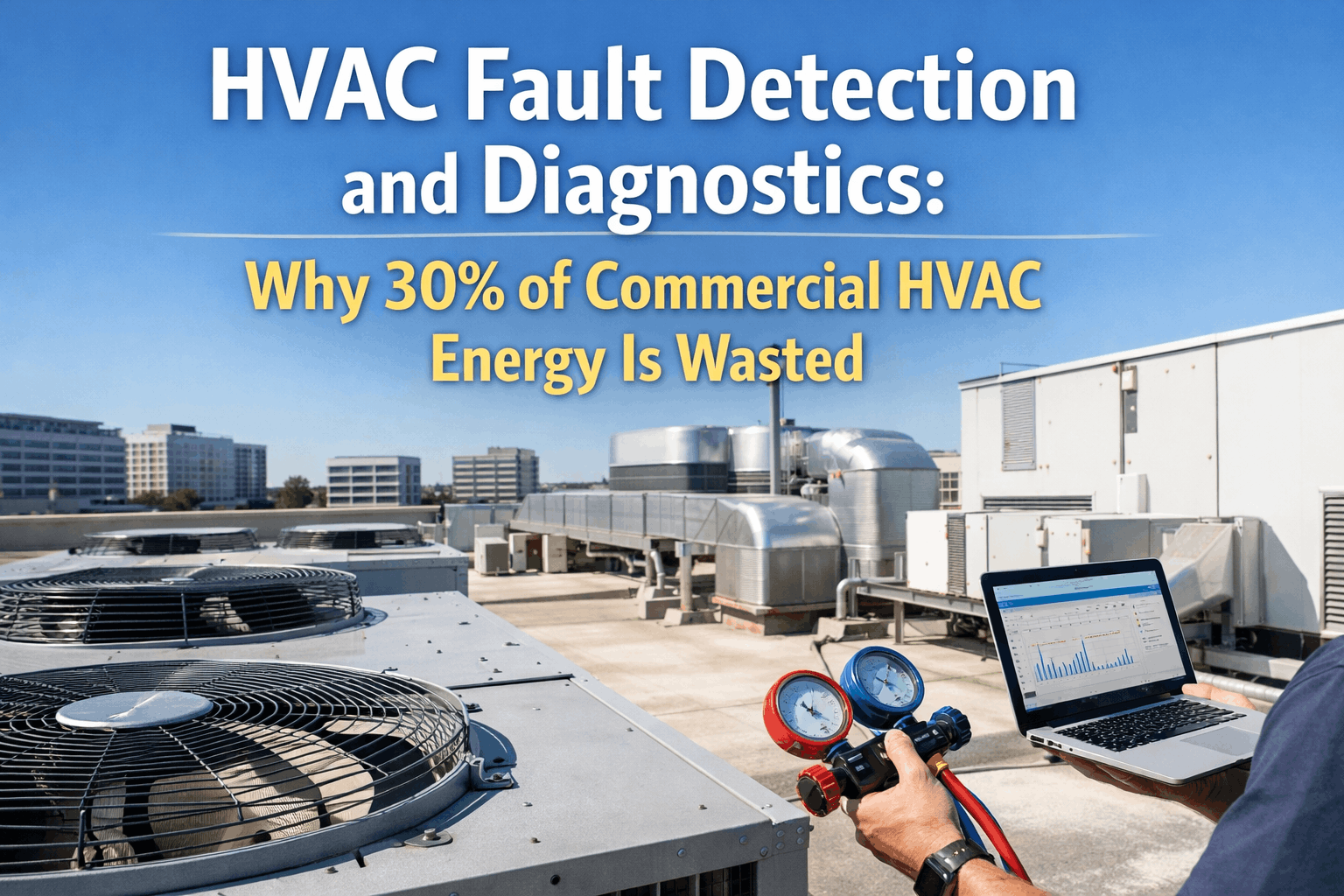
HVAC faults in large facilities rarely announce themselves with an alarm — they degrade silently over days and weeks, consuming 15 to 40 percent more energy before a technician notices something is wrong. Stuck dampers, refrigerant leaks, dirty coils, and failing economisers all produce detectable sensor signatures long before they cause comfort complaints or equipment failures. Facilities using Oxmaint's AI-powered fault detection and diagnostics are identifying these signatures automatically, dispatching work orders before occupants notice, and cutting HVAC energy waste at the source rather than on the utility bill.
Fault Detection · Predictive Maintenance AI · P1 Critical
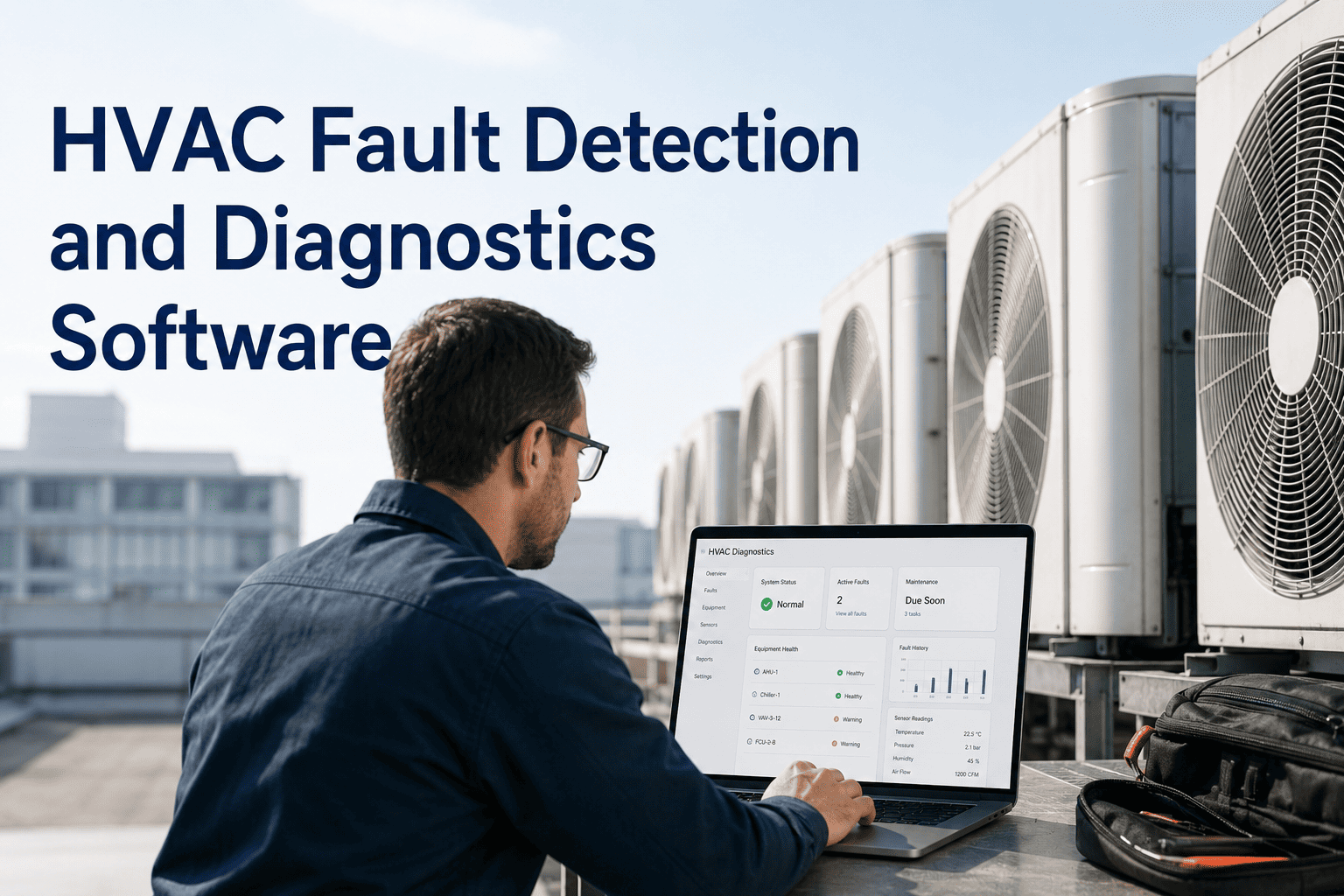
HVAC Fault Detection and Diagnostics Software
AI diagnostics + BMS data + sensor trends + automated work orders — find HVAC faults in hours, not weeks, and fix them before they become failures or energy crises.
30%
Of commercial HVAC energy is wasted by equipment running with undetected faults
ASHRAE / Lawrence Berkeley National Lab
11 days
Average time between fault onset and detection without FDD software in place
BOMA Energy Benchmarking Survey
4.2x
Higher cost of HVAC emergency repair vs planned intervention triggered by early fault detection
McKinsey Facilities Operations
How FDD Works
From BMS Data to Diagnosed Fault in Under 2 Minutes
Traditional HVAC monitoring relies on fixed alarm setpoints — a temperature that must exceed a specific limit before anyone is notified. FDD (Fault Detection and Diagnostics) works differently. It builds a behavioural baseline for each piece of equipment under normal operating conditions, then continuously compares live sensor data against that baseline. Deviations that individually would not trigger an alarm — a slightly elevated supply air temperature combined with a marginal increase in compressor current and a subtle drop in evaporator delta-T — are recognised together as the symptom signature of refrigerant undercharge, and a diagnosed fault alert is generated with the probable cause and recommended action attached.
1
Data Ingestion
BMS, IoT sensors, smart meters, and control system data streamed into Oxmaint in real time via BACnet, Modbus, OPC-UA
2
Baseline Modelling
AI builds normal operating envelope per asset — accounting for load, weather, occupancy, and seasonal variation
3
Anomaly Scoring
Deviations across multiple sensor channels scored simultaneously — multi-signal patterns recognised as specific fault types
4
Fault Diagnosis
Probable fault cause identified from the pattern — not just "anomaly detected" but "economiser damper stuck at 30% open"
5
Work Order
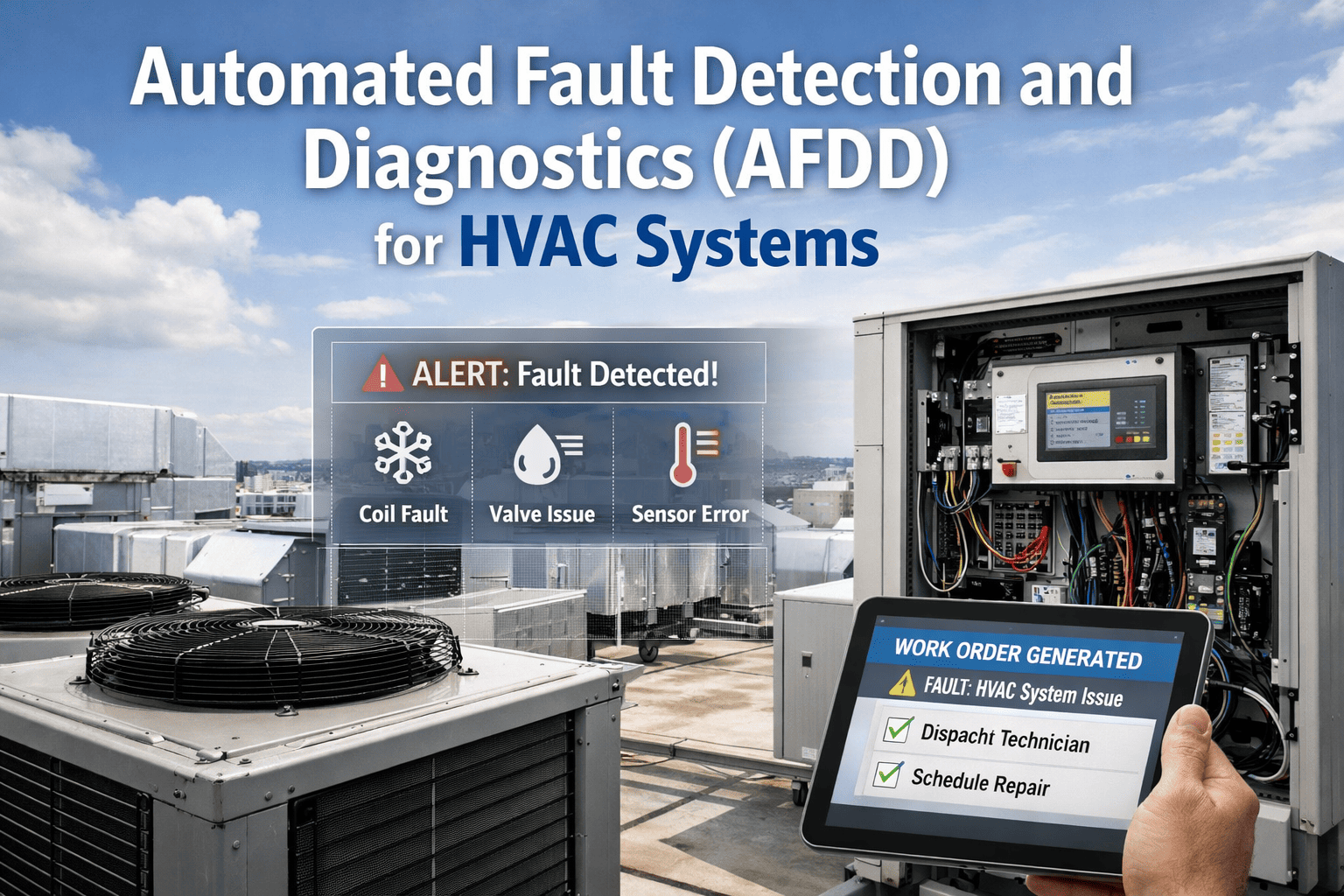
Maintenance work order auto-generated with asset ID, fault diagnosis, estimated energy impact, and recommended action
Fault Library
HVAC Faults Oxmaint FDD Detects — With Lead Time
| Equipment |
Fault Type |
Detection Signals |
Advance Warning |
Energy Impact |
| AHU |
Stuck economiser damper |
Mixed air temp deviation from OA/RA blend |
2–5 days |
+8–18% cooling energy |
| AHU |
Dirty supply air filter |
Static pressure rise + fan power increase |
3–7 days |
+5–12% fan energy |
| Chiller |
Refrigerant undercharge |
Suction pressure drop + compressor current rise |
1–3 weeks |
+15–25% chiller kWh |
| Chiller |
Condenser fouling |
Approach temperature trend rise |
2–4 weeks |
+10–20% chiller energy |
| VAV Box |
Damper actuator failure |
Zone temp vs setpoint deviation + static pressure imbalance |
1–2 days |
Comfort complaints + overcooling |
| Cooling Tower |
Approach temperature rise |
CWS/CWR delta-T narrowing vs design |
1–2 weeks |
+8–15% condenser energy |
| Heat Pump |
Defrost cycle fault |
COP drop + extended defrost duration anomaly |
2–4 days |
+12–22% heating energy |
| Pump / CHWP |
Impeller wear |
Flow rate drop vs VFD speed + differential pressure |
3–6 weeks |
+10–18% pump energy |
87%
Fault detection accuracy
Across AHUs, chillers, VAVs, pumps and cooling towers in Oxmaint FDD deployments
See HVAC Fault Detection Live in Oxmaint
Connect your BMS data, set equipment baselines, and start receiving diagnosed fault alerts with automated work orders — deployed in under 30 days.
Energy ROI
What FDD Delivers Financially
$28K–$74K
Annual energy savings per 100,000 sq ft facility from HVAC fault detection and correction in first year
LBNL Commercial FDD Study, 2024
6.8 months
Average payback period for FDD software deployment including BMS integration and sensor additions
Oxmaint Customer Average
61%
Reduction in HVAC emergency call-out costs in the 12 months after FDD deployment vs 12 months prior
Oxmaint Verified Case Data
Expert Review
What HVAC and Smart Building Specialists Say
"FDD is the highest-return technology investment available to building operators today — bar none. The combination of energy savings, reduced emergency maintenance spend, and extended equipment life creates payback periods that no other building technology category can match. The constraint has never been the technology; it has been connecting BMS data to a system that can act on it through maintenance workflows."
— ASHRAE Journal, Fault Detection and Diagnostics in Commercial Buildings, 2024
"The single most important distinction between effective FDD systems and ineffective ones is the quality of fault diagnosis — not just fault detection. Telling a maintenance team that 'AHU-07 has an anomaly' adds little value. Telling them 'AHU-07 economiser damper appears stuck at approximately 25% open based on mixed air temperature deviation from expected blend ratio' gives them everything they need to resolve the issue on the first visit."
— Building Automation Monthly, AI Diagnostics Feature, Q3 2024
Common Questions
Frequently Asked Questions
Does Oxmaint FDD require replacing our existing BMS?
No. Oxmaint's FDD module connects to your existing BMS as a data subscriber — reading sensor data via BACnet/IP, Modbus TCP, or OPC-UA without replacing or modifying the existing control system. The BMS continues to handle all its normal control functions; Oxmaint receives a copy of the data stream for analytics processing. Most BMS integration configurations are completed within 5 to 10 days. Where BMS data coverage is incomplete, Oxmaint can specify the additional IoT sensors required to achieve effective FDD coverage for priority equipment.
Sign up free to start with a BMS connectivity assessment for your building.
How long does it take for Oxmaint to learn the baseline for our HVAC equipment?
Oxmaint's AI baseline modelling requires 2 to 4 weeks of normal operating data to establish a reliable equipment performance model — accounting for load variation, outdoor conditions, occupancy schedules, and seasonal transitions. During this learning period, fault alerts are suppressed to avoid false positives from incomplete baseline data. After baseline establishment, fault detection accuracy is typically above 85 percent for well-instrumented equipment. For priority assets such as chillers and main AHUs, the baseline can be accelerated using historical BMS log data if available.
Book a demo to see the baseline configuration process for your equipment types.
How does Oxmaint FDD handle false positives and alert fatigue?
Alert fatigue is the primary reason FDD deployments fail in practice — when maintenance teams receive too many alerts with low diagnostic specificity, they begin ignoring the system. Oxmaint addresses this through three mechanisms: multi-signal fault confirmation (alerts only fire when multiple sensor signals confirm the same fault pattern, not single threshold breaches), confidence scoring (each alert includes a confidence percentage so low-confidence signals are visible but not alarming), and alert grouping (multiple signals from the same root cause generate one actionable alert rather than ten individual notifications). Oxmaint customers typically receive 3 to 8 high-confidence fault alerts per building per week — an actionable volume that maintenance teams can investigate within their normal workflow.
Can Oxmaint FDD prioritise which HVAC faults to address first?
Yes. Every fault alert in Oxmaint is scored on two dimensions — energy impact (estimated additional kWh consumption per day while the fault persists) and equipment criticality (the operational consequence if the fault escalates to failure). The maintenance dashboard ranks open fault alerts by a combined priority score so teams with limited capacity address the highest-impact faults first. A refrigerant undercharge on the chiller serving a data centre will always rank above a dirty filter on a secondary AHU regardless of which alert was generated first. This prioritisation logic is configurable for each facility's specific criticality framework.
Start Detecting HVAC Faults in Hours, Not Weeks
Connect your BMS, establish baselines, and receive diagnosed fault alerts with automated work orders — Oxmaint FDD deployed in under 30 days for most facilities.