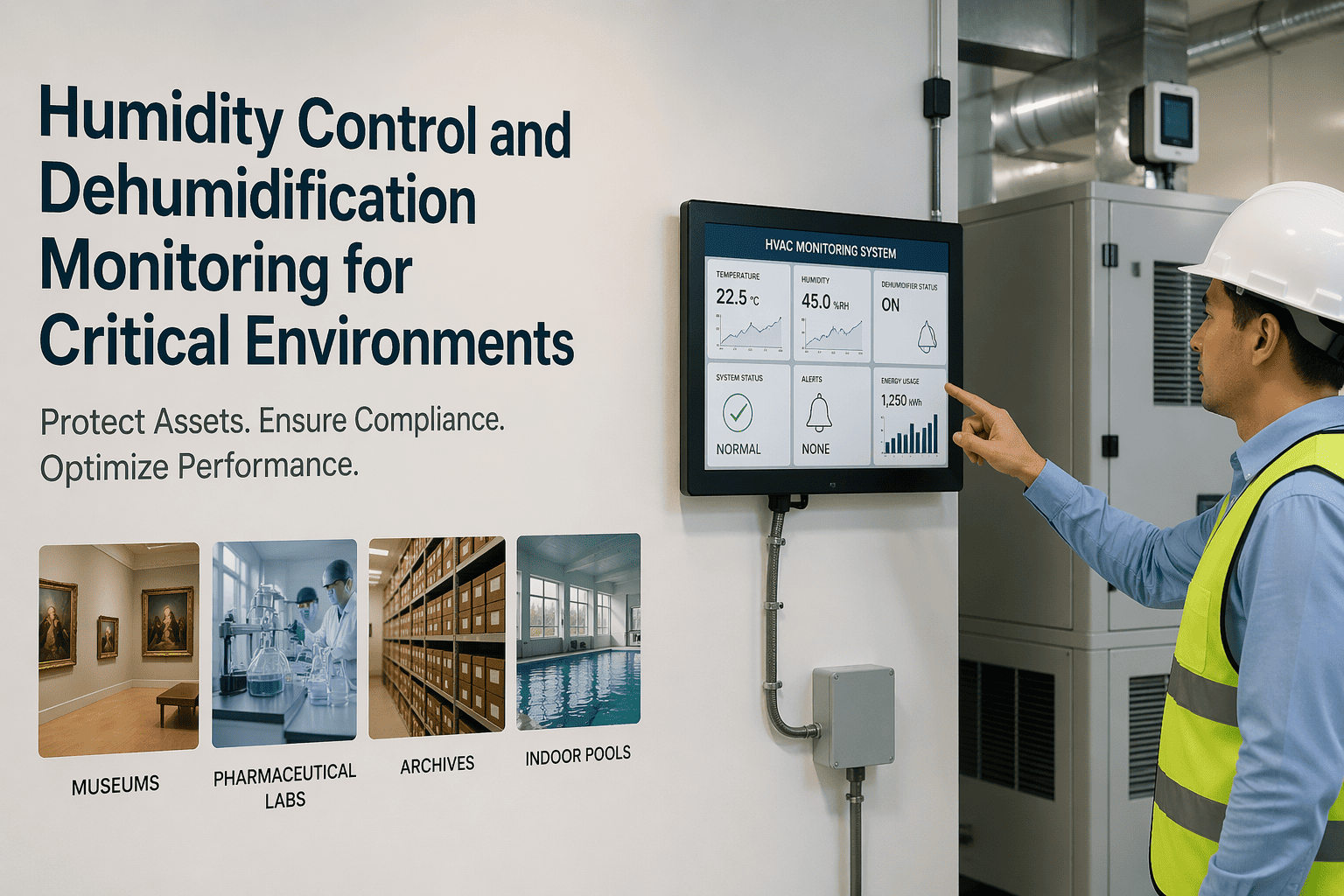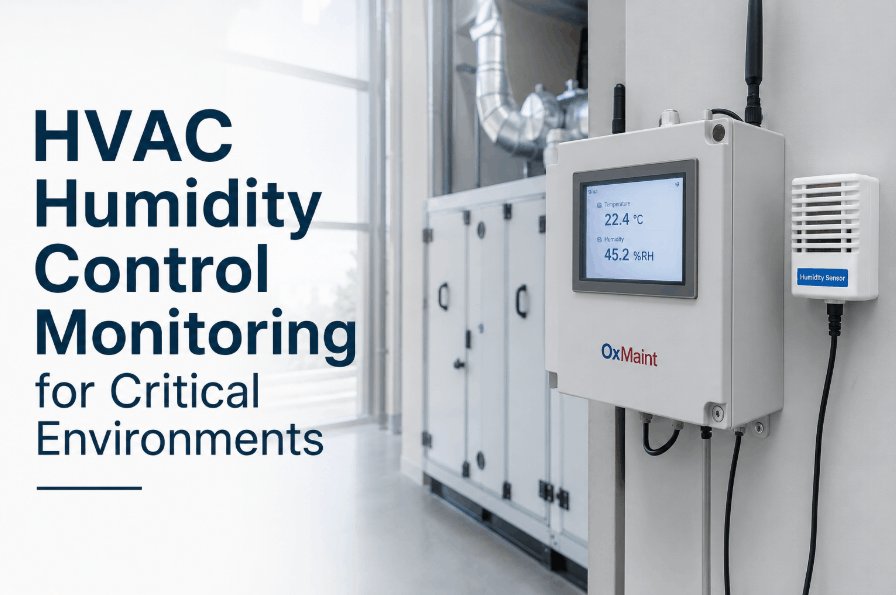
Humidity control failure in a critical environment is rarely dramatic — it rarely trips an alarm or shuts down a machine. It creeps: a hospital OR developing microbial growth on instrument trays, a pharmaceutical API absorbing moisture that degrades potency, a data center server room reaching dew point and condensing on circuit boards, a museum storage vault allowing relative humidity to swell wood and crack paint. Sign Up Free to start tracking humidity system performance across all your critical environments in OxMaint — where every sensor reading, deviation alert, and maintenance event is stored in a single auditable asset record. Effective HVAC humidity control monitoring requires more than a building management system dashboard — it demands a structured maintenance program that verifies humidifier and dehumidifier performance, tracks sensor calibration, enforces PM schedules, and creates the documentation trail needed for regulatory compliance and insurance risk management. Book a Demo to see how OxMaint helps facilities managers and maintenance teams close the gap between environmental monitoring data and maintenance action.
Track Humidity Control System Performance Across Every Critical Environment
OxMaint gives maintenance teams IoT sensor integration, automated PM scheduling, deviation alerts, calibration tracking, and compliance-ready documentation — built for hospitals, labs, pharma facilities, data centers, museums, and any environment where humidity deviation carries operational or regulatory risk.
Why Humidity Control Monitoring Fails Without a Structured Maintenance Program
Most facilities have humidity sensors and BMS alarms — yet humidity-related failures continue to occur. The gap is not data collection; it is maintenance program structure. A humidity sensor that drifts 5% RH out of calibration will report falsely compliant readings while the actual environment slowly diverges from setpoint. A humidifier with scale buildup on its heating elements will lose capacity over weeks, not hours — never triggering an alarm until the system can no longer maintain setpoint under peak load conditions. Book a Demo to see how OxMaint's predictive maintenance and IoT sensor integration closes this gap — connecting real-time humidity data to automated maintenance triggers, technician workflows, and calibration schedules that keep sensors accurate and equipment capable throughout the full operating year. Reactive humidity maintenance — responding only after a setpoint violation — consistently misses the gradual degradation events that cause the most damage to regulated processes and sensitive materials.
8 Critical Environments Requiring Structured Humidity Control Monitoring
Pharmaceutical Manufacturing
API hygroscopicity, tablet coating, lyophilization, and sterile fill-finish operations all require humidity within validated ranges. Excursions create batch quality events, increase microbial contamination risk, and trigger mandatory GMP deviation documentation under FDA and EU GMP regulatory frameworks.
Hospital Operating Theaters and ICUs
ASHRAE 170 and ANSI/ASHRAE standards specify 30–60% RH for operating rooms, with sterile processing areas requiring tighter control. Humidity below 30% increases static electricity and surgical fire risk; above 60% promotes microbial growth on surfaces and medical devices.
Data Centers and Server Rooms
ASHRAE A1 class recommends 20–80% non-condensing RH for data center equipment. High humidity risks condensation on circuit boards; low humidity below 20% creates electrostatic discharge risk that can damage hardware silently over time without immediate visible symptoms.
Museum and Archive Storage
Artifacts, paintings, manuscripts, and archival collections require 45–55% RH with minimal fluctuation. Seasonal RH swings above ±5% cause wood swelling, paint delamination, paper brittleness, and metal corrosion that constitutes irreversible cultural heritage loss.
Research and Analytical Laboratories
Precision weighing, cell culture, PCR workflows, and calibration of analytical instruments all require stable humidity environments. Laboratory humidity fluctuations introduce measurement uncertainty, compromise sample integrity, and can invalidate validation studies conducted under variable conditions.
Food Processing and Cold Chain Facilities
Food manufacturing environments require humidity management across multiple zones — from high-humidity wet processing areas to controlled low-humidity packaging zones. Condensation in refrigerated areas accelerates microbial growth; inadequate drying area humidity affects product shelf life and packaging seal integrity.
Electronics and Semiconductor Manufacturing
Cleanrooms for semiconductor wafer fabrication and electronics assembly maintain 40–55% RH to prevent electrostatic discharge while avoiding condensation at precision tolerance surfaces. Humidity variability directly impacts yield rates and defect counts in high-value production processes.
Textile and Printing Facilities
Paper and textile manufacturing require precise humidity for dimensional stability during processing — too dry causes static and breakage, too humid causes stretch and adhesion failures. Print registration accuracy in high-speed digital and offset printing is directly affected by paper moisture content. Sign Up Free to configure humidity monitoring assets in OxMaint for your facility type.
Humidity Control System KPIs: What to Monitor and Act On
| Parameter | Industry / Standard | Target Range | Action on Deviation |
|---|---|---|---|
| Relative Humidity | ASHRAE 55 / ISO 14644 | 30–60% RH (zone-specific) | Deviation alert + HVAC inspection |
| Humidity Sensor Accuracy | GMP / NIST Traceable | ±2% RH calibrated | Recalibrate + data review |
| Humidifier Output Capacity | ASHRAE 62.1 | Rated kg/hr at setpoint load | Scale removal + element test |
| Dehumidifier Run Hours | Manufacturer PM Schedule | Per manufacturer interval | PM work order triggered |
| Dew Point Temperature | Data Center ASHRAE A1 | 5.5°C–15°C dew point | Cooling setpoint review |
| Supply Air Humidity (AHU) | HVAC Design Specification | Per zone design conditions | Coil or control investigation |
| PM Completion Rate | Facility Compliance Target | ≥95% on-time | Escalation to facilities manager |
Humidity Control Maintenance Program: Phase-by-Phase with OxMaint
Sensor and Instrument Baseline
Register all humidity sensors, transmitters, and loggers as assets in OxMaint with calibration due dates, acceptable drift tolerances, and responsible technician assignments. OxMaint sends automated calibration reminders and flags any sensor operating outside its verified accuracy window so data integrity issues are caught before they affect compliance records.
Humidifier and Dehumidifier PM Scheduling
OxMaint schedules all humidifier and dehumidifier maintenance — scale removal, electrode cleaning, steam dispersion tube inspection, desiccant replacement, condensate system clearing — based on manufacturer intervals or runtime hours. Technicians receive mobile work orders with step-by-step SOP tasks and mandatory photo documentation fields before work order closure.
IoT Integration and Real-Time Deviation Alerts
OxMaint integrates with PLC sensor networks and BMS systems to pull real-time humidity data into asset records. When a zone breaches its setpoint band, OxMaint automatically creates a work order, alerts the responsible technician, and begins logging the deviation event with timestamps — creating the paper trail needed for regulatory reporting and insurance documentation. Book a Demo to see IoT humidity integration in action.
Trend Analysis and Predictive Maintenance
OxMaint's analytics dashboard tracks humidity setpoint adherence, deviation frequency, and humidifier capacity trends over time. Gradual capacity degradation — the early warning sign of scale buildup or electrode wear — is visible weeks before the system fails to maintain setpoint, enabling preventive intervention before any regulated environment is affected.
Reactive vs. Structured Humidity Control Maintenance: What Changes
Connect Your Humidity Monitoring Data to Automated Maintenance Actions
OxMaint bridges the gap between BMS environmental data and maintenance execution — automatically creating work orders on deviation, scheduling calibration before drift affects compliance, and giving facilities managers real-time humidity system health across every critical environment they operate.
Frequently Asked Questions: HVAC Humidity Control Monitoring
What relative humidity range is required in a pharmaceutical cleanroom?
Most GMP guidelines specify 40–60% RH for general pharmaceutical manufacturing, with specific product areas requiring tighter validated ranges. Parenteral and lyophilization environments often require 30–50% RH. Validated ranges are product-specific and must be defined in the facility's environmental control documentation and maintained by the HVAC system.
How often should humidity sensors be calibrated in critical environments?
GMP-regulated environments typically require annual calibration with NIST-traceable standards, while non-regulated critical environments should follow manufacturer recommendations — generally 6–12 months. Sensors showing drift above ±2% RH between calibration events should trigger an out-of-calibration investigation and review of data recorded during the affected period.
What causes humidifiers to lose capacity over time?
Scale buildup on heating elements, electrode fouling in electrode steam humidifiers, blocked steam dispersion tubes, and water treatment failures are the primary causes of gradual capacity loss. Scheduled descaling and electrode replacement on OxMaint PM work orders prevents the silent capacity degradation that causes setpoint failure during peak humidity load conditions.
How does OxMaint integrate with BMS systems for humidity monitoring?
OxMaint integrates with PLC and BMS sensor networks through its IoT sensor integration module, pulling real-time environmental data into asset records. Out-of-range humidity readings automatically trigger work order creation, technician alerts, and deviation logging — connecting monitoring data directly to maintenance action without manual intervention.
What is the ASHRAE recommended humidity range for hospital environments?
ASHRAE 170 specifies 30–60% RH for most hospital patient care areas, with operating rooms typically targeting 20–60% RH per the 2021 revision. Sterile processing departments require 30–60% RH to maintain sterilization efficacy. OxMaint tracks compliance against zone-specific setpoints and alerts maintenance teams when any area drifts outside its validated range.
Can OxMaint manage humidity control maintenance across multiple facilities?
OxMaint's multi-site management capability allows facilities managers to standardize humidity control PM schedules, calibration protocols, and deviation response workflows across all locations from a single dashboard. Site-level performance metrics and overdue task visibility give regional managers the oversight needed to maintain consistent environmental control standards. Sign Up Free to configure multi-site humidity monitoring in OxMaint today.
Ready to Build a Structured Humidity Control Maintenance Program Across Every Critical Environment?
OxMaint gives facilities maintenance teams the IoT sensor integration, automated PM scheduling, calibration tracking, and deviation documentation needed to maintain humidity compliance in hospitals, pharma plants, data centers, labs, and museums — from a single CMMS platform built for critical environment asset management.