New York City's Local Law 97 is the most ambitious municipal building emissions law in the world — and it is no longer theoretical. The first compliance period began in 2024, annual reporting through the DOB's BEAM portal is mandatory from May 2025, and penalties of $268 per metric ton of CO₂ over each building's emissions cap are assessed automatically every year. A commercial building 150 tons over its limit faces $40,200 in annual fines before a single retrofit dollar is spent. For building owners and facility managers, the path to compliance runs directly through HVAC — the single largest contributor to building carbon emissions — and the data that proves compliance comes from maintenance records, energy analytics, and asset upgrade documentation that most facilities are not currently structured to produce. Start a free trial on OxMaint or book a demo to see how Energy and ESG Reporting integrates with HVAC maintenance data to support Local Law 97 compliance.
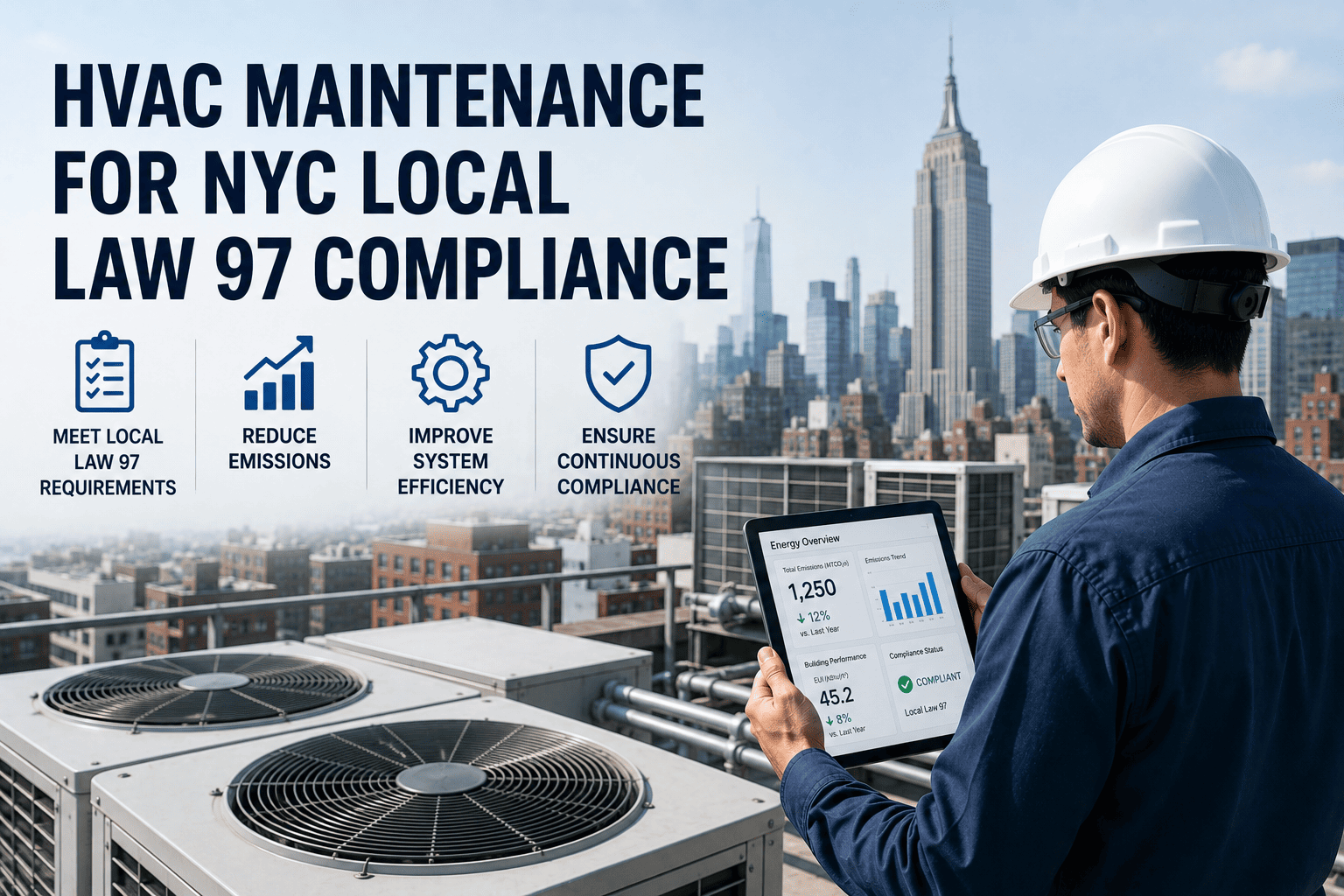
HVAC Maintenance for NYC Local Law 97 Compliance
How HVAC maintenance data, energy analytics, and documented asset upgrades support Local Law 97 carbon reduction goals — and what facility teams need to track to avoid $268/ton annual penalties.
Local Law 97 — Compliance Timeline Every NYC Facility Manager Needs to Know
Carbon emissions caps took effect for covered buildings over 25,000 sq ft. Initial limits — approximately 11% of buildings exceeded their cap on day one.
Mandatory reporting through the DOB BEAM portal began. Reports must be certified by a Registered Design Professional — PE or RA. Late filing: $0.50 per sq ft per month. 93% of covered buildings filed.
Annual reporting continues every May 1st reflecting prior calendar year emissions. DOB is actively preparing OATH case filings for buildings that remain non-compliant. Penalties being assessed.
Emission caps tighten approximately 40%. An estimated 63–80% of covered buildings will exceed their 2030 cap without significant HVAC upgrades. Comprehensive retrofits require 19–39 months from assessment to commissioning — planning must start now.
Zero emissions mandate for all covered properties. The path from today's emissions to net-zero in 2050 runs entirely through HVAC electrification, system efficiency upgrades, and documented energy performance.
How HVAC Maintenance Directly Drives LL97 Emissions Performance
Buildings account for nearly 70% of NYC's total greenhouse gas emissions. HVAC systems — heating, cooling, and ventilation — represent 40–60% of a typical commercial building's energy consumption. Every percentage of HVAC efficiency lost to poor maintenance is a percentage increase in the building's carbon emissions score.
| HVAC Maintenance Gap | Energy Impact | CO₂ Impact (25,000 sq ft building) | Annual LL97 Penalty Risk |
|---|---|---|---|
| Chiller running at 85% efficiency (fouled tubes) | +15–18% energy use on cooling | +28–35 metric tons CO₂/yr | +$7,500–$9,400/yr in fines |
| AHU economiser stuck closed (missed PM) | +12–20% mechanical cooling energy | +20–38 metric tons CO₂/yr | +$5,400–$10,200/yr in fines |
| Steam trap failures (heating system leaks) | +10–25% heating energy waste | +18–45 metric tons CO₂/yr | +$4,800–$12,000/yr in fines |
| VFD drive bypassed on AHU fan | +30–40% fan energy at full load | +8–15 metric tons CO₂/yr | +$2,100–$4,000/yr in fines |
| Cooling tower drift (scale buildup, reduced capacity) | +8–12% chiller energy use | +15–22 metric tons CO₂/yr | +$4,000–$5,900/yr in fines |
HVAC Maintenance Actions That Reduce LL97 Carbon Emissions
The fastest path to emissions reduction for most NYC buildings is not capital replacement — it is eliminating the efficiency losses that deferred maintenance has accumulated in existing systems. These six maintenance actions typically deliver 12–22% emissions reduction within 12 months without equipment replacement.
Fouled condenser and evaporator tubes increase compressor lift, raising energy use 15–18% from peak efficiency. Annual tube cleaning and water treatment verification restores efficiency and directly reduces the building's reported carbon emissions in the following LL97 period.
A stuck or non-functioning economiser forces mechanical cooling during hours when free cooling is available. Quarterly economiser inspection and damper actuator verification restores the free-cooling hours that directly reduce chiller runtime and carbon output.
Failed-open steam traps in NYC heating systems waste live steam continuously — one failed trap can waste 50–200 lbs/hr of steam, representing significant natural gas consumption and direct carbon output. Annual steam trap surveys with OxMaint work orders ensure failed traps are identified and replaced before the next LL97 reporting period.
Variable frequency drives bypassed for any reason — a controls fault, a technician shortcut, a post-maintenance temporary override never reversed — run fans at full speed 24/7. A quarterly VFD status audit ensures every drive is active, correctly parameterised, and contributing its fan energy savings to the building's carbon score.
LL97 Documentation — What Your Annual Report Needs
Annual LL97 reports submitted to the DOB BEAM portal must be certified by a Registered Design Professional. The underlying data that feeds the report — energy consumption by fuel type, efficiency records, asset upgrade documentation — comes from your building operations records. This is where most non-compliant buildings discover their data gap.
| LL97 Report Data Element | Where Data Comes From | OxMaint Support |
|---|---|---|
| Total energy use by fuel type (kWh, therms, steam) | Utility bills + ENERGY STAR Portfolio Manager | Energy meter integration + monthly consumption log |
| Equipment upgrade records (efficiency improvements) | Maintenance records + contractor invoices | Asset upgrade work orders with contractor cert attached |
| Carbon offset / REC purchase documentation | Third-party certificate + DOB registration | Compliance document upload against building record |
| Beneficial electrification evidence | Contractor records of fossil fuel system replacement | Equipment decommission + replacement work order records |
| Decarbonisation plan (if on glide path) | Engineering firm documentation | Project tracking work orders with milestone completion |
Frequently Asked Questions
Every Deferred HVAC PM Is an Uncounted Carbon Liability Under Local Law 97
OxMaint's Energy and ESG Reporting integrates HVAC maintenance records with energy analytics — showing the carbon impact of each PM completed, each efficiency gap identified, and each asset upgrade documented — so your LL97 report is supported by data your team actually controls.