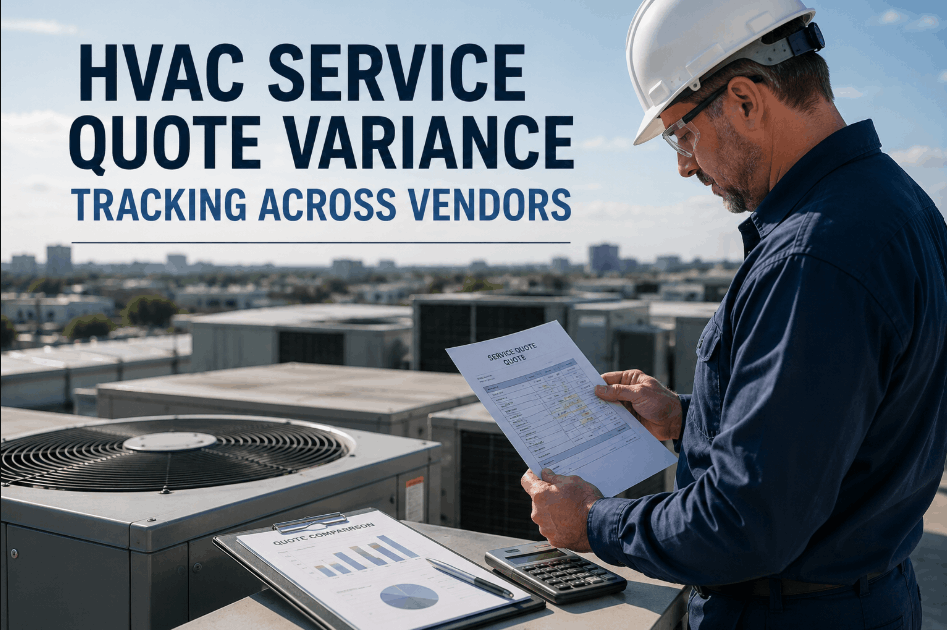
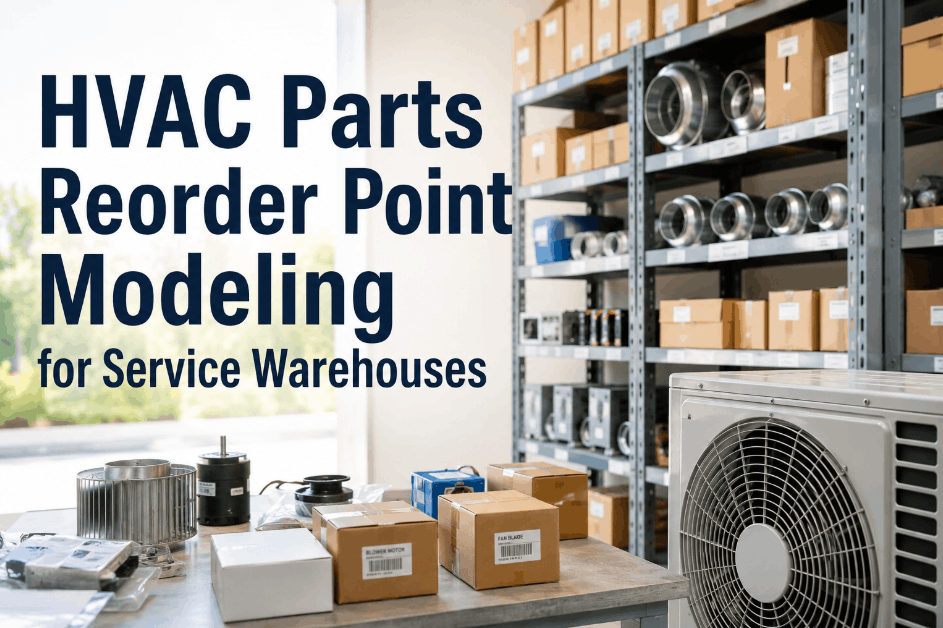
In most HVAC service operations, parts exist in a state of managed chaos—spread across a main warehouse, one or two branch locations, and 20 to 80 service vans, with no reliable way to know what is where at any given moment. A technician on the north side of town needs a 40µF capacitor. There are six of them sitting in a van parked at a job site three miles away—but nobody knows that, so the tech drives 45 minutes round trip to the main warehouse instead. A branch location runs out of condenser fan motors while the main warehouse has 14 in stock, but the branch manager doesn't discover the shortage until a tech is standing in front of an angry customer with an empty shelf behind them. A senior technician retires, and nobody realizes there are $4,500 worth of parts on the van that never got transferred back into general inventory. Parts transfers between locations and vans are the invisible logistics layer that determines whether your inventory investment actually serves your technicians or just sits in the wrong place at the wrong time. Without a systematic transfer process, every location and every van operates as an independent island—hoarding parts they might need, running out of parts they do need, and duplicating inventory across the fleet because nobody trusts that parts will be available when requested from another location. A proper parts transfer system creates a unified inventory view across all locations and vehicles, enables rapid lateral transfers between vans in the field, automates restock transfers from warehouse to branch to van, and maintains complete chain-of-custody accountability so nothing disappears between origin and destination. The result is dramatically better parts availability using significantly less total inventory—because parts flow to where they're needed instead of being stockpiled everywhere they might be needed.
35–50%
Of total HVAC parts inventory sits on service vans at any given time
$2K–$8K
Average parts value per van that is untracked or misallocated
4–8 trips
Unnecessary warehouse runs per van per week due to transfer gaps
The Three Transfer Problems That Cost You Every Day
Parts transfer failures happen constantly in HVAC operations—they're just invisible because nobody tracks them. Every unnecessary warehouse trip, every field stockout that could have been solved by a van-to-van transfer, and every branch shortage that the main warehouse could have prevented represents lost time, lost revenue, and wasted fuel. Facilities that sign up to manage their multi-location inventory on a unified platform gain the cross-fleet visibility that makes intelligent transfers possible.
Scenario
Tech A needs a TXV for a Carrier 50XC. The warehouse is 40 minutes away. Tech B, parked at a site 8 minutes away, has two TXVs on the van. But Tech A has no way to know this — no visibility into any inventory except their own truck and the warehouse. Tech A drives 80 minutes round trip. Tech B's TXVs sit unused.
Daily cost across a 50-van fleet: 6–10 unnecessary warehouse trips × 50 min average × $65/hr loaded labor rate = $325–$540/day in wasted technician time
Scenario
Tech A hands Tech B a compressor contactor in a parking lot between jobs. Neither records the transfer. Tech A's van inventory now overstates by one contactor. Tech B's understates by one. When the warehouse runs restock reports, it orders a replacement for Tech B (who already has one) and doesn't order for Tech A (who gave theirs away). Multiply by 20–50 informal transfers per week.
Annual cost across a 50-van fleet: $18K–$45K in inventory drift, phantom shortages, and over-ordering caused by unrecorded informal transfers
Scenario
The south branch exhausts its condenser fan motor stock on Monday. The branch manager doesn't submit a transfer request until Wednesday because they're busy with service calls. The warehouse processes the request Thursday. The parts arrive Friday. Four days of south-side service calls that needed fan motors either waited, used warehouse round trips, or were rescheduled — all because the transfer wasn't automated.
Annual cost per branch: $12K–$30K in delayed service, warehouse round trips, and rescheduled jobs from manual restock processes
The Four Transfer Types Every HVAC Operation Needs
A complete parts transfer system handles four distinct movement patterns—each with different triggers, approval flows, and tracking requirements. Covering all four eliminates the gaps where parts and accountability disappear.
01
Warehouse → Van (Scheduled Restock)
The most common transfer type. Parts move from the central warehouse to individual service vans to replenish consumed stock. Triggered automatically when van inventory drops below the reorder point for any part, or batch-triggered before each day's work orders based on the parts needed for tomorrow's jobs.
Trigger: Van inventory falls below reorder point, or next-day kit staging generates a pull list
Frequency: Daily to weekly per van, depending on call volume and van stock model
Tracking: Transfer order generated → warehouse pick/pack → staged for tech pickup or delivery → tech confirms receipt on mobile app → van inventory updated
02
Van → Van (Field Transfer)
The highest-impact, least-managed transfer type. A tech in the field needs a part that another nearby tech has available. Instead of driving to the warehouse, the techs meet and transfer the part directly. This saves 30–60 minutes per event but historically goes unrecorded, causing inventory drift.
Trigger: Tech searches fleet inventory from mobile app, identifies nearby van with the needed part, initiates transfer request
Frequency: 3–8 times per day across a 50-van fleet
Tracking: Sending tech confirms part release → receiving tech confirms receipt → both van inventories update simultaneously → warehouse restock triggers if sending van drops below threshold
03
Warehouse → Branch (Replenishment Transfer)
Scheduled or threshold-triggered transfers that keep branch locations stocked from the central warehouse. Without automation, branch restocking is reactive—someone notices a shortage and calls the warehouse. Automated replenishment ensures branch inventory stays within target ranges without manual intervention.
Trigger: Branch inventory drops below reorder point, or weekly scheduled replenishment cycle
Frequency: 1–3 times per week per branch location
Tracking: Auto-generated transfer order → warehouse picks and ships → branch receives and confirms → inventory updates at both locations simultaneously
04
Van → Warehouse (Return & Rebalance)
Parts returning from vans to the warehouse—unused kit items, replaced warranty parts for manufacturer return, recalled parts, slow-moving stock removed during van rebalancing, and parts from decommissioned or reassigned vehicles. Without return tracking, these parts simply disappear from the system.
Trigger: Work order completion with unused kit parts, van stock rebalance cycle, technician departure/reassignment, warranty return requirement
Frequency: Daily (unused kit returns) to monthly (rebalancing)
Tracking: Tech initiates return on mobile → warehouse confirms receipt and inspects condition → part returned to available inventory or routed to warranty return → both inventories updated
Every Part. Every Van. Every Location. One View.
OxMaint gives you real-time visibility across your entire parts network — warehouse, branches, and every service van. Transfer requests, approvals, and confirmations happen on the mobile app so inventory stays accurate no matter how fast parts move.
How Mobile-First Transfers Work in the Field
The key to successful parts transfers is making the process faster than the workaround. If recording a van-to-van transfer takes longer than just handing the part over informally, technicians will always choose the informal route. The transfer process must be completable in under 60 seconds on a mobile device.
Receiving Tech
Opens app → searches fleet inventory for needed part → sees which nearby vans have it in stock, sorted by distance → taps "Request Transfer" on the closest van
15 seconds
Sending Tech
Receives push notification → reviews request → taps "Approve and Release" → confirms part and quantity leaving their van
10 seconds
Both Techs
Meet at convenient location (job site, parking lot, coffee shop). Physical handoff of the part takes place.
Travel time varies
Receiving Tech
Taps "Confirm Receipt" on mobile app. Both van inventories update simultaneously. Sending van's reorder logic recalculates. Transfer logged with timestamp, GPS coordinates, part details, and both technician IDs.
5 seconds
Chain-of-Custody Accountability: Where Parts Go and Why
Parts that move without records don't just cause inventory inaccuracy — they create a trust problem. When parts shrinkage occurs and nobody can prove where inventory went, the default assumption is theft or negligence. A proper transfer system creates a complete, timestamped chain of custody for every part movement, replacing suspicion with data.
Who initiated
Named user account with authentication — no shared logins, no anonymous transfers
Who received
Named recipient confirms receipt — two-party verification on every transfer
What moved
Part number, description, serial number (if serialized), quantity, and unit cost
When
Timestamp on initiation, approval, and receipt confirmation — full timeline visible
Where
Origin location/van and destination location/van with GPS coordinates at confirmation
Why
Transfer reason (restock, field request, return, rebalance, warranty) linked to work order if applicable
Authorization
Approval chain for transfers above configurable value thresholds — automatic below threshold
This chain-of-custody data eliminates the "parts black hole" where inventory shrinks by 5–12% annually with no explanation. When every movement is recorded, shrinkage drops to under 1% because the data either explains where parts went or identifies exactly where accountability broke down. Facilities that sign up to track parts across their entire fleet turn inventory mystery into inventory certainty.
ROI: Parts Transfer Management for HVAC Operations
$165K
Eliminated Unnecessary Warehouse Trips
60% of warehouse trips replaced by van-to-van field transfers averaging 35 min savings each × 250 days
$72K
Inventory Shrinkage Reduction
Parts shrinkage reduced from 8–12% to under 2% through chain-of-custody tracking across all locations and vans
$48K
Reduced Total Inventory Investment
Unified visibility enables 15–25% inventory reduction — parts flow to demand instead of being duplicated everywhere
$38K
Faster Branch Replenishment
Automated warehouse-to-branch transfers eliminate 3–5 day manual restock delays
$22K
Administrative Time Savings
Automated transfer processing replaces phone calls, emails, and manual paperwork for inter-location parts movement
Expert Perspective: Getting Parts Transfers Under Control
"
We operate out of three locations with 62 service vans. Before we implemented tracked transfers, our annual parts shrinkage was running at 9.4% — over $67,000 per year in parts that we purchased, received into inventory, and then simply could not account for. We knew it wasn't theft. It was informal transfers. Technicians helping each other in the field — handing parts through van windows in parking lots — without recording anything. The sending tech's van inventory stayed inflated. The receiving tech used the part on a work order and the system showed it consumed from their van even though it was never officially there. The warehouse reordered based on phantom inventory levels and we slowly accumulated a growing gap between what the system said we had and what actually existed on our shelves and trucks. The fix wasn't complicated — we just made transfers easier to record than to skip. The mobile transfer takes 30 seconds. Techs can see each other's inventory sorted by distance. One tap to request, one tap to approve, one tap to confirm receipt. Three taps and the system is accurate. Within four months, shrinkage dropped from 9.4% to 1.7%. We actually found $23,000 in "lost" inventory that had simply been on the wrong vans all along. The warehouse stopped over-ordering replacement parts for phantom shortages. And we reduced total fleet inventory by 18% because techs could see and access each other's stock instead of everyone hoarding their own buffer.
Make transfers easier than the workaround — if it takes longer to record than to hand over informally, nobody will record it
Show techs each other's inventory — this alone replaces 60% of warehouse trips with faster van-to-van transfers
Require two-party confirmation — the sender releases and the receiver confirms to eliminate disputed transfers
Automate warehouse-to-branch restocking — manual restock requests add days of delay to a process that should be instant
Parts transfer management is the missing logistics layer that connects your inventory investment to your service execution. Without it, you have islands of parts with no coordination. With it, you have a unified parts network that flows inventory to demand in real time. If you're ready to eliminate inventory blind spots and stop losing parts between locations, book a free demo to see how multi-location parts tracking works on mobile.
Connect Every Van. Every Branch. Every Part. In Real Time.
OxMaint turns isolated vans and branches into a unified parts network — with real-time inventory visibility, one-tap field transfers, automated warehouse restocking, and complete chain-of-custody tracking for every part that moves.
Frequently Asked Questions
How do you get technicians to actually record van-to-van transfers?
Adoption depends entirely on making the recorded transfer faster and easier than the informal alternative. If the process takes more than 60 seconds on a mobile device, compliance will be low regardless of policies. The most successful implementations use three principles. First, reduce the process to the minimum possible taps — search for the part, tap "Request," tap "Confirm Receipt." Three taps, 30 seconds, done. Second, provide an incentive that technicians actually care about: the ability to see every other van's inventory from their phone. When a tech realizes they can find a needed part on a van 5 minutes away instead of driving 40 minutes to the warehouse, they adopt the transfer system enthusiastically because it saves them time. Third, make transfer compliance visible at the team level — track transfer recording rates per technician and include it in performance reviews. Most operations achieve 85–90% compliance within 60 days and 95%+ within 90 days once technicians experience the time savings of fleet-wide inventory visibility.
How does fleet inventory visibility work when vans are in different locations throughout the day?
Fleet inventory visibility combines real-time inventory data with location awareness. Each van's inventory is updated in real time as parts are consumed on work orders, received from transfers, or returned to the warehouse. When a technician searches for a part, the system shows every van and location that has the part in stock, sorted by distance from the searching technician's current GPS position. The display shows the van identifier, the technician assigned to it, the quantity of the requested part, and the approximate distance. The searching tech can then initiate a transfer request directly from the search results. Location data updates when technicians check in at job sites or when the mobile app's background location updates. The accuracy doesn't need to be precise to the minute — knowing that Tech B's van with the needed TXV is "approximately 3 miles south" is sufficient for the requesting tech to decide whether a field transfer makes more sense than a warehouse trip. Privacy considerations are addressed by showing only part availability and approximate distance — not real-time tracking of technician movement.
How do we prevent technicians from hoarding parts and refusing transfer requests?
Parts hoarding is a rational behavior in systems without reliable restocking — technicians stockpile because they don't trust that parts will be available when they need them. The solution is addressing the root cause, not punishing the behavior. First, implement reliable van restocking so technicians know that any part they transfer out will be replaced quickly (ideally next morning via the kit staging process). When the restocking system is trustworthy, the motivation to hoard disappears. Second, set transfer request expectations: transfer requests for parts the sending technician doesn't need for a scheduled job that day should be approved. Requests that would leave the sending tech short for a scheduled job can be declined with a reason. Third, track transfer approval and decline rates per technician. Technicians who consistently decline requests without scheduling justification can be coached. Fourth, consider team-level incentives tied to first-visit fix rates — when the team understands that helping each other with parts improves everyone's metrics, collaboration follows naturally. Most operations find that hoarding behavior diminishes significantly within 30–60 days of implementing reliable restocking, because the root anxiety about parts availability has been addressed.
What happens when a transfer is initiated but the physical handoff doesn't happen?
The system handles incomplete transfers through a two-party confirmation requirement and automatic timeout. When a transfer is initiated (sender approves release), the parts are placed in a "transfer in transit" status — deducted from the sender's available inventory but not yet added to the receiver's. This prevents the same part from being double-counted or double-committed. If the physical handoff occurs, the receiver taps "Confirm Receipt" and both inventories update to their final state. If the handoff doesn't happen (plans changed, techs couldn't meet, etc.), either party can cancel the transfer. Cancelled transfers automatically return the parts to the sender's available inventory. If neither confirmation nor cancellation occurs within a configurable timeout period (typically 4–8 hours), the system generates an alert to both technicians and their supervisor, prompting resolution. The "in transit" status ensures that inventory accuracy is maintained even during the gap between initiation and completion — no parts exist in two places simultaneously, and no parts disappear from both places.
How do we handle parts that require tracking beyond simple quantity — like serialized items or warrantied returns?
Serialized and warranty-tracked parts require additional data capture during transfers, but the process remains mobile-friendly. For serialized items (compressors, certain motors, electronic controls), the transfer process includes a serial number scan or entry step. The serial number follows the part through every transfer, consumption, and return — creating a complete lifecycle record from receipt through installation or warranty return. For warranty returns, the system supports a specific "warranty return" transfer type that routes the part from the technician's van to the warehouse with warranty-specific metadata: the original equipment serial number, failure description, work order reference, and warranty claim number. At the warehouse, the part is segregated into a warranty return staging area rather than returned to general inventory. The system tracks warranty return processing status and generates alerts if returns aren't shipped to the manufacturer within the required timeframe. For high-value serialized parts, configurable approval thresholds can require manager authorization before field transfers — preventing unauthorized movement of items above a specified value while keeping routine transfers fast and frictionless.